Written by Adv. Aman Chawla | Family & Matrimonial Law | Delhi High Court & Supreme Court of India
A matrimonial dispute can quickly turn into a legal battle involving criminal allegations, maintenance, domestic violence proceedings and divorce. One spouse may approach the police alleging cruelty or dowry harassment. The other may file for divorce or contest the allegations. Meanwhile, a court may need to decide who will meet everyday living expenses while the cases continue.
This situation raises an important question: Can a Section 498A case affect a wife’s maintenance claim in India?
The short answer is that a criminal complaint does not automatically decide entitlement to maintenance. Courts examine the applicable law, each party’s financial circumstances, the evidence, and the purpose of the proceedings. A pending criminal case and a maintenance petition generally address different legal questions.
The distinction matters in Delhi and across India. A spouse may face criminal proceedings while also responding to a claim for interim maintenance. Both matters require careful preparation, accurate financial disclosure and a clear understanding of the law.
Recent court developments have renewed attention on allegations against husbands and their relatives. However, the law must protect women who experience genuine cruelty while preventing criminal proceedings from continuing where the allegations do not disclose the required offence.
What Is Section 498A, and What Replaced It in 2024?
Section 498A of the Indian Penal Code addressed cruelty by a husband or his relatives towards a married woman. The provision targeted serious conduct, including wilful behaviour likely to cause grave injury or drive a woman to suicide, and harassment connected with unlawful demands for property or valuable security.
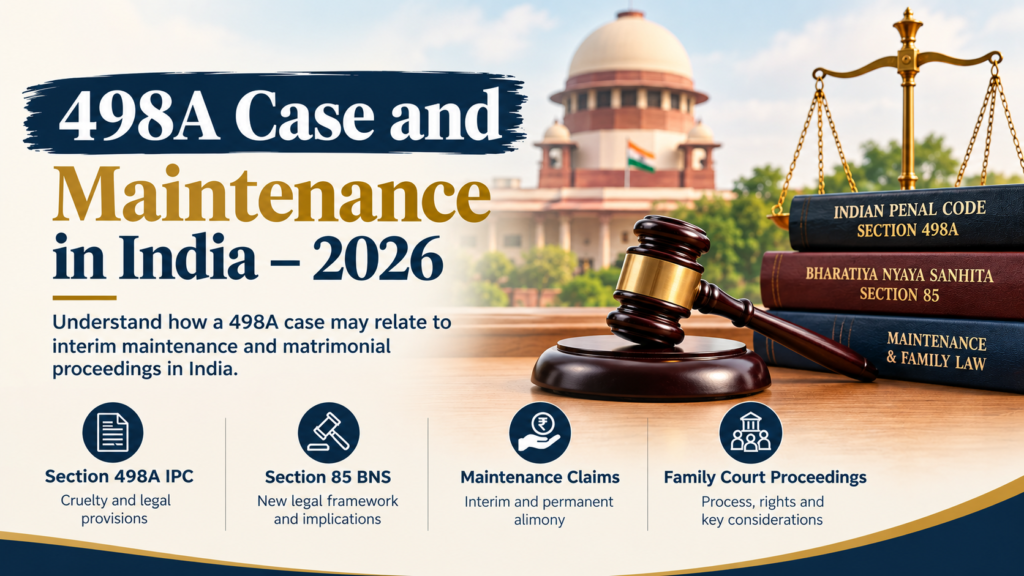
The Bharatiya Nyaya Sanhita, 2023 (BNS) came into force on 1 July 2024. Section 85 BNS now addresses cruelty by a husband or his relatives, while Section 86 explains cruelty for this purpose.
People still commonly use the expression “498A case” because the older provision remains relevant to many existing cases and continues to appear in legal discussions. The correct provision depends on the alleged conduct, the relevant dates and the applicable transitional rules.
For incidents governed by the new criminal law, Section 85 BNS and its accompanying definition require attention. For older incidents and proceedings, lawyers must examine the applicable savings and transitional provisions rather than simply replacing every reference to Section 498A with Section 85.
This distinction is important when preparing a complaint, seeking bail, challenging an FIR or assessing the relationship between criminal allegations and a separate maintenance claim.
Can a 498A Case Stop a Wife from Claiming Maintenance?
A pending cruelty complaint does not, by itself, cancel a wife’s right to seek financial support. Equally, filing a maintenance application does not prove that the husband committed cruelty.
A maintenance court considers the legal provision under which the applicant seeks relief, the applicant’s financial needs, the respondent’s income and resources, and other relevant circumstances. The court may also consider material from connected proceedings where the law permits it and the material genuinely helps resolve an issue.
For example, a wife may allege dowry harassment and seek interim maintenance because she cannot meet reasonable living expenses. Her husband may deny the allegations and argue that she has independent income. The court must assess the maintenance claim on its own legal and factual merits. It should not treat the mere registration of an FIR as conclusive proof for either side.
Similarly, a husband cannot automatically defeat a maintenance claim by describing the complaint as false. He needs relevant material to support his position, and the court must apply the governing maintenance law.
The practical lesson is straightforward: a criminal allegation and a financial-support claim are connected by the facts, but they are not interchangeable proceedings.
Which Laws Govern Maintenance During a 498A Case?
The applicable maintenance provision depends on the relief sought and the facts of the case. Several legal routes may arise during a matrimonial dispute.
Section 144 of the Bharatiya Nagarik Suraksha Sanhita, 2023 (BNSS) provides a statutory route for maintenance of wives, children and parents who satisfy its requirements. Section 125 of the former Code of Criminal Procedure (CrPC) remains relevant to proceedings governed by the applicable transitional provisions.
The Protection of Women from Domestic Violence Act, 2005 also provides monetary relief in qualifying cases. Section 20 addresses monetary relief, which can include maintenance for the aggrieved person and, where appropriate, her children. A spouse may also seek interim or permanent maintenance under the personal law governing the marriage, where the relevant conditions apply.
These routes do not all operate in exactly the same way. The court must consider the particular statute, the relief requested and any orders that another court has already passed.
A party should disclose relevant maintenance proceedings and existing orders. Courts may need to account for amounts awarded in overlapping proceedings to avoid inappropriate duplication or inconsistent financial directions.
For a broader explanation, read our related guide: One Marriage, Five Court Cases: Divorce, Domestic Violence, 498A, Maintenance & RCR Explained.
What Does the Court Examine When Deciding Interim Maintenance?
Interim maintenance aims to address financial needs while a case remains pending. It does not ordinarily amount to a final determination of every allegation in the marriage dispute.
Courts assess the financial circumstances of both parties. They may examine salary, business income, bank statements, investments, property, regular expenses, liabilities and other reliable evidence. The court also considers the applicant’s reasonable needs and the respondent’s actual capacity to provide support.
An applicant’s employment does not automatically settle the issue. The court may need to determine whether the applicant’s income is sufficient to meet reasonable expenses and how the applicable law treats that income.
Likewise, a respondent cannot necessarily avoid maintenance by claiming that all earnings go towards loans, family responsibilities or business expenses. The court may examine whether the claimed liabilities are genuine and whether the financial disclosure presents a complete picture.
The parties should provide accurate information through the disclosure process required by the relevant court and applicable directions. Concealing income or presenting misleading financial records can damage credibility and complicate the proceedings.
Does an FIR prove that the husband committed cruelty?
No. An FIR records allegations and initiates the relevant criminal process. It does not, on its own, establish guilt.
A criminal court assesses the case under the applicable procedural and evidentiary rules. A maintenance court addresses financial entitlement under the law governing that claim. Each court must apply the appropriate legal test.
The same principle works in the other direction. The mere fact that a husband denies the allegations does not establish that the wife has made a false complaint. Courts must assess the available material rather than accept either party’s description without scrutiny.
October 2026 Development: Bombay High Court Examines General Allegations Against Relatives
A recent report by The Times of India, published on 14 October 2026, discussed a Bombay High Court order dated 1 October 2026 concerning allegations under Section 498A IPC and other provisions.
The complaint included allegations involving the husband and six relatives. Among other things, the woman alleged harassment and said that relatives had asked her to wash clothes and utensils at a relative’s home.
The High Court found that the allegations against the six relatives lacked sufficient detail about their individual roles. The complaint did not adequately specify the time, place and manner of the alleged harassment. The Court quashed the FIR and related proceedings insofar as they concerned those six petitioners.
Importantly, the order did not quash the proceedings against the husband. The decision therefore should not be described as a complete dismissal of the woman’s case.
The ruling highlights a practical principle: naming a relative in a matrimonial complaint does not remove the need to examine the allegations against that person. Courts look at the substance of the complaint, the alleged conduct and whether the facts disclose the required offence.
It does not mean that a relative who lives separately can never face prosecution. Nor does it establish that a domestic complaint must fail whenever it lacks a particular type of document. The assessment depends on the allegations, applicable law and circumstances.
The report is available here: Bombay High Court ruling on allegations against relatives under Section 498A.
Why does this ruling matter in maintenance disputes?
The ruling concerns the sufficiency of criminal allegations against particular relatives. It does not establish a general rule that a wife loses maintenance when a court quashes a complaint against her husband’s family.
A maintenance claim requires its own assessment. The outcome of a criminal proceeding may be relevant to particular factual disputes, but it does not automatically determine financial entitlement.
A lawyer should therefore examine the actual order before relying on it in a maintenance case. The court’s reasoning, the parties covered by the order and the precise relief granted all matter.
Supreme Court Guidance: Courts Must Examine Specific Allegations
The Supreme Court has repeatedly addressed the need to distinguish genuine allegations of cruelty from broad accusations that do not disclose the involvement of particular family members.
In Dara Lakshmi Narayana v. State of Telangana (2024), reported as (2025) 3 SCC 735, the Supreme Court emphasised the importance of scrutinising general and sweeping allegations in matrimonial criminal proceedings. The Court cautioned against continuing proceedings against relatives merely because they belong to the husband’s family, without specific allegations indicating their involvement.
In Rahul Gupta v. Station House Officer and Others, 2026 INSC 374, the Supreme Court considered a matrimonial dispute involving an FIR under Section 498A IPC and the Dowry Prohibition Act. The judgment provides a further recent reference for understanding the scrutiny courts apply in such disputes.
Another significant judgment is Charul Shukla v. State of U.P. & Others, 2026 INSC 297. The case concerned criminal proceedings involving the husband’s relatives and issues including the nature of the allegations and delay. Readers should consult the judgment itself before applying its reasoning to a different factual situation.
These decisions do not create a blanket exemption for husbands or their families. Specific, credible allegations may justify criminal proceedings. The courts’ task is to apply the law to the facts rather than presume guilt or innocence based solely on the relationship between the parties.
For legal research, the Supreme Court’s official judgment repository is available at Supreme Court of India.
Can a Husband Use a Pending 498A Case to Oppose Interim Maintenance?
A husband may place relevant evidence before the maintenance court, but he should identify the specific legal issue that the evidence addresses.
Suppose a husband argues that the wife’s account of events contains inconsistencies. The court may consider relevant material where the law permits it. However, a dispute about cruelty does not automatically answer whether the wife needs financial support or whether the husband has the means to provide it.
A stronger response to a maintenance application usually requires a clear account of the parties’ financial circumstances. The husband should prepare reliable evidence of income, necessary expenses, liabilities, assets and any existing maintenance orders. If he believes the applicant has undisclosed income or resources, he should present relevant material instead of relying on unsupported allegations.
He should also avoid treating a criminal complaint as proof that the wife acted dishonestly. A court may reject that assumption if the evidence does not support it.
The appropriate strategy depends on the stage of the criminal case, the maintenance proceedings and the relief each party seeks. A lawyer can assess whether a particular document, statement or order is legally relevant and how to present it properly.
What Should a Wife Do When She Faces Cruelty and Needs Financial Support?
A woman experiencing cruelty should prioritise safety and seek appropriate legal or emergency assistance where necessary. She does not need to wait for a criminal case to finish before exploring a maintenance remedy that the law makes available to her.
She should preserve relevant material, such as messages, emails, medical records, bank documents and records of financial dependence. The usefulness of any particular item depends on the facts and the legal issue it helps establish. A lack of one specific document does not automatically defeat a genuine complaint.
For maintenance, she should prepare a realistic account of living expenses, income, assets and financial needs. If children depend on her, their expenses and relevant care arrangements may also matter.
She should give her lawyer a complete and truthful account of events. Exaggeration, omission or inconsistent statements can create avoidable difficulties. Accurate information helps the lawyer identify the appropriate legal remedy and present the case responsibly.
A complaint should describe the conduct as accurately as possible. Where relatives allegedly participated in cruelty, the account should explain what each person did, to the extent the complainant can truthfully provide those details.
What Should a Husband or His Family Do After a 498A Complaint?
A husband who learns of a criminal complaint should obtain reliable information about the FIR, the sections invoked and the stage of the investigation. He should not ignore police communications or assume that the case will disappear without legal action.
The family should preserve relevant communications and records. These may include travel details, messages, financial transactions and other material that genuinely relates to the allegations. Nobody should create, alter or destroy evidence to improve a legal position.
A lawyer can assess the available remedies, including anticipatory bail where legally appropriate and a petition to quash proceedings when the facts and law support that relief. Neither remedy is automatic. The court examines the relevant statutory requirements and circumstances.
Relatives who face allegations should understand the specific accusations against them. If the complaint relies only on general statements, the lawyer can evaluate whether the allegations disclose the required offence. Separate residence may be relevant in some cases, but it does not by itself guarantee that proceedings will end.
The family should also respond separately to any maintenance proceedings. Criminal defence and financial disclosure require different preparations, even when the disputes arise from the same marriage.
Section 85 BNS, Anticipatory Bail and Quashing: What Is the Difference?
These remedies serve different purposes.
Anticipatory bail addresses the risk of arrest and operates under the applicable statutory requirements. Under the BNSS, Section 482 deals with directions for grant of bail to a person apprehending arrest, subject to the law and applicable restrictions.
Quashing seeks to end criminal proceedings where the legal grounds justify that relief. Section 528 BNSS preserves the High Court’s inherent powers for specified purposes, including preventing abuse of the process of a court and securing the ends of justice. The precise route and applicability require case-specific legal analysis.
A settlement may also affect matrimonial litigation, but the parties should not assume that every criminal proceeding ends automatically when they reach an agreement. The nature of the offence, the applicable law and the court’s powers all matter.
None of these remedies automatically determines a separate maintenance claim. A person facing both criminal proceedings and maintenance litigation should obtain advice on each matter and ensure that the legal strategy remains consistent.
How Can a 498A Case Affect Divorce Proceedings?
A matrimonial dispute may involve a criminal complaint alongside a divorce petition. The parties may rely on overlapping events, communications and documents, but each proceeding has its own legal purpose.
For example, a spouse may rely on alleged conduct in support of a matrimonial claim for cruelty. The other spouse may deny the allegations and present a different account. The family court must assess the relevant evidence under the applicable matrimonial law.
The existence of a criminal case does not automatically establish a ground for divorce. Similarly, the mere filing of a divorce petition does not prove that a later criminal complaint is retaliatory.
The parties should keep their statements and documentary records accurate across proceedings. Inconsistencies may require explanation, especially when the same incident appears in different pleadings. Lawyers should review connected cases together so that they can identify overlapping issues and avoid contradictory positions.
For a related overview, see One Marriage, Five Court Cases: Divorce, Domestic Violence, 498A, Maintenance & RCR Explained.
Common Mistakes in 498A and Maintenance Litigation
One frequent mistake is assuming that a criminal complaint automatically proves cruelty. An FIR starts a process; it does not replace the court’s assessment of evidence.
Another mistake is assuming that a complaint against the husband automatically disqualifies the wife from maintenance. Courts must examine the applicable maintenance law and the parties’ circumstances.
Financial disclosure also deserves careful attention. A party who understates income, conceals assets or submits misleading information may weaken their position. Accurate records help the court assess the claim fairly.
Families should avoid broad accusations against every relative without explaining the alleged conduct of each person. At the same time, complainants should not hesitate to describe genuine abuse merely because the accused are relatives. The law requires a fact-specific assessment.
Finally, parties should not rely on headlines alone. A news report may summarise a judgment, but the exact order determines whom the court protected, which allegations it considered and what relief it granted.
How to Prepare for a Maintenance Hearing While a 498A Case Is Pending
Preparation begins with identifying the questions the maintenance court must decide. The parties should understand the legal provision invoked, the relief requested and the financial facts that require proof.
The applicant should organise income information, expense records, relevant bank statements and documents showing financial needs. The respondent should prepare a truthful account of earnings, assets, liabilities and existing financial obligations. Each side should disclose information as required by the applicable law and court directions.
Where the criminal and maintenance cases overlap, the lawyer should review the FIR, relevant court orders and pleadings before deciding whether particular material should be placed before the maintenance court. A document may matter to one issue but have little bearing on another.
A hearing is not an opportunity to punish the other spouse for filing a case. The court needs reliable information to apply the relevant legal test. Clear pleadings and accurate records make it easier to address the real dispute.
Frequently Asked Questions (FAQs)
1. Can a wife claim maintenance while a 498A case is pending?
Yes, where she satisfies the requirements of the applicable maintenance law. The criminal case does not automatically prevent her from seeking financial support. The court will assess the maintenance claim on its own merits.
2. Does filing a 498A case guarantee maintenance?
No. A criminal complaint does not guarantee a maintenance order. The court examines the applicable statute, financial needs, income, resources and other relevant circumstances.
3. Can a husband stop maintenance by proving that the 498A allegations are false?
Not automatically. The court must assess the maintenance claim under the governing law. Evidence relevant to the parties’ credibility may matter, but a dispute over criminal allegations does not by itself settle financial entitlement.
4. What is the difference between Section 498A IPC and Section 85 BNS?
Section 498A IPC was the former provision addressing cruelty by a husband or his relatives. Section 85 BNS now addresses the corresponding offence under the Bharatiya Nyaya Sanhita, which came into force on 1 July 2024. The correct provision depends on the dates and applicable transitional law.
5. Can a 498A case against in-laws be quashed if the allegations are vague?
A High Court may quash proceedings when the legal grounds justify that relief, including where the allegations do not disclose the required offence. The outcome depends on the complaint, evidence available at the relevant stage and applicable law. Separate residence alone does not guarantee quashing.
6. Does a Bombay High Court ruling against relatives cancel the wife’s maintenance?
No automatic cancellation follows. A ruling that quashes criminal proceedings against particular relatives does not, by itself, determine a separate maintenance claim. The maintenance court must assess that claim under the applicable law.
7. Which section of BNSS deals with anticipatory bail?
Section 482 BNSS addresses directions for grant of bail to a person apprehending arrest, subject to applicable requirements and restrictions. A lawyer should examine the specific facts before advising on this remedy.
8. Can a husband seek quashing of a 498A-related criminal case?
He may approach the appropriate court if the facts and law support a recognised ground for quashing. The High Court exercises its powers under the applicable legal framework, including Section 528 BNSS where applicable. Quashing is not automatic.
9. What documents are useful for a maintenance hearing?
Relevant documents may include income records, bank statements, tax returns, expense records, details of assets and liabilities, existing maintenance orders and information about dependent children. The documents needed depend on the issues in dispute and the court’s directions.
10. Should the criminal case and maintenance case be handled together?
The parties should coordinate their legal strategy because both proceedings may involve overlapping facts. However, each case has a separate legal purpose and may require different pleadings, evidence and remedies. A lawyer should review the connected proceedings together while addressing the correct legal test in each.
11. Can a wife seek maintenance under the Domestic Violence Act as well?
A woman who meets the statutory requirements may seek monetary relief, including maintenance, under the Protection of Women from Domestic Violence Act, 2005. The court will consider the facts, applicable provisions and any existing financial orders.
12. What should someone do after receiving a notice in a 498A or maintenance case?
Read the notice carefully, note the deadlines and hearing dates, preserve relevant documents and obtain legal advice promptly. Do not ignore court directions or submit inaccurate information. The correct response depends on the stage and nature of the proceedings.
Conclusion: A 498A Complaint and Maintenance Claim Require Separate Legal Assessment
A Section 498A complaint—or a case under Section 85 BNS where the new law applies—does not automatically decide whether a wife qualifies for maintenance. The court must examine the relevant statute, financial circumstances and evidence.
Recent judgments also underline the need to assess allegations against each accused person rather than assume that every relative participated in alleged cruelty. However, courts must continue to protect people who face genuine abuse and dowry-related harassment.
For anyone involved in these proceedings, the most useful step is to obtain advice based on the actual documents and stage of the case. A clear legal strategy should address criminal proceedings, maintenance, domestic violence and matrimonial litigation without confusing their different purposes.
Need guidance on a matrimonial or maintenance dispute in Delhi? The Matrimonial Lawyers provides legal assistance in family and matrimonial matters, including maintenance proceedings, divorce litigation, domestic violence cases and defence in appropriate criminal matrimonial proceedings. Seek case-specific advice before taking a legal step.
Disclaimer: This article provides general legal information, not individual legal advice. The applicable law depends on the dates, facts, procedural stage and relief sought. Consult a qualified lawyer about your circumstances.
Written by Adv. Aman Chawla. This article offers general information and does not replace legal advice. Outcomes depend on the facts, the evidence, the statute and the court. Please consult a qualified lawyer before you act.
Talk to a Transfer Petition lawyer in Delhi. Call +91 80768 36899, email info@thematrimoniallawyers.com or request a confidential consultation. Office: Basement, O-11A, Block O, Jungpura Extension, New Delhi 110014.