
Written by Adv. Aman Chawla | Matrimonial Law Specialist | Delhi High Court & Supreme Court of India
8 Years Exclusive Practice in Family & Matrimonial Law | Jangpura, New Delhi
If you have landed on this page, you are likely either a wife who wants to know her rights or a husband who is worried about what he may have to pay. Both are valid concerns, and both deserve an honest, clear answer.
This guide is not a generic legal explainer. It is written from eight years of appearing before Delhi Family Courts, Saket, Rohini, Dwarka, Karkardooma, and Patiala House, and watching how judges actually decide maintenance. The law on paper and the law in practice are sometimes different. This article will give you both.
What Is Maintenance? Understanding the Basics First
Maintenance, also called alimony in some contexts, is the financial support a spouse is legally entitled to receive from the other spouse. In India, it is governed by multiple laws simultaneously, and understanding which law applies to your situation is the first step.
The key laws are:
- Section 125, Code of Criminal Procedure (CrPC) / Section 144, Bharatiya Nagarik Suraksha Sanhita (BNSS) 2023 , applies to all religions. A wife, child, or dependent parent can claim maintenance here.
- Sections 24 and 25, Hindu Marriage Act, 1955 (HMA) , apply to Hindus, Sikhs, Jains, and Buddhists. Section 24 covers interim maintenance during the pendency of proceedings. Section 25 covers permanent alimony after divorce.
- Protection of Women from Domestic Violence Act, 2005 (PWDVA) , Allows a wife to claim monetary relief as part of a domestic violence complaint, even without filing for divorce.
- Special Marriage Act, 1954 , applies to inter-religion or civil marriages.
- Hindu Adoption and Maintenance Act, 1956 , Governs maintenance obligations within Hindu families independently of divorce proceedings.
A wife is not limited to claiming under just one law. In many cases, parallel applications are filed across two or three forums simultaneously, which is entirely permissible.
Is There a Fixed Formula? What the Supreme Court Has Said
This is the question everyone asks first. The honest answer is: there is no single fixed formula, but the Supreme Court has provided the most important guidance through two landmark judgments.
Rajnesh v. Neha (2020) , The Governing Framework
In Rajnesh v. Neha & Anr., (2021) 2 SCC 324, a three-judge bench of the Supreme Court laid down comprehensive guidelines for maintenance that are now binding on all courts across India. The key directions were:
- A uniform format for financial affidavits (disclosure of income, assets, liabilities) must be filed by both parties in all maintenance proceedings.
- Courts must determine maintenance based on the actual financial capacity of the husband, not his claimed income.
- Overlapping maintenance orders across different forums (family court, criminal court, DV court) must be adjusted; a wife cannot receive double maintenance for the same period from different proceedings.
- Maintenance orders must be made from the date of application, not from the date of the court order, a critical protection for wives who face prolonged delays.
The 25% Guideline: What It Means in Practice
The Supreme Court, in multiple decisions including Kalyan Dey Chowdhury v. Rita Dey Chowdhury (2017), observed that, as a general guideline, approximately 25% of the husband’s net salary may be considered a reasonable amount for the wife’s maintenance, where there are no children involved.
However, and this is critically important, this is a starting point, not a ceiling or a floor. Courts regularly award more or less, depending on the facts. In my experience at Delhi Family Courts, I have seen awards ranging from 15% to 40% of the husband’s income in contested matters, depending on the specific circumstances of each case.
The 25% figure gets misquoted constantly. Husbands cite it as the maximum they must pay. Wives cite it as what they are guaranteed. Neither is correct. It is a judicial benchmark, not a statutory limit.
What Factors Does a Delhi Court Actually Consider?
When I appear before a Family Court judge on a maintenance matter, these are the factors that genuinely drive the outcome:
-
The Husband’s Actual Income, Not Just His Salary Slip
Courts in Delhi are increasingly sophisticated about this. A husband who shows a salary of ₹50,000 per month but lives in a ₹2 crore flat, drives a car, and sends his children to a private school will not be believed. Judges look at the standard of living as a proxy for actual income.
In cases involving self-employed persons, businessmen, or professionals, the court appoints an inquiry or relies on ITR filings, bank statements, and lifestyle evidence. An experienced matrimonial lawyer will build this financial picture systematically.
-
The Wife’s Own Income and Assets
A working wife can still claim maintenance, but her income significantly affects the quantum. The legal standard is whether she can maintain the standard of living she enjoyed during the marriage using her own income. If she cannot, the difference is what the husband must bridge.
A wife who earns ₹30,000 per month but was accustomed to a household income of ₹2,00,000 per month is not disentitled from maintenance simply because she is employed.
-
Whether Children Are in the Wife’s Custody
If the wife has custody of minor children, child maintenance is added on top of the wife’s personal maintenance. These are treated as separate claims. In Delhi courts, child maintenance of ₹5,000 to ₹20,000 per child per month is common in middle-income cases, with higher amounts in affluent matters.
-
The Duration of the Marriage
Courts do consider how long the marriage lasted. A wife who was married for 20 years and has no independent career has a much stronger claim to long-term alimony than someone married for 2 years. The longer the marriage, the more the wife’s financial dependence is considered legitimate.
-
The Wife’s Age, Health, and Employability
An older wife, or one with health issues, or one who gave up a career to manage the household, receives significantly more weight in maintenance determinations. Delhi courts have consistently held that a wife who sacrificed career advancement for the marriage cannot be left in financial destitution.
-
Conduct of the Parties
Adultery, desertion without cause, or cruelty by the wife can disentitle her from maintenance under Section 125(4) CrPC. However, these are defences that must be specifically proved; courts do not presume them.
Types of Maintenance: The Practical Breakdown
Interim Maintenance (During Pendency of Case)
This is the most immediately relevant for most clients. Filed under Section 24 HMA or Section 125 CrPC, interim maintenance is what the wife receives while the main case is ongoing.
In Delhi, applications for interim maintenance are typically decided within 3 to 6 months of filing if properly pursued. This is money the wife starts receiving while the divorce is still pending, sometimes for years.
Typical amounts in Delhi Family Courts (2024-2025):
| Husband’s approximate income | Common interim maintenance range |
| ₹30,000 – ₹60,000/month | ₹8,000 – ₹18,000/month |
| ₹60,000 – ₹1,50,000/month | ₹18,000 – ₹45,000/month |
| ₹1,50,000 – ₹5,00,000/month | ₹40,000 – ₹1,50,000/month |
| Above ₹5,00,000/month | Determined case-by-case, no ceiling |
These are general observations from court practice, not guaranteed amounts.
Permanent Alimony (After Divorce, Section 25 HMA)
Once divorce is granted, the court can award a lump sum or monthly alimony under Section 25 HMA. Importantly, the application for permanent alimony must be filed at the time of the divorce proceedings themselves; a common procedural error is to miss this window.
Lump-sum settlements are increasingly preferred by both parties in Delhi, as they achieve finality. In my experience, lump-sum amounts typically represent anywhere from 3 to 7 years’ worth of what the monthly alimony would have been, negotiated as a one-time settlement.
Maintenance Under the DV Act
Monetary relief under the Protection of Women from Domestic Violence Act can be claimed in addition to maintenance under HMA or CrPC. It covers actual losses, medical expenses, loss of earnings, and maintenance. One important practical advantage of the DV route is that it can be filed before a Magistrate’s Court, which often moves faster than a Family Court for initial reliefs.
Can a Wife Claim Maintenance Without Filing for Divorce?
Yes. This surprises many people. A wife who is living separately from her husband , for any justifiable reason including cruelty, desertion, or threat , can claim maintenance under Section 125 CrPC / Section 144 BNSS without initiating divorce proceedings at all.
This is an important strategic option for wives who are not yet ready to file for divorce but need immediate financial support.
Can Maintenance Be Stopped or Reduced?
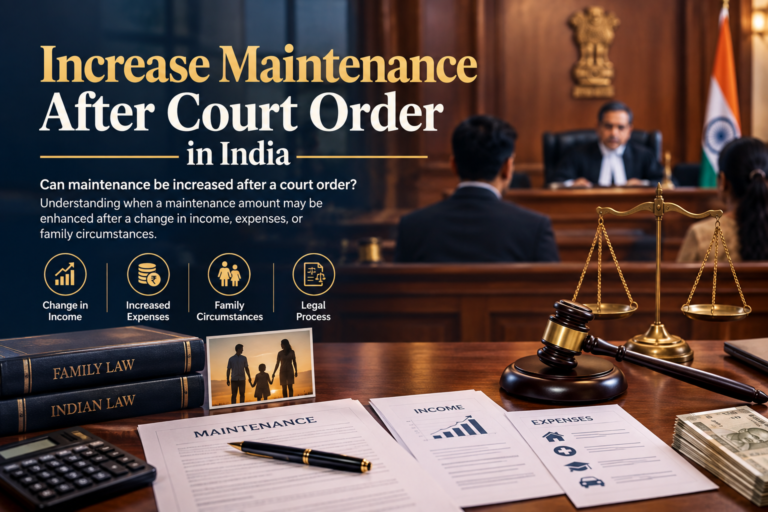
Maintenance orders are not permanent and unchangeable. A husband can approach the court for modification if:
- His income has genuinely decreased (job loss, business failure, health condition)
- The wife has started earning significantly
- The wife has remarried
- The wife is living in adultery
A wife can approach for enhancement if:
- The husband’s income has increased substantially
- Her expenses have increased (children’s education, medical needs)
- The original order is now inadequate due to inflation
Courts in Delhi routinely entertain modification applications. The key is demonstrating a material change in circumstances since the original order.
What If the Husband Does Not Pay?
This is a real and common problem. Non-payment of maintenance is not just a civil default , it has serious legal consequences.
A wife can file an execution petition before the Family Court, which can result in:
- Attachment of the husband’s salary (the employer is directed to deduct and deposit)
- Attachment and sale of the husband’s property
- Arrest and imprisonment of the husband (under Section 125(3) CrPC , up to one month)
- Attachment of bank accounts
In practice, salary attachment is the most effective and commonly used remedy. Courts in Delhi have become increasingly strict about enforcement, especially after the Rajnesh v. Neha guidelines.
Common Myths About Wife Maintenance in India
Myth 1: “A working wife cannot claim maintenance.
“ False. Her income is a factor, but it does not automatically disentitle her. The relevant question is whether she can maintain her prior standard of living on her own income.
Myth 2: “25% of salary is the maximum a court will award.
“ False. The 25% figure is a guideline for cases with no children. Courts regularly award more in high-income cases or where children are in the wife’s custody.
Myth 3: “If the wife left the house on her own, she cannot claim maintenance.
“ Not always true. If she left due to the husband’s cruelty, desertion, or misconduct, she retains the right to maintenance. The reason for leaving matters enormously.
Myth 4: “Maintenance stops automatically after divorce.
“ False. Post-divorce permanent alimony under Section 25 HMA continues until the wife remarries or the court modifies the order. It does not automatically stop the moment the divorce decree is issued.
Myth 5: “A husband with a low income does not have to pay anything.
“ Courts have repeatedly held that an able-bodied, educated man cannot claim inability to pay maintenance. If the husband is underemployed or voluntarily unemployed, courts impute an income based on his qualifications and earning capacity.
Adv. Aman Chawla’s Practical Note
In eight years of exclusively handling matrimonial matters before Delhi courts, I have observed one consistent pattern: maintenance disputes are almost always won or lost at the evidence stage, not at the argument stage.
The husband who meticulously documents his actual income, liabilities, and expenses , and presents this honestly , is treated far more fairly by the court than one who conceals assets. Equally, the wife who presents a clear, documented picture of her needs and the husband’s actual lifestyle will always be in a stronger position than one who makes vague, unsubstantiated claims.
If you are on either side of a maintenance dispute , whether you are about to file or you have just been served with a notice , the single most important thing you can do right now is gather your financial documentation and speak to a specialist.
Maintenance cases, unlike many legal matters, are deeply fact-sensitive. The numbers I have cited in this article are general observations , your specific outcome will depend entirely on the facts of your case, the court you appear before, and the quality of legal representation you have.
Frequently Asked Questions
Q: Can a wife claim maintenance if she has a job?
Yes. Her income is taken into account, but employment alone does not bar a maintenance claim if she cannot maintain her prior standard of living independently.
Q: How long does it take to get a maintenance order in Delhi?
An interim maintenance order typically takes 3 to 6 months if the application is diligently pursued. Delays occur mainly where financial affidavits are incomplete or the husband adopts delaying tactics.
Q: Can maintenance be claimed for past periods?
Yes. Courts can grant maintenance from the date of application, and the Rajnesh v. Neha guidelines make this mandatory. Arrears can accumulate significantly if a husband delays compliance.
Q: What is the difference between maintenance and alimony?
In Indian law, “maintenance” generally refers to ongoing monthly payments, while “alimony” (under Section 25 HMA) refers to permanent alimony granted at or after the time of divorce. In common usage, both terms are often used interchangeably.
Q: If both parties agree on an amount, do they need a court order?
A written and registered Memorandum of Understanding or settlement deed is strongly advisable. Without a court sanction, a verbal or informal agreement is difficult to enforce.
Q: Can a husband claim maintenance from his wife?
Yes. Section 24 HMA is gender-neutral and allows either spouse to claim interim maintenance. In practice, husbands claim maintenance where the wife has a substantially higher income. This is uncommon but legally valid and increasingly litigated.
Consult Advocate Aman Chawla., Matrimonial Law Specialist, practicing before the Supreme Court of India, Delhi High Court, and all Delhi Family Courts. Available for urgent matters, outstation clients, and online consultations across India.
Call: +91-8076836899 | WhatsApp | Email: info@thematrimoniallawyers.com Office: O-11A Basement, Jangpura Extension, New Delhi – 110014
Written by Advocate Aman Chawla.. This article is for informational purposes only and does not constitute legal advice. Every case is fact-specific. Please consult a qualified lawyer before taking any legal action.