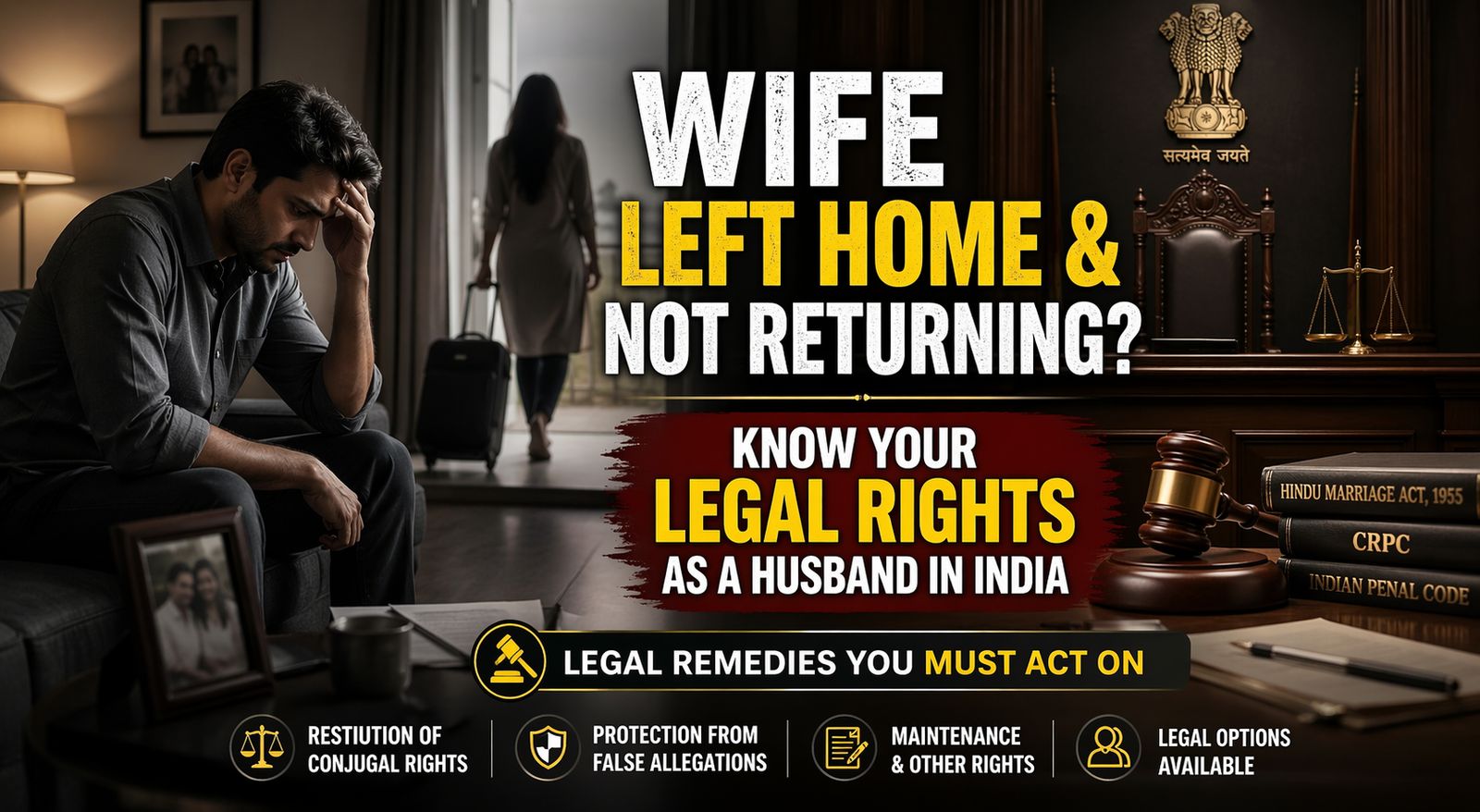
Wife Has Left Home and Is Not Returning, What Are My Legal Options?

Written by Adv. Aman Chawla | Matrimonial Law Specialist | Delhi High Court & Supreme Court of India 8 Years Exclusive Practice in Family & Matrimonial Law | Jangpura, New Delhi.
She left. Maybe with her parents. Maybe after a fight. Maybe one morning you woke up, and she was simply gone, along with the children, the jewellery, and any explanation.
Days passed. Then weeks. She is not picking up your calls. Her family says she is not coming back. And you are sitting there not knowing whether to wait, to fight, to file, or to let go.
This is one of the most common situations I encounter in my practice. And it is one of the most disorienting, because unlike a clear-cut divorce filing or a police complaint, this situation has no obvious first step. You are in a legal grey zone, and nobody is telling you what your options actually are.
This article will.
I will walk you through every option available to you, honestly, practically, and in the order I actually recommend them to my clients, based on eight years of exclusive matrimonial practice before Delhi courts
First, Understand That Leaving Home Does Not Decide the Case
Before anything else, understand this clearly: the fact that your wife left the matrimonial home does not automatically mean she is wrong, and it does not automatically mean you lose.
Courts look at why she left. If she left because of genuine cruelty or domestic violence on your part, her leaving may be legally justified. If she left without adequate reason, or was encouraged to leave by her parents as a matrimonial strategy, that is a very different legal situation.
The reasons for leaving, the circumstances of departure, and what happened before and after, these are the facts that determine everything. Your job right now is to document and preserve all of that.
The Tool That 99% of People Are Not Using, And Should Be
Before I walk you through litigation options, I want to tell you about something that almost nobody uses, and almost everybody should.
It is called pre-litigation mediation. And in my eight years of practice, it is the most underutilised and most genuinely useful tool available to a husband in your exact situation.
What Is Pre-Litigation Mediation?
Pre-litigation mediation means approaching a mediator before filing any court case. No petition. No FIR. No litigation. You simply approach a mediation centre, file a request, and a neutral, trained mediator is appointed who invites both parties to sit together and attempt a resolution.
For my Delhi clients, I always recommend the Delhi High Court Mediation and Conciliation Centre, Samadhan. It is one of the best mediation centres, staffed by trained and experienced mediators, and it is accessible, affordable, and genuinely effective.
How Does It Actually Work?
You, through your lawyer, file an application for pre-litigation mediation at the Samadhan Centre. A mediator is appointed. The centre then sends a formal request letter to your wife, inviting her to appear on a specific date for mediation.
This letter is not a court summons. It carries no legal compulsion. But in practice, most women, and their families, do respond and appear. The formal, institutionalised nature of the request, coming from a Delhi High Court mediation centre rather than from you or your family, gives it a credibility that a personal request never could.
Multiple sessions take place. The mediator speaks to both sides, sometimes together, sometimes separately, and helps both parties work toward a decision. In my experience, a large proportion of matters that reach mediation at this stage find some resolution here, either through reconciliation or through a mutually agreed separation.
Why Is This So Powerful, Especially in Your Situation?
I meet clients every week who tell me:
“Sir, I don’t want to file a case against my wife. I just want to know if there is any chance.”
“Sir, I don’t know what she wants. Nobody from her side is talking to me.”
“Sir, if I approach her family, they will just create more problems.”
“Sir, I am scared that if I call her, she will use it against me somehow.”
Pre-litigation mediation is the answer to all of these concerns. Here is why:
It is not litigation. You are not filing a case against your wife. There is no petition, no allegations, no court record of blame. It is a structured, neutral attempt to have a conversation with a professional in the room who knows how to handle these situations.
It does not harm you in any way. Filing for pre-litigation mediation cannot be used against you in any subsequent court proceedings. It cannot be construed as an admission of anything. It cannot trigger a counter-case. There is zero legal downside to trying it.
It creates a neutral space that the family cannot. When there is no family member on either side who can step forward as a mediator, which is increasingly common, the Samadhan Centre fills that role with someone who is trained, neutral, and experienced in matrimonial disputes.
It gives you clarity. Even if the mediation does not result in reconciliation, it almost always results in clarity. After 2 or 3 sessions with a trained mediator, you will know, with far more certainty than you do today, whether your wife wants to return, whether she is open to a settlement, and what her actual position is. That clarity is enormously valuable for whatever legal step you take next.
It is the mature, dignified first move. Courts and lawyers respond well to parties who have attempted mediation before rushing to litigation. It demonstrates that you were not the one who wanted to fight; you were the one who wanted to resolve.
What Happens If Mediation Succeeds?
If both parties reach an agreement, whether for reconciliation, separation on agreed terms, or anything in between, it can be reduced to a written settlement agreement. This agreement, properly drafted and signed, becomes legally binding and enforceable.
In the best case, a matter that could have lasted 4 years in court resolves in 4 sessions of mediation. No public record of allegations. No criminal complaints. No years of hostile litigation. Both parties move forward with dignity.
What Happens If Mediation Fails?
If pre-litigation mediation fails, if your wife does not appear, or if multiple sessions produce no resolution, you now have something very important: a clear decision in your head.
You have tried the peaceful route. You have made a genuine, documented, good-faith effort to resolve matters outside court. You know where she stands. And you know what you need to do next.
That clarity is worth more than most people realise. A client who comes to me after a failed mediation is in a completely different, and better, mental state than one who has been paralysed by uncertainty for 18 months. He knows it is over. He knows what he wants. And he is ready to pursue it cleanly.
After Mediation: Your Three Legal Paths
If mediation has been attempted and has not resolved matters, your options are clear. Here is how I think about them.
Path 1, She Is Willing to Return: Then File for Restitution of Conjugal Rights
If, after mediation there is a genuine willingness on her part to return, not under pressure, but genuinely, then a Petition for Restitution of Conjugal Rights (RCR) under Section 9 HMA can be filed to formalise that process and give it legal backing.
An RCR petition is a formal application to the Family Court directing the wife to return to the matrimonial home and resume cohabitation.
But I want to be direct with you here, because I think honesty matters more than telling clients what they want to hear:
If your wife is not willing to continue this relationship, do not file an RCR petition.
I say this clearly to every client who asks. Courts themselves have recognised that an RCR decree is essentially a paper decree. It cannot be executed. A court cannot physically bring someone back to their home. If she is determined not to return, an RCR order will not change that. What it will do is consume 2 to 3 years of your life in litigation, deepen the hostility between both sides, and leave you in exactly the same position, except older, more exhausted, and more financially depleted.
I have seen this happen too many times. A husband files RCR, hoping it will somehow bring his wife back or demonstrate to the court that he tried. The decree is passed. She does not comply. The marriage has still broken down. And now you are 3 years behind where you could have been.
The only situations where RCR genuinely makes sense are:
- There is a realistic, demonstrated willingness on her part to consider a return
- You want to use the non-compliance with the RCR decree as a clean, time-bound ground for divorce under Section 13(1-a) HMA, as a strategic legal move, not as a genuine attempt at reconciliation
- Your lawyer has specifically advised it in the context of your case’s overall strategy
Otherwise, skip RCR. If the marriage is over, file for divorce.
Path 2, The Marriage Is Over: File for Divorce
If mediation has failed and it is clear the marriage has irretrievably broken down, the direct and honest path is divorce.
Option A, Mutual Consent Divorce (If She Will Agree)
Even after a failed mediation, mutual consent divorce remains the best outcome if both sides can agree on the terms, maintenance, stridhan, and custody. Mediation sometimes fails on the relationship question, but opens the door to agreement on separation terms. Your lawyer should explore this possibility.
In Delhi, where the parties have been separated for a substantial period and all disputes are resolved, courts have waived the 6-month cooling-off period and granted mutual divorce within 30 to 90 days. This is the cleanest, fastest, and most dignified exit from a marriage , regardless of fault.
Option B: Contested Divorce
If she will not agree to divorce, you file a contested divorce petition under Section 13(1) HMA. The most relevant grounds where a wife has left home are:
Cruelty, Section 13(1)(ia)
Mental cruelty is the most commonly invoked ground in Delhi Family Courts today and does not require physical violence. Courts have consistently held that the following constitute mental cruelty justifying divorce:
- Filing false criminal cases (498A, DV) without factual basis
- Making false allegations of dowry demand or domestic violence
- Denying the husband access to the children and alienating them
- Prolonged, unjustified desertion combined with persistent refusal to reconcile
- Public humiliation or false statements made in court proceedings
Desertion , Section 13(1)(ib)
If your wife left home more than two years ago, without adequate cause, and has consistently refused to return, desertion is available as a ground for divorce. Your lawyer will establish that she left willingly, without justification, and has maintained that position continuously.
How Long Does a Contested Divorce Take in Delhi?
Honestly, 2 to 4 years if diligently pursued at Delhi Family Courts (Saket, Rohini, Dwarka, Karkardooma). Cases that drift can stretch to 5 to 7 years. The timeline is significantly influenced by the quality of legal management at every stage — opposing adjournments, keeping evidence ready, and using procedural tools like Section 21B HMA to push for faster disposal. I have written a detailed, courtroom-based guide specifically on how to speed up this process — you can read it here: How to Get Divorce Fast in India — A Practical Guide
Path 3: You Are Not Sure Yet: Protective Steps to Take Immediately
Whether you ultimately try mediation, file for divorce, or are still deciding, there are protective actions that must happen right now, regardless.
Protect Your Children
If your wife left with your children and is denying you access , this is an emergency. File an application for interim custody or visitation before the Family Court immediately. One parent cannot unilaterally deny access to the other without a court order. An interim visitation order in Delhi typically takes 4 to 8 weeks if urgently pursued.
If there is any risk she plans to take the children out of Delhi or out of India, apply for an order restraining relocation immediately.
Protect Your Financial Position
The moment a matrimonial dispute begins, your financial exposure increases on multiple fronts simultaneously , maintenance applications, DV monetary relief claims, and stridhan demands. Proactively organise:
- Salary slips and ITR filings for the last 3 years
- Bank statements showing income and expenditure
- Loan obligations and financial liabilities
- A written, itemised record of all gifts and stridhan given at the time of marriage
A well-documented financial picture, presented honestly, is your best defence against inflated maintenance claims.
Preserve All Evidence
Back up every WhatsApp conversation, email, call log, and document , today. Evidence not preserved today may be impossible to recover later. This includes photographs, joint financial records, and any communication that reflects the actual state of the marriage.
What If She Is Threatening a 498A or DV Case?
If your wife, or her family, is threatening to file a 498A complaint or DV case unless you meet their financial demands, this is a situation I deal with constantly.
My advice is always the same: do not make financial settlements under the pressure of a criminal threat.
A settlement reached under that kind of coercion is almost always one you will regret, and it rarely ends the matter. It often invites further demands.
Instead, take the threat seriously by preparing:
- Preserve all communication evidence of the threat itself
- Have your anticipatory bail application ready if needed
- Engage a matrimonial specialist who handles both criminal and civil proceedings as one integrated strategy
A coerced, undocumented payment resolves nothing. A prepared, legally guided response to the threat gives you genuine protection.
Your Immediate Action Checklist
This week, without delay:
Consult a matrimonial specialist , bring all available documents. Discuss whether pre-litigation mediation at the Delhi High Court Samadhan Centre is the right first step in your situation. If children are involved and access is being denied, file for interim visitation immediately. Begin gathering and organising your financial documentation.
Do not , under any circumstances:
Contact your wife’s family to negotiate without legal guidance. Make any financial transfers or sign anything without your lawyer reviewing it. Change the locks of the matrimonial home without legal advice. Post anything about the situation on social media. Approach your wife directly if threats of 498A or DV have already been made.
Adv. Aman Chawla's Practical Note
The situation you are in, wife gone, no communication, complete uncertainty, is the most common starting point for a matrimonial case in my practice.
And the most common mistake I see is not a legal one. It is a human one. Men in this situation spend months paralysed, hoping she will come back, afraid to file anything, unsure what to do , while the other side is quietly building a case. By the time they come to me, 18 months have passed, evidence has been lost, and positions have hardened.
The single most useful thing you can do right now, before filing anything, before deciding anything , is to attempt pre-litigation mediation. It costs very little. It carries zero legal risk. It creates a genuine opportunity for resolution. And if it fails, it gives you the clarity and the documented good faith you need to pursue the next step with full confidence.
I have seen mediation resolve matters that looked completely impossible from the outside. I have also seen it fail quickly and cleanly , giving my client the certainty he needed to file for divorce without guilt or hesitation.
Either outcome is better than where you are right now.
Frequently Asked Questions
Q: My wife left 3 months ago. How long should I wait before taking legal action?
There is no fixed waiting period, but do not let uncertainty become paralysis. If children’s access is being denied or threats of 498A have been made, act immediately. If the situation is relatively quiet, use the time to consult a lawyer and consider pre-litigation mediation as your first step.
Q: Can I change the locks after she leaves?
Not if the house is the matrimonial home. Under the PWDVA, a wife retains residence rights in the shared household regardless of ownership. Changing locks can be cited as an act of domestic violence. Do not do this without specific legal advice.
Q: She left with the children. Can I get access?
Yes. File an urgent application for interim visitation at the Family Court. One parent cannot unilaterally deny access to the other. Courts move relatively quickly on interim access applications when properly filed.
Q: She is threatening 498A unless I pay her demands. What should I do?
Do not pay under threat. Consult a lawyer immediately, preserve all evidence of the threat, and prepare your defence proactively. A coerced payment without legal documentation almost never resolves the matter.
Q: Can she claim maintenance even though she left voluntarily?
Yes , if she establishes that she left due to the husband’s conduct. Whether she succeeds depends on evidence. A wife who left voluntarily, without justification, and who has independent income has a weaker claim , but it must be argued specifically in your proceedings.
Q: We have been separated for over 2 years. Can I file for divorce on desertion grounds?
Potentially yes, subject to establishing the specific legal conditions that she left willingly, without adequate cause, and has persistently refused to return. Your lawyer will assess whether desertion or another ground, like cruelty, is stronger on your specific facts.
Q: Is pre-litigation mediation confidential?
Yes. What is said in mediation sessions cannot be used as evidence in subsequent court proceedings. This confidentiality is one of its most important features; it allows both parties to speak candidly without fear that their words will be used against them later.
Consult Adv. Aman Chawla, Matrimonial Law Specialist, practicing before the Supreme Court of India, Delhi High Court, and all Delhi District Courts. Available for urgent matters, outstation clients, and online consultations across India.
Call: +91-8076836899 | WhatsApp | Email: info@thematrimoniallawyers.com Office: O-11A Basement, Jangpura Extension, New Delhi – 110014
Written by Adv. Aman Chawla. This article is for informational purposes only and does not constitute legal advice. Every case is fact-specific. Please consult a qualified lawyer before taking any legal action.
Knowing wife left home not returning legal options India ensures you take timely legal action and protect your rights through proper legal remedies available under Indian matrimonial law.