The Complete Step-by-Step Process
By Advocate Aman Chawla | The Matrimonial Lawyers, New Delhi | Published: August 2026
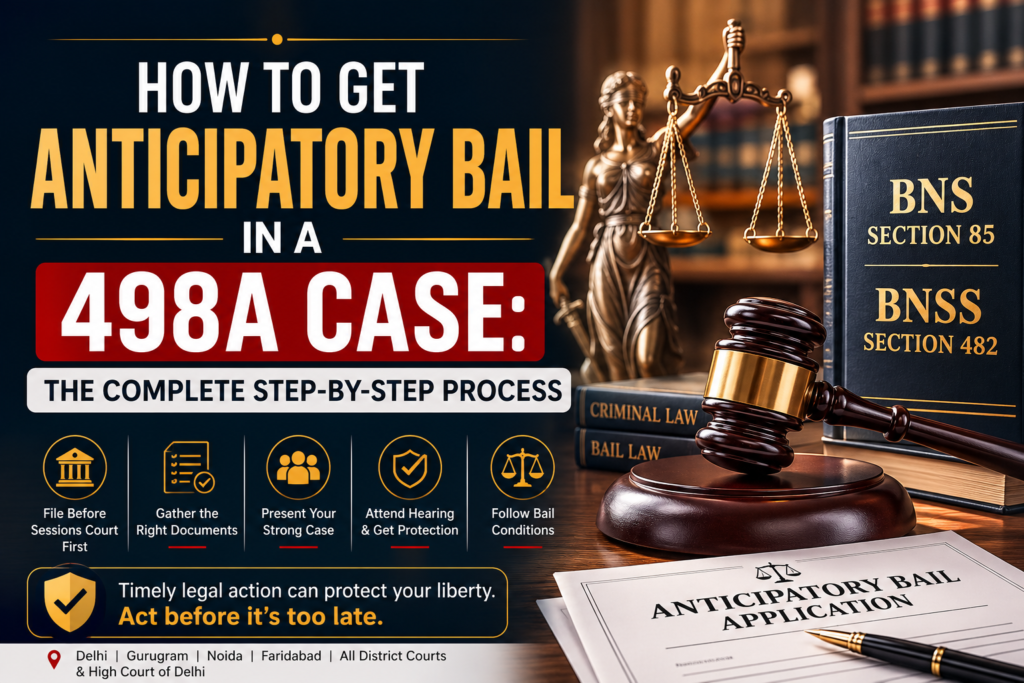
If you’ve just learned that a 498A complaint has been filed against you, or you have credible reason to believe one is coming, the single most time-sensitive decision you’ll make is when and how to apply for anticipatory bail. Section 85 of the Bharatiya Nyaya Sanhita, 2023 (the renumbered successor to Section 498A IPC) is cognizable and non-bailable, which means arrest can happen quickly once an FIR is registered. Here’s exactly how the process works, step by step.
Step 1: Confirm You Actually Need It — And Act Immediately
Anticipatory bail under Section 482 of the Bharatiya Nagarik Suraksha Sanhita, 2023 (formerly Section 438 CrPC) is available to anyone with a reasonable apprehension of arrest for a non-bailable offence — you don’t need to wait for an FIR to already exist. If your wife or her family has explicitly threatened a 498A complaint, or you’ve received any indication police intend to act, that’s sufficient grounds to apply now, before the FIR is even registered.
This matters because timing genuinely changes your options. Filing before arrest gives you court-ordered protection in place; filing after arrest limits you to regular bail instead, which is a materially weaker position to argue from. The law doesn’t require you to wait for certainty — “reasonable apprehension” is a deliberately lower bar than proof that arrest is imminent, precisely because the entire purpose of anticipatory bail is to act before the situation becomes urgent, not after.
What counts as reasonable apprehension in practice? Courts have accepted a range of triggers: a direct verbal or written threat to file a complaint, a formal legal notice referencing an intended 498A filing, a mediation or counselling session at a women’s cell that appears headed toward a complaint, or even credible information from a relative or mutual acquaintance that a complaint is being prepared. You don’t need documentary proof of the threat itself to apply, though having it strengthens your application considerably. What you do need is a genuine, articulable basis — a vague, generalised fear without any specific trigger is unlikely to be treated as sufficient grounds on its own.
This is also where people most often lose valuable time. It’s common to spend the first few days after learning of a threatened complaint trying to resolve things informally — a call to the wife’s family, an attempt at reconciliation, a hope that the situation cools down. There’s nothing wrong with also pursuing reconciliation, but it should run in parallel with legal preparation, not instead of it. An anticipatory bail application doesn’t foreclose reconciliation; sitting on your hands while a complaint is being drafted against you very much can foreclose your legal options.
Step 2: File Before the Sessions Court First, Not the High Court
This is a procedural detail that trips people up more than almost anything else in this process. Your application should be filed before the Sessions Court first, not the High Court. High Courts in Delhi generally decline to entertain a first-instance anticipatory bail application in a matrimonial matter and will direct you back to the Sessions Court, costing you time you don’t have.
If the Sessions Court declines your application, you can then move to the Delhi High Court. This sequencing isn’t just procedural formality — a fast, well-prepared Sessions Court application is often the difference between resolving this within 24–48 hours versus losing days to a court redirecting you elsewhere.
Where exactly you file also depends on where the FIR is, or would be, registered — which is determined by the police station having jurisdiction over the complainant’s residence or the alleged incidents. Across Delhi NCR, this typically means Saket, Dwarka, Rohini, Karkardooma, Tis Hazari, or Patiala House, or the corresponding Sessions Courts in Noida, Gurugram, or Faridabad if the marital residence or complaint falls within those jurisdictions. Filing in the wrong Sessions Court, or assuming Delhi jurisdiction when the FIR is actually registered in Noida or Gurugram, is a mistake that can cost real time — confirming the correct forum before filing is a five-minute check that avoids a completely avoidable delay.
There’s also a practical reason the Sessions-Court-first approach matters beyond simply following procedure correctly: Sessions Courts in matrimonial matters generally move faster on urgent applications than the High Court’s more crowded docket, and judges at this level are often more directly familiar with the day-to-day realities of how 498A complaints unfold locally. A well-prepared Sessions Court application, argued properly, resolves the immediate arrest risk in the large majority of matrimonial cases without ever needing to reach the High Court at all.
Step 3: Gather Your Documents Before You File
A well-prepared application moves faster and is taken more seriously. Before filing, your lawyer will typically need:
- A copy of the FIR, if one has already been registered, or a written record of the specific threat if it hasn’t. If the FIR isn’t yet available, your lawyer can usually obtain a certified copy quickly, or, in urgent cases, proceed based on documented knowledge of the complaint’s substance.
- Proof of your identity and address, and those of any co-accused family members applying alongside you. Aadhaar, PAN, and a recent utility bill or rent agreement are generally sufficient.
- Evidence relevant to your defence — communications, financial records, or anything contradicting the specific allegations, even at this early stage. This might include bank statements showing no dowry-related transactions, message threads that contradict specific incidents alleged, or documentation of where you actually were on dates named in the complaint.
- Proof of no prior criminal record, which is a factor courts weigh heavily. A character certificate or an affidavit confirming this is standard.
- Details establishing you’re not a flight risk — stable employment, property ownership, or ties to the jurisdiction. Employment ID, salary slips, or property documents all help establish this.
- A vakalatnama authorising your lawyer to represent you.
Assembling these before your first meeting with your lawyer, rather than after, is one of the simplest ways to compress your timeline. In genuinely urgent situations, an experienced matrimonial lawyer can file with a partial set of documents and supplement the record shortly after, but a complete package from day one gives your application its strongest possible footing.
What If Your Parents or Siblings Are Also Named?
A recurring pattern in 498A complaints is naming the husband’s entire family — parents, siblings, sometimes relatives who don’t even reside in the same city — often using identical, generic language for each person. If this has happened in your case, each named family member generally needs their own anticipatory bail protection; a grant of bail to you personally doesn’t automatically extend to them.
The good news is that the same application can often be filed jointly for multiple family members, provided each person’s specific circumstances and documents are properly represented. The Supreme Court, in Preeti Gupta v. State of Jharkhand (2010), specifically cautioned courts against mechanically proceeding against relatives where the complaint contains vague, sweeping accusations without specific incidents tied to each individual — this is a genuinely useful argument for family members caught up in a complaint with little or no direct connection to the specific allegations. Your lawyer should raise this distinction explicitly for each family member, rather than treating the family as a single undifferentiated group in the application.
Step 4: Understand What the Court Is Actually Weighing
Courts assess a consistent set of factors when deciding whether to grant anticipatory bail in a 498A matter: whether the allegations appear to be a civil or matrimonial dispute given a criminal colour, whether you have any prior criminal history, whether you’re cooperating with the investigation, whether there’s any genuine risk of you fleeing or tampering with evidence, and the overall specificity (or vagueness) of the allegations themselves.
The Supreme Court’s ruling in Arnesh Kumar v. State of Bihar (2014) remains central here — it held that arrest in offences punishable by up to seven years, which includes Section 85 BNS, should never be automatic or routine. Police are required to record specific written reasons before making an arrest, and courts increasingly expect anticipatory bail applications to lean directly on this safeguard rather than simply asserting innocence in general terms.
It’s worth understanding what actually changed with the transition from the CrPC to the BNSS framework, since this affects how your application should be framed. Section 482 BNSS largely preserves the substance of the old Section 438 CrPC, but the surrounding procedural framework — including Section 35 BNSS’s requirements around arrest and the recording of reasons — has been more explicitly codified than under the old Code. In practice, this means your lawyer has a more clearly spelled-out statutory basis to argue that arrest wasn’t necessary or justified, rather than relying purely on judicial precedent built up under the older CrPC framework. This is a subtle but genuinely useful shift, and an application that references the specific BNSS provisions directly tends to read as more current and more precisely argued than one still framed entirely in older CrPC language.
Courts also weigh the timeline of events surrounding the complaint. A complaint filed shortly after you initiated divorce or maintenance proceedings, for instance, is a pattern courts have grown more attentive to, and is worth highlighting clearly in your application if it applies to your situation — not as an accusation of bad faith, but as relevant context for the court’s overall assessment.
Step 5: The Hearing Itself
At the hearing, your lawyer presents the application, and the Investigating Officer or Public Prosecutor typically responds on behalf of the state. In many matrimonial matters, courts grant what’s sometimes called interim protection at the first hearing itself — meaning you can’t be arrested while the fuller application is being decided — followed by a more substantive hearing shortly after.
Courts frequently impose specific conditions alongside the grant of bail: appearing for interrogation when required, not leaving the country without permission, surrendering your passport, not contacting the complainant, and cooperating fully with the investigation. These conditions aren’t a sign the case is going against you — they’re standard practice, and violating them is what actually puts your bail at risk.
Expect the first hearing to move relatively quickly — often a matter of minutes for the interim protection order, with the court simply confirming the application is properly filed and setting a date for the state’s response. The more substantive hearing, where the Investigating Officer’s status report is considered and both sides make fuller arguments, typically follows within one to three weeks, though this varies by court and how contested the matter becomes.
If the Sessions Court Rejects Your Application
A rejection at the Sessions Court level isn’t the end of the road, and it happens often enough that it shouldn’t be treated as a signal your case is weak. Your next step is to move the same application, refined based on the Sessions Court’s specific reasoning, before the Delhi High Court.
This is where the quality of your original application matters retroactively — a Sessions Court order that rejected your application on narrow, specific grounds (rather than a broad dismissal) gives your High Court application a clearer target to address. Your lawyer should obtain a certified copy of the Sessions Court’s order promptly and use its specific reasoning to strengthen, not simply repeat, the High Court filing.
In the period between a Sessions Court rejection and a High Court hearing, you remain at genuine risk of arrest unless interim protection has been separately secured, which makes moving quickly to the High Court — ideally within days, not weeks — a priority rather than something to plan around at leisure.
What This Typically Costs and How Long It Takes
While fees vary by lawyer and the complexity of your specific matter, it’s worth setting realistic expectations. A well-prepared Sessions Court anticipatory bail application in a straightforward matrimonial matter is often resolved within 24 to 72 hours of filing, particularly where interim protection is granted at the first hearing. Matters that proceed to the High Court after a Sessions Court rejection typically add another one to three weeks to the timeline, depending on the court’s docket.
Cost considerations should factor in not just the initial application, but the likelihood of needing to argue for full-period rather than limited-period protection (see Step 6), and the possibility of a subsequent High Court application if the Sessions Court declines. Discussing this full scope with your lawyer upfront — rather than assuming the process ends with a single filing — avoids surprises later.
Step 6: Know How Long Your Protection Actually Lasts — This Is Where Most Guides Get It Wrong
This is the detail that deserves far more attention than most articles on this topic give it. The general rule, confirmed by the Supreme Court in Sushila Aggarwal v. State (NCT of Delhi) (2020), is that anticipatory bail doesn’t need to be limited to a fixed period and can, in principle, continue until the conclusion of the trial, unless a court specifically restricts it.
In practice, though, the picture in Delhi has been shifting. Through 2025 and into 2026, Delhi and Punjab & Haryana High Courts have increasingly granted anticipatory bail for a limited period rather than for the life of the case, directing the accused to approach the regular bail court once a chargesheet is filed. If your lawyer doesn’t specifically argue for full-period protection at the hearing, you may find yourself needing to return to court for regular bail sooner than you expected — at a more vulnerable stage of the process.
This is genuinely one of the most consequential, and most commonly overlooked, procedural details in a 498A anticipatory bail matter right now, and it’s worth raising directly with your lawyer before your hearing, not after.
Step 7: What Happens After Bail Is Granted
Anticipatory bail protects you from arrest — it doesn’t end the case. The investigation continues, and you’ll typically be required to join it as directed by the conditions of your bail. This is also the stage where a longer-term strategy matters: building your evidentiary defence, addressing whether the complaint names family members with vague, generic allegations, and evaluating whether quashing the FIR entirely is realistic on your facts. Our companion guide on how to fight a false 498A case covers this next phase of the process in full.
Common Mistakes That Weaken an Application
A few recurring errors show up often enough in matters we handle that they’re worth flagging directly:
- Waiting to see if the complaint “blows over.” Complaints rarely resolve themselves once family members or legal counsel are already involved on the other side. Waiting almost always narrows your options rather than preserving them.
- Contacting the complainant or her family directly to negotiate. Beyond the risk of this being characterised as pressure or intimidation, it can directly undermine your anticipatory bail application, since courts specifically look at whether the accused has attempted to influence the complainant.
- Filing a vague, template-style application. An application that reads as generic — asserting innocence without engaging with the specific allegations — is less persuasive than one that directly, specifically addresses what’s actually been alleged.
- Treating every named family member identically. As discussed above, each person’s specific connection (or lack of one) to the allegations should be addressed individually, not folded into a single blanket defence.
- Assuming anticipatory bail ends your legal exposure. It protects you from arrest; it doesn’t resolve the underlying case. Treating it as the finish line rather than the first step often leads to under-preparing for what comes next.
A Realistic Example
A husband learns from a relative that his wife intends to file a 498A complaint within the week. Rather than waiting for the FIR, his lawyer files an anticipatory bail application before the Sessions Court that same week, supported by his employment records, proof of no prior criminal history, and a clear, dated account of the marriage’s actual timeline. The Sessions Court grants anticipatory bail with standard conditions, and — because his lawyer specifically raised the recent Delhi trend and argued for protection through the conclusion of trial rather than a limited period — the order is drafted to avoid requiring a second bail application later in the process.
Frequently Asked Questions
1. Can I apply for anticipatory bail before an FIR is even filed?
Yes. You just need a reasonable apprehension of arrest — a credible threat, or knowledge that a complaint is imminent, is sufficient grounds to apply.
2. Should I file in the Sessions Court or the High Court first?
The Sessions Court, in almost all cases. Delhi High Court generally won’t entertain a first-instance application and will direct you back to the Sessions Court, costing valuable time.
3. How quickly can anticipatory bail actually be granted?
In matrimonial matters, courts often grant interim protection at the very first hearing, with a fuller hearing shortly after. A well-prepared application can realistically secure protection within 24–48 hours.
4. Does anticipatory bail protect me for the entire case, or just temporarily?
It can, under Sushila Aggarwal, extend through the trial — but Delhi and Punjab & Haryana High Courts have increasingly been granting it for a limited period instead in recent practice. This needs to be specifically argued for at your hearing, not assumed.
5. What conditions will the court likely impose?
Common conditions include appearing for questioning when directed, surrendering your passport, not leaving the country without permission, and not contacting the complainant. These are standard, not a sign your case is weak.
6. What happens if my anticipatory bail application is rejected by the Sessions Court?
You can then move the application before the Delhi High Court. This is a normal, expected next step in the process, not a dead end.
7. Does getting anticipatory bail mean the case against me is dropped?
No. It protects you from arrest while the investigation and case proceed. Addressing the underlying complaint — through your defence, potential quashing, or trial — is a separate, subsequent phase of the process.
8. Can my parents or siblings get anticipatory bail if they’re named in the same FIR?
Yes, generally through the same or a coordinated application, though each family member’s specific circumstances and connection to the allegations should be addressed individually rather than treated as a single group defence.
9. What if my wife filed the complaint in a different city, like Noida or Gurugram, not Delhi?
Your application needs to be filed before the Sessions Court with jurisdiction over wherever the FIR is or would be registered — this is typically tied to the complainant’s residence or where the alleged incidents occurred, not necessarily where you currently live.
10. Is it worth trying to settle with my wife before or instead of filing for anticipatory bail?
The two aren’t mutually exclusive, and pursuing settlement discussions alongside legal preparation, rather than instead of it, is generally the safer approach. Relying solely on an informal resolution while taking no legal steps leaves you exposed if those discussions don’t succeed.
Disclaimer: This article is for general informational purposes only and does not constitute legal advice. As per the Rules of the Bar Council of India, advocates are not permitted to advertise or solicit work, and nothing in this article should be construed as advertising, solicitation, or an invitation to engage this firm. Every case is fact-specific — consult a qualified advocate regarding your specific circumstances before taking any legal action.