What if the Wife is Capable of Earning but Chooses Not to Work?

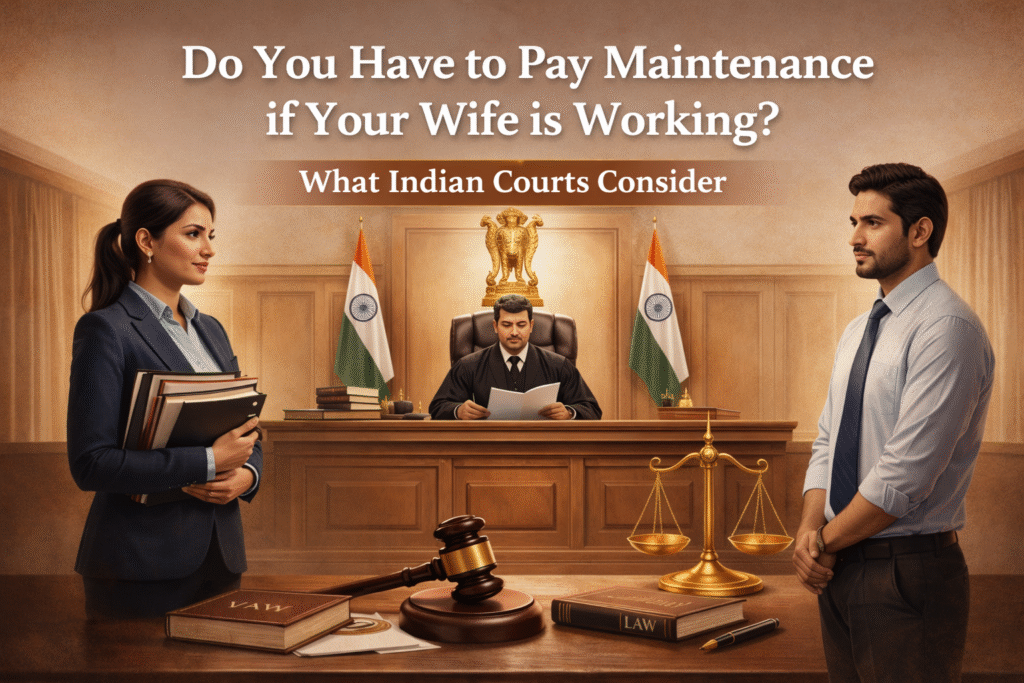
A frequently raised concern in maintenance cases is whether a husband is still liable to pay maintenance when the wife is well-qualified, previously employed, but has chosen not to work. While Indian law does not automatically disqualify such a wife from claiming maintenance, the position is far more nuanced—especially when viewed from the husband’s perspective.
Legal Position: Capability vs. Actual Need
It is correct that courts have held that a wife cannot be forced to work merely to reduce the husband’s financial burden. However, this principle is not absolute. Courts increasingly examine whether the wife is intentionally remaining unemployed despite having the capacity, qualifications, and prior work experience.
Maintenance is not meant to encourage voluntary unemployment. The objective is to ensure fairness, not dependency.
Key Factors Considered by Courts
From a husband’s defence standpoint, courts typically evaluate:
- When was the wife last employed?
- What was her previous salary and professional standing?
- Why did she leave her job?
- Whether she made genuine efforts to seek employment post-separation?
- Whether the claim of being forced to leave the job is substantiated or merely alleged?
A common allegation seen in litigation is that the husband or in-laws forced the wife to leave her job after marriage. However, mere allegations without evidence are not sufficient. Courts carefully scrutinize such claims.
Practical Case Insight
In a recent matter handled from the husband’s side, the marriage lasted only about three months. The wife left the matrimonial home and alleged that she was forced out and that she had earlier left her job at the insistence of the husband and his family.
However, it was demonstrated that:
- She was highly qualified,
- Previously employed as an HR professional, and
- Earning approximately ₹1.15 lakh per month prior to marriage
In these circumstances, a submission was made before the court that while the husband was willing to provide temporary financial support, the wife should not be allowed to remain indefinitely unemployed.
The court accepted this balanced approach and:
- Granted maintenance for a limited period of 6 months, and
- Directed the wife to actively seek employment, along with filing an affidavit demonstrating her efforts during this period
Key Takeaways for Husbands
- A wife’s intentional unemployment can be questioned if she is qualified and previously earning.
- Courts may grant temporary or reduced maintenance, rather than long-term support.
- Allegations such as being “forced to leave a job” must be proved with evidence.
- Courts can direct the wife to make genuine efforts to become financially independent.
Conclusion
While the law protects a wife’s right to maintenance, it does not support indefinite financial dependence where the wife is fully capable of earning. For husbands, a well-documented approach highlighting the wife’s qualifications, past employment, and lack of effort to seek work can significantly influence the outcome.
Each case ultimately depends on its facts, but courts are increasingly inclined towards a balanced and practical approach, ensuring that maintenance serves as support, not a substitute for self-sufficiency.
FAQs – Wife Capable of Earning but Not Working
- Can my wife claim maintenance even if she is qualified and capable of working?
Yes, but her qualifications and earning capacity are important factors that can reduce or limit maintenance.
- Will the court consider my wife’s previous job and salary?
Yes. Courts closely examine her past employment, salary, and professional background.
- What if my wife left her job after marriage?
The court will assess the reason. Mere allegations that she was forced to leave are not enough without proof.
- Can maintenance be denied if she is intentionally not working?
In many cases, courts may not deny it completely but can reduce it or limit it for a specific period.
- Can the court direct my wife to find a job?
Yes. Courts can grant temporary maintenance and direct her to actively seek employment.
- What if she was earning well before marriage?
This strengthens the husband’s case that she is capable of maintaining herself.
- Is temporary maintenance common in such cases?
Yes. Courts may grant short-term maintenance to allow the wife time to become financially independent.
- Do courts verify efforts made by the wife to get a job?
Yes. Courts can ask for affidavits or proof of job search efforts.
- Can I offer limited maintenance instead of long-term support?
Yes. Courts may accept a reasonable, time-bound approach depending on facts.
- What is the main defense for a husband in such cases?
To demonstrate that the wife is qualified, previously employed, and deliberately not making efforts to work.
Written by Adv. Aman Chawla, practising in Delhi, focuses on matrimonial and family law matters.