Written by Adv. Aman Chawla | Matrimonial Law Specialist | Delhi High Court & Supreme Court of India
Practising in Family & Matrimonial Law | Jangpura, New Delhi
Introduction
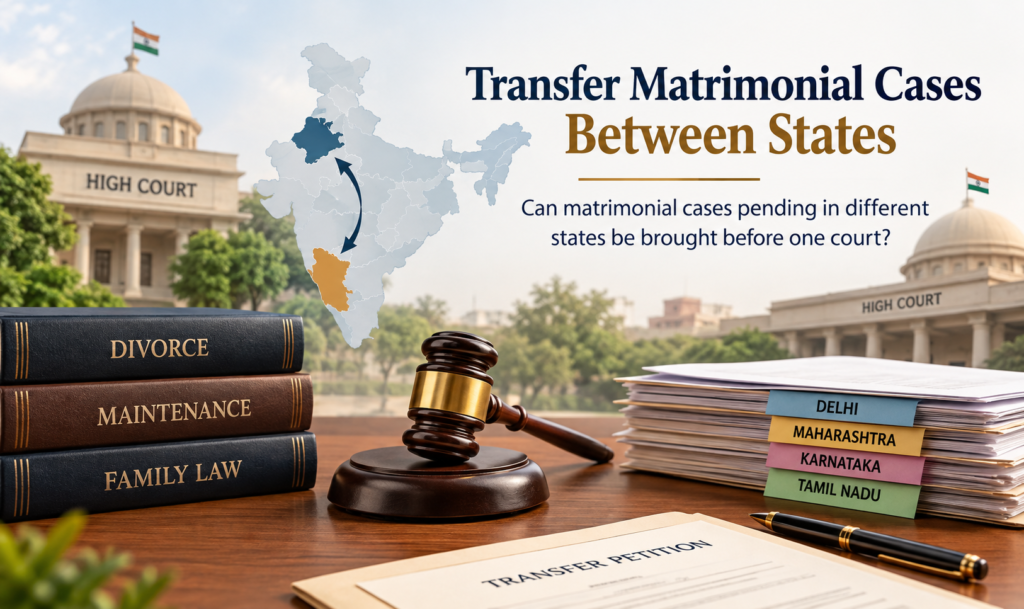
Can you transfer matrimonial cases between states when divorce and maintenance proceedings are pending in different courts? This is a question many spouses face when one case is filed in Delhi and another is pending hundreds of kilometres away.
Picture a couple whose marriage has broken down. The husband files for divorce in Pune, where he now lives. A few weeks later, his wife files for maintenance in Delhi. She has gone back to her parents’ home with a young child. Within a year, two courts in two states are hearing two halves of one story. Each court issues its own dates, its own notices and, sooner or later, its own orders.
Neither spouse can attend both courts comfortably. One of them often cannot afford to.
This situation is common. It is one of the quickest ways a matrimonial dispute turns from painful to exhausting. At The Matrimonial Lawyers, clients ask us one question again and again: can the Supreme Court bring both cases under one roof? The short answer is yes, in the right circumstances. The longer answer depends on which cases are pending, who asks, and how maintenance fits in.
Why One Marriage Ends Up in Two States
Most people think a matrimonial dispute is a single case. In practice, it is a bundle of cases. A husband may file for divorce or restitution of conjugal rights under the Hindu Marriage Act, 1955. A wife may answer with a maintenance application, a complaint under the Domestic Violence Act, 2005, a custody petition or a criminal complaint. Each remedy has its own rules on where you can file.
The filing rules that cause the split
Section 19 of the Hindu Marriage Act gives several choices. A petition can go where the marriage took place, where the respondent lives, or where the couple last lived together. A wife can also file where she lives when she presents the petition.
Maintenance follows a similar rule. Section 144 of the Bharatiya Nagarik Suraksha Sanhita, 2023 (BNSS) replaced Section 125 of the old CrPC. It lets an applicant file where the husband lives, where the wife lives, or where they last lived together.
Two lawful filings, one tangled dispute
Both spouses usually act within their rights. Nobody breaks the law. Two people who no longer share a city simply file where it suits them, often in a hurry and often on the advice of the first lawyer they meet. The result is a pair of cases that overlap in facts but not in geography.
What the Supreme Court Can Do
A High Court can move a case from one district court to another inside its own state. It cannot send a case across a state border. Only the Supreme Court holds that power.
Section 25 CPC for civil cases
Divorce, judicial separation, restitution of conjugal rights and many custody disputes are civil matters. Section 25 of the Code of Civil Procedure, 1908 lets the Supreme Court move such a case from a court in one state to a court in another. The Court must feel the transfer is expedient for the ends of justice.
Section 446 BNSS for criminal and quasi-criminal cases
Maintenance applications and some Domestic Violence Act proceedings fall on the criminal side. Section 406 of the CrPC once governed their transfer. After the 2023 reforms, Section 446 of the BNSS does the same job in much the same way.
Article 139A of the Constitution
Article 139A sits beneath both provisions. It allows the Supreme Court to withdraw and transfer cases when the interests of justice demand it. In practice, a party in either state can file a transfer petition and ask the Court to bring the cases together. When the two cases sit in different states, this is the only route.
The Test: What Does “Expedient for the Ends of Justice” Mean?
The phrase sounds grand. Courts have given it a grounded meaning. The Supreme Court does not decide who is right in the main dispute. It asks where the cases can be heard fairly, with the least avoidable hardship.
What judges weigh
Judges look at a handful of practical questions:
- How far apart are the two courts, and how hard is the journey for each spouse?
- Who is more vulnerable, financially or physically?
- Do young children depend on one parent staying in one place?
- Does anyone have a real fear for their safety while travelling?
- Could two courts reach conflicting conclusions on the same facts?
The Court’s leaning towards the wife’s convenience
Several decisions show a steady pattern. These include Sumita Singh v. Kumar Sanjay (2001), Anindita Das v. Srijit Das (2006) and Arti Rani v. Dharmendra Kumar Gupta (2008). The Court has often preferred the wife’s convenience. The reasoning is simple. A wife with a small child, a modest income and little support in an unfamiliar city usually finds the journey hardest. A husband with steady earnings can usually bear it better.
Why this is not a guaranteed win
Do not treat this pattern as a rule of automatic success. The Court has refused transfers where the petitioner showed no real hardship. It has also refused where the request looked like a bid to delay, or where the case had travelled too far to move sensibly. Your petition must rest on facts, not on a general sense of unfairness.
Where Maintenance Changes the Picture
Many guides on transfer petitions skip this part. In a broken marriage, the urgent question is rarely who gets the divorce. It is how the lower-earning spouse and the children will live while the case runs. That is a maintenance question, and it has its own clock.
The different maintenance remedies
A wife can seek interim maintenance inside the divorce case under Section 24 of the Hindu Marriage Act. She can seek permanent alimony under Section 25 once the court decides the case. She can also file a separate application under Section 144 BNSS. Under Sections 12 and 20 of the Domestic Violence Act, she can ask for monetary relief.
Each remedy stands on its own, and each can sit in a different court. A woman facing a divorce petition in one state may well have her own maintenance application in another.
The real danger: inconsistency and delay
The risk is more than inconvenience. Two courts can fix two different figures. One judge may hear that the husband earns a modest salary. Another may see proof of business income. The wife may have to prove the same income, expenses and lifestyle twice, before two judges, in two cities.
What Rajnesh v. Neha requires
The Supreme Court tackled this problem in Rajnesh v. Neha (2021). It directed both sides to file a full affidavit of assets and liabilities. It also directed that courts adjust a later award where maintenance has been claimed under more than one law, so nobody is paid twice for the same need. Parties must disclose earlier orders.
That guidance works best when one judge sees the whole picture. When the cases sit in two states, it depends on each party’s honesty and each court’s information.
Transfer as a maintenance strategy
For this reason, a transfer petition is often a maintenance strategy as much as a procedural step. One court can assess income, needs and conduct once. It can then fix a coherent figure. Transfer also blunts a familiar pressure tactic. A case that costs a fortune to attend is easy to abandon, and a stronger spouse can use distance to wear the other side down.
Which Cases Can Be Grouped Together
Be realistic about what a transfer petition can achieve. The Supreme Court can move cases from different courts to one court. It usually picks a court in the place where the more vulnerable spouse lives or where the child is settled.
Civil and criminal cases stay separate in form
The Court will not merge a civil case and a criminal case into a single file. They follow different procedures. It can, however, send each to a court in the same city. Then nobody has to cross a state border to defend them.
A typical order
In a typical order, the husband’s divorce petition moves to the family court in the wife’s city. Her maintenance application is already pending there. A custody petition can travel the same way. A restitution case or a complaint filed by the husband can follow.
Criminal proceedings tied to the marriage may need a separate petition under Section 446 BNSS. Allegations of cruelty under Section 498A of the IPC are an example. The Bharatiya Nyaya Sanhita now carries that offence under Section 85.
A recent example
In March 2026, the Supreme Court dealt with Aditi Chhonkar v. Dhawal Kaushal. A wife sought to move her husband’s divorce case so that it sat alongside parallel matrimonial proceedings in another state. Published summaries describe the order as a routine use of the Section 25 test, not a new rule. That is the point. The principles are settled, and each case turns on its facts.
How a Transfer Petition Is Filed
The process is more formal than most people expect. Only an Advocate-on-Record, a specially registered advocate, may file in the Supreme Court. Your own lawyer in Delhi or elsewhere can work alongside that advocate.
What the petition must show
The petition lists both cases, the courts that hear them and the stage each has reached. It then gives the reasons for transfer. Those reasons must be concrete. “The journey is difficult” is not enough.
Explain how far apart the courts are. Say whether the petitioner has a child to look after. State whether she works or depends on others, and whether she has health problems. Describe any threats or harassment. Attach the pleadings, orders and maintenance affidavits. If safety is a worry, add police complaints or medical records.
What happens after filing
At the first hearing, the Court usually issues notice to the other side. Judges very often refer the parties to the Supreme Court Mediation Centre. They hope to settle the dispute or at least narrow it. Many matrimonial transfer petitions end in a compromise at this stage. Approach the petition with an open mind, then, and not only as a weapon.
If mediation fails, the Court hears both sides. It may allow the petition, dismiss it, or allow it with conditions. Common conditions include sharing the other side’s travel costs or allowing video hearings at certain stages.
Timing and Cost
Courts look kindly on petitions filed early, while the cases are still at the pleadings stage. They look far less kindly on petitions filed after witnesses have testified. A request made on the eve of final arguments can look like an attempt to reset the clock, and judges notice.
The real expense
Cost matters too. You pay an Advocate-on-Record, court fees, and travel and stay in Delhi. For some families, that is small beside years of travelling between two states. For others, it is a heavy burden. Talk frankly with your lawyer. A settlement, a video-conferencing request or an application to the existing court may solve the problem more cheaply.
Video conferencing as an alternative
Courts now allow video conferencing in many matrimonial matters. It does not replace transfer in every case. It can, however, ease the hardship enough that you no longer need the petition.
When a Transfer Petition Is the Wrong Tool
A transfer petition does not cure every problem. In several situations it is the wrong move.
- Both cases sit in one state. The High Court can transfer between districts, so you do not need the Supreme Court.
- You dislike an order. Appeal or revision is the answer, not transfer.
- You want to delay maintenance. The Court will see through the tactic, and your credibility in the main case will suffer.
- The other side merely lives far away. Without special vulnerability on your part, the Court may dismiss the petition.
Maintenance orders keep running
The Supreme Court has made clear that it will not tolerate procedural tricks to avoid payment. A spouse who ignores an interim maintenance order faces execution proceedings. In serious cases, the court treats that spouse as a defaulter, whichever court hears the main case. A pending transfer petition does not pause the duty to pay unless the Court says so.
Practical Steps If You Are in Two Courts Today
Whatever you decide about transfer, a few steps will help you.
Organise your records
Collect every order, notice and pleading in one file, with dates. A clear record helps your lawyer present the petition. It also helps in any later appeal.
Prepare your financial papers
Gather salary slips, bank statements, income tax returns, property details and expense records. Under Rajnesh v. Neha, both sides must disclose them. Courts have little patience for anyone who hides assets.
Tell your lawyer everything
Mention every other proceeding, even a minor one. A forgotten complaint or an old maintenance order can complicate a later petition.
Put the child first
Courts give heavy weight to a child’s stability. Show exactly how schooling and daily care suffer. That makes a petition stronger than one based only on a parent’s convenience.
Consider a settlement
A well-drafted settlement can cover divorce, maintenance, custody and property in a single document. Once both sides sign, the question of which court should hear what largely disappears. Our firm often finds that the papers prepared for a transfer petition also help in settlement talks. They push both sides to see the facts as a neutral judge would.
A Word on Fairness to Both Spouses
Many people believe only wives use transfer petitions against husbands. That is not the full picture. A husband who cares for a child alone can ask for transfer. So can a husband who is unwell, who supports a disabled parent, or who earns little. The Court weighs these facts case by case.
What the Court does not accept is a request that rests only on the petitioner’s preference. A spouse who cannot afford to attend a distant court may also lose the case by default. That serves nobody. The transfer power exists to protect the fairness of the process, not to favour either side.
Final Thoughts
The Supreme Court can bring two matrimonial cases from two states to one court, and it does so regularly. The power rests on Section 25 of the CPC and, for criminal matters, Section 446 of the BNSS. Its logic is simple: justice should not depend on who can afford to travel further. For anyone caught between a divorce case in one place and a maintenance case in another, a petition can be a lifeline. It works only if you file at the right time, for the right reasons, with the facts set out clearly.
Not sure whether transfer is right for you? Speak to a lawyer who understands both the procedure and the money side. At The Matrimonial Lawyers in Delhi, we advise on transfer petitions, interim maintenance, alimony and settlement. We will tell you plainly when a petition is worth filing and when it is not. Read how we handle maintenance and alimony cases, divorce proceedings and child custody disputes. You can also contact our team for a confidential discussion.
Frequently Asked Questions
1. Which court can transfer a matrimonial case from one state to another?
Only the Supreme Court of India. A High Court can move a case between courts inside its own state. A transfer across state lines needs a petition in the Supreme Court. Section 25 of the CPC covers civil cases, and Section 446 of the BNSS covers criminal cases.
2. Can a maintenance case be transferred along with a divorce case?
Yes. Maintenance under Section 144 BNSS and Domestic Violence Act proceedings can move. They sit on the criminal side, so Section 446 BNSS usually applies. The divorce petition moves under Section 25 CPC. Your lawyer can raise both in connected petitions.
3. Does the Supreme Court always favour the wife in a transfer petition?
No. The Court has often given weight to the wife’s convenience, especially where she has a young child or limited means. The real test is what serves the ends of justice. A husband can succeed if he shows real hardship, such as illness, caring duties or a low income.
4. How long does a transfer petition take?
No fixed timeline exists. Many petitions get a hearing within a few months of filing. The pace depends on the Court’s schedule, service of notice and any mediation. Some cases settle at the mediation stage.
5. Do I have to keep paying interim maintenance while the transfer petition is pending?
Generally, yes. A pending petition does not cancel an existing maintenance order unless the Supreme Court says so. Non-payment can lead to recovery proceedings.
6. Can I attend my case by video conferencing instead of transferring it?
Often, yes. Courts increasingly allow video conferencing in matrimonial matters. If travel is your main difficulty, apply to the court where the case is pending.
7. What documents do I need for a transfer petition?
Usually the petitions and pleadings from both cases, all orders, proof of residence and details of the child’s schooling or care. Add income and asset details, plus any material on safety concerns, such as police complaints or medical records. Your Advocate-on-Record will give you the full list.
8. Is a transfer petition worth filing if my case is almost over?
Usually not. Courts view late petitions with suspicion. Moving a case after evidence closes wastes time and can look like a delay tactic.
Disclaimer: This article is for general information only and is not legal advice. Laws and court practice change, and every matrimonial case turns on its own facts. Please consult a qualified advocate before acting on anything discussed here.
Written by Adv. Aman Chawla. This article is for informational purposes only and does not constitute legal advice. Every case is fact-specific. Please consult a qualified lawyer before taking any legal action.