This Article is written by Adv. Aman Chawla, Family Law Expert | Delhi High Court & Supreme Court of India
Practising in Family & Matrimonial Law | Jangpura, New Delhi
When a Child Custody Dispute Suddenly Becomes a POCSO Case
A child custody dispute can become complicated very quickly.
A disagreement that initially concerns visitation, residence, schooling or parental access can sometimes develop into something far more serious when one parent alleges that the child has been sexually abused by the other parent or by a family member living with that parent.
A POCSO complaint may then be registered.
The police investigation begins. The Family Court proceedings continue. Questions of custody and visitation remain pending. The accused parent may also have to deal with criminal-law consequences.
The same family can therefore find itself dealing with several legal proceedings at the same time.
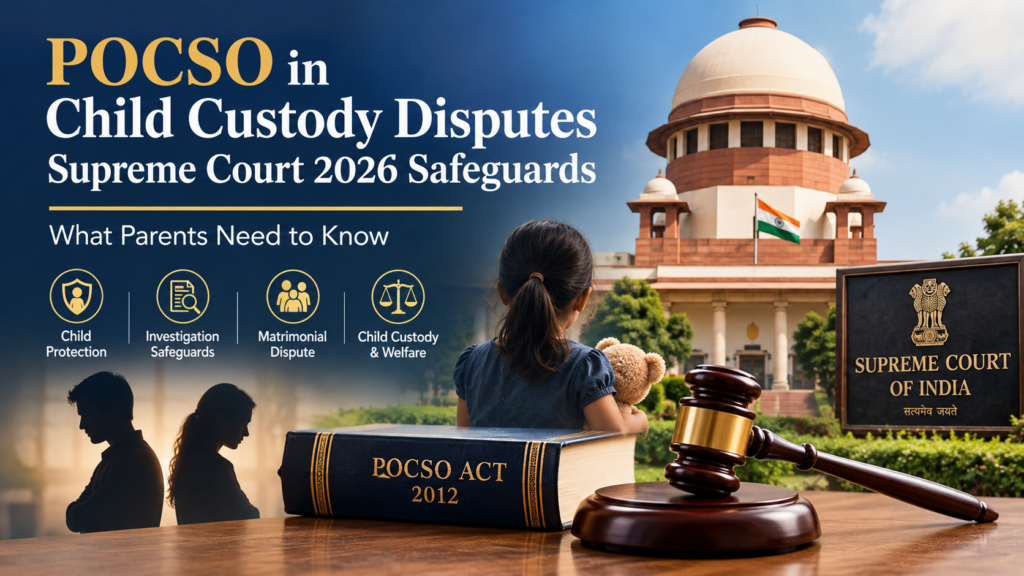
This difficult intersection between POCSO law, matrimonial disputes and child custody has now received important attention from the Supreme Court.
In Rajeev Giri v. Ekta Singh, 2026 INSC 1049, decided on 24 September 2026, the Supreme Court considered a prolonged matrimonial and custody dispute in which serious POCSO allegations were made against a parent and members of the family.
The judgment is important not because it says that POCSO allegations in custody disputes should be ignored.
It does not.
Instead, the Supreme Court created specific procedural safeguards for a defined category of cases where a POCSO allegation arises against a parent or household family member in the background of a matrimonial dispute.
The Court directed greater care in investigation, including the use of an expert in child and adolescent psychiatry or clinical psychology in circumstances covered by the safeguards.
At the same time, the Court reiterated that the protection of children remains the central purpose of the POCSO law.
For parents involved in custody litigation, this distinction is extremely important.
What Happened in Rajeev Giri v. Ekta Singh?
The case arose from a long-running dispute between the parents concerning their daughter.
The custody litigation had already been before the courts when a POCSO FIR was registered against the father and members of his family.
The Supreme Court had previously been dealing with the custody dispute. During the proceedings, the Court became concerned about the impact that the continuing litigation was having on the child.
In April 2026, the Supreme Court directed the Central Bureau of Investigation (CBI) to take over the investigation of the FIR and directed the CBI to constitute a committee headed by an officer not below the rank of DIG, along with a renowned woman psychologist and other appropriate members.
The Court subsequently considered the CBI investigation and the psychological and psychiatric material placed before it.
The final judgment dealt with both the criminal proceedings and the custody-related issues.
The Court ultimately quashed the FIR in the particular case and issued broader safeguards for future cases falling within the defined category.
That is the part of the judgment that is likely to have continuing significance for matrimonial and custody litigation.
What Are the Supreme Court’s New POCSO Safeguards?
The most important point is that the safeguards do not apply to every POCSO complaint.
The Supreme Court identified threshold conditions.
The case must involve a POCSO allegation against a parent or a family member living under the same roof as the child, and there must be a matrimonial dispute between the parents.
The Court explained that the matrimonial dispute does not necessarily have to be pending before a court.
This is important because many family disputes continue informally or through different legal proceedings without there being a single pending divorce petition.
Once the relevant conditions exist, the safeguards prescribed by the Court become relevant.
The judgment therefore should not be interpreted as creating a general requirement that every POCSO investigation must involve a psychologist before police action can be taken.
The safeguards are specifically connected with the situation identified by the Supreme Court.
Why Did the Supreme Court Consider Additional Safeguards Necessary?
The Court recognised a difficult problem.
When parents are already involved in a serious matrimonial dispute, the authorities may sometimes face difficulty in evaluating allegations where the available information is incomplete, conflicting or heavily influenced by the surrounding family conflict.
That does not mean the allegation is false.
It means the investigation may require additional safeguards to understand the circumstances properly.
The Court described the purpose of its approach as addressing an informational difficulty that may arise in some cases where the threshold conditions are met.
For that reason, the Court prescribed the involvement of an expert in child and adolescent psychiatry or clinical psychology in the situations covered by its directions.
The idea is not to replace the police investigation.
It is to make the investigation more informed.
Does a Psychologist Decide Whether the POCSO Case Is True?
No.
This is an important distinction.
The expert’s assessment is intended to assist the investigation.
The investigating officer remains responsible for deciding the appropriate course of action under the law.
The psychological or psychiatric assessment is therefore not a substitute for:
- witness statements;
- medical evidence;
- electronic evidence;
- CCTV;
- school records;
- forensic material;
- other documentary evidence;
- or the overall investigation.
The Supreme Court’s judgment shows why a complete factual picture can be important.
In the case before it, the investigation examined extensive material, including psychological and psychiatric evaluation and collateral information.
An expert opinion is therefore one part of the evidentiary picture.
It should not be misunderstood as an automatic mechanism for either ending or proving a criminal case.
What Does the Judgment Say About Arrest?
The judgment also discusses the importance of following the statutory requirements governing arrest.
A POCSO FIR does not mean that arrest becomes an automatic mechanical step in every case.
The Supreme Court referred to the principles concerning unnecessary arrest and the statutory safeguards now contained in Section 35 of the Bharatiya Nagarik Suraksha Sanhita, 2023 (BNSS).
The broader principle is familiar from Arnesh Kumar: the police must consider whether arrest is actually necessary under the applicable statutory requirements rather than treating registration of a criminal case as an automatic reason for arrest.
The Supreme Court connected this principle with the special circumstances addressed by its judgment.
Therefore, in an appropriate case covered by the safeguards, the investigating authority must carefully consider the available material before taking coercive steps.
That does not mean that a person accused under POCSO cannot be arrested.
It means the statutory requirements governing arrest continue to matter.
What Happens When the Complaint Is Made Directly Before the Special Court?
The Supreme Court’s directions also address private complaints under the POCSO framework.
Where the threshold conditions are satisfied, the Special Court should consider the benefit of expert assistance in evaluating the circumstances before proceeding.
The Court also recognised that there can be situations where the material is already sufficiently clear and compelling.
In such circumstances, the need for expert involvement can be dispensed with for recorded reasons.
This makes the safeguard flexible rather than automatic.
The Court was therefore not creating a rigid procedural barrier in every case.
It was asking courts and investigating authorities to exercise greater care in the specific category of family-related POCSO cases identified in the judgment.
What Does This Mean for Child Custody?
This is where the judgment becomes especially relevant to family-law litigation.
A POCSO FIR can obviously have consequences for a custody dispute.
A parent may argue that the existence of a POCSO case demonstrates that the other parent is unsafe for the child.
The other parent may respond that the criminal allegation is disputed and should not automatically determine custody.
The Supreme Court’s approach is important here.
The registration of a criminal case cannot, by itself, become a substitute for judicial assessment of the child’s welfare.
At the same time, a serious allegation of sexual abuse cannot simply be ignored because the parents are already involved in matrimonial litigation.
Both issues have to be examined carefully.
The custody court remains concerned with the welfare and best interests of the child.
The criminal investigation has its own statutory framework.
The two proceedings may arise from the same factual circumstances, but they do not become one proceeding merely because they concern the same family.
Does a POCSO FIR Automatically Mean That a Father Loses Custody?
No automatic rule should be assumed.
This is one of the most important practical points for parents.
A POCSO FIR is a serious development and can have significant consequences.
But an FIR is not itself a final finding of guilt.
At the same time, the allegation can be relevant when a Family Court assesses the safety and welfare of the child.
The court may have to consider the nature of the allegations, the investigation, available evidence, interim protective arrangements, existing custody orders and other circumstances.
The final question remains:
What arrangement serves the child’s welfare and safety?
This is why statements such as “a POCSO FIR automatically cancels the father’s custody” are too simplistic.
The opposite statement — that a POCSO allegation made during matrimonial litigation is automatically false — is equally unsafe.
The facts and evidence matter.
The Supreme Court Did Not Dilute the POCSO Act
This point deserves special emphasis.
The purpose of POCSO is to protect children from sexual assault, sexual harassment and exploitation.
The safeguards introduced by the Supreme Court should therefore not be understood as an exemption from POCSO.
They are procedural safeguards designed for a particular factual situation.
The Court’s reasoning attempts to address two concerns simultaneously:
The child must be protected from genuine sexual abuse.
And:
A person should not be subjected to unnecessary coercive consequences without proper investigation and application of law.
These are not necessarily contradictory objectives.
A child-sensitive investigation can protect both interests.
Why the Child’s Welfare Remains Central
Child custody law does not operate on the principle that one parent “wins” and the other “loses”.
The court’s responsibility is different.
It has to determine what arrangement serves the child’s welfare.
This can involve questions concerning:
- safety;
- emotional stability;
- education;
- health;
- daily care;
- parental relationships;
- living arrangements;
- visitation;
- and the overall development of the child.
A POCSO allegation can therefore become highly relevant.
But the court must still examine the circumstances carefully.
The Supreme Court’s judgment reinforces the need to avoid making the child’s future dependent solely upon the existence of a criminal case.
What Evidence Can Become Important in a POCSO-Custody Dispute?
A case involving POCSO allegations and custody can involve several different categories of evidence.
The first is medical evidence, where relevant to the allegations.
The second is digital or electronic evidence.
Messages, photographs, recordings, CCTV footage, emails and other electronic material may become relevant depending upon the facts.
This is another reason why parents involved in matrimonial litigation should understand how digital evidence is preserved and presented rather than relying on screenshots alone.
You can also read our detailed guide on WhatsApp messages as evidence in divorce cases.
The third category is independent witness evidence.
Teachers, school staff, neighbours, relatives, domestic workers or other people may have information relevant to the circumstances.
The fourth is expert evidence or assessment, where the Supreme Court’s safeguards apply.
Finally, the broader litigation history can become relevant as part of the surrounding circumstances.
None of these categories should automatically be treated as conclusive in every case.
The court or investigating authority has to assess the evidence in context.
What If the Complaint Is Made Immediately After a Custody Order?
This is a sensitive issue.
The timing of a complaint can be relevant to the overall investigation.
But timing alone does not establish that an allegation is false.
For example, a genuine allegation may be disclosed after a custody or visitation event because the child has only then had an opportunity to disclose something.
At the same time, where an allegation arises immediately after a significant development in an ongoing custody dispute, the sequence of events may form part of the factual investigation.
Authorities may therefore need to examine:
- what custody order existed;
- what visitation arrangement was operating;
- when the child moved between households;
- when the allegation was first disclosed;
- who first received the disclosure;
- what independent evidence exists;
- whether there are relevant CCTV or school records;
- and what the overall investigation reveals.
The important point is that timing is evidence of context, not automatic proof of motive or falsity.
What Should Parents Do After a POCSO Complaint Is Registered?
The first step should be to understand the exact legal position.
Do not rely solely on a message from a relative, a phone call or a social-media post.
Obtain the available information concerning the FIR, complaint and investigation through proper legal channels.
If a custody case is already pending, collect the existing custody and visitation orders.
Preserve relevant evidence.
If CCTV footage may be important, preservation should be considered immediately because many systems automatically overwrite older footage.
The same applies to relevant digital communications.
Do not delete messages simply because they appear inconvenient.
Do not edit, manipulate or manufacture material.
And do not attempt to coach the child about what should be told to police, a psychologist, a counsellor or the court.
The integrity of the investigation and the welfare of the child are both extremely important.
What Parents Should Avoid
A POCSO-custody dispute can become even more complicated if the parties begin fighting publicly.
Parents should avoid:
- publishing allegations on social media;
- revealing the child’s identity;
- threatening the other parent;
- pressuring witnesses;
- repeatedly questioning the child;
- deleting potentially relevant evidence;
- creating edited screenshots;
- making public accusations against police officers or witnesses;
- or treating the Family Court case and criminal case as though they are identical proceedings.
Legal proceedings should be handled through the appropriate legal channels.
The focus should remain on evidence, procedure and the welfare of the child.
How This Judgment Changes the Way Matrimonial Lawyers Should Look at Custody Cases
Modern matrimonial litigation rarely remains confined to one petition.
A single marriage may generate divorce proceedings, maintenance proceedings, domestic-violence litigation, criminal allegations, custody proceedings and applications concerning property or residence.
A POCSO allegation can make the situation even more complex.
The lesson from Rajeev Giri v. Ekta Singh is that lawyers handling custody disputes must pay attention to the interaction between these proceedings.
A lawyer looking only at the divorce petition may miss an urgent criminal-law development.
Likewise, someone focusing exclusively on the FIR may overlook existing custody orders, visitation arrangements and the child’s welfare.
The cases may be legally distinct, but the factual background can overlap.
For a broader discussion of how several matrimonial proceedings can develop from one marriage, see our article on divorce, domestic violence, 498A, maintenance and RCR proceedings.
How the 2026 Judgment Relates to 498A and Other Matrimonial Cases
The Supreme Court’s discussion of arrest also connects with an established line of cases concerning unnecessary arrest in matrimonial offences.
The Court referred to Arnesh Kumar while discussing the need for police officers to apply the statutory requirements before taking coercive action.
This is important because matrimonial litigation can involve several criminal allegations at the same time.
A POCSO allegation should never be casually equated with a 498A allegation — the offences and statutory frameworks are different.
However, the broader procedural principle that arrest should not be mechanically treated as inevitable remains relevant.
For readers dealing with a separate 498A matter, our guide on discharge in 498A cases and relevant Supreme Court judgments provides a separate discussion.
A Practical Checklist for Parents
If a POCSO allegation arises during a custody dispute, start by building a clear chronology.
Record the dates of:
- previous custody orders;
- visitation;
- relevant school events;
- medical appointments;
- communications;
- disclosure of the allegation;
- complaint;
- FIR;
- police notices;
- and court hearings.
Then preserve the underlying documents.
Do not rely solely on your own recollection.
Court orders, school records, medical records, CCTV, messages and other contemporaneous material can become important.
Most importantly, avoid taking steps that could be interpreted as interference with the investigation or pressure upon the child.
The objective is not to “win” the dispute outside court.
The objective is to allow the relevant authorities and courts to determine the matter on reliable evidence while protecting the child.
Frequently Asked Questions
Does a POCSO FIR automatically lead to arrest?
No. Arrest remains subject to the applicable statutory requirements. The Supreme Court emphasised that coercive action should not be taken mechanically in cases falling within the safeguards identified by the judgment.
Do the new safeguards apply to every POCSO case?
No. The safeguards concern a defined category involving a POCSO allegation against a parent or family member living with the child and a matrimonial dispute between the parents.
Is psychological evaluation mandatory in every POCSO investigation?
No. The Supreme Court’s directions are linked to the threshold conditions identified in the judgment, and the Court recognised circumstances in which expert involvement may be dispensed with for recorded reasons.
Can a psychologist decide whether the accused parent is guilty?
No. An expert assessment assists the investigation. It does not replace the investigation or determine criminal guilt.
Does a POCSO case automatically end a father’s custody?
No. The existence of an FIR does not by itself determine custody. The Family Court must consider the child’s welfare and the relevant facts and material.
Can a POCSO allegation affect visitation?
Yes. Depending on the circumstances and the material available, a custody court can consider protective arrangements concerning visitation and contact.
Does the timing of a POCSO complaint prove that it is false?
No. Timing can be part of the factual context, but it does not by itself establish either truth or falsity.
What evidence can be useful in a POCSO custody dispute?
Depending on the case, relevant evidence may include medical material, CCTV footage, school records, witness statements, electronic communications, photographs, expert assessments and previous court orders.
Should parents question the child about the allegations?
Parents should avoid repeated questioning or coaching. The child should be dealt with through appropriate child-sensitive procedures.
What should I do if a POCSO complaint is filed during my custody case?
Obtain the relevant FIR and complaint information, preserve potentially relevant evidence, comply with lawful directions and seek prompt legal advice concerning both the criminal proceedings and the pending custody case.
Conclusion: A Serious Allegation Requires a Serious Investigation
The Supreme Court’s decision in Rajeev Giri v. Ekta Singh is an important development at the intersection of POCSO law and matrimonial litigation.
Its message is more nuanced than the headlines suggesting either “POCSO misuse” or “automatic protection for accused parents”.
The Court has created specific safeguards for a defined category of cases where a POCSO allegation against a parent or household family member arises in the background of a matrimonial dispute.
The purpose is to encourage careful, child-sensitive and evidence-based investigation.
The judgment does not remove the protection provided by POCSO.
It does not declare every custody-related allegation false.
And it does not mean that a POCSO complaint can be ignored simply because the parents are involved in divorce proceedings.
For parents, the practical lesson is straightforward:
Take the allegation seriously. Protect the child. Preserve the evidence. Follow the legal process. And do not assume that the existence of an FIR, by itself, determines the final outcome of the custody dispute.
Where criminal proceedings and Family Court proceedings overlap, the complete factual picture matters.
Legal position discussed above is based on the law and reported decisions available as of September 2026. Individual cases may have different outcomes depending on their facts, evidence and procedural stage.
Adv. Aman Chawla
Family Law Expert | Delhi High Court & Supreme Court of India
Practising in Family & Matrimonial Law | Jangpura, New Delhi
Disclaimer: This article provides general legal information and does not constitute legal advice. NRI matrimonial disputes are fact-specific, and jurisdiction, recognition and enforcement can depend upon the countries involved, the applicable matrimonial law, existing proceedings and the precise relief sought.