Written by Adv. Aman Chawla | Matrimonial Law Specialist | Delhi High Court & Supreme Court of India
Practising in Family & Matrimonial Law | Jangpura, New Delhi
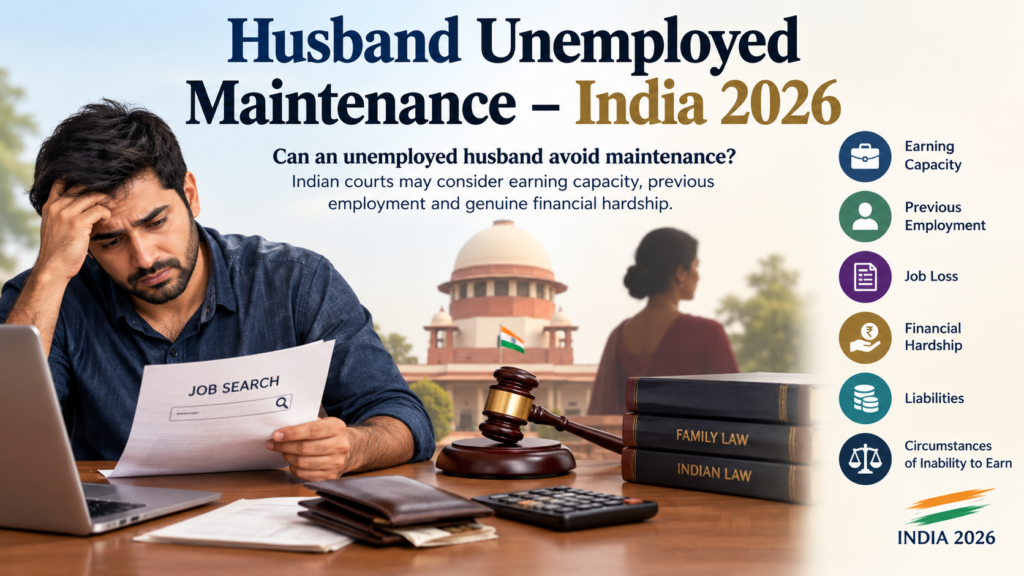
A husband facing a maintenance case may argue that he cannot pay because he has no job or regular income. But husband unemployed maintenance is not decided simply by looking at whether a salary is currently being credited to his bank account. Indian courts can examine his earning capacity, previous employment, professional qualifications, financial records, lifestyle and the reason behind his unemployment before deciding what maintenance, if any, is appropriate.
This distinction has become particularly important in 2026. Recent court decisions show that being temporarily unemployed does not automatically mean that a husband has no ability to earn. At the same time, genuine job loss, serious illness, disability or demonstrable financial hardship can be relevant circumstances. The real issue is not merely whether a husband has a job today, but whether his claimed inability to earn is genuine and supported by evidence.
What Does “Unemployed” Actually Mean in a Maintenance Case?
In ordinary life, unemployed simply means a person currently has no job.
In a maintenance proceeding, however, the court may need to ask why that person is unemployed, what his qualifications are, what he earned previously, whether he is capable of working, what efforts he has made to find work, what assets and liabilities he has, and whether the claimed lack of income is genuine.
Imagine a software engineer who earned ₹2 lakh per month and then says he has been unemployed for six months.
Now compare him with a person who has suffered a permanent disability and genuinely cannot work.
Both may technically be “unemployed”. Their legal and financial situations are obviously not identical.
This is why earning capacity becomes important.
A court is not necessarily required to accept the simple equation of “current salary = zero, therefore maintenance capacity = zero.”
The Karnataka High Court made this distinction particularly clearly in Praveen Kumar R. v. Sreelekha K., decided on September 9, 2026. The husband said he was unemployed, facing financial constraints, had approximately ₹25 lakh in loan liabilities and had to support aged parents. The wife argued that he was an engineer who had previously worked for a reputed company and remained capable of earning. The High Court held that even assuming he was unemployed, that fact alone did not absolve him from his obligation where there was no material showing that he had permanently become incapable of earning.
That is the practical lesson.
Being without a job today is not necessarily the same thing as being without earning capacity.
The 2026 Karnataka High Court Ruling: Why It Matters
The September 2026 Karnataka High Court decision is particularly useful because it deals with the argument husbands frequently raise in maintenance proceedings.
The husband had sought divorce and, during the matrimonial case, the wife filed an application under Section 24 of the Hindu Marriage Act seeking interim maintenance. The Family Court awarded ₹10,000 per month.
The husband challenged the order.
His case was that he was unemployed, financially constrained, had significant loan liabilities and had dependent parents to support. He also disputed the wife’s claim about his earning capacity.
The High Court did not say that his financial difficulties were irrelevant.
Instead, it examined the larger question of whether unemployment itself was sufficient to eliminate his maintenance obligation.
The Court concluded that it was not.
The judgment specifically recognised that while determining interim maintenance, the court can consider not merely the actual income disclosed by a party but also earning capacity, qualifications, status and other relevant circumstances. The Family Court’s ₹10,000 monthly award was therefore allowed to stand.
This is an important distinction for anyone facing a maintenance application.
The law is not saying:
“You have no job, so you must pay as if you earn a salary.”
It is saying:
“Show the court the complete financial reality. Do not assume that a temporary absence of salary proves an absence of earning capacity.”
Can a Husband Avoid Maintenance by Simply Saying “I Have No Income”?
Usually, that argument is not enough by itself.
The court may look at salary records, income-tax returns, bank statements, investments, property, professional qualifications, previous employment, business activity, lifestyle and other financial material.
The court can also examine whether the husband voluntarily left employment, whether he resigned immediately before or during litigation, whether he has made genuine efforts to find another job and whether the claimed financial condition is consistent with his actual lifestyle.
This is where maintenance litigation often becomes evidence-driven.
A person may say, “I am unemployed.”
But the other side may produce evidence showing that he recently worked in a senior position, owns valuable property, operates a business informally, receives payments through accounts, has professional qualifications in a high-demand field or continues to maintain a lifestyle inconsistent with complete financial inability.
The court does not have to blindly accept either side.
It has to assess the evidence.
What If the Husband Really Lost His Job?
This is where the answer becomes more balanced.
A genuine job loss can absolutely be relevant.
Indian courts do not impose maintenance mechanically without considering changed financial circumstances. If a husband genuinely loses employment, suffers a serious reduction in income or experiences another material change, he may have legal grounds to seek modification of an existing maintenance order depending on the provision under which the order was passed and the facts of the case.
The important mistake is to assume that the husband can simply stop paying.
He generally should not treat job loss as an automatic cancellation of a court order.
The existing order continues unless it is modified, varied, stayed or otherwise legally altered.
The Matrimonial Lawyers has separately explained this issue in its article on reduction or stoppage of maintenance after a change in circumstances, including job loss. Can Maintenance Be Reduced or Stopped in India?
So if employment has genuinely disappeared, the safer legal approach is to place the changed circumstances before the competent court with supporting documents rather than simply stopping payments.
That distinction can make a major difference when arrears later accumulate.
What If the Husband Left His Job Voluntarily?
This is considerably more complicated.
Courts can be sceptical where a well-qualified husband voluntarily reduces his income and then relies upon that reduced income to argue that maintenance should also be reduced.
The concern is obvious.
If someone earning ₹1.5 lakh per month resigns without a genuine reason immediately after matrimonial litigation begins and later says, “I earn nothing now,” the court may ask whether the loss of income was actually unavoidable.
Delhi High Court has already dealt with similar concerns in 2026. In Vinod Kumar v. Seema Devi, decided on March 16, 2026, the Court considered a challenge involving maintenance and the husband’s financial circumstances. The case illustrates why courts examine the wider financial picture rather than treating a claimed reduction in present employment as conclusive.
The broader judicial concern has also been reported in relation to voluntary retirement and deliberate reduction of income. Delhi High Court stressed in another 2026 maintenance ruling that a person cannot necessarily escape financial responsibility simply by stepping away from a stable source of income.
The message is not that a husband is forbidden from changing jobs.
People lose jobs. Businesses fail. Careers change. Health problems arise.
The issue is whether the reduction in income is genuine and unavoidable or strategically created to reduce maintenance liability.
Does the Court Always Assume That an Able-Bodied Husband Can Earn?
Not automatically.
This is an important point that should not be lost in headlines.
The phrase “earning capacity” does not mean that every husband can be treated as though he is earning a very high salary merely because he has a degree.
Courts must consider realistic circumstances.
A 55-year-old person who has been out of work for years is not necessarily comparable to a 30-year-old engineer who recently left a well-paid technology position.
Similarly, a person suffering from a serious medical condition may have a very different earning capacity from an otherwise healthy professional.
Location matters.
Professional experience matters.
Previous salary matters.
Age matters.
Health matters.
The availability of work matters.
Existing liabilities may also be relevant, although liabilities do not automatically override the maintenance needs of a spouse or child.
The Karnataka High Court’s September 2026 ruling is useful precisely because it did not simply say “unemployment is irrelevant.” It considered whether the husband had shown that he was permanently incapable of earning and found that he had not.
What Evidence Can a Husband Produce to Prove Genuine Unemployment?
If unemployment is genuine, documentation becomes extremely important.
A husband defending a maintenance claim should not rely only on an oral statement that he has no income.
Employment termination letters, resignation documents, unemployment records where available, bank statements, income-tax records, business records, medical documents, loan statements and evidence of job-search efforts may help establish the actual financial position.
Suppose a company terminates an employee because the company itself shuts down.
That is very different from a person resigning from a well-paid job after receiving notice of a maintenance application.
Similarly, someone suffering a documented medical condition that prevents employment stands on different footing from a healthy professional who simply refuses available work.
The court needs evidence because maintenance proceedings are ultimately about financial reality.
Can the Wife Say, “He Is Qualified, So He Must Be Earning”?
That argument also cannot automatically succeed.
Qualification and actual income are different concepts.
A husband may have an engineering degree but genuinely be unemployed.
He may have previously earned a high salary but currently be between jobs.
He may have qualifications that are no longer easily marketable.
The wife may have to place credible material before the court if she alleges that the husband is concealing income.
The court can then assess the complete circumstances.
This is similar to the distinction courts have drawn when considering a wife’s earning capacity.
The Delhi High Court’s 2026 reasoning in Rakesh Ray v. Priti Ray emphasised that the ability to earn cannot simply be equated with actual earnings when assessing maintenance. The Court also recognised the economic value of unpaid domestic work and upheld maintenance for the wife and child after examining the circumstances.
The same broader lesson is important from the husband’s side: maintenance analysis cannot be reduced to a theoretical salary figure.
What If the Wife Is Also Earning?
Then the court has another important factor to consider.
Maintenance is not determined in isolation from the financial position of both parties.
If the wife has substantial independent income, that income may be relevant to the calculation.
But the existence of some income does not automatically mean that maintenance becomes zero.
The court may consider the difference between the parties’ incomes, the standard of living during marriage, reasonable needs, dependent children, housing expenses and the overall financial circumstances.
This is one reason why simplistic internet formulas such as “maintenance is always 25% of salary” are unreliable.
Indian courts do not apply one universal mathematical formula to every maintenance dispute.
The assessment is fact-specific.
The Matrimonial Lawyers has already covered this from another angle in its detailed guide on whether a working wife can still receive maintenance. Working Wife Maintenance in India — 2026 Guide
That article complements the present issue: the court can examine actual income and financial circumstances rather than relying on labels such as “working,” “unemployed,” “qualified” or “homemaker.”
Can the Husband’s Previous Salary Be Considered After He Loses His Job?
It can be relevant.
Previous income may help the court understand the person’s professional background and earning potential.
But previous salary does not automatically become present income.
This distinction matters.
If a software engineer earning ₹2 lakh per month is unemployed for two months, the court may look at the circumstances surrounding the job loss and the person’s ability to obtain comparable work.
But that does not mean the court must automatically assume that ₹2 lakh continues to enter the bank account every month.
The evidence and circumstances determine the appropriate assessment.
The recent Karnataka decision demonstrates precisely this approach by considering the husband’s qualifications and previous employment alongside his claim of present unemployment.
What About Loans and Other Financial Liabilities?
A husband may genuinely have substantial liabilities.
Home loans, education expenses, medical expenses, dependent parents and other financial commitments can be relevant.
But a maintenance proceeding does not necessarily become a simple competition between the husband’s debts and the wife’s needs.
The court has to balance the relevant circumstances.
For example, a husband cannot necessarily prioritise every discretionary expense while claiming that there is nothing left for maintenance.
At the same time, a court should also consider genuine unavoidable liabilities when assessing what is realistically payable.
This is why a complete assets, income and expenditure picture is often more useful than selectively showing one loan statement.
What If the Husband Is Supporting His Parents?
Dependent parents can be a relevant circumstance.
The court may consider genuine family responsibilities when assessing maintenance.
But again, the existence of dependent parents does not automatically eliminate the wife’s or children’s claim.
The question is one of overall financial capacity and competing legitimate needs.
In the September 2026 Karnataka case, the husband specifically relied upon responsibility for aged dependent parents and a substantial loan. The High Court nevertheless upheld the interim maintenance because he had not demonstrated permanent inability to earn.
That is why documents and proportionality matter.
Does the Law Treat a Homemaker’s Work Differently?
Yes, and this has become an important part of the 2026 maintenance discussion.
A wife who does not receive a salary may still contribute significantly through domestic labour, childcare, household management and other unpaid work.
The Delhi High Court’s decision in Rakesh Ray v. Priti Ray received significant attention for recognising the economic value of a homemaker’s contribution. The Court rejected an approach that treated a non-earning homemaker as simply “idle” and examined the actual financial and domestic circumstances.
This is relevant to the present topic because maintenance law is increasingly moving away from crude assumptions.
A wife is not automatically entitled to full maintenance simply because she is unemployed.
A husband is not automatically free from maintenance simply because he is unemployed.
The court has to examine why the person is not earning, what the person is capable of earning, what the other spouse actually needs and what the complete financial circumstances reveal.
That is the more accurate way to understand the law.
What Competitor Articles Often Miss About Unemployment and Maintenance
A review of current online legal explanations shows a recurring problem.
Many articles reduce the issue to one headline: “Unemployed husband must pay maintenance.”
Others go to the opposite extreme and suggest that losing a job automatically removes maintenance liability.
The recent case law shows why both versions are incomplete.
The September 2026 Karnataka High Court decision adds a useful layer that many generic explainers miss: the court looks at whether the husband has shown a genuine and substantial inability to earn, rather than accepting unemployment as the end of the analysis.
Similarly, Delhi High Court decisions demonstrate that maintenance analysis requires consideration of actual financial circumstances, earning capacity, domestic contribution and evidence rather than simplistic assumptions.
This is also where the 2026 discussion is different from many older online articles. The current approach is increasingly evidence-oriented.
Bank statements matter.
Income affidavits matter.
Past employment matters.
Lifestyle evidence can matter.
Medical evidence can matter.
Professional qualifications can matter.
The reason for leaving employment can matter.
The timing of unemployment can matter.
And the existence of an existing maintenance order matters enormously because simply stopping payment is not the same as legally obtaining a reduction.
What If the Husband Loses His Job After a Maintenance Order?
This is one of the most practical questions.
Suppose a court has already ordered ₹40,000 per month.
Six months later, the husband loses his job.
Can he simply pay nothing?
That is risky.
The correct legal response depends on the nature of the order and the applicable statute, but the central principle is that a court order should not simply be ignored.
The husband may need to approach the appropriate court seeking modification, reduction or other relief based on the material change in circumstances.
The Matrimonial Lawyers’ existing guide on reduction or cancellation of maintenance explains why a genuine change in circumstances can become the basis for seeking modification, but why unilateral non-payment can create additional legal problems. Maintenance Reduction or Cancellation After Job Loss
This is especially important where arrears are already accumulating.
What Laws Can Apply to Maintenance?
The exact legal route depends on the facts and the type of proceeding.
For matrimonial proceedings under the Hindu Marriage Act, Section 24 deals with maintenance pendente lite and expenses of proceedings where the statutory conditions are met.
Section 25 deals with permanent alimony and maintenance.
For maintenance proceedings under the criminal-procedure framework, the corresponding current provision is Section 144 of the Bharatiya Nagarik Suraksha Sanhita, 2023, which replaced Section 125 of the Code of Criminal Procedure.
Claims may also arise under the Protection of Women from Domestic Violence Act, 2005, depending on the circumstances.
That means the same family can sometimes have maintenance issues arising in more than one proceeding, making coordination particularly important.
The Supreme Court’s decision in Rajnesh v. Neha also remains central to the disclosure and assessment framework in maintenance proceedings, including the need for financial disclosure and adjustment where multiple maintenance orders overlap.
The precise provision therefore matters.
A lawyer assessing a maintenance dispute should first identify where the maintenance application has been filed, under which provision, whether an earlier order exists and what financial disclosures have already been made.
Can a Husband Challenge an Unreasonable Maintenance Amount?
Yes, depending on the stage and legal route available.
If the husband believes the amount has been fixed without proper consideration of his actual income, liabilities, earning capacity or other relevant circumstances, the order may be challengeable or capable of modification under the applicable law.
But the challenge should be evidence-based.
Simply saying “the amount is too high” is generally much weaker than producing the financial record that demonstrates why the amount is unsustainable.
A proper financial affidavit, bank statements, tax records, employment documents and evidence of genuine liabilities can become important.
At the same time, the wife may challenge an amount that does not adequately reflect the husband’s actual financial capacity.
Maintenance litigation is therefore not simply about who makes the stronger statement.
It is often about who can establish the financial facts more convincingly.
What Should a Husband Do If He Is Genuinely Unemployed?
The first step should be to stop thinking of “unemployed” as the entire defence.
The real defence, where appropriate, is genuine financial incapacity supported by evidence.
A husband who has lost his job should preserve the termination letter or other proof of job loss, maintain transparent bank records, document genuine job-search efforts, disclose income and assets accurately and prepare a realistic statement of monthly expenses and liabilities.
If there is a medical reason preventing employment, proper medical documentation becomes important.
If a business has failed, business records and tax documents may matter.
If the husband has voluntarily changed employment for a legitimate reason, the reason should be supported rather than merely asserted.
The court is more likely to engage seriously with a transparent financial picture than with a bare claim of “I have no income.”
What Should a Wife Do If the Husband Claims He Is Unemployed?
The wife should also avoid relying solely on the allegation that the husband is lying.
If there is evidence suggesting hidden income, it should be placed before the court.
Previous salary records, LinkedIn or professional profiles, company records, property documents, bank transactions, business information, vehicle ownership, lifestyle evidence and other legally obtained material may become relevant depending on the facts and admissibility requirements.
The objective should not be to exaggerate the husband’s income.
It should be to help the court reach a realistic assessment.
This is particularly important because maintenance disputes can become unnecessarily prolonged when both sides provide incomplete financial information.
The Delhi Perspective: Why This Matters in Family Courts
For couples litigating in Delhi, the issue can arise across Family Courts at Saket, Dwarka, Rohini, Karkardooma, Tis Hazari and Patiala House, depending on jurisdiction.
The practical reality is that maintenance applications are rarely decided by one sentence such as “the husband is unemployed.”
The court may examine affidavits, bank records, employment history, tax information, liabilities, lifestyle and the financial needs of the wife and children.
The Matrimonial Lawyers regularly handles maintenance and alimony disputes as part of its broader matrimonial practice across Delhi NCR, including proceedings involving divorce, custody and domestic violence. Maintenance & Family Law Practice in Delhi NCR
If a maintenance dispute is connected with a pending divorce, child custody matter, domestic violence proceeding or another matrimonial case, the strategy should also be coordinated rather than treating each case as an isolated proceeding.
Frequently Asked Questions
Can an unemployed husband avoid maintenance completely?
Not merely because he is unemployed. Courts can examine earning capacity, qualifications, previous employment and the surrounding financial circumstances. The September 2026 Karnataka High Court ruling specifically rejected unemployment as an automatic escape from maintenance where permanent inability to earn was not established.
What if the husband genuinely has no job?
Genuine unemployment can be relevant to the amount of maintenance. The husband should place credible financial evidence before the court and, where an existing order has become unsustainable because of a genuine material change, seek appropriate legal relief rather than simply stopping payment.
Can the court consider the husband’s previous salary?
Yes, previous employment and income can be relevant to assessing earning capacity and the overall financial circumstances. But previous salary is not automatically treated as current income.
Can a husband reduce maintenance after losing his job?
Potentially, depending on the order, the applicable law and the nature of the financial change. A genuine material change can be placed before the appropriate court. The husband should not assume that job loss automatically cancels an existing order.
Can the wife claim maintenance if the husband says he has no income?
She can still make a claim where the statutory requirements are satisfied. The court will examine the husband’s actual financial position, earning capacity and other circumstances.
Does a wife’s income affect maintenance?
It can. The wife’s actual independent income and financial circumstances may be relevant to entitlement and quantum. But the existence of some income does not automatically mean that maintenance must be denied.
Can a husband’s loans reduce maintenance?
Genuine liabilities can be relevant, but the existence of loans does not automatically eliminate maintenance. The court considers the overall financial circumstances and competing needs.
What if the husband voluntarily resigns before the maintenance case?
The circumstances surrounding the resignation may become relevant. If the court finds that income was deliberately reduced to avoid maintenance, the husband may face difficulty relying solely on the reduced current income.
Can the husband prove that he is genuinely unable to work?
Yes. Medical evidence, termination records, employment history, financial documents and other credible material may help establish genuine incapacity or financial hardship.
Is maintenance automatically 25% of the husband’s salary?
No universal percentage automatically applies to every maintenance case. Courts assess the facts, including the financial position of both spouses, reasonable needs, standard of living, dependent children and other relevant circumstances.
The Real Answer: “No Job” Is Not the Same as “No Earning Capacity”
The most important point from the latest 2026 decisions is that maintenance law is not designed around a single payslip.
A husband who genuinely loses his job should not be treated as though nothing has changed.
But a husband who is educated, professionally capable and temporarily unemployed cannot necessarily assume that writing “zero income” on an affidavit ends the inquiry.
The court can ask what happened to the job, what the husband is capable of earning, whether he has genuinely tried to find work, what his previous income was, what assets and liabilities he has and what the complete financial picture shows.
That is why the title “No Job, No Excuse” needs one important qualification.
There may be no automatic excuse merely because a person says he is unemployed. But there is also no automatic rule that every unemployed husband must pay an amount based on an imaginary salary.
The law looks at reality.
In 2026, the stronger maintenance strategy is therefore not to argue only from the word “unemployed.” It is to establish the actual financial circumstances with evidence.
For a husband, that may mean proving genuine job loss, reduced income, medical incapacity or other financial hardship.
For a wife, it may mean showing that the husband’s claimed unemployment does not reflect his actual earning capacity or financial resources.
And for both sides, the most important lesson is simple: maintenance is ultimately a fact-sensitive judicial assessment, not an automatic reward or automatic punishment for being employed or unemployed.
If the dispute also involves divorce, child custody, domestic violence, concealed income or multiple matrimonial proceedings, the maintenance strategy should be considered together with those proceedings rather than in isolation.
For related guidance, readers can also review the detailed resources on working wife maintenance, qualified wife maintenance and maintenance reduction after job loss.
Written by Adv. Aman Chawla. This article is for informational purposes only and does not constitute legal advice. Every case is fact-specific. Please consult a qualified lawyer before taking any legal action.`
Disclaimer: This article is for general legal information and does not constitute legal advice. Maintenance depends on the facts, applicable statutory provision, evidence and the court seized of the matter.