By Adv. Aman Chawla | Matrimonial Law Specialist | Delhi High Court & Supreme Court of India
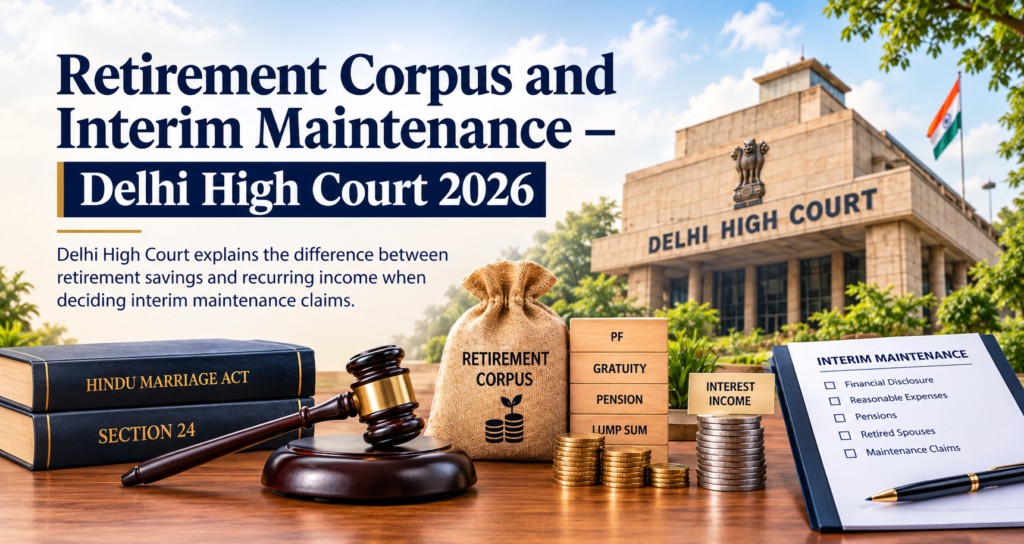
Matrimonial disputes no longer belong only to young couples. Many Delhi families now face divorce after thirty or forty years of marriage, when both spouses have retired and the children have grown up. In that setting, a new question keeps surfacing. If one spouse has a large provident fund, gratuity and savings, does that nest egg block a claim for interim support? The retirement corpus maintenance question reached the Delhi High Court on 8 October 2026, and the answer gives older couples a clear framework.
The short version helps both sides. A retirement corpus is not monthly income, so a court cannot treat it as a salary. But the interest and returns it earns do count, and the savings still form part of the overall picture. The Court also reminded everyone that Section 24 of the Hindu Marriage Act does not exist to match one spouse’s income with the other’s.
This guide explains the ruling, the numbers behind it, and what retired wives and husbands should do next.
Why Retirement Changes the Maintenance Question
Maintenance during a case, called pendente lite maintenance, supports a spouse who cannot meet basic needs and litigation costs while the case runs. For a young wife with no job, the analysis is usually simple. She has no income, her husband has a salary, and the court fixes a monthly amount.
Retirement scrambles that picture. Both spouses may hold pensions. Both may own savings, fixed deposits, a Public Provident Fund account, and property. Neither may have dependent children. The “needy spouse” and the “earning spouse” no longer sit in separate boxes.
Courts therefore face a harder task. They must ask whether the claimant truly lacks sufficient independent income, and they must decide how to treat capital that does not arrive as a monthly cheque. Two wrong answers tempt judges. One says that large savings mean no maintenance. The other says that the spouse with the bigger pension must always pay.
The Delhi High Court rejected both shortcuts. If you want the wider framework first, our page on maintenance law in Delhi explains how courts approach claims at different stages.
The Case: Meenakshi Batra v. Vijay Kumar Batra
The Division Bench of Justice Vivek Chaudhary and Justice Renu Bhatnagar decided Meenakshi Batra v. Vijay Kumar Batra (MAT.APP.(F.C.) 109/2022) on 8 October 2026. The wife appealed under Section 19 of the Family Courts Act, 1984, against a Saket Family Court order dated 5 April 2022 that had dismissed her application for interim maintenance.
The couple married on 16 October 1983 in Faridabad. They had two children, born in 1984 and 1988, and both are now adults. The wife alleged long-running discord and abuse. In 2019, she filed a criminal complaint and a complaint under the Domestic Violence Act. The husband left the matrimonial home in October 2019. He then filed for divorce on the ground of cruelty, and she applied for interim maintenance under Section 24.
Both spouses had retired from government service. The husband was a retired Army officer aged 61 when the Family Court heard the matter. The wife was a retired Central Government teacher with an MA and a B.Ed. She had retired on 31 October 2019.
So the case offered a rare, balanced contest. Two retired, educated spouses, each with a pension, each with savings, and no dependent children, asked the court to decide who should support whom. You can read the full order on LawWeb.
What Each Spouse Disclosed
The numbers in the affidavits explain why the case was hard.
The wife’s fresh affidavit showed a pension of about ₹35,329 a month and interest of about ₹34,000 a month from her investments. That gave her recurring income of roughly ₹69,000 a month. She also held retirement benefits that included a General Provident Fund payout of about ₹39.3 lakh, gratuity of about ₹10.1 lakh, commutation of about ₹14.2 lakh, leave encashment of about ₹3.7 lakh and a PPF balance of about ₹18 lakh. The couple had also sold a jointly owned Bangalore flat for ₹94 lakh. She claimed monthly expenses of about ₹1,16,150 and said she was using her savings because her pension fell short.
The husband’s fresh affidavit showed a pension of about ₹1,09,000 a month. He disclosed roughly ₹73 lakh in shares, mutual funds and bonds, and about ₹16.5 lakh in PPF. He supported his mother, who was about 87 years old and needed medical care. He also ran a training venture called “Colonel’s Learning Café,” which he said no longer earned income.
His pension clearly exceeded hers. The wife argued that he also had hidden resources, pointing to a car, club expenses and ₹60 lakh in donations. She argued that the Family Court wrongly treated her savings as continuing income.
What the Family Court Decided
The Family Court took a broad view of the wife’s finances. It noted her pension, her fixed-deposit interest, the sale proceeds of the Bangalore flat and her retirement benefits, which it put at more than ₹50 lakh. It also noted that both spouses were over 60, both were retired and both had pensions. The children were well settled.
On that basis, the court concluded that her income was at least equal to her husband’s, and perhaps greater. It dismissed her Section 24 application because both spouses had equal qualifications, had retired from Central Government service and held sufficient savings.
The wife appealed. She raised two main points. First, the Family Court treated her accumulated retirement benefits as a continuing source of income, even though she had to spend that capital on daily living. Second, the court ignored the husband’s assets and failed to assess her reasonable needs.
Those two points shaped the High Court’s reasoning. The Division Bench agreed with the wife on one of the legal questions, but it still dismissed her appeal on the facts.
The Key Distinction: Corpus Versus Income
The heart of the ruling lies in a distinction that every retired litigant should know. The Court separated the retirement corpus from the income that the corpus generates.
The corpus, the Court said, is accumulated capital. It does not become monthly income merely because it is large. A retired person should not have to use up savings just because they exist. The Court said clearly that the entire retiral corpus cannot count as recurring monthly income.
But the returns on that capital belong to a different category. Where savings sit in investments that pay interest or other returns, those recurring returns are income, and the court must count them. In this case, the wife’s interest of about ₹34,000 a month fell into that category.
The Court added a balance. The existence of a corpus is not completely irrelevant. It forms part of the claimant’s overall financial circumstances. A court may consider the resources available to her when it decides whether she can support herself. What it cannot do is treat the corpus as though it were a salary.
This framework gives retired couples a practical test. Ask what the savings earn, not only what they total.
Why the Wife Still Lost
The Division Bench disagreed with part of the Family Court’s reasoning, yet it upheld the final result. Its reasons matter for anyone planning a similar application.
Section 24 applies only when the applicant has no independent income sufficient for her support and for the necessary expenses of the case. The Court found that the wife failed that threshold. She had a regular pension, recurring investment income of roughly ₹69,000 a month in total, and accumulated resources. She had no dependent child. She also had access to medical care through an ECHS-empanelled hospital.
The Court then looked at her expenses. She claimed about ₹1,16,150 a month. The Court held that an expense figure in an affidavit does not prove itself. Section 24 asks about reasonable needs, so the court must test each category. It must separate necessary costs, such as housing, medical care and daily living, from discretionary spending. The Court noted that her affidavit included an item of ₹12,500 a month for holidays.
It also said that expenditure above recurring income does not automatically entitle a claimant to maintenance. Section 24 secures reasonable support. It does not reimburse every disclosed expense.
So the wife lost, not because her savings were income, but because her real income and resources met her reasonable needs.
Section 24 Does Not Equalise Incomes
The Court repeated an important principle. Section 24 aims to prevent vagrancy and hardship during litigation. It does not aim to equalise one spouse’s income with the other’s. The Division Bench quoted an earlier Delhi High Court bench with approval: where both spouses earn well, a mere difference in salary cannot justify maintenance.
This point matters because many people assume that the higher earner must pay the lower earner. The Court rejected that idea. It held that the husband’s higher pension was relevant, but it was not enough by itself. The statute asks first whether the applicant lacks sufficient independent income. Only after that does the court consider the other spouse’s capacity.
The Court also described the exercise as non-mathematical. A judge does not subtract one income from another and award the gap. Instead, the judge weighs both spouses’ needs, status, resources and obligations.
The ruling also relied on the Supreme Court’s decisions in Manish Jain v. Akanksha Jain (2017) and Rajnesh v. Neha (2021). Those cases confirm that education alone does not defeat a claim, that the applicant’s parents’ wealth is irrelevant, and that courts must strike a careful balance between both parties.
Proving Hidden Income: The Court’s Caution
The wife argued that her husband had undisclosed income. She pointed to his training venture, his car, his club expenses and his donations of ₹60 lakh. The Court took these points seriously, but it required evidence.
It said that a court needs some material on record before it can attribute extra recurring income to a party. A business that existed in the past does not prove present earnings. The husband said the venture no longer earned anything, and the wife offered nothing to show otherwise. The Court declined to assume a monthly income from that source.
Donations raised a similar issue. The Court said such spending may help paint a picture of financial status, but it does not by itself prove a hidden recurring income.
The Court also restated a principle from Rajnesh v. Neha. Where a party does not make full disclosure, a court may make a reasonable assessment of income. But the assessment needs a basis in the record. Suspicion and guesswork do not suffice.
In practice, a claimant who suspects hidden income should gather bank statements, tax returns, business records, property documents and similar material. She should ask the court to direct disclosure rather than rely on allegations.
What This Means for a Retired Wife
If you are a retired wife, the ruling gives you protection and a warning.
The protection is simple. A court cannot treat your entire provident fund, gratuity and savings as if they were a salary. You do not have to spend your retirement capital to qualify for support. If a Family Court tries to count the corpus itself as income, you can cite this ruling.
The warning is equally simple. Courts will count the returns your savings earn, and they will consider the overall resources you hold. A wife with a pension, interest income and no dependants may not meet the Section 24 threshold if those sources cover her reasonable needs.
Prepare your affidavit with care. List your pension, interest and other recurring income accurately. Explain your expenses, and separate necessities such as rent, medical care and food from discretionary items. Attach documents. A realistic, well-supported budget carries far more weight than a large figure with no backup.
If you are better qualified or have worked for years, you may also find our article on qualified wife maintenance useful, together with our guide on working wife maintenance.
What This Means for a Retired Husband
The ruling also helps husbands, but it does not give them a free pass.
The Court confirmed that a higher pension does not automatically create a duty to pay. A husband who faces a Section 24 application from a spouse with her own pension and investment income can argue that she lacks no sufficient independent means. He can also ask the court to test the reasonableness of her expenses.
He should still disclose fully. The Court noted his ₹109,000 pension and his ₹73 lakh in investments, and it took his obligation to support his elderly mother into account. Those facts helped him. A husband who hides income or assets damages his case, and a court can make a reasonable assessment where disclosure falls short.
He should also avoid dismissing every claim as a pretext. If a wife has no pension and little savings, the analysis changes. The Court’s reasoning protects fair outcomes, not blanket denial.
If an order is passed, he should comply. Our guide on maintenance arrears recovery explains the cost of default.
Section 24 Works Both Ways
The ruling also reminds readers that Section 24 is gender-neutral. The section lets either the wife or the husband apply for interim maintenance and litigation expenses, so long as the applicant lacks sufficient independent income. A husband who is ill, unemployed or dependent can claim it too.
The Delhi High Court has also said, in a separate 2026 ruling reported by Court book, that interim maintenance under Section 24 can continue while an appeal against a divorce decree remains pending, because the appeal continues the original proceeding. If that issue matters in your case, take specific advice on the current position.
Section 24 also carries a timing rule. The application should reach disposal within sixty days of service of notice on the respondent. In reality, delays still occur, so parties should file complete affidavits at the start. A thin affidavit invites a thin order.
Courts do not rely on stereotypes about who earns and who depends. They look at each spouse’s income, resources, health, age and obligations. That approach suits older couples, where roles often blur.
What Competitor Guides Miss About Retirement Corpus Maintenance
We checked what currently ranks on Section 24 and interim maintenance, including explainers from Legal Service India, and Court book’s coverage of earlier Delhi High Court rulings. They explain that Section 24 is gender-neutral, that there is no 25 percent formula and that education does not defeat a claim.
The gaps lie in the detail. Few pages address retired couples at all. Almost none explains how a court treats a provident fund, gratuity or fixed deposit, or why the interest counts while the principal does not. Few discuss how a court tests a long list of claimed expenses, and few explain what evidence a spouse needs before a court will attribute hidden income.
The ruling is also very recent. Most coverage predates 8 October 2026, so the corpus-versus-income distinction does not yet appear in many guides.
We wrote this article to fill those gaps, and to give both retired spouses a balanced, practical view.
Practical Notes for Delhi Family Courts
The case started in the Saket Family Court, and the same approach will guide family courts across Delhi. Judges at Saket, Dwarka, Rohini, Karkardooma, Patiala House and Tis Hazari now have a clear statement from a Delhi High Court Division Bench.
Expect the court to ask for fresh income affidavits, as the High Court did in 2023. Expect questions about pension, interest, rent, medical costs and dependants. Expect the judge to separate capital from returns.
If an order goes against you, the appeal route runs through the High Court under Section 19 of the Family Courts Act. If a larger legal question arises, the Supreme Court of India remains available.
Families with related claims, such as domestic violence or criminal complaints, should coordinate strategy. Our pages on domestic violence remedies and 498A matters explain how those proceedings interact with maintenance.
Frequently Asked Questions
Is a retirement corpus treated as monthly income?
No. In Meenakshi Batra v. Vijay Kumar Batra (8 October 2026), the Delhi High Court held that the corpus is capital and cannot be treated as a monthly salary. Only the interest or returns it generates count as income.
Does a large retirement fund stop me from claiming interim maintenance?
Not automatically. The corpus forms part of your overall financial circumstances, but the court asks whether your recurring income and resources meet your reasonable needs.
Does the higher earner always have to pay maintenance?
No. Section 24 does not equalise incomes. The Court held that a higher pension is relevant but not enough by itself.
Can a husband claim interim maintenance from his wife?
Yes. Section 24 of the Hindu Marriage Act applies to either spouse who lacks sufficient independent income.
What expenses will a court accept?
Courts accept reasonable, necessary costs such as housing, medical care and daily living. They examine discretionary items, such as holidays, more closely. A figure in an affidavit does not prove itself.
Can I claim that my spouse hides income?
You can, but you need material. The Court refused to assume income from a business that the husband said had stopped earning. Bank records, tax returns and business documents make the argument credible.
Do donations or lifestyle expenses prove hidden income?
Not by themselves. They may help show financial status, but the Court said they do not prove a recurring undisclosed source of income.
How fast should a court decide a Section 24 application?
The law says within sixty days of service of notice on the respondent. Delays still happen, so file a complete affidavit and supporting documents at the start.
Does the ruling apply to couples who are not retired?
The principle that capital is not income, while its returns are, applies more widely. But each case turns on its facts, so take advice on your own position.
The Bottom Line on Retirement Corpus Maintenance
The Delhi High Court has given older couples a clear rule. Capital is not salary, but the income it earns counts, and the savings still shape the overall picture. A higher pension does not automatically create a duty to pay, and a long list of expenses does not prove need.
For retired wives, the lesson is to document recurring income and reasonable needs with care. For retired husbands, the lesson is to disclose fully and to test the other side’s claims with evidence. For both, honest affidavits and realistic budgets matter more than big numbers.
If you face an interim maintenance application, or you plan to file one, you can speak to our matrimonial lawyers in Delhi or request a confidential consultation. For related reading, see our guides on increasing maintenance after a court order and reducing or stopping maintenance.
Written by Adv. Aman Chawla. This article is for general information and is not legal advice. Interim maintenance depends on the affidavits, the evidence, the statute and the court that hears the case. Please consult a qualified lawyer before you act.
Talk to a maintenance lawyer in Delhi. Call +91 80768 36899, email info@thematrimoniallawyers.com or request a confidential consultation. Office: Basement, O-11A, Block O, Jungpura Extension, New Delhi 110014.