Interim vs Final Maintenance in India | Legal Explanation

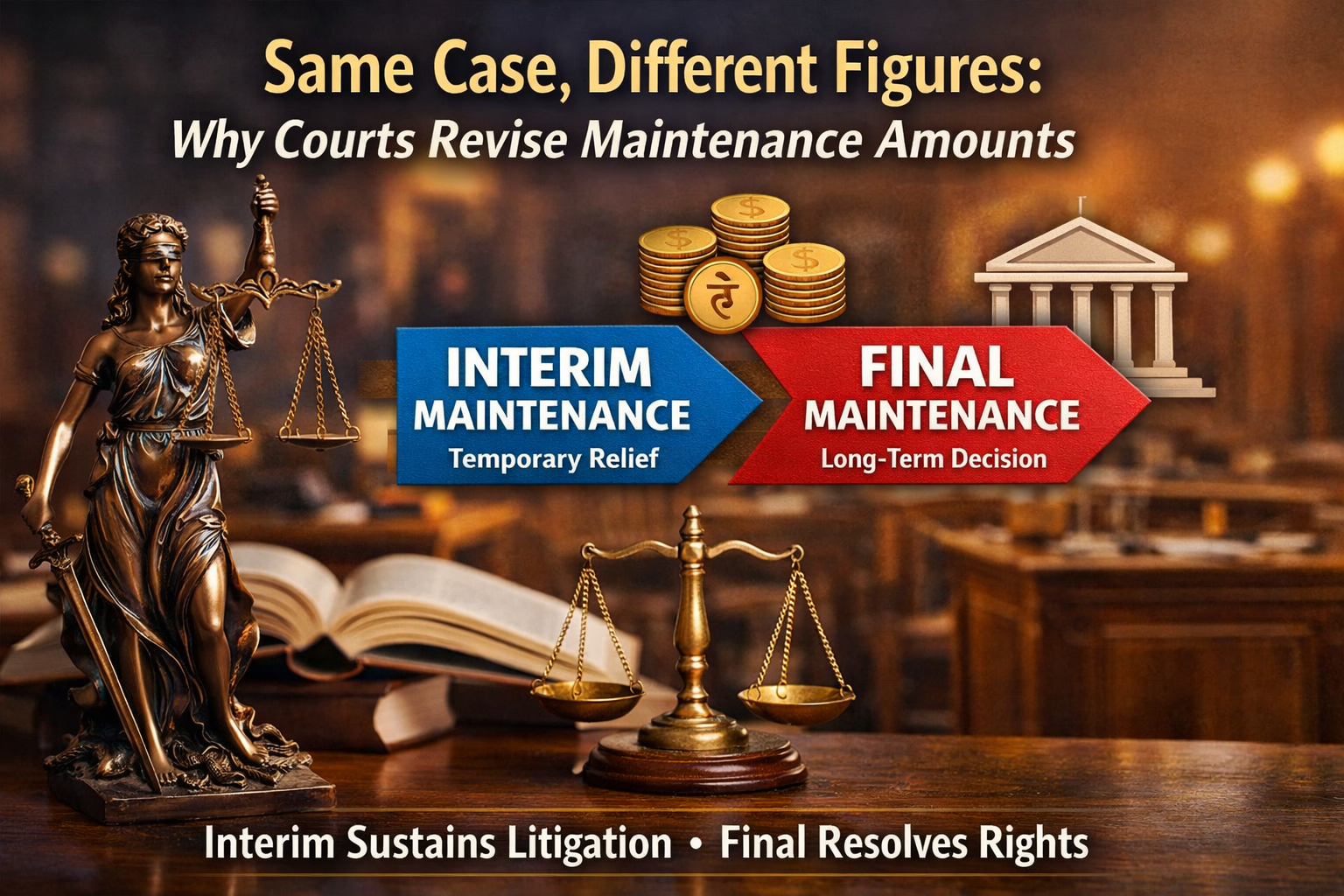
Interim vs Final Maintenance: Why Courts Fix Different Amounts
1. Brief Introduction Stating the Legal Issue
In matrimonial and family law proceedings, it is frequently observed that the amount of interim maintenance awarded during the pendency of proceedings differs from the final maintenance determined upon conclusion of the case. Litigants often perceive this variation as inconsistency. However, Indian courts have consistently clarified that interim and final maintenance operate at different legal stages, serve distinct purposes, and are governed by different standards of judicial assessment.
2. Applicable Legal Principles and Statutory Framework
The power to grant maintenance arises under multiple statutory provisions, including:
• Section 24 and Section 25 of the Hindu Marriage Act, 1955
• Section 125 of the Code of Criminal Procedure, 1973
• Sections 20 and 23 of the Protection of Women from Domestic Violence Act, 2005
Interim maintenance is typically granted under provisions enabling temporary relief, whereas final maintenance is determined after full adjudication. The object of these provisions, as courts have held, is to prevent vagrancy and financial hardship, while ensuring fairness to both parties.
Judicial discretion plays a central role, subject to statutory guidance and binding precedent, including decisions of the Hon’ble Supreme court which has repeatedly emphasised that maintenance proceedings are remedial and not punitive in nature.
3. Judicial Approach and Reasoning Commonly Adopted by Courts
At the interim stage, courts proceed on a prima facie assessment. The inquiry is necessarily limited, as the matter is pending trial. Affidavits of income, pleadings, and apparent lifestyle indicators are considered, without a detailed examination of evidence. The focus remains on immediate subsistence and the ability of the applicant to participate meaningfully in the proceedings.
In contrast, final maintenance is determined after parties have had the opportunity to lead evidence, produce financial records, and address discrepancies through cross-examination. Courts then undertake a holistic evaluation, considering income, assets, liabilities, standard of living during marriage, duration of the relationship, and future needs.
Courts have held that interim maintenance is provisional in nature and does not create a vested or permanent right. Consequently, the final amount may legitimately vary once a clearer financial picture emerges.
4. Practical Considerations Observed in Family Court Proceedings
In practice, particularly before the Family Courts in Delhi and under the supervisory jurisdiction of the Hon’ble Delhi High Court certain recurring considerations are observed:
• Interim maintenance applications are often decided expeditiously to avoid undue hardship.
• Incomplete or disputed income disclosures at the interim stage may lead to tentative assessments.
• Allegations of suppression of income or overstatement of expenses are more effectively tested at the final stage.
• Changes in circumstances during prolonged litigation may also influence the final determination.
It has been observed that interim maintenance is not intended to mirror the final outcome but to maintain a basic financial equilibrium until rights are conclusively determined.
5. Neutral Conclusion: Summarising the Legal Position
The difference between interim and final maintenance is rooted in statutory design and judicial reasoning. Interim maintenance serves as a temporary measure based on limited material, whereas final maintenance reflects a reasoned determination following due process. Courts have consistently held that variation between the two does not indicate arbitrariness, but rather the calibrated exercise of judicial discretion at different stages of adjudication. Understanding this distinction aligns expectations with the settled legal position under Indian family law.
Written by Adv. Aman Chawla, practising in Delhi, focuses on matrimonial and family law matters.
Also Read:
Maintenance Is Not Decided on Income Affidavits Alone: Judicial Approach in Matrimonial Cases
👉 https://thematrimoniallawyers.com/maintenance-is-not-decided-on-income-affidavits-alone-judicial-approach-in-matrimonial-cases/