In modern matrimonial disputes, digital communication often plays an important role in determining the facts of a case. Couples today frequently communicate through messaging platforms like WhatsApp, and these conversations may sometimes become relevant during divorce proceedings.
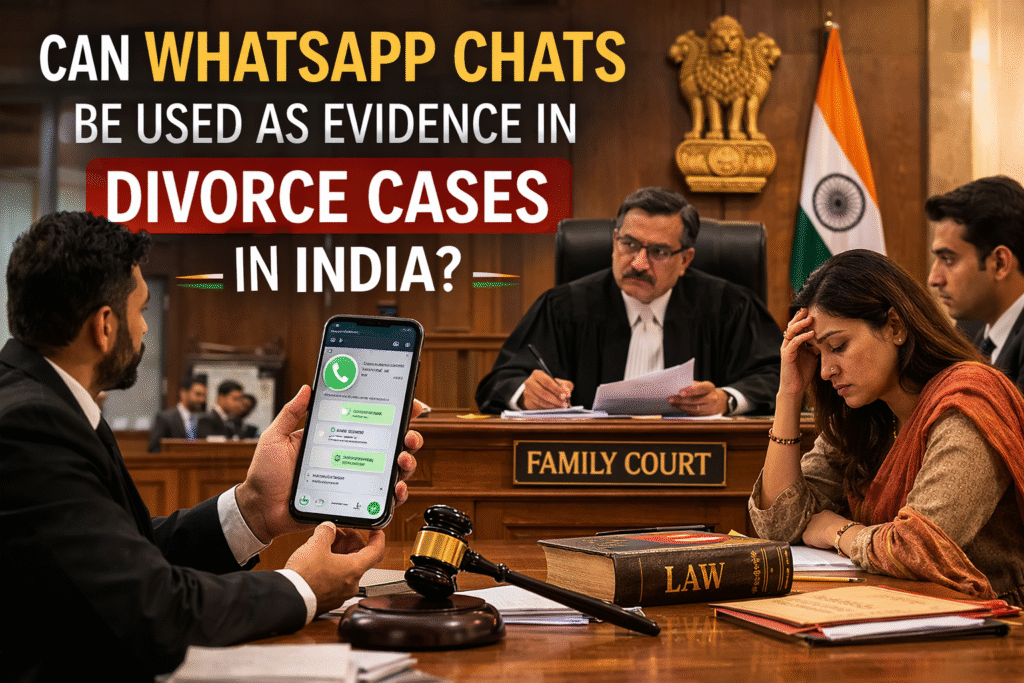
A common question that arises in family courts is whether WhatsApp chats can be used as evidence in divorce cases in India. The short answer is yes. Indian courts can rely on WhatsApp messages as evidence, provided they satisfy the legal requirements governing electronic records.
With the enactment of the Bharatiya Sakshya Adhiniyam, 2023 (BSA), which replaced the Indian Evidence Act, the law relating to electronic evidence has been updated. Courts now evaluate digital records such as WhatsApp chats under the framework of this new legislation.
This article explains the legal validity of WhatsApp chats in divorce cases, the relevant provisions under Indian law, and how courts examine digital conversations as evidence.
Legal Recognition of Electronic Evidence in India
Indian law recognizes electronic records as a valid form of documentary evidence. Under the Bharatiya Sakshya Adhiniyam, 2023, electronic records such as emails, SMS messages, call logs, social media conversations, and WhatsApp chats can be produced before courts if they are relevant to the dispute.
In matrimonial litigation, these digital communications can help courts understand:
• The behavior of spouses
• The nature of their relationship
• Events leading to marital disputes
• Admissions made during communication
However, for electronic evidence to be legally admissible, certain procedural requirements must be followed.
Section 63 of the Bharatiya Sakshya Adhiniyam, 2023
The admissibility of electronic records is primarily governed by Section 63 of the Bharatiya Sakshya Adhiniyam, 2023.
This provision corresponds to the earlier Section 65B of the Indian Evidence Act, 1872, which dealt with electronic evidence.
Under Section 63, electronic records such as WhatsApp chats must generally be accompanied by a certificate verifying their authenticity. The purpose of this requirement is to ensure that the digital evidence produced before the court is genuine and has not been tampered with.
The certificate typically confirms:
• The identity of the electronic record being produced
• The device from which the record was extracted
• That the device was functioning properly at the relevant time
• That the copy produced is a true reproduction of the original data
Without proper certification, courts may refuse to rely on electronic records in many cases.
Can WhatsApp Chats Prove Grounds for Divorce?
In matrimonial disputes, WhatsApp chats may sometimes help establish certain legal grounds for divorce under Indian personal laws.
1. Mental Cruelty
Messages containing abusive language, threats, humiliation, or persistent harassment may support allegations of mental cruelty. Courts often examine the tone and context of communication to determine whether such behavior caused emotional distress to a spouse.
2. Admissions by a Spouse
Sometimes WhatsApp chats contain admissions regarding important issues such as:
• Living separately
• Financial arrangements between spouses
• Acknowledgment of marital disputes
Such admissions may carry evidentiary value in divorce proceedings.
3. Extramarital Relationships
In certain cases, intimate or inappropriate conversations between a spouse and a third person may be produced in court to support allegations of adultery or misconduct. However, courts generally require additional corroborative evidence, as chats alone may not conclusively prove adultery.
How Courts Verify WhatsApp Chats
Courts approach digital evidence cautiously because electronic records can be edited or manipulated. Therefore, judges examine several factors before relying on WhatsApp chats.
These factors may include:
• Whether the chats are supported by certification under Section 63 of the Bharatiya Sakshya Adhiniyam
• Whether the entire conversation has been produced instead of selective messages
• Consistency of timestamps and message sequences
• Whether the original device containing the chats is available
• Whether the chats are supported by other evidence or witness testimony
If the court finds that the messages may have been altered or selectively presented, their evidentiary value may be reduced.
Are WhatsApp Screenshots Admissible in Court?
Many litigants attempt to rely on screenshots of WhatsApp chats in divorce cases. While screenshots may sometimes be considered, they are generally not sufficient by themselves.
Courts usually prefer complete chat records extracted from the device, along with the required certification under the Bharatiya Sakshya Adhiniyam. Producing the original device can further strengthen the credibility of the evidence.
Providing the full conversation also helps the court understand the context of the communication rather than relying on isolated messages.
Privacy Concerns and WhatsApp Evidence
Another issue that may arise in matrimonial litigation is whether accessing a spouse’s WhatsApp chats violates the right to privacy.
Indian courts may examine how the chats were obtained. If the messages were accessed through unauthorized means, the court may scrutinize the legality of the method used to obtain the evidence.
At the same time, courts often attempt to balance privacy rights with the need to discover the truth in matrimonial disputes. The admissibility of such evidence may therefore depend on the facts and circumstances of each case.
Practical Tips for Using WhatsApp Chats as Evidence
Parties who wish to rely on WhatsApp chats in divorce cases should take certain precautions to ensure their admissibility in court.
Some practical steps include:
• Preserve the original phone or device containing the chats
• Export the entire chat conversation instead of selective screenshots
• Ensure proper certification under Section 63 of the Bharatiya Sakshya Adhiniyam, 2023
• Maintain the chronological order of messages
• Avoid editing or altering the chat records
Proper preservation of digital evidence significantly increases its reliability before the court.
Conclusion
WhatsApp chats can be used as evidence in divorce cases in India, provided they comply with the requirements of the Bharatiya Sakshya Adhiniyam, 2023, particularly Section 63, which governs electronic evidence.
As communication increasingly takes place through digital platforms, courts are recognizing the importance of electronic records in matrimonial disputes. However, they also exercise caution due to the possibility of manipulation or selective presentation.
When properly authenticated and supported by other evidence, WhatsApp chats can play an important role in establishing facts such as cruelty, admissions, or the nature of the marital relationship in divorce proceedings.
Written by Adv. Aman Chawla, practising in Delhi, focuses on matrimonial and family law matters.