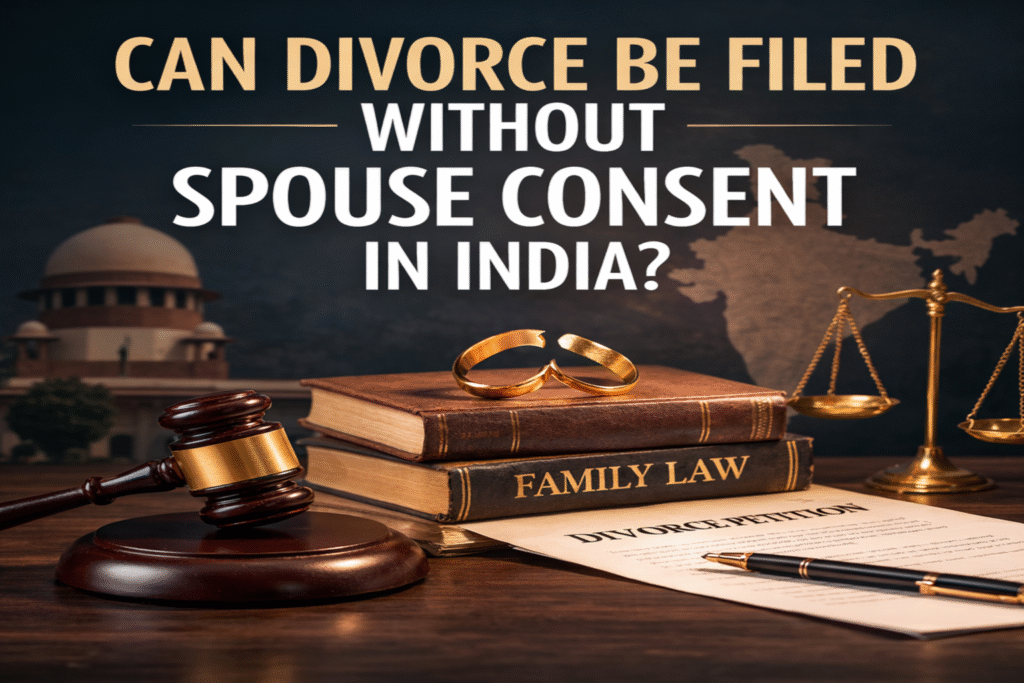
Divorce is never an easy decision, and legal complexities can make the process even more challenging. One of the most frequently asked questions is whether a person can file for divorce without the consent of their spouse. Under Indian family law, the answer is yes—a spouse can initiate divorce proceedings even if the other party does not agree.
However, such cases fall under what is known as a contested divorce, which involves specific legal grounds, procedures, and timelines.
Understanding Divorce Laws in India
Divorce laws in India are governed by different personal laws depending on religion, including:
- Hindu Marriage Act, 1955
- Special Marriage Act, 1954
- Indian Divorce Act, 1869 (for Christians)
- Muslim personal laws (based on religious principles)
While the provisions may vary slightly, the concept of contested divorce without mutual consent is recognized across these legal frameworks.
Types of Divorce in India
- Mutual Consent Divorce
This type of divorce occurs when both spouses agree to dissolve the marriage. It is generally quicker, less stressful, and involves fewer legal complications.
- Contested Divorce
A contested divorce is filed by one spouse without the agreement of the other. This type of divorce requires valid legal grounds and is subject to judicial scrutiny.
Is Spouse Consent Mandatory for Divorce?
No, spouse consent is not mandatory for filing a divorce petition. Any individual can approach the court independently if they believe their marriage has broken down due to legally recognized reasons.
However, the absence of consent means the court will carefully evaluate the case before granting a divorce.
Legal Grounds for Filing Divorce Without Consent
To file a contested divorce, the petitioner must establish one or more legally valid grounds. Some of the most common grounds include:
- Cruelty
Cruelty can be physical or mental. It includes abusive behavior, harassment, or actions that make it unsafe or unreasonable to continue the marriage.
- Adultery
If one spouse engages in a voluntary sexual relationship outside the marriage, it can be a valid ground for divorce.
- Desertion
Desertion refers to one spouse abandoning the other without reasonable cause for a continuous period, typically at least two years.
- Conversion of Religion
If a spouse converts to another religion without the consent of the other, it may be grounds for divorce.
- Mental Disorder
Severe mental illness that affects marital life and makes cohabitation difficult can be cited as a ground.
- Communicable Disease
Certain serious diseases, as recognized by law, may also form the basis for divorce.
- Renunciation of the World
If a spouse renounces worldly life and enters a religious order, the other spouse may seek divorce.
- Presumption of Death
If a spouse has not been heard from for seven years or more, they may be presumed dead under law.
Step-by-Step Legal Process of Contested Divorce
Filing for divorce without spouse consent involves multiple legal steps:
- Drafting and Filing the Petition
The petitioner files a detailed divorce petition in the appropriate family court, outlining the grounds for divorce.
- Issuance of Notice
The court issues a notice to the other spouse, informing them about the case and asking them to respond.
- Reply by the Respondent
The other spouse (respondent) files a written statement either contesting or responding to the allegations.
- Evidence and Documentation
Both parties are required to present evidence, documents, and witnesses to support their claims.
- Mediation and Reconciliation
Courts often attempt reconciliation through mediation before proceeding further.
- Trial Stage
Arguments are presented, witnesses are examined, and evidence is evaluated.
- Final Judgment
After considering all aspects, the court passes a judgment granting or rejecting the divorce.
Key Challenges in Filing Divorce Without Consent
Contested divorces can be more complex due to:
- Lengthy legal procedures
- Requirement of strong evidence
- Emotional and financial strain
- Disputes related to child custody, maintenance, and property
Important Legal Considerations
Child Custody
Courts prioritize the welfare of the child while deciding custody arrangements.
Maintenance and Alimony
One spouse may be required to provide financial support depending on the circumstances.
Property Division
Assets and liabilities may be divided based on applicable laws and court decisions.
How Long Does a Contested Divorce Take?
Unlike mutual divorce, which may be completed within 6–12 months, contested divorce cases can take several years, depending on:
- Complexity of the case
- Evidence presented
- Court workload
- Cooperation between parties
Conclusion
Filing for divorce without spouse consent is legally permissible in India, provided there are valid grounds and proper legal procedures are followed. While the process may be longer and more complex than mutual divorce, understanding the legal framework can help individuals navigate it more effectively.
Frequently Asked Questions (FAQs)
- Can divorce be filed without informing the spouse?
No, the court will notify the other spouse after the petition is filed.
- What if the spouse refuses to attend court?
The court may proceed expert (in absence of the spouse) if they fail to appear despite notice.
- Is evidence necessary in contested divorce?
Yes, strong evidence is crucial to prove the grounds for divorce.
- Can the court reject a contested divorce?
Yes, if the petitioner fails to prove valid legal grounds, the court may reject the petition.
Written by Adv. Aman Chawla, practising in Delhi, focuses on matrimonial and family law matters.