Can a Converted Dalit Reclaim SC Status? Supreme Court’s Real Test Explained

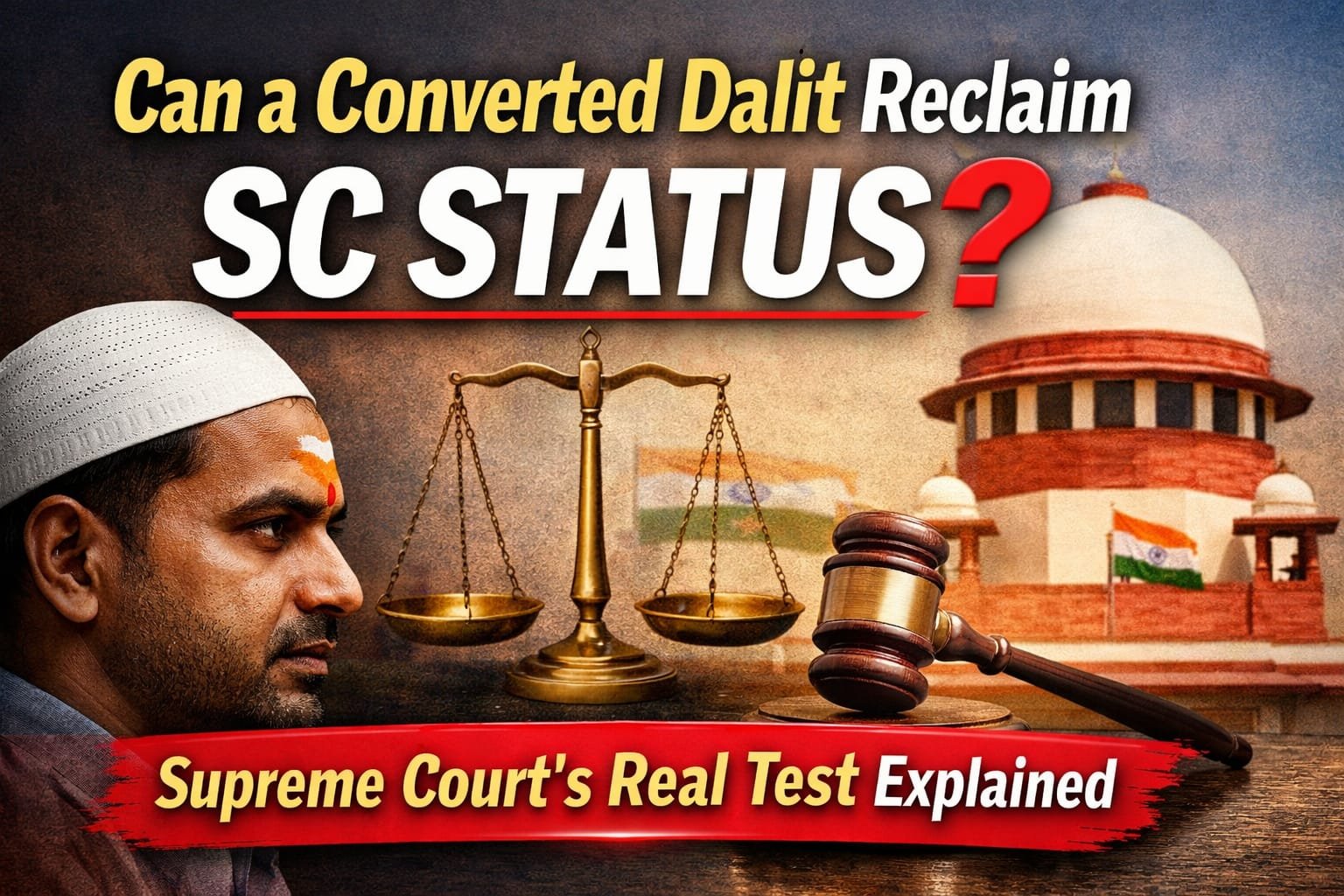
The question of whether a person born into a Scheduled Caste (SC), who later converts to another religion and then reconverts, can reclaim SC status has been a significant legal issue in India.
The Supreme Court of India has addressed this issue through various judgments, laying down clear legal principles.
The key takeaway is simple:
Reconversion alone does not automatically restore Scheduled Caste status.
Legal Framework
Scheduled Caste status in India is governed by:
- Article 341 of the Constitution of India
- Constitution (Scheduled Castes) Order, 1950
These provisions specify which communities qualify as Scheduled Castes and restrict such status to certain religions, primarily Hinduism, later extended to Sikhism and Buddhism.
Effect of Conversion on SC Status
When a person converts from a recognized religion to another religion not covered under the law:
- Scheduled Caste status is generally lost
- Associated legal protections and benefits may no longer apply
This is because SC status is linked not only to caste but also to social and religious context.
Can SC Status Be Reclaimed After Reconversion?
Yes, but only under specific conditions.
The Supreme Court of India has clarified that reconversion does not automatically revive SC status. Courts apply a factual and social test to determine eligibility.
The Supreme Court’s “Real Test”
The courts focus on practical realities rather than formal religious changes. The following factors are considered:
- Return to a Recognized Religion
The individual must reconvert to a religion eligible for SC status, such as Hinduism, Sikhism, or Buddhism.
- Acceptance by the Original Caste Community
This is one of the most important factors.
The person must be:
- Socially accepted
- Recognized by their original caste group
Without such acceptance, reclaiming SC status becomes difficult.
3. Continuation of Social Disadvantages
Courts assess whether the individual continues to face.
- Social stigma
- Discrimination
- Caste-based disadvantages
If these conditions are absent, SC status may not be granted.
4. Social Reality Over Formal Identity
The courts prioritize:
- Actual social conditions
- Lived experiences
- Community perception
Rather than relying solely on formal conversion or reconversion documents.
Key Judicial Decisions
C.M. Arumugam v. S. Rajgopal (1976)
The Court held that reconversion may restore caste status if the individual is accepted back by the community.
Kailash Sonkar v. Maya Devi (1984)
The Court emphasized that caste is a social identity, and it can revive upon reconversion depending on social acceptance.
Punit Rai v. Dinesh Chaudhary (2003)
The Court denied SC status where the individual did not face caste-based disadvantages after conversion.
Important Legal Position
- Reconversion alone is not sufficient
- Community acceptance is essential
- Social disadvantage must be established
- Each case is decided on its own facts
Practical Illustration
Consider a person who:
- Was born in a Scheduled Caste Hindu family
- Converted to another religion
- Later reconverts to Hinduism
Such a person may reclaim SC status only if:
- Their caste community accepts them again
- They continue to experience caste-based social disadvantages
Conclusion
The Supreme Court of India has consistently held that caste is not merely a religious label but a social identity shaped by ground realities.
Therefore, the restoration of Scheduled Caste status after reconversion depends on:
- Social acceptance
- Continued disadvantage
- Actual lived experience
Not merely on the act of reconversion.
FAQs
Q1. Is SC status automatically restored after reconversion?
No, courts require proof of community acceptance and continued social disadvantage.
Q2. Which religions are eligible for SC status?
Hinduism, Sikhism, and Buddhism.
Q3. What is the most important factor in reclaiming SC status?
Acceptance by the original caste community.
Q4. Can SC status be denied even after reconversion?
Yes, if the individual does not face caste-based discrimination.
Q5. Does every case have the same outcome?
No, each case is decided based on its specific facts and circumstances.
Written by Adv. Aman Chawla, practising in Delhi, focuses on matrimonial and family law matters.