Frequently Asked Questions on Maintenance Laws in India

Can the court consider my lifestyle (car, house, expenses) instead of declared income?
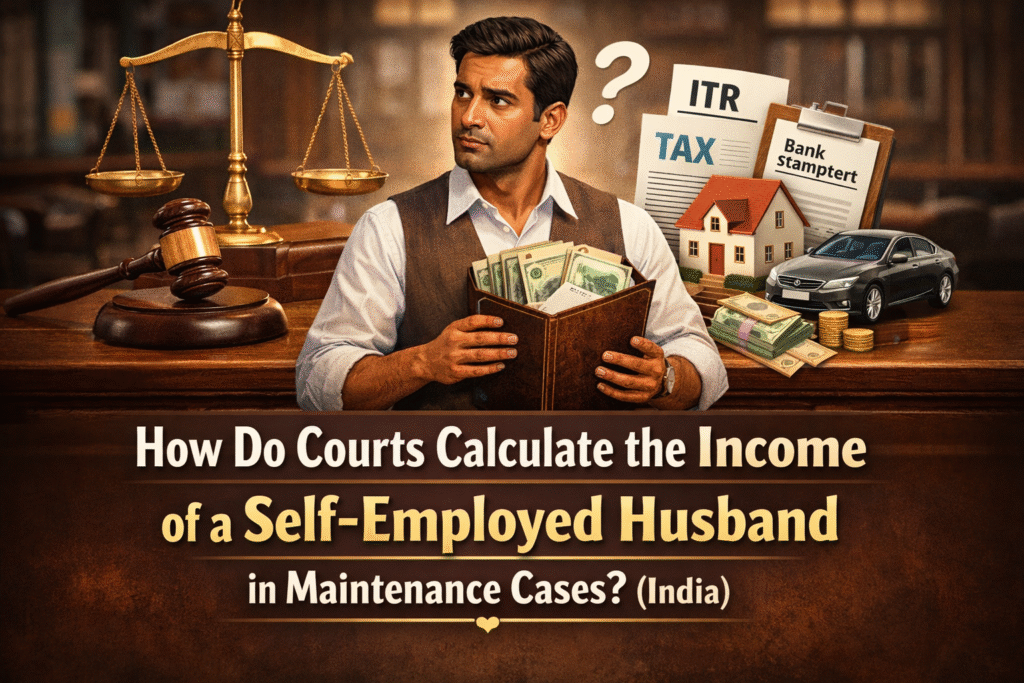
Absolutely. Courts are well aware that declared income, especially in the case of self-employed individuals, may not reflect the true financial status. Therefore, courts frequently rely on the “status and lifestyle” of the parties as a crucial indicator of income. Factors such as the type of car owned, the nature of the residential property, frequency of foreign travel, club memberships, and overall monthly expenditure are taken into account to make a realistic assessment of a person’s financial capacity. If there is a significant disparity between the declared income and the observed lifestyle, the court will likely rely on the latter to determine the maintenance amount.
What if I have financial liabilities like loans, EMIs, or dependent parents?
The court takes into consideration the husband’s reasonable financial liabilities while calculating the maintenance amount. The husband must provide documentary proof of his liabilities, such as loan agreements, EMI schedules, and evidence of expenses incurred for dependent parents. The court will assess these liabilities to determine the husband’s “net disposable income.” Only necessary and unavoidable expenses are typically considered. The obligation to maintain one’s wife and children is a primary responsibility, and courts ensure that it is not evaded under the pretext of other financial commitments.
Do I need to disclose all bank accounts, ITRs, and assets?
Yes, it is mandatory for both parties in a maintenance proceeding to truthfully disclose all their assets, income, and liabilities. The Hon’ble Supreme Court of India in the landmark case of Rajnesh v. Neha has mandated the filing of a detailed Affidavit of Assets and Liabilities by both the petitioner and the respondent. This affidavit requires a comprehensive declaration of all sources of income, movable and immovable properties, investments, bank account details, and liabilities. Any attempt to conceal information or file a false affidavit can lead to adverse inferences being drawn by the court and may even invite proceedings for perjury.
What if my income has recently reduced or I lost my job?
If there is a substantial and involuntary change in your financial circumstances, such as a job loss or a significant reduction in business income, you can approach the court to seek a modification of the maintenance order. An application under Section 127 of the CrPC or Section 25(2) of the Hindu Marriage Act can be filed, requesting a reduction or temporary suspension of the maintenance payments. You must provide concrete evidence to the court to prove the change in circumstances, such as a termination letter, proof of business losses, or updated bank statements. The court will then re-evaluate the situation and may modify the order accordingly.
Can maintenance be denied if my wife is living in adultery?
Under Section 125(4) of the CrPC, a wife is not entitled to maintenance if she is “living in adultery.” The term “living in adultery” implies a continuous course of adulterous conduct, not merely a single or isolated lapse from virtue. The husband bears the heavy burden of proving the allegation of adultery with cogent and convincing evidence. A mere suspicion or a single act of infidelity is generally not sufficient for the court to deny maintenance on this ground.
What if my wife has filed false cases against me?
The filing of false criminal or civil cases can be considered an act of mental cruelty and may serve as a valid ground for seeking a divorce. However, it does not automatically disentitle the wife from claiming maintenance. The maintenance application is decided independently on its own merits, based on the financial needs of the wife and the earning capacity of the husband. While the conduct of the parties is a relevant factor, the primary objective of maintenance laws is to prevent destitution and vagrancy.
Can I refuse maintenance if she refuses to live with me without valid reason?
Yes. As per Section 125(4) of the CrPC, if a wife refuses to live with her husband without any sufficient reason, the court can deny her claim for maintenance. The husband may offer to maintain his wife on the condition of her living with him. If she refuses this offer without a valid justification, such as proven cruelty or harassment, her claim for maintenance can be rejected.
Is maintenance payable if there are no children?
Yes. The husband’s legal obligation to maintain his wife is independent of whether the couple has children. The right of a wife to claim maintenance stems from the marital relationship itself. The purpose is to support a spouse who is unable to maintain herself. The presence of children is a factor that increases the quantum of maintenance, as their needs must also be met, but their absence does not extinguish the wife’s right to maintenance.
How long does it take for interim maintenance to be decided?
The law, such as the proviso to Section 24 of the Hindu Marriage Act, stipulates that an application for interim maintenance should ideally be disposed of within sixty days from the date of service of notice on the other party. However, in practice, due to the high volume of cases in Indian courts, the process can often take several months. The timeline depends on various factors, including the complexity of the case, the cooperation of the parties in providing financial documents, and the workload of the specific court.
Do I have to start paying immediately after the filing of the case?
No, the liability to pay maintenance does not begin immediately upon the filing of the case. It commences only after the court passes an order for interim or final maintenance. However, the court generally directs that the maintenance be paid from the date the application for maintenance was filed by the wife, not from the date of the order. This is to ensure that the wife is supported for the period she had to sustain herself during the pendency of the application.
Can interim maintenance be challenged or reduced?
Yes, an interim maintenance order is not final and can be challenged in a higher court. If you are aggrieved by the amount of interim maintenance awarded, you can file a revision petition or a writ petition before the High Court, challenging the legality and correctness of the lower court’s order. The order can be challenged on grounds that the court did not properly assess the income of the parties or ignored relevant liabilities.
Can I settle the matter outside court to avoid long litigation?
Yes, parties are always encouraged to settle their disputes amicably outside the court. You can opt for mediation, either through a court-annexed mediation centre or a private mediator, to arrive at a mutually acceptable settlement regarding maintenance and other issues. If a settlement is reached, the terms can be recorded in a formal agreement, which is then submitted to the court. The court will pass an order in terms of the settlement, making it legally binding on both parties.
What happens if I fail to pay maintenance ordered by the court?
Failure to comply with a maintenance order has serious legal consequences. The wife can file an execution petition to enforce the order. The court can issue a warrant for levying the amount due from your movable or immovable property (attachment of property). It can also order your employer to deduct the maintenance amount directly from your salary (attachment of salary). In cases of willful default, the court has the power to issue a warrant for your arrest and sentence you to imprisonment for a term which may extend to one month for each month’s default, or until payment is sooner made.
Can maintenance be modified later if circumstances change?
Yes, a maintenance order is not permanent and can be modified at any time. Under Section 127 of the CrPC and Section 25(2) of the Hindu Marriage Act, either party can file an application for alteration of the maintenance amount if there has been a “material change in the circumstances.” For instance, the husband can seek a reduction if he suffers a permanent disability or a significant financial loss. Similarly, the wife can seek an enhancement if her needs increase or if the husband’s income has substantially increased.
Can maintenance be avoided by mutual divorce settlement?
Yes. In a divorce by mutual consent filed under Section 13B of the Hindu Marriage Act, the parties can mutually agree on the terms of settlement, including the issue of maintenance. This can be a one-time, full and final lump-sum payment (alimony) or periodic payments. Once the parties have agreed upon the terms and the court has passed a decree of divorce incorporating these terms, the wife generally cannot file a fresh claim for maintenance, provided the settlement was fair and not vitiated by fraud or coercion.
Can a wife claim maintenance in multiple cases (DV Act + 125 CrPC)?
A wife is entitled to seek relief under multiple statutes simultaneously (e.g., file a petition under Section 125 CrPC and another under the Protection of Women from Domestic Violence Act, 2005). However, she cannot claim the full maintenance amount awarded in each case independently. The law prevents double recovery. The courts will adjust the amounts awarded. If a certain amount of maintenance has been awarded in one proceeding, the court in the subsequent proceeding will take that amount into account and may grant an amount that supplements the earlier order, ensuring a fair total amount without duplication.
Do I have to pay both child maintenance and wife’s maintenance separately?
Yes. The husband has an independent and absolute obligation to maintain his wife and his minor children. The court assesses the needs of the wife and each child separately and typically passes a composite order specifying the amount payable to the wife for her maintenance and the amount payable for the maintenance of each child. The maintenance for the child is payable until the child attains majority, and in some cases, even beyond, such as for an unmarried daughter.
Written by Adv. Aman Chawla, practising in Delhi, focuses on matrimonial and family law matters.
Read Also – How Do Courts Calculate the Income of a Self-Employed Husband in Maintenance Cases? (India)