Written by Adv. Aman Chawla | Matrimonial Law Specialist | Delhi High Court & Supreme Court of India Practice in Family & Matrimonial Law | July 2026
This question came up in a client consultation just last month.
She had a Section 25 HMA permanent alimony order for ₹30,000 per month. Her ex-husband had remarried. Then, unexpectedly, he died.
Her first instinct was that her maintenance had ended. “He’s gone. There’s nothing left to claim.” She came in ready to accept that.
She was wrong. And the Bombay High Court confirmed today — July 28, 2026 — in a ruling covered by LiveLaw, that she was wrong.
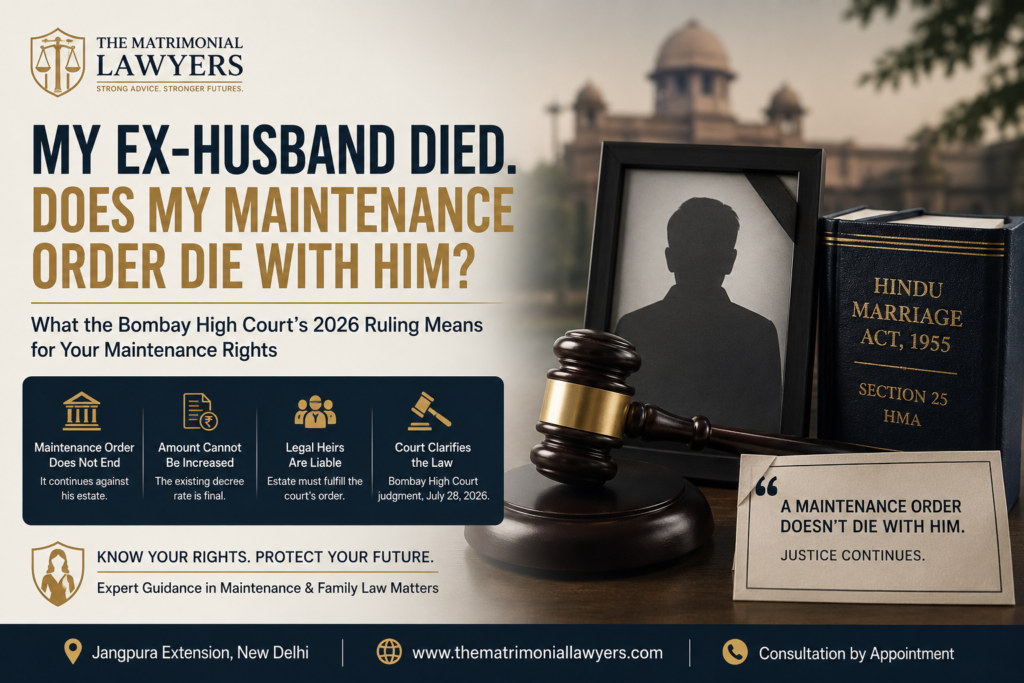
A divorced woman can continue to claim maintenance based on her decree from her ex-husband’s estate and properties even after his death. The decree does not die with him.
But there is a crucial limitation that the same ruling also established. She cannot seek enhancement of that maintenance from his estate after his death. The rate is locked at what the decree says. She can collect it — but she cannot increase it.
This article explains why, what it means for your specific maintenance situation, and the one critical planning lesson every woman with a maintenance order needs to understand before it is too late to act on it.
1. The Bombay High Court’s Ruling — What It Actually Held
The Division Bench of the Bombay High Court, in its July 28, 2026 ruling (2026 LiveLaw (Bom) 284, Justice Bharati Dangre), was dealing with a case where a divorced woman had a maintenance decree and sought to enforce and enhance it against her ex-husband’s estate after his death.
The Court addressed two questions:
Question 1: Can she enforce the existing maintenance decree against the estate?
Answer: Yes. A maintenance decree passed under Section 25 of the Hindu Marriage Act is a court order creating a legal obligation. When the payer dies, his legal obligations do not simply evaporate. Under general principles of law, court-decreed debts and obligations bind the estate of the deceased. The maintenance decree falls within this category — the estate (represented by the legal heirs) must honour it.
Question 2: Can she seek an enhancement of the maintenance amount from the estate?
Answer: No. Enhancement of maintenance requires the court to assess the paying party’s income, capacity, and circumstances. A deceased person has no income, no capacity, and no changing circumstances to assess. The court’s power to vary or enhance a maintenance order under Section 25(2) HMA depends on the existence of a living person whose financial situation can be re-evaluated. Once the payer is dead, that evaluation is impossible, and the enhancement jurisdiction ceases.
The result: she gets exactly what the decree says. Not a rupee more, not a rupee less — regardless of inflation, regardless of how long ago the order was passed.
2. The Law Behind the Ruling — Section 25 HMA and the Silence
on Payer’s Death
The legal reasoning becomes clearer when you look at what Section 25 actually says.
Section 25(3) of the Hindu Marriage Act provides: “If the wife or the husband, as the case may be, with whom an order is made under this section dies, the order shall cease.”
Notice what this says carefully. It refers to the death of the person with whom the order is made — the person receiving the maintenance. If the wife dies, her maintenance order ceases. If the husband dies while HE is the one receiving maintenance (an uncommon but legally possible scenario), his order ceases.
What Section 25(3) does NOT say is that the order ceases on the death of the paying spouse. This silence is deliberate or at minimum meaningful, and the Bombay HC treats it as such.
The obligation to pay runs for the life of the recipient, not the life of the payer. If the obligation was to run for the wife’s lifetime, and the wife is still alive, the obligation continues — now owed by the estate rather than by the living husband.
The Hindu Adoptions and Maintenance Act (HAMA) reinforces this: Section 21 of HAMA specifically addresses the right of a Hindu wife to maintenance from her husband’s estate. A divorced wife (as distinct from a widow) has a related right that courts have applied in conjunction with Section 25 HMA where the husband’s estate is concerned.
Hindu Succession Act principles also apply: A court-decreed financial obligation is a debt of the deceased. When a person dies, their debts pass to their estate. The legal heirs who inherit the estate also inherit the obligation to service these debts from the estate’s assets. A maintenance decree is in this category.
3. The Enhancement Limitation — Why It Matters So Much in Practice
The enhancement limitation is the ruling’s most practically significant aspect, and understanding it changes how women with maintenance orders should think about their long-term financial planning.
The problem with old, unchallenged maintenance orders:
Maintenance orders — particularly those passed 5, 10, or 15 years ago — may reflect the financial reality of that time and not the current one. ₹15,000 per month in 2010 was a different sum than ₹15,000 per month in 2026. The Rakhi Sadhukhan SC ruling (2025) introduced a 5% biennial inflation escalation for NEW orders — but existing old orders do not automatically update.
The appropriate response, while the husband is alive, is to file an enhancement application under Section 25(2) HMA, citing changed circumstances — inflation, increased costs of living, a change in the husband’s financial position. Courts can and do enhance maintenance on such applications.
What the Bombay HC ruling means for this:
Once the husband dies, that Section 25(2) enhancement route is closed. The court cannot assess his income capacity (there isn’t one). The enhancement jurisdiction requires a living paying party. Without one, the existing order rate is frozen.
The critical planning lesson:
If you have a maintenance order that you believe is below what it should be — whether because it was set years ago, because his income has grown substantially since then, or because your needs have increased — file an enhancement application while he is alive. Do not assume you can do it later. The window closes permanently at his death.
4. What This Means for Settlement Negotiations in Mutual Divorce
For women currently in mutual consent divorce negotiations, the Bombay HC’s ruling carries a specific practical message:
The amount you agree to now, in writing, in the settlement deed, may be the amount you are locked into for the rest of your life — including after his death.
Where maintenance is structured as an ongoing monthly obligation (rather than a lump sum), the settlement agreement becomes the equivalent of a decree for the purpose of the principles the Bombay HC applied. The rate in that agreement:
- Can be enforced against him during his lifetime
- Can be enforced against his estate after his death
- CANNOT be enhanced from his estate after his death
This makes the initial settlement amount even more important than most women realise during negotiations. Agreeing to a lower amount now, with the intention of revisiting it later, may not be possible if the husband dies in the interim.
The alternative — a lump sum settlement — eliminates this risk entirely. A lump sum paid during the husband’s lifetime gives the wife complete financial settlement regardless of what happens afterward. There is no ongoing obligation to enforce, no estate to pursue, no enhancement issue. This is one reason the Supreme Court and senior practitioners increasingly prefer lump-sum structures in mutual divorce settlements. Our full analysis of lump sum vs monthly permanent alimony covers this in detail.
5. The Estate’s Obligation — Practical Enforcement
Knowing that the estate owes you maintenance is one thing. Knowing how to actually collect it is another.
When your ex-husband dies and his estate owes you maintenance under your decree, here is how enforcement works in practice:
Step 1 — Identify the legal representatives of the estate: These are typically the legal heirs — his children, his current wife (if any), or other family members who inherit under the will or intestate succession rules. The legal representative who takes over the estate takes on the liability too.
Step 2 — File an execution application: Your existing maintenance decree remains enforceable. You file an execution application in the court that passed the original decree, naming the legal representatives of the estate as the judgment debtors. Courts have well-established mechanisms for executing decrees against estates.
Step 3 — Trace and identify estate assets: The decree can be enforced against any estate assets — property, bank accounts, investments, business interests. Your lawyer will need to identify what assets exist before enforcement can be effective.
Step 4 — Concurrent claims: Be aware that the estate may have other creditors and other obligations. A maintenance decree is a judgment debt and typically has priority over ordinary unsecured creditors in a winding-up scenario, but the specifics depend on the estate’s composition and other obligations.
6. The Delhi HC Ruling on In-Law Property — A Related Reminder
From the same LiveLaw family law section today, the Delhi High Court also confirmed a connected principle: a woman cannot continue to occupy a property owned by her sister-in-law after her husband — who was only a permissive occupant (not the owner or title holder) — vacates.
This connects to the DV Act “shared household” question we have covered extensively, and it illustrates the same underlying principle the Bombay HC ruling reflects: rights are tied to the legal framework in which they exist. When the underlying relationship changes (husband vacates, husband dies), the derived rights are similarly affected — subject to what the specific legal provisions say about survival.
For women relying on DV Act residence orders in properties that belong entirely to the husband’s relatives, this Delhi HC ruling is a reminder to get this addressed as part of any settlement or court order while the husband is an active party to the proceedings.
Consult Adv. Aman Chawla, Matrimonial Law Specialist, practising before the Supreme Court of India, Delhi High Court, and all Delhi district courts. Available for urgent matters, outstation clients, and online consultations across India.
Call / WhatsApp: +91-8076836899 | Email: info@thematrimoniallawyers.com Office: O-11A Basement, Jangpura Extension, New Delhi – 110014
7. Frequently Asked Questions
Q1. My ex-husband died. Does my maintenance order stop automatically?
No — based on the Bombay High Court’s July 28, 2026 ruling (2026 LiveLaw (Bom) 284). A maintenance decree passed against your ex-husband during his lifetime continues to be enforceable against his estate after his death. Your right to receive the decreed amount continues. What ends is the court’s power to enhance or increase that amount from the estate, because enhancement requires assessing a living person’s income capacity.
Q2. Can I get more maintenance (enhancement) from my ex-husband’s estate after his death?
No. The Bombay HC specifically held that while enforcement of the existing decree continues, enhancement of the maintenance amount cannot be sought from the estate after the husband’s death. Courts need to assess the payer’s income capacity to grant enhancement — something impossible with a deceased person. Whatever the decree says, that is the rate that binds the estate.
Q3. Does Section 25(3) HMA end my maintenance when my husband dies?
Section 25(3) ends a maintenance order on the death of the person receiving the maintenance (the wife or husband to whom it was granted). It does not address what happens when the paying spouse dies. The Bombay HC’s ruling fills this gap: the paying obligation continues to bind the estate, subject to the no-enhancement limitation.
Q4. My ex-husband’s family says my maintenance ended when he died. What do I say?
Refer them to the Bombay HC’s July 2026 ruling (2026 LiveLaw (Bom) 284). A maintenance decree is a court-ordered financial obligation that binds the estate of the deceased. File an execution application in the court that passed the original decree, naming the legal heirs/estate representatives as judgment debtors. The court will enforce it.
Q5. The maintenance I was getting was very low — set years ago. Can I get more from the estate now?
No — the Bombay HC’s ruling specifically prevents enhancement from the estate. Whatever the decree says is the ceiling. This is why it is critical to file enhancement applications while the husband is alive. Once he dies, the rate is frozen permanently. If you have an old, inadequate order and your husband is still alive, consider filing for enhancement immediately under Section 25(2) HMA.
Q6. Is lump-sum alimony a better option precisely because of this risk?
Yes — from a planning perspective. A lump-sum settlement paid during the husband’s lifetime eliminates all of these post-death enforcement and enhancement issues. Once the lump sum is paid, there is no ongoing obligation, no estate to enforce against, and no frozen rate. Our full analysis of lump sum vs monthly alimony covers the complete comparison including tax treatment.
Q7. My mutual divorce settlement included ongoing monthly maintenance. Is that equivalent to a decree for these purposes?
Yes — a mutual consent divorce decree that incorporates a settlement deed with ongoing maintenance obligations creates the same effect as a Section 25 HMA permanent alimony order. The Bombay HC’s principles apply: the obligation binds the estate, enhancement cannot be sought from the estate. This is why the settlement amount at the time of mutual divorce is so critical — it may be the rate you live with for the rest of your life.
Q8. My maintenance is for child support, not personal maintenance. Does the same rule apply?
Child maintenance is different. Children’s maintenance obligations derive from parental duty and are typically treated as obligations of the estate in a more straightforward way. Children have independent rights to maintenance from their father’s estate under Hindu law, and courts are more flexible about enforcement in child maintenance matters. However, the same principle — get a realistic, adequate order while the father is alive — applies.
Q9. Can I claim unpaid maintenance arrears (that accrued before my husband died) from his estate?
Yes. Arrears of maintenance that had accrued and were unpaid at the time of the husband’s death are a debt of his estate, fully enforceable in execution proceedings. The estate must settle outstanding arrears along with ongoing maintenance obligations. This is an important point — any maintenance he failed to pay during his lifetime becomes a claim you can enforce against what he has left behind.
Q10. The maintenance I was awarded is not enough even now. What should I do before it’s too late?
File an enhancement application under Section 25(2) HMA immediately. The power to enhance maintenance requires a living person’s income and circumstances to assess. If your husband is alive — however much you may wish to avoid further proceedings — now is the time to address an inadequate maintenance order, not after his death. After he dies, the rate is permanently frozen. Contact a maintenance lawyer today to assess whether an enhancement application is viable in your specific case.
Written by Adv. Aman Chawla. This article is for informational purposes only and does not constitute legal advice. Every case is fact-specific. Please consult a qualified lawyer before taking any legal action.