This Article is written by Adv. Aman Chawla, Family Law Expert | Delhi High Court & Supreme Court of India
Practising in Family & Matrimonial Law | Jangpura, New Delhi
Quick Answer
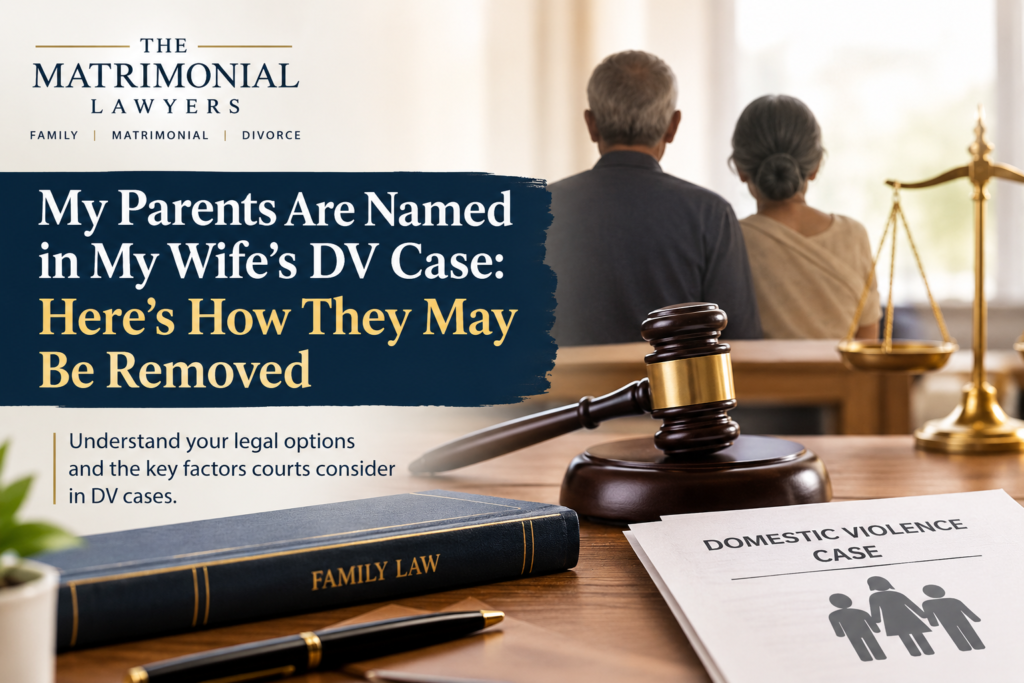
If your parents are named in your wife’s DV case, their inclusion does not automatically mean they must remain parties throughout the proceedings. Where the facts show that they never shared a genuine domestic relationship or household with the wife, and allegations against them are vague or unsupported by specific incidents, legal remedies may be available. The appropriate remedy depends on the facts, the stage of the proceedings and the nature of the allegations.
I Know Exactly Why You’re Reading This
Let me guess how your morning went. A summons arrived, you opened it expecting your own name, and there, alongside it, were your parents’ names too. Maybe they’re in their sixties or seventies. Maybe they’ve never even lived in the same city as your wife. And now they’re being asked to appear before a court over a marriage that, in their day-to-day life, they had almost nothing to do with.
I want you to know this happens constantly, and there’s a real, well-established path to fixing it. But I also want to walk you through this properly, not with false comfort, because getting your parents out of this case depends entirely on understanding how it actually got them into it in the first place.
How Your Parents Actually Ended Up in This Case
Here’s the sequence, and knowing it matters, because it tells you exactly where you are right now and what comes next. A complaint under Section 12 of the Protection of Women from Domestic Violence Act, 2005, is filed before the Magistrate. The court’s first move is almost always to issue notice to the husband. Then, before anything else happens, the court calls for a Domestic Incident Report, prepared by the Protection Officer, essentially a fact-finding note on what’s actually being alleged. It’s only after this DIR comes back, at the next hearing, that the Magistrate typically takes cognizance and decides whether to issue notice to the other relatives named in the complaint, your parents, siblings, whoever else has been included.
If you’re at the stage where your parents have just received notice, this tells you the court has already looked at the DIR and decided, at least on a preliminary basis, that there’s enough on paper to call them in. That’s not a final finding against them. It’s an early step, and it’s exactly the step you can challenge.
The Thing Almost Nobody Explains Properly: DV Is Neither Fully Civil Nor Fully Criminal
This confuses people constantly, including some lawyers handling it for the first time. A DV case is quasi-criminal and quasi-civil at the same time. It’s tried by a Magistrate, using criminal court procedure, but the actual reliefs the law provides, protection orders, residence orders, monetary relief, are civil in character, not punishment. This is exactly why a DV case and a 498A complaint are two separate, independent proceedings, even when they arise from the same marriage and get filed around the same time. Being cleared in one doesn’t automatically end the other, and a strategy that works for one doesn’t automatically transfer to the other. The Supreme Court examined this hybrid character directly in Shaurabh Kumar Tripathi v. Vidhi Rawal, 2025 INSC 734, decided 19 May 2025 by Justices Abhay S. Oka and Ujjal Bhuyan, holding that while Section 12 proceedings are predominantly civil in nature, the Magistrate hearing them is, procedurally, a criminal court, which is exactly why the High Court’s inherent powers to quash proceedings can still reach a DV case, even though its outcome is civil relief, not punishment.
The Two Words That Decide Everything: Domestic Relationship
This is the heart of your parents’ defence, so I want to slow down here. The DV Act only applies where there’s a “domestic relationship,” and that phrase has a real, specific legal meaning, it isn’t satisfied just because two people are related by blood or marriage. It requires that the parties have, at some point, lived together in a shared household, in a relationship resembling family life. Practically, this is often described as living under one roof, sharing meals, running a common kitchen, being part of the same domestic unit day to day, not simply visiting occasionally or being connected on paper as relatives.
For years, courts leaned on a narrower reading of “shared household” from S.R. Batra v. Taruna Batra, (2007) 3 SCC 169, which limited it largely to a house owned by the husband or his joint family. That changed with Satish Chander Ahuja v. Sneha Ahuja, (2021) 1 SCC 414, where the Supreme Court broadened the definition to cover any household where the parties actually lived together in a domestic relationship, regardless of who owns it. But broadening the definition of “household” doesn’t erase the separate requirement that an actual domestic relationship existed in the first place. If your parents never lived with your wife, never shared that day-to-day domestic life with her, the expanded Satish Chander Ahuja definition doesn’t rescue a complaint that was never grounded in a real relationship to begin with.
The Case That Should Give You Real Confidence
In X v. State (NCT of Delhi), 2025 SCC OnLine Del 4662, decided 3 July 2025 by Justice Manmeet Pritam Singh Arora, the Delhi High Court dealt with almost exactly your situation. A wife had filed a DV complaint against her husband, his parents, and his brother and sister-in-law, more than two decades into the marriage. The allegations against the husband were specific, dates, incidents, a clear pattern. The allegations against the in-laws, though, were general, taunts, remarks, demands for gifts, nothing tied to a particular date or incident. The brother-in-law and his wife had been living on a separate floor of the property since 2013, in their own, distinct household.
The Trial Court deleted the in-laws from the case entirely, finding no domestic relationship existed since the parties were living separately. The Appellate Court agreed. The wife then approached the Delhi High Court, seeking to have the in-laws summoned anyway. The High Court refused, and its reasoning is worth sitting with closely. The complaint had been filed twenty-one years into the marriage, nine years after the wife had last actually resided with her in-laws. The specific incidents in the complaint were already being pursued against the husband alone in a separate proceeding. Against that backdrop, the Court found the allegations against the relatives stale, and observed they appeared aimed at pressuring the husband through his family, rather than reflecting any genuine, ongoing threat from the relatives themselves. The Court drew directly on the Supreme Court’s reasoning in Kamal v. State of Gujarat, Criminal Appeal No. 2042 of 2025, where allegations of mere taunts were held insufficient to justify criminal proceedings against relatives in a matrimonial dispute, and on Geddam Jhansi v. State of Telangana, 2025 SCC OnLine SC 263, in upholding the deletion of a mother-in-law and a sister-in-law living separately.
If your parents’ situation looks anything like this, general allegations, no specific dates, a separate residence, a complaint filed long after any real domestic contact ended, this is the exact precedent your lawyer should be building your application around.
The Two Real Paths Forward, and How to Choose Between Them
Your first option is a deletion of name application, filed before the same trial court where the DV case is pending. This asks the Magistrate to remove your parents from the array of parties on the ground that no domestic relationship ever existed between them and your wife. This is usually the right first move, it’s faster, it’s before the court already familiar with your case, and it directly addresses the missing legal ingredient.
Your second option is a quashing petition before the High Court, under Section 482 of the CrPC, now Section 528 of the BNSS. This is generally the stronger route where the trial court has already refused to delete the names, or where the facts show a clearer pattern of misuse, allegations that are not just general but plainly an attempt to pressure your family through parents who have no real connection to the dispute. Shaurabh Kumar Tripathi confirms this route is genuinely available for DV proceedings, but the Supreme Court was equally clear that High Courts should use this power sparingly, reserved for cases of real, gross abuse of process rather than ordinary factual disputes that deserve a full hearing.
What Your Application Actually Needs to Show
This is where the real work happens, and it’s exactly what you already seem to understand instinctively. Lay out, chronologically, every relevant date and event from the day of the marriage onward, where your parents lived, when and how often your wife actually visited or stayed with them, when any separate household was established, and specifically what the complaint alleges against them, and when. The goal is to show the court, plainly, that there was never a domestic relationship in the sense the law requires, not simply that your parents are respectable people who wouldn’t do such things. Courts respond to a documented timeline showing separate residence and the absence of specific, dated incidents, not to character references.
A Realistic Example
A son’s elderly parents, living in their native town, are named in his wife’s DV complaint filed in the city where the couple lived after marriage. The complaint alleges they “supported” the husband’s cruelty and once made a comment about dowry at the wedding, but gives no date, no specific later incident, and no claim that the parents ever lived with the couple after the wedding itself. The application filed on their behalf sets out, with supporting documents, ration cards, utility bills, and a clear residence history, that the parents have lived exclusively in their native town throughout the marriage and never shared a household with the wife even once. Relying on the reasoning in X v. State (NCT of Delhi), the trial court finds no domestic relationship existed and deletes their names from the array of parties, while the case against the husband himself, where specific, dated allegations are pleaded, continues.
What To Do Next
Sit down today and build the timeline, don’t wait for your lawyer to ask for it. Every address your parents have lived at since your marriage, every visit your wife made to them and how long it lasted, every specific allegation the complaint makes against them and whether it actually has a date attached. If the honest answer is that your parents genuinely never shared a household with your wife, that timeline is the foundation of a strong deletion application. If there was a period of genuine cohabitation, be honest about that with your lawyer too, since the strategy changes considerably depending on what actually happened, not on what you wish had happened.
Frequently Asked Questions
My parents have been named in my wife’s DV case. What’s the very first thing I should do?
Don’t panic, and don’t ignore the notice. Start documenting where your parents have lived throughout the marriage and gather any proof of separate residence, then speak to a lawyer promptly about filing a deletion of name application before the same court.
What does “domestic relationship” actually mean under the DV Act?
It means the parties have, at some point, actually lived together in a shared household as part of the same domestic unit, not simply that they’re related. Being in-laws on paper isn’t enough if there was never real, shared day-to-day living.
Can my parents be removed from the case if they never lived with my wife at all?
Yes, this is precisely the situation courts have granted deletion in, most recently the Delhi High Court in July 2025, where relatives living in a genuinely separate household were removed from a DV complaint.
Is a DV case the same as a 498A case against my parents?
No, they’re separate legal proceedings, even though they often arise from the same dispute. A DV case seeks civil reliefs like protection and residence orders through a Magistrate; a 498A case is a criminal prosecution. Success in one doesn’t automatically resolve the other.
Should I file a deletion application or go straight to the High Court for quashing?
Generally, start with the deletion application before the trial court, it’s faster and directly addresses the missing domestic relationship. A quashing petition before the High Court becomes the stronger option if the trial court refuses, or where the facts show clear, serious misuse of the process.
What kind of proof actually helps get my parents’ names deleted?
A clear, documented residence history, address proof, utility bills, ration cards, showing where your parents actually lived throughout the marriage, along with a plain demonstration that the complaint’s allegations against them lack any specific date or incident.
If the complaint mentions my parents but doesn’t give any specific date or incident, does that help our case?
Yes, significantly. Courts have repeatedly held that vague, general allegations against relatives, without specific incidents tied to dates, don’t meet the threshold needed to keep them in the case.
Conclusion
Getting your parents’ names out of a domestic violence case isn’t about arguing they’re good people, it’s about showing, clearly and with documents, that the legal foundation for including them, a genuine domestic relationship in a shared household, was never actually there. The law has said this plainly, most recently in July 2025, when the Delhi High Court upheld exactly this kind of deletion for relatives who’d been living separately. Build your timeline honestly, choose the right forum for your specific facts, and let the record speak for your parents rather than your fear on their behalf.
Adv. Aman Chawla practices matrimonial and family law before the Delhi High Court, Delhi Family Courts (Saket, Rohini, Dwarka, Karkardooma, Patiala House), and the Supreme Court of India. For a consultation on your specific situation, reach out through the contact details on this website.
Disclaimer: This article is for general informational purposes only and does not constitute legal advice. As per the Rules of the Bar Council of India, advocates are not permitted to advertise or solicit work, and nothing in this article should be construed as advertising, solicitation, or an invitation to engage this firm. Readers should consult a qualified advocate regarding their specific circumstances before taking any legal action.