
Written by Adv. Aman Chawla | Matrimonial Law Specialist | Delhi High Court & Supreme Court of India 8 Years Exclusive Practice in Family & Matrimonial Law | Jangpura, New Delhi
Introduction
An NRI husband 498A case can create serious concerns about arrest, international travel, passport restrictions and a possible Look Out Circular (LOC). If you live abroad and face a matrimonial criminal case in India, it is important to understand your legal position before travelling. This guide explains how LOCs, bail conditions and passport restrictions may affect your ability to enter India and return overseas.
The call usually comes late at night, India time.
“Sir, I am in Toronto. My wife went to India for a holiday with our son and now she has filed a dowry case against me and my parents. If I fly to Delhi for my father’s surgery, will I be stopped at the airport? Will they take my passport? Will I lose my job here?”
I receive calls like this every month from the US, Canada, the UK, the UAE, Australia and Singapore. For NRI husbands, a 498A case creates more than a legal problem. It can threaten their jobs, visas, immigration status and ability to see their parents.
This article explains how Look Out Circulars and passport impounding work in matrimonial cases. It also discusses recent court judgments, travel to India and the steps you can take before boarding a flight.
Quick Answer
A 498A (now Section 85 BNS) case against an NRI husband can lead to a Look Out Circular (LOC) or passport impounding proceedings. However, neither action happens automatically.
Courts have held that authorities should not issue LOCs mechanically in matrimonial cases when the accused cooperates. A wife’s complaint alone also does not justify passport impounding.
Before you travel, check whether an FIR, LOC, warrant or passport action exists. Obtain anticipatory bail or interim protection where necessary. Keep proof of your cooperation. You may also attend many hearings through a lawyer or by video conference.
1. What Is a Look Out Circular (LOC)?
An LOC is an alert sent to immigration checkpoints. It asks officials to stop, detain or report a person who tries to leave or enter India. The Ministry of Home Affairs issues LOC guidelines. The current consolidated guidelines appear in an Office Memorandum dated 22 February 2021.
Authorities designed LOCs for serious situations. These include people evading arrest in grave offences, economic offenders and threats to national security.
An LOC was not designed as a routine tool for matrimonial disputes. However, in practice, authorities have opened LOCs in 498A cases at the request of complainants or investigating officers. This happens especially when the husband lives abroad.
2. What Recent Judgments Say About LOCs in 498A Cases
Andhra Pradesh High Court, February 2026
In Lagubeeru Venkata Arun Kiran v. Union of India (Andhra Pradesh High Court, 4 February 2026, 2026:APHC:3446), the husband worked in Dubai.
His wife filed an FIR under Section 85 BNS and the Dowry Prohibition Act. He appeared before the police, obtained bail and returned to his job.
Later, he came to India to attend family court proceedings. Officials stopped him at Visakhapatnam airport under an LOC. Authorities had opened the LOC without notice, and it prevented him from returning to Dubai.
The High Court held that authorities cannot issue LOCs mechanically in matrimonial cruelty cases. The Court said they should open LOCs only against persons accused of grave offences, financial irregularities, offences against society, or conduct detrimental to the nation, as the MHA guidelines contemplate.
No non-bailable warrant remained pending against the husband. The Court also found no evidence that he had failed to cooperate or tried to evade the process. It therefore quashed the LOC and treated it as a violation of personal liberty under Article 21.
The lesson is clear: you can challenge an LOC in a matrimonial case, especially if you have cooperated, obtained bail and face no warrant.
3. Passport Impounding in Matrimonial Cases
Under Section 10(3)(e) of the Passports Act, 1967, the passport authority may impound a passport if criminal proceedings for an offence are pending against the holder before a criminal court in India.
The key word is “may”.
In Mohammad Umar v. Union of India (Allahabad High Court, Division Bench, July 2024), the husband worked in Saudi Arabia. The authorities impounded his passport only because his wife’s criminal case was pending.
The High Court held that passport impounding is discretionary, not mandatory. The officer must consider the facts and give the passport holder a hearing. The Court quashed the order and sent the matter back for a fresh decision.
In a 2025 Supreme Court judgment (2025 INSC 254), the authorities had impounded a husband’s passport after his wife filed multiple cases against him and his family.
The Supreme Court held that authorities cannot impound a passport merely because the wife filed numerous cases. It called the action ex facie illegal. The authorities had also failed to give the husband a hearing, violating the principles of natural justice. The Court directed them to release his passport.
In Satish Chandra Verma v. Union of India (Supreme Court, 2019), the Court described the right to travel abroad as an important basic human right. It forms part of personal liberty.
4. Can I Travel to India and Go Back?
In most cases, yes, if you prepare properly. Here is the checklist I give NRI clients before they book a ticket.
Find out what exists: Has anyone registered an FIR? Is there an LOC, a non-bailable warrant or a passport notice? Your lawyer in India can check court records and, where possible, confirm the status with the police.
Get protection first: If the police have registered an FIR, apply for anticipatory bail or interim protection. Courts often grant protection with conditions. These may require you to join the investigation on a specified date, avoid leaving India without permission until the investigation ends, or submit your travel details.
Plan your return: Your bail conditions may require court permission before you travel abroad. If so, apply in advance. Submit your employment letter, visa, return ticket and an undertaking to appear when required.
Carry documents: Keep copies of bail orders, court orders, your lawyer’s contact details and proof of your employment abroad.
Do not hide: Courts are more willing to protect a husband who cooperates than one who appears to avoid the process.
Real-life example: Vikram works in Dallas. His wife filed a 498A FIR in Ghaziabad while visiting her parents.
Vikram did not avoid India. His lawyer applied for anticipatory bail and submitted his US employment papers and return ticket. The court granted protection. It directed him to join the investigation on a fixed date and seek permission before travelling.
He flew to India, joined the investigation and applied for permission to travel. With the court’s leave, he flew back within two weeks.
Two years later, he still attends hearings through his lawyer. He appears in person only when the court requires it.
5. What If an LOC Has Already Been Opened?
If you discover an LOC or officials stop you at the airport, take these steps:
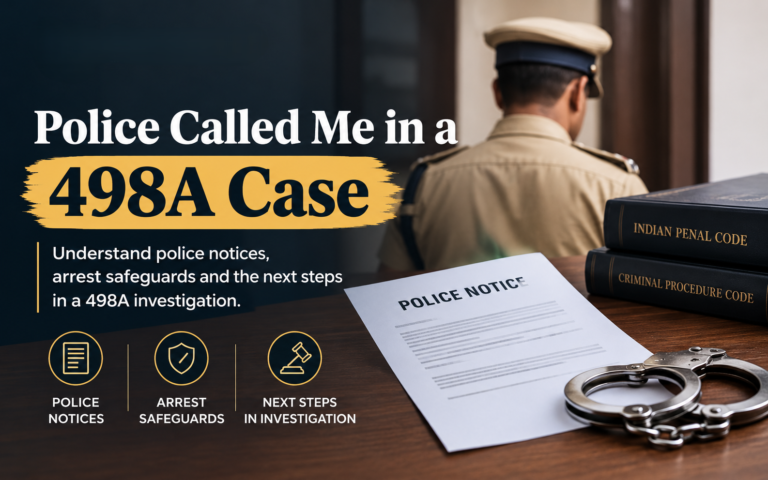
- Stay calm and cooperate with immigration officers. Contact your lawyer immediately.
- Ask your lawyer to obtain the LOC details from the authority that requested it.
- Apply to the trial court or file a writ petition in the High Court. Seek an order to quash or suspend the LOC.
- Show the court your cooperation, bail, overseas employment and family ties.
- Offer reasonable conditions, such as an undertaking to appear, a surety or a deposit.
6. Can I Attend Court Hearings From Abroad?
Many courts allow the accused to appoint a lawyer and seek exemption from personal appearance. The court may require the accused to appear only at important stages.
Courts also use video conferencing more often in matrimonial matters. On the civil side, I have discussed transfer petitions and video conferencing separately.
7. Other Risks for NRI Husbands
Proclaimed offender proceedings: Do not ignore summons or warrants for a long time. The court can begin proceedings to declare you a proclaimed offender. This makes the situation much harder. Do not let it reach that stage.
Foreign divorce decrees: A divorce obtained abroad may not receive recognition in India if it does not meet Indian legal requirements. I have discussed this issue in my article on US divorces in India.
Maintenance claims: Your foreign income matters when Indian courts assess maintenance. Courts also take a serious view of non-payment.
8. Practical Advice for Families in India
Parents and siblings named in the FIR often face greater exposure than the NRI husband because they live in India.
They should seek legal advice and consider anticipatory bail promptly. This is especially important for elderly parents and married sisters who live elsewhere. They should also keep proof of where they lived and how little they were involved.
Frequently Asked Questions
Q: Can an LOC be issued in a 498A case?
A: Authorities can open an LOC. However, courts have held that they should not issue LOCs mechanically in matrimonial cases when the accused cooperates and no warrant remains pending. Courts have quashed such LOCs.
Q: Can my passport be impounded because my wife filed a 498A case?
A: The passport authority has discretion under Section 10(3)(e) of the Passports Act. However, it must consider the facts and give you a hearing. In 2025, the Supreme Court held that authorities acted illegally by impounding a passport merely because the wife had filed numerous cases.
Q: Will I be arrested at the airport?
A: Officials may detain you if an LOC or warrant requires it. Before travelling, ask your lawyer to check the position. If an FIR exists, obtain anticipatory bail or interim protection where appropriate.
Q: Can I get anticipatory bail while I am abroad?
A: Courts follow different procedures. Many require some commitment from you to appear or join the investigation. Discuss the best approach with your lawyer before travelling.
Q: Do I have to come to India for every hearing?
A: Not necessarily. Courts often allow you to appoint a lawyer and seek exemption from personal appearance. They may require you to attend only at important stages.
Q: Can my parents be arrested even if I am abroad?
A: Arrest is not automatic in 498A cases under Arnesh Kumar and Section 35 BNSS. However, your parents should seek legal advice and consider anticipatory bail promptly. For related guidance, read about 498A arrest after FIR under Section 85 BNS.
Adv. Aman Chawla’s Practical Note
The biggest mistake NRI husbands make is staying silent. They hope the case will “go away” if they remain abroad. It does not. Warrants may follow, and authorities may open an LOC. One day, they may find themselves unable to attend a parent’s funeral without facing legal risks.
The second biggest mistake is panic. Some husbands fly to India without checking their legal position. They then face the risk of an LOC at the airport.
The right approach sits between these two mistakes. Find out exactly what exists. Get protection before you travel. Cooperate with the authorities and keep proof of your cooperation. Also, retain a lawyer in India who understands both criminal and matrimonial law.
Final Words
A 498A case does not have to end your career abroad or cut you off from India. Courts have recognised that authorities cannot use LOCs and passport impounding as routine weapons in matrimonial disputes. They have also recognised the right to travel as part of personal liberty.
With timely legal steps and genuine cooperation, many NRI husbands can travel, attend court and continue their lives while the case runs its course.
Consult Adv. Aman Chawla, Matrimonial Law Specialist, practicing before the Supreme Court of India, Delhi High Court, and all Delhi District Courts. Available for urgent matters, outstation clients, and online consultations across India.
Call: +91-8076836899 | WhatsApp | Email: info@thematrimoniallawyers.com Office: O-11A Basement, Jangpura Extension, New Delhi – 110014
Written by Adv. Aman Chawla. This article is for informational purposes only and does not constitute legal advice. Every case is fact-specific. The examples in this article are illustrative and names and details have been changed or simplified. Please consult a qualified lawyer before taking any legal action.