By Advocate Aman Chawla | The Matrimonial Lawyers, New Delhi Published: June 2026
The phone rings at 7 in the morning. It is the husband’s mother. She says the police came last night, banged on the door, and took her son away — within 24 hours of an FIR being filed under Section 498A (now Section 85 of the Bharatiya Nyaya Sanhita, BNS). Nobody told her this would happen so fast. Nobody explained the law. And here is the uncomfortable truth: in most of these cases, that arrest was not legally required at all.
This article cuts through the confusion. If you or your family is facing a 498A / Section 85 BNS case — whether you are the complainant trying to understand your rights, or the accused trying to understand whether arrest is imminent — you need to know exactly what the law says today, not what the police station constable tells you, and not what your neighbour heard from his cousin’s lawyer.
The answer to “will I be arrested?” is not a simple yes or no. But the law is far more protective of personal liberty than most people — including many police officers — realise.
1. First, Let Us Get the Law Change Straight: 498A IPC Is Now Section 85 BNS
From 1 July 2024, India replaced three old criminal laws with three new ones. The Indian Penal Code (IPC) became the Bharatiya Nyaya Sanhita (BNS). The Code of Criminal Procedure (CrPC) became the Bharatiya Nagarik Suraksha Sanhita (BNSS). The Indian Evidence Act became the Bharatiya Sakshya Adhiniyam (BSA).
What does this mean for 498A cases practically?
- FIRs registered before 1 July 2024 continue under Section 498A IPC and CrPC.
- FIRs registered on or after 1 July 2024 are registered under Section 85 BNS, with arrest procedure governed by BNSS Section 35.
- The substance of the offence is identical. The wording of Section 85 BNS is almost a word-for-word carry-forward of Section 498A IPC.
- Punishment remains the same: imprisonment up to 3 years and a fine.
- It remains a cognizable and non-bailable offence — but that does NOT mean automatic arrest.
That last point is the one everyone gets wrong. Non-bailable does not mean no bail possible. It simply means bail cannot be granted by a police officer at the police station — the accused must approach a Magistrate or a Sessions Court / High Court for bail or anticipatory bail. It says nothing about whether the police must arrest in the first place.
2. The Arnesh Kumar Judgment (2014): The Foundation That Still Stands
Before we get to the new BNSS framework, you must understand Arnesh Kumar v. State of Bihar (2014) 8 SCC 273. This Supreme Court judgment from over a decade ago is not old news — it is the bedrock of arrest law in 498A / Section 85 BNS matters, and every lawyer worth consulting will cite it.
Arnesh Kumar was accused in a 498A case. He feared immediate arrest. He approached the Supreme Court. The Court, looking at crime data and conviction rates, noted that 498A had become a tool for mechanical arrest — police were arresting everyone named in the FIR, including elderly in-laws and distant relatives, without any genuine assessment of necessity.
The Supreme Court laid down a mandatory checklist — a set of questions every police officer must ask himself before arresting anyone in a case punishable with imprisonment of less than 7 years. Section 498A / Section 85 BNS carries a maximum sentence of 3 years, so it squarely falls within this protection.
The Arnesh Kumar Checklist — What Police MUST Ask Before Arrest:
- Whether the person’s arrest is necessary to prevent further offence?
- Whether the person needs to be arrested to properly investigate the case?
- Whether there is a need to prevent tampering of evidence or intimidation of witnesses?
- Whether the person appears likely to flee justice?
The Court further directed Magistrates not to mechanically authorise custody when the accused is produced — they must apply their mind and record reasons. Violation of Arnesh Kumar guidelines is not merely procedural — courts have used it as grounds to grant bail, quash arrests, and even initiate departmental action against police officers.
3. BNSS Section 35: The New Arrest Framework That Changes Everything
With the BNSS replacing the CrPC, Section 35 now governs the power of arrest. It is the successor to Sections 41 and 41A of the old CrPC, but the legislature has written the safeguards more explicitly this time.
Section 35(1): Discretion, Not Obligation
Section 35(1) of BNSS uses the word “may” — a police officer “may” arrest without warrant in a cognizable offence. The Supreme Court has specifically noted this choice of language in its January 2026 ruling: the power to arrest is discretionary, not mandatory. An FIR being registered does not create an automatic obligation to arrest.
Section 35(3): The Notice Requirement — The Game-Changer
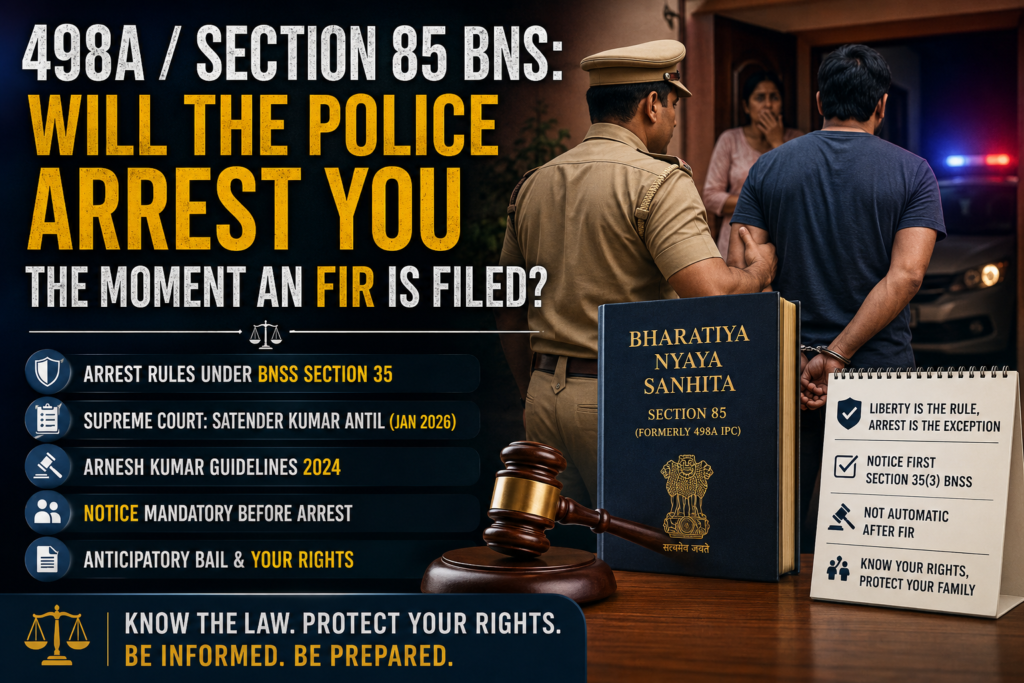
This is the most important provision for anyone facing a 498A / Section 85 BNS case. Section 35(3) of the BNSS requires that for any offence punishable with imprisonment up to 7 years — and Section 85 BNS carries only 3 years maximum — the police officer must first issue a Notice of Appearance to the accused person before considering arrest.
This notice is not a courtesy or a formality that the police can skip when they feel like it. As of January 2026, the Supreme Court has held it is mandatory — it is the default starting point.
Section 35(5) and 35(6): Compliance Protects You From Arrest
Section 35(5) is a protection clause. If you have received a Section 35(3) notice, and you have complied with its terms — meaning you appear when asked — the police cannot simply arrest you anyway. They need to form a fresh opinion that arrest is necessary, and they must record that opinion in writing with reasons.
Section 35(6) allows arrest of a notice-recipient only when the conditions under Section 35(1)(b) are satisfied. Even then, the Supreme Court has said this “is not a matter of routine, but an exception, and the police officer is expected to be circumspect and slow in exercising the said power.”
4. The January 2026 Supreme Court Ruling: Satender Kumar Antil v. CBI — What It Actually Says
On 15 January 2026, a Supreme Court bench of Justices M.M. Sundresh and Nongmeikapam Kotiswar Singh delivered a judgment in Satender Kumar Antil v. CBI (2026 INSC 115) that has become the definitive statement of arrest law under the BNSS.
The case had arisen partly because a 2025 Bombay High Court ruling created a grey area — it seemed to suggest that police could still arrest as long as they recorded reasons, even when a notice should have been issued. The Supreme Court stepped in to clear the confusion.
The Court’s key findings, in plain language:
- Notice under Section 35(3) BNSS is the RULE for all offences carrying imprisonment up to 7 years. Arrest without issuing a notice first is the EXCEPTION, not the other way around.
- An investigation does not begin or end with arrest. Police can collect evidence, examine witnesses, and investigate thoroughly without placing the accused in custody.
- If a person complies with the Section 35(3) notice, arresting them anyway is legally impermissible unless strictly necessary, and the reasons must be recorded in writing.
- Police discretion is not unfettered — it is subject to constitutional discipline under Article 21 (right to life and personal liberty).
- The 2022 and 2026 Satender Kumar Antil rulings, read with the BNSS framework, embed the Arnesh Kumar principles as substantive statutory obligations — not mere guidelines.
This is a landmark shift. Under the old CrPC + Arnesh Kumar framework, many police officers treated the checklist as something to fill on paper after the fact. Under the BNSS + 2026 ruling, the notice mechanism is now front-loaded — it must happen before, not after.
5. Practical Situations: What Actually Happens on the Ground
Law on paper and law on the street are two different things in India. Here is how these provisions play out in common real-world scenarios.
Scenario A: FIR Filed, Police Come to the House at Night
This is the most common scenario. An FIR is filed in the evening, and police arrive at night to arrest the husband and sometimes the in-laws. Under the law, if no anticipatory bail is in place, the police technically can arrest — but only after satisfying the Section 35(1)(b) conditions and recording reasons. Practically, if no anticipatory bail has been obtained, the accused is vulnerable to immediate arrest in the first 12–48 hours. This is precisely why lawyers insist on filing for anticipatory bail under Section 482 BNSS the moment you have reason to believe a complaint will be filed.
Scenario B: You Receive a Notice from the Police Station Under Section 35(3) BNSS
This is actually a good sign — it means the police are following the law. A Section 35(3) notice requires you to appear at the police station on a given date. Do not ignore it. Do not panic. Engage a lawyer immediately. Comply with the notice. As long as you comply, and you are not trying to flee or tamper with evidence, the police are legally barred from arresting you without written, recorded reasons. If they arrest you despite compliance and without recorded reasons, that arrest can be challenged before a Magistrate or High Court, and bail/release is obtainable on this ground alone.
Scenario C: Elderly Parents or Siblings Named in the FIR
One of the worst abuses in 498A litigation is the naming of every member of the husband’s family — elderly parents in their 70s, married sisters who live in another city, brothers who haven’t visited in years. The Supreme Court in Arnesh Kumar, and subsequently in Kahkashan Kausar v. State of Bihar (2022) and Ghanshyam Soni v. State (2025), has repeatedly warned against this. Unless specific acts of cruelty are attributed to specific individuals with specific details of time and place, the FIR against them can be challenged. Omnibus allegations — “they all harassed me” — are legally insufficient to justify arrest. In-laws in particular have strong grounds for anticipatory bail when the allegations are vague and general.
Scenario D: Police Say ‘We Have to Arrest, It’s Non-Bailable’
This is legally incorrect, and unfortunately common. Non-bailable means bail cannot be granted at the police station — it does not mean arrest is compulsory. The police officer who says this either does not know the law or is choosing to ignore it. You or your lawyer can point to the BNSS Section 35 framework and the Arnesh Kumar / Satender Kumar Antil judgments. If the officer proceeds with an illegal arrest, the first application before the Magistrate can raise this, and the Magistrate is duty-bound to examine whether arrest was warranted before authorising custody.
6. How BNSS Section 35 Differs from the Old CrPC Sections 41 and 41A
For those familiar with the CrPC framework, here is what changed:
- Old CrPC Section 41: Gave broad power to arrest, with a checklist. Courts read in the Arnesh Kumar safeguards by judicial interpretation.
- Old CrPC Section 41A: Introduced the notice mechanism — but as a seemingly separate track that could be bypassed with “recorded reasons.”
- New BNSS Section 35: Integrates both — the notice under Section 35(3) is now explicitly the default, and arrest without notice is an exception that requires written justification. The Supreme Court has held this is mandatory, not directory.
The practical significance is substantial. Under the old CrPC, police would often record boilerplate reasons for arrest — +’accused may flee,’ ‘accused may tamper evidence’+ — without any basis. The 2026 ruling demands that reasons be objectively justifiable, not just formulaic. A court reviewing custody can now look at whether those reasons hold up.
7. What You Must Do the Moment an FIR is Filed or Threatened
Step 1: Do not wait for the police to knock. The moment you have credible information that an FIR has been or will be filed against you or your family, contact a criminal lawyer immediately. The window between FIR filing and arrest can be as short as a few hours.
Step 2: File for anticipatory bail under BNSS Section 482. This is your most powerful tool. An anticipatory bail order from a Sessions Court or High Court prevents your arrest without permission of the court. Under Section 85 BNS, anticipatory bail is available. The Arnesh Kumar and 2026 BNSS judgments strengthen your case before the bail court.
Step 3: Compile evidence of your location, conduct, and cooperation. Courts look favourably on accused who demonstrate they are not a flight risk and are willing to cooperate. Family photographs, proof of residence, employment details, and communication records can all support a bail application.
Step 4: If you receive a Section 35(3) BNSS notice — comply and document. Appear at the police station as directed, with your lawyer. Document your compliance in writing. This compliance is your legal shield against arrest.
Step 5: If you are arrested despite compliance or without Section 35 reasons being recorded — challenge immediately. Your lawyer can file a bail application before the Magistrate the very next day (or same day under urgent circumstances), and can challenge the arrest as illegal under Section 35 BNSS read with the Supreme Court’s 2026 ruling.
8. A Word for the Complainant: Protections Do Not Mean Your Case is Weak
If you are the woman who has filed a complaint, reading the above might feel discouraging. It should not. The safeguards against automatic arrest exist to prevent abuse of process — they do not diminish your case on merits.
Section 85 BNS remains a cognizable offence — police can and should investigate without waiting for your direction. If the evidence supports custodial interrogation, the police can arrest with recorded justification. Courts can take cognisance and summon accused persons for trial. And for cases involving dowry death under Section 80 BNS (formerly Section 304B IPC), which carries a minimum sentence of 7 years, the Section 35(3) notice requirement does not apply — arrest can be immediate.
The law also recognises that the 2-month cooling-off period endorsed by the Supreme Court in Shivangi Bansal v. Sahib Bansal (2025 INSC 883) — where cases are referred to Family Welfare Committees — is not available in cases involving serious IPC crimes. If the allegations are specific, corroborated, and serious, the legal machinery moves forward regardless of these general safeguards.
9. Quick Reference: Key Provisions and Judgments at a Glance
- Section 85 BNS: The offence (formerly 498A IPC). Cognizable, non-bailable, max 3 years. Applies to FIRs from 1 July 2024.
- BNSS Section 35(1): Arrest power is discretionary (“may”), not mandatory.
- BNSS Section 35(3): Notice of appearance is mandatory before arrest in cases carrying up to 7 years sentence.
- BNSS Section 35(5)/(6): Compliance with notice bars arrest unless written justification is recorded.
- BNSS Section 482: Anticipatory bail (formerly Section 438 CrPC).
- Arnesh Kumar v. State of Bihar (2014) 8 SCC 273: No mechanical arrest in 498A / sub-7-year offences. Mandatory checklist.
- Satender Kumar Antil v. CBI (2026 INSC 115): Notice under Section 35(3) BNSS is mandatory. Arrest is the exception, not the rule.
- Shivangi Bansal v. Sahib Bansal (2025 INSC 883): 2-month cooling-off period and Family Welfare Committee referral endorsed for Section 85 BNS / 498A cases.
- Kahkashan Kausar v. State of Bihar (2022) / Ghanshyam Soni v. State (2025): Omnibus allegations against relatives without specific instances are insufficient for arrest or prosecution.
The Bottom Line
An FIR under Section 498A / Section 85 BNS is not an arrest warrant. It is not a conviction. It is the beginning of a process that the law surrounds with substantial procedural safeguards — safeguards that the Supreme Court has reinforced and strengthened, most recently in January 2026.
The ground reality is messy — not every police station follows the law as written. But the legal protection exists, and it is enforceable. A well-briefed lawyer, a proactive anticipatory bail application, and knowledge of your rights under BNSS Section 35 are your three most important tools the moment you learn that a complaint has been filed.
If the police come to your door tonight, you have rights. Know them.
Adv. Aman Chawla’s Practical Note
In eight years of matrimonial and criminal practice, the clients who spent the most — emotionally and financially — were not always those with the most complicated cases. They were those who came in after the crisis had already snowballed: after the arrest had already happened, after the family had already been humiliated at the police station, after the anticipatory bail window had been missed by 48 hours.
The families who navigated 498A / Section 85 BNS cases with the least damage were those who moved first. They did not wait to see what happens. The moment a matrimonial dispute turned hostile — the moment the wife stopped responding, the moment relatives started getting calls from her family — they came in, understood their legal exposure honestly, and took pre-emptive steps.
One thing I tell every client at the very first meeting: the law is on your side more than the police station will ever tell you. BNSS Section 35 is not a technicality — it is a constitutional guarantee. Arnesh Kumar is not old law that no longer matters — it is still cited in High Court bail orders every single week. But no provision of law protects you automatically. Someone has to invoke it, correctly, at the right time.
And one more thing: a 498A case does not have to end in years of contested litigation. Most of these disputes have an underlying matrimonial breakdown that can be resolved — sometimes through mediation, sometimes through a negotiated settlement. The cases that drag on for five years are usually the ones where nobody told the client, early enough, that the cost of winning often exceeds the cost of settling wisely.
A Section 85 BNS case is serious. It deserves serious, experienced legal attention from Day 1 — not after the damage is done.
Consult Adv. Aman Chawla
Matrimonial Law Specialist — Practicing before the Supreme Court of India, Delhi High Court, and all Delhi District Courts.
Available for urgent matters, outstation clients, and online consultations across India.
Frequently Asked Questions (FAQ)
Will the police immediately arrest me if an FIR is filed under Section 85 BNS / 498A?
No. An FIR under Section 85 BNS (formerly 498A IPC) does not automatically lead to arrest. Under BNSS Section 35(1), arrest is discretionary — the word used is “may,” not “must.” For offences carrying a maximum sentence of up to 7 years (Section 85 BNS carries only 3 years), the police are legally required to first issue a Notice of Appearance under BNSS Section 35(3) before considering arrest. Immediate arrest without a notice is the exception, not the rule, and requires written justification from the police officer.
What is the BNSS Section 35(3) notice and what should I do if I receive one?
A BNSS Section 35(3) notice is a formal Notice of Appearance requiring you to present yourself at the police station on a specified date. Receiving it is actually a positive sign — it means the police are following the law rather than arresting you outright. You must engage a criminal lawyer immediately and comply with the notice by appearing on the stated date. Compliance with the notice is a legal shield: under BNSS Section 35(5), if you have complied, the police cannot arrest you without recording fresh written reasons establishing necessity. Ignoring the notice removes this protection.
Does “non-bailable” mean the police must arrest me in a 498A / Section 85 BNS case?
No. This is one of the most common legal misconceptions in 498A matters. “Non-bailable” simply means bail cannot be granted at the police station — the accused must approach a Magistrate or Sessions Court / High Court. It says nothing about whether the police are obligated to arrest. Under the BNSS framework confirmed by the Supreme Court in Satender Kumar Antil v. CBI (2026 INSC 115), arrest remains discretionary and is subject to the mandatory notice requirement under Section 35(3). A police officer who claims arrest is compulsory because the offence is non-bailable is either mistaken or misrepresenting the law.
What is anticipatory bail and how does it protect against arrest in Section 85 BNS cases?
Anticipatory bail, now governed by BNSS Section 482 (formerly Section 438 CrPC), is a pre-arrest bail order granted by a Sessions Court or High Court. Once obtained, it prevents the police from arresting you without prior court permission. In Section 85 BNS / 498A cases, filing for anticipatory bail the moment you have credible information that an FIR has been or will be filed is your most powerful legal tool. The Arnesh Kumar guidelines (2014) and the January 2026 Supreme Court ruling in Satender Kumar Antil strengthen anticipatory bail applications by establishing that arrest is not automatic and liberty is the norm.
Can elderly in-laws or relatives be arrested just because they are named in a 498A / Section 85 BNS FIR?
Not without specific, credible allegations. The Supreme Court in Arnesh Kumar v. State of Bihar (2014), and more recently in Kahkashan Kausar v. State of Bihar (2022) and Ghanshyam Soni v. State (2025), has held that omnibus or vague allegations against relatives — without specifying individual acts of cruelty with details of time and place — are legally insufficient to justify arrest or even prosecution. In-laws and relatives named in a 498A / Section 85 BNS FIR on the basis of general allegations have strong grounds to seek anticipatory bail and, in appropriate cases, to challenge the FIR itself.
What changed from CrPC Sections 41/41A to BNSS Section 35 regarding arrest in 498A cases?
Under the old CrPC, Sections 41 and 41A created a notice mechanism that police could bypass by recording reasons — in practice, boilerplate reasons were routinely used to justify arrest. BNSS Section 35 integrates both provisions and makes the notice under Section 35(3) explicitly the default starting point, not an optional step. The Supreme Court’s January 2026 ruling in Satender Kumar Antil confirmed this is mandatory and that courts will now scrutinise whether recorded reasons are objectively justifiable, not just formulaic. This is a significant strengthening of personal liberty protections in 498A / Section 85 BNS matters.
What is the Arnesh Kumar judgment and does it still apply under the BNSS?
Arnesh Kumar v. State of Bihar (2014) 8 SCC 273 is the landmark Supreme Court judgment that established a mandatory checklist for police before arresting anyone in a case punishable with less than 7 years’ imprisonment — which includes Section 85 BNS / 498A. The checklist requires police to assess whether arrest is necessary to prevent further offence, aid investigation, prevent evidence tampering, or prevent flight risk. Yes, it fully applies under the BNSS. The Supreme Court’s 2026 ruling in Satender Kumar Antil has embedded these principles as substantive statutory obligations under BNSS Section 35, giving them even greater legal force than before.
If I am wrongly arrested in a 498A / Section 85 BNS case, what can I do?
If you have been arrested despite complying with a Section 35(3) notice, or if the police arrested you without issuing a notice and without recording written reasons, your lawyer can challenge the arrest immediately. On the very next day (or the same day in urgent circumstances), a bail application can be filed before the Magistrate raising the illegal arrest as a ground. The Magistrate is duty-bound to examine whether arrest was legally warranted before authorising custody. High Courts regularly grant bail and, in egregious cases, initiate action against police officers for violations of BNSS Section 35 and the Arnesh Kumar guidelines.
Consult Adv. Aman Chawla, Matrimonial Law Specialist, practicing before the Supreme Court of India, Delhi High Court, and all Delhi District Courts. Available for urgent matters, outstation clients, and online consultations across India.
Call: +91-8076836899 | WhatsApp | Email: info@thematrimoniallawyers.com Office: O-11A Basement, Jangpura Extension, New Delhi – 110014
Written by Adv. Aman Chawla. This article is for informational purposes only and does not constitute legal advice. Every case is fact-specific. Please consult a qualified lawyer before taking any legal action.