This Article is written by Adv. Aman Chawla, Family Law Expert | Delhi High Court & Supreme Court of India
Practising in Family & Matrimonial Law | Jangpura, New Delhi
Recording your wife’s conversation can become relevant in a divorce case when a party seeks to rely on the conversation as evidence. However, whether a particular recording can be admitted depends on the facts of the case, the manner in which it was obtained, and the applicable rules of evidence.
Quick Answer
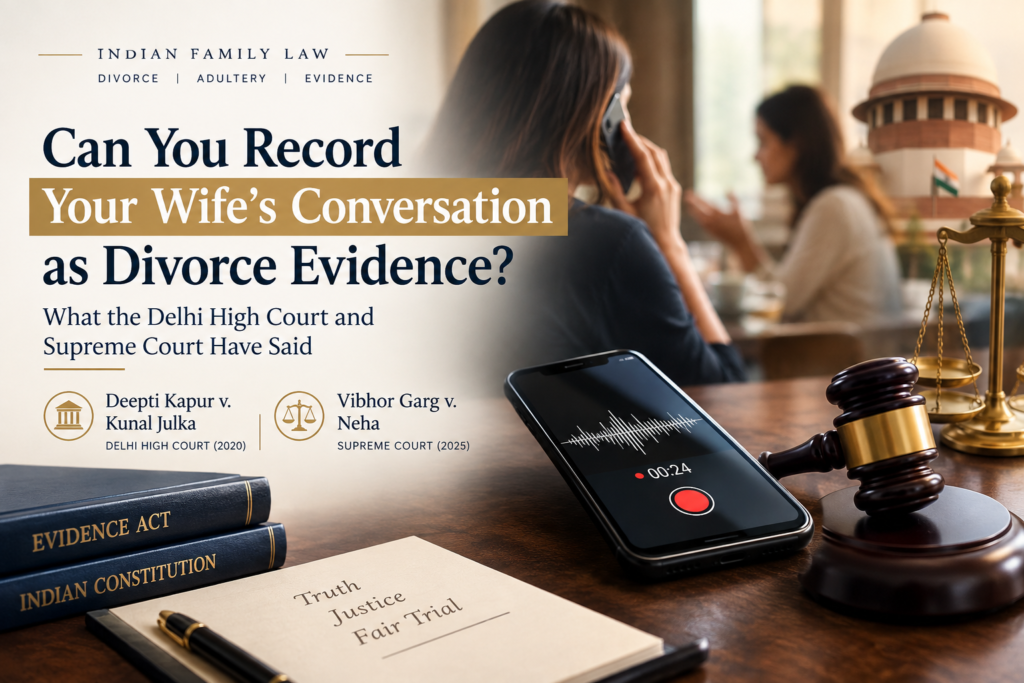
Yes, in most cases you can, and there is real, decided case law supporting it. The leading judgment is Deepti Kapur v. Kunal Julka, decided by the Delhi High Court in 2020, where a husband secretly recorded his wife’s phone conversation with a friend and was allowed to use it as evidence in his divorce case. The Court’s reasoning was direct: evidence obtained in breach of privacy is not automatically inadmissible, and where privacy and the right to a fair trial collide, the right to a fair trial can prevail. This was reinforced by the Supreme Court’s 2025 ruling in Vibhor Garg v. Neha, which confirmed that secretly recorded spousal conversations are admissible in matrimonial proceedings. The one thing worth understanding clearly before you record anything is that admissibility in your case and legal exposure for how you got the recording are two separate questions, and this guide covers both honestly.
Why the Old Advice on This Is Outdated
If you’ve searched this before, you’ve probably come across older articles confidently stating that secretly recording your wife’s conversations is inadmissible and a privacy violation, full stop. That advice is now out of date. It was built largely on a single, older judgment, and Indian courts, right up to the Supreme Court, have moved substantially since then. This guide walks through the actual, current case law, not the outdated version still circulating on the internet.
The Case That Answers This Directly: Deepti Kapur v. Kunal Julka
Deepti Kapur v. Kunal Julka, 2020 SCC OnLine Del 672, decided by the Delhi High Court on 30 June 2020, is about as close to your exact question as case law gets. The husband, in the middle of divorce proceedings, filed a Compact Disc containing an audio-video recording of his wife speaking on the phone with a friend, discussing him and his family in derogatory terms. He hadn’t recorded a conversation between the two of them, he’d recorded her conversation with someone else entirely.
The wife challenged this directly, arguing that a recording obtained without her knowledge or consent breached her fundamental right to privacy under Article 21 and should be excluded from evidence altogether. The Family Court disagreed and allowed the CD to be brought on record. The wife appealed to the Delhi High Court.
Justice Anup Jairam Bhambhani upheld the Family Court’s decision, and the reasoning is now one of the most frequently cited passages on this subject, evidence collected in breach of the right to privacy, by itself, does not make it inadmissible in a court of law. The Court held that where the right to privacy and the right to a fair trial genuinely collide, both being facets of Article 21, the right to a fair trial may have to be given precedence, particularly in a Family Court, where Section 14 of the Family Courts Act, 1984, gives the judge wide latitude to receive material that a strict civil or criminal court might otherwise keep out, precisely because the goal is getting to the truth of a matrimonial dispute.
The 2025 Supreme Court Ruling That Reinforces This
More recently, in Vibhor Garg v. Neha, 2025 SCC OnLine SC 1421, decided 14 July 2025 by a Bench of Justices B.V. Nagarathna and Satish Chandra Sharma, the Supreme Court examined this entire area afresh. A husband had secretly recorded years of phone conversations with his wife to support his divorce case. The Punjab and Haryana High Court had thrown the recordings out on privacy grounds; the Supreme Court reversed that and restored their admissibility.
What makes this judgment especially useful is that the Supreme Court didn’t decide in a vacuum, an amicus curiae placed before the Bench a full compilation of how different High Courts had ruled on this exact question. Deepti Kapur v. Kunal Julka was specifically listed among the judgments that had allowed such recordings into evidence. The Supreme Court’s own reasoning reinforced that direction, holding that Section 122 of the Evidence Act, which protects spousal communications as privileged, was designed to protect the institution of marriage, not to shield one spouse’s conduct from scrutiny in a dispute between the two of them, and that this privilege carries a built-in exception for exactly this kind of proceeding. The Court applied a three-fold test before such material is actually admitted, relevance, proper identification of the voice, and accuracy, meaning the recording hasn’t been tampered with.
Between these two judgments, you have both a Delhi High Court decision squarely on point, recording a conversation with a third party, and a Supreme Court decision reinforcing the underlying principle at the highest level. That’s about as solid a legal footing as this kind of question gets in Indian law right now.
The Contrary View, and Why It’s Worth Knowing About Too
In fairness, this isn’t a completely uniform picture, and you should know the other side exists so you’re not caught off guard. In Rayala M. Bhuvaneswari v. Nagaphanender Rayala, AIR 2008 AP 98, the Andhra Pradesh High Court took the opposite view on similar facts, a husband recording his wife’s conversations with others, and held that the act of tapping itself was illegal and the recordings were inadmissible, regardless of their content. Some other High Courts have followed similar reasoning in specific cases.
What the Supreme Court’s compilation in Vibhor Garg makes clear is that this is a genuine, acknowledged split among High Courts, not a settled, one-sided position. But the direction of travel, particularly with the Supreme Court’s 2025 ruling and its reliance on Family Court flexibility under Section 14, and with Deepti Kapur standing as good law in Delhi, is now clearly toward admissibility. If your matter is in Delhi specifically, Deepti Kapur is binding precedent you can rely on directly.
The One Thing Worth Separating Clearly: Evidence vs. Conduct
Here’s the nuance that both Deepti Kapur and Vibhor Garg are careful about, and it’s worth being equally careful about yourself. The courts are answering the question “can this recording be used as evidence,” not the question “was it fine for you to make it.” Deepti Kapur itself noted that if the act of recording amounted to something independently unlawful, that conduct could still be dealt with separately, under privacy law or otherwise, even while the evidence itself gets admitted in your case. In practice, this separate risk is rarely pursued and has not stopped courts from admitting the evidence, but it’s worth knowing it exists rather than assuming there’s zero exposure of any kind.
A Reminder Worth Repeating: Adultery Itself Isn’t a Crime
One more thing worth being clear on before you act on any of this. Since Joseph Shine v. Union of India, (2019) 3 SCC 39, decided in 2018, adultery is no longer a criminal offence in India, Section 497 IPC was struck down. You can’t file a police complaint over the affair itself. What a recording like this is actually useful for is establishing grounds for your own divorce, typically cruelty, or corroborating a claim under Section 13(1)(i) of the Hindu Marriage Act, not initiating any criminal proceeding against your wife or the other person.
What This Means Practically
If you’re recording a conversation, whether it’s one you’re personally part of or one your wife is having with someone else, keep the original file completely untouched, don’t edit, trim, or re-save it in a way that could be challenged as tampering, since accuracy is one of the three tests courts apply. Be ready to have the recording authenticated, typically through a certificate under Section 63 of the Bharatiya Sakshya Adhiniyam for electronic evidence, and through voice identification if the other side disputes whose voice is on it. And go in with realistic expectations, this evidence supports a divorce petition on grounds like cruelty; it isn’t a criminal complaint against anyone.
A Realistic Example
A husband suspects his wife is involved with a colleague and, using a recording app on a phone she sometimes leaves at home, records a call where she speaks to the colleague in terms that make the nature of the relationship fairly evident. He files this recording in his divorce petition, seeking dissolution on the ground of cruelty. His wife’s counsel argues the recording should be excluded entirely because it was obtained without her knowledge and violates her privacy. Relying on Deepti Kapur v. Kunal Julka and the Supreme Court’s reasoning in Vibhor Garg v. Neha, his counsel argues the recording is admissible regardless of how it was obtained, and that its relevance to establishing cruelty outweighs the privacy objection at the admissibility stage. The Family Court agrees to take the recording on record, subject to the husband establishing, through the standard three-fold test, that the voice is identifiable as his wife’s and that the recording hasn’t been altered.
What To Do Next
If you already have a recording, preserve the original file exactly as it was created, don’t forward it, edit it, or create copies that could complicate establishing its authenticity later. If you’re deciding whether to record something going forward, understand that the law is now genuinely on your side if the recording ends up being used as evidence in a matrimonial case, but that doesn’t mean every method of obtaining it is risk-free, talk to a lawyer about your specific situation before you act, particularly if what you’re considering goes beyond a simple audio recording into territory like installing tracking software or accessing her accounts directly.
Frequently Asked Questions
Can I actually use a recording of my wife talking to someone else in my divorce case?
Yes, this is supported by real case law. In Deepti Kapur v. Kunal Julka, the Delhi High Court allowed exactly this, a husband’s recording of his wife’s phone call with a friend, to be used as evidence in his divorce case.
Does it matter that she didn’t know she was being recorded?
Not for the question of whether the evidence is admissible. Courts have held that a privacy violation, by itself, doesn’t automatically exclude evidence, particularly in Family Court proceedings where the priority is resolving the actual dispute.
Is there a Supreme Court judgment that backs this up, or is it just a Delhi High Court ruling?
Both. Deepti Kapur is a Delhi High Court decision, and the Supreme Court’s 2025 ruling in Vibhor Garg v. Neha reinforced the same underlying principle at the national level, secretly recorded spousal conversations are admissible in matrimonial proceedings, subject to establishing relevance, identification, and accuracy.
Can I get in any legal trouble for making the recording, even if it’s allowed as evidence?
It’s a separate question from admissibility, and courts have acknowledged it exists, but in practice this hasn’t stopped recordings from being admitted in the cases discussed here. It’s still worth discussing your specific method of recording with a lawyer beforehand.
Do I need to prove the actual act of adultery, or is a recording like this enough on its own?
You don’t need direct proof of the act itself, courts have long accepted circumstantial evidence for adultery. A recording like this is typically used to support a cruelty ground or to corroborate the overall picture, alongside other evidence, rather than standing entirely alone.
Can I file a criminal case against my wife for adultery once I have this evidence?
No. Adultery was decriminalised by the Supreme Court in 2018. This kind of evidence is used in your civil divorce petition, not in a criminal complaint.
What do I need to do to make sure the recording actually gets accepted in court?
Keep the original file unaltered, be prepared to have the voice identified as your wife’s, typically through her own admission or expert comparison, and be ready to produce a certificate under Section 63 of the Bharatiya Sakshya Adhiniyam authenticating the electronic evidence.
Conclusion
The honest, verified answer is yes, courts in India, including the Delhi High Court in Deepti Kapur v. Kunal Julka and the Supreme Court in Vibhor Garg v. Neha, have allowed secretly recorded conversations, including a wife’s conversation with someone else, to be used as evidence in matrimonial proceedings. The reasoning is consistent: a privacy objection alone doesn’t make evidence inadmissible, particularly where it’s relevant to resolving a genuine matrimonial dispute. Keep your recording unaltered, be ready to authenticate it properly, and go in understanding that this evidence builds your divorce case, not a criminal complaint, since adultery itself is no longer a crime in India.
Adv. Aman Chawla practices matrimonial and family law before the Delhi High Court, Delhi Family Courts (Saket, Rohini, Dwarka, Karkardooma, Patiala House), and the Supreme Court of India. For a consultation on your specific situation, reach out through the contact details on this website.
Disclaimer: This article is for general informational purposes only and does not constitute legal advice. As per the Rules of the Bar Council of India, advocates are not permitted to advertise or solicit work, and nothing in this article should be construed as advertising, solicitation, or an invitation to engage this firm. Readers should consult a qualified advocate regarding their specific circumstances before taking any legal action.