
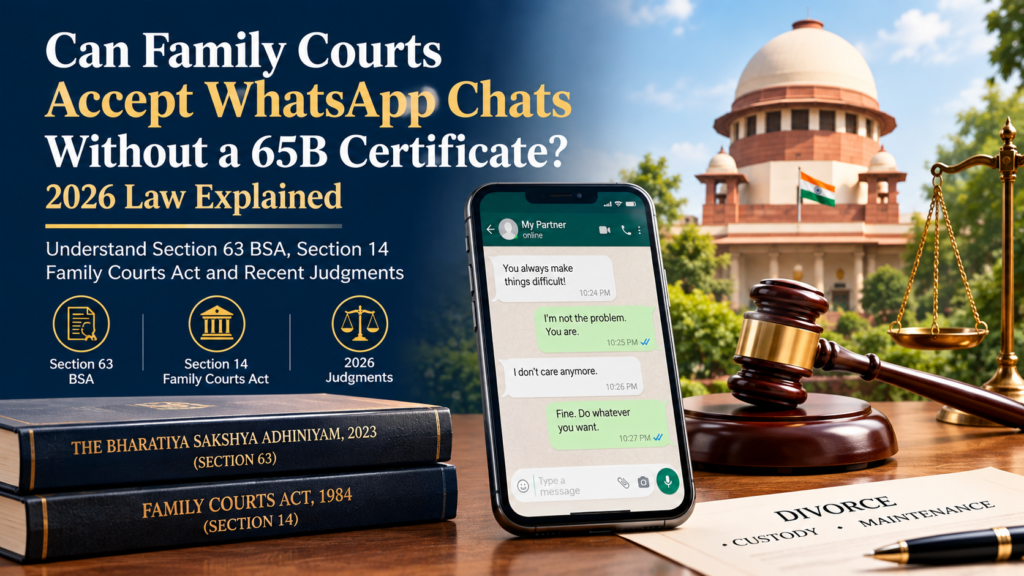
This Article is written by Adv. Aman Chawla, Family Law Expert | Delhi High Court & Supreme Court of India
Practising in Family & Matrimonial Law | Jangpura, New Delhi
WhatsApp chats as evidence have become increasingly important in matrimonial and Family Court disputes. A message sent late at night, a series of abusive texts, a conversation with a spouse’s family member, or a chat revealing conduct relevant to cruelty may appear straightforward on a mobile phone. But when that conversation reaches a courtroom, the question becomes much more complicated.
Is a WhatsApp screenshot automatically evidence?
The answer is no.
And in 2026, there is an even more important question for matrimonial litigation:
Can a Family Court consider WhatsApp chats even when the usual electronic-evidence certification requirements have not been fully complied with?
Recent judgments show that the answer cannot be reduced to a simple yes or no.
The ordinary rules governing electronic records continue to matter. At the same time, Family Courts have a special statutory framework under Section 14 of the Family Courts Act, 1984, which gives them wider flexibility in receiving material that may help them effectively decide a matrimonial dispute.
Two 2026 decisions illustrate this tension particularly clearly. In Jyoti Rani v. Nishant Kumar, the Patna High Court treated the absence of the required electronic-evidence certificate as fatal to the WhatsApp messages relied upon in that case. Just weeks later, in Archana Singh v. Anand Kumar Gupta, the Chhattisgarh High Court held that WhatsApp chats placed before a Family Court could not simply be ignored merely because the strict evidentiary requirements had not been complied with, particularly when the material had not been specifically controverted.
For someone involved in a divorce, cruelty, custody or maintenance dispute, this distinction is extremely important.
A WhatsApp Screenshot Is Not Automatically Proof
People often believe that if a WhatsApp message is visible on their phone, they can simply take a screenshot, print it and submit it to the court.
That approach can create problems.
A screenshot can show what appears on a screen, but the court may still have questions about who sent the message, which device was used, whether the conversation is complete, whether anything was deleted or edited, how the electronic record was extracted, and whether the copy being produced accurately represents the original digital record.
This is why electronic evidence has traditionally been treated differently from an ordinary paper document.
For many years, Section 65B of the Indian Evidence Act, 1872 governed the admissibility of electronic records. The Supreme Court’s decision in Arjun Panditrao Khotkar v. Kailash Kushanrao Gorantyal reaffirmed the importance of the statutory certificate for secondary electronic evidence.
Since 1 July 2024, the Bharatiya Sakshya Adhiniyam, 2023 (BSA) has replaced the Indian Evidence Act. The corresponding provision dealing with electronic records is now Section 63.
Therefore, when people continue to use the expression “65B certificate” in 2026, they are often referring to the electronic-evidence certification concept that now operates under Section 63 of the BSA.
That distinction matters because matrimonial lawyers and litigants should not treat “65B” as if the old Evidence Act is still generally governing every new proceeding.
What Does Section 63 of the BSA Do?
Section 63 of the Bharatiya Sakshya Adhiniyam deals with the admissibility of electronic records.
The law recognises electronic and digital records as documents, but when a party relies upon an electronic record in the manner contemplated by the provision, the statutory requirements for establishing the record become important.
The BSA also contains a prescribed certificate mechanism. The schedule to the legislation requires information concerning the device or digital source from which the electronic record has been produced and other relevant technical details.
This becomes particularly relevant where a person wants to rely upon screenshots, exported WhatsApp conversations, copied digital files, recordings, emails or other electronic material.
The important practical lesson is simple:
Do not assume that possessing a screenshot means that the evidentiary foundation has already been established.
The stronger question is whether the electronic material can be properly identified, authenticated and presented in the form required by the applicable law.
But Family Courts Are Different
This is where matrimonial litigation becomes more complicated.
Family Courts are not exactly the same as ordinary civil courts when it comes to receiving evidence.
Section 14 of the Family Courts Act, 1984 gives a Family Court power to receive reports, statements, documents, information and other material that may assist it in effectively dealing with a dispute, even where such material might otherwise face objections under ordinary evidentiary rules.
This provision exists because matrimonial disputes are often deeply personal and fact-intensive.
A husband and wife may communicate through WhatsApp every day. Their relationship may involve hundreds or thousands of messages. Important events may never have been recorded through formal documents. A dispute concerning cruelty, harassment, separation, reconciliation, threats or conduct towards family members may therefore leave a digital trail rather than a traditional documentary record.
Family Courts are designed to examine such disputes in a manner that facilitates effective adjudication.
But this does not mean that every WhatsApp screenshot automatically becomes reliable evidence.
There is an important difference between receiving material for consideration and accepting every allegation contained in that material as proved.
That distinction is at the heart of the recent case law.
The September 2026 Chhattisgarh High Court Decision
The issue received fresh attention in Archana Singh v. Anand Kumar Gupta, decided by the Chhattisgarh High Court on 23 September 2026.
The wife had relied upon WhatsApp chats concerning family members in support of her allegations of matrimonial cruelty.
The Family Court had not accepted the chats as sufficient material, among other reasons because there were concerns regarding the identity of the person holding the mobile phone and because the chats were incomplete.
The matter reached the High Court.
The High Court took a different approach.
It noted that the husband had not specifically denied or controverted the contents of the WhatsApp material. The Court therefore held that the chats could not simply be brushed aside.
The judgment placed particular emphasis on Section 14 of the Family Courts Act. The Court observed that a Family Court is not fettered by the strict rules of relevancy and admissibility in precisely the same manner as an ordinary civil court.
The Court consequently considered the WhatsApp material along with the surrounding circumstances and concluded that the conduct reflected in the chats amounted to mental cruelty.
The marriage was consequently dissolved on the ground of cruelty.
The significance of this judgment is not that “WhatsApp evidence never needs a certificate in Family Court.”
That would be an overstatement.
The more accurate understanding is that Section 14 gives a Family Court wider discretion to receive and consider material that may assist in resolving the matrimonial dispute, and the absence of strict compliance with ordinary evidentiary requirements does not necessarily mean that such material must automatically be ignored in every Family Court proceeding.
That is a much narrower—and more useful—proposition.
The Patna High Court Took a Different Approach
The contrast becomes particularly clear when the September judgment is compared with Jyoti Rani v. Nishant Kumar, decided by the Patna High Court in August 2026.
In that case, WhatsApp messages were relied upon as part of the husband’s evidence in a divorce case.
The High Court examined the electronic material and found that the required certificate under Section 65B(4) of the then-applicable Evidence Act had not been produced.
Relying upon the Supreme Court’s decision in Arjun Panditrao Khotkar, the Court treated the certificate requirement as mandatory for the electronic record relied upon in that case.
The Court further held that oral testimony could not cure the absence of the statutory certificate.
Once the WhatsApp material was excluded, the remaining evidence was found insufficient to establish cruelty of the required degree, gravity and continuity. The divorce decree was therefore set aside.
This judgment demonstrates why a litigant should never approach electronic evidence casually.
A WhatsApp conversation may appear extremely damaging on a phone screen. But if the court ultimately cannot rely upon it in the manner required by the applicable evidentiary framework, the entire case can become much weaker.
So Which Rule Applies in 2026?
This is where many online explanations become misleading.
It is incorrect to say:
“Every WhatsApp screenshot requires a 65B certificate.”
It is equally risky to say:
“Family Courts can accept WhatsApp chats without any certificate.”
Neither statement captures the full legal position.
The correct analysis depends on several factors.
The first question is which evidentiary law applies to the proceeding and the electronic record being tendered. For current proceedings, the Bharatiya Sakshya Adhiniyam and Section 63 must be considered.
The second question is what exactly is being produced. There is a difference between an original electronic record, material directly available from the relevant device, screenshots, printouts, exported conversations and copies obtained from another source.
The third question is whether the authenticity or identity of the material has been disputed.
The fourth question is whether the matter is before a Family Court and whether Section 14 of the Family Courts Act is being invoked.
The fifth question is whether the material actually assists the court in deciding the matrimonial dispute.
And finally, even if material is received by a Family Court, the court still has to determine what weight should be given to it in the context of the entire evidence.
That is why a screenshot should never be treated as the beginning and end of the evidence strategy.
What Happens If the Other Spouse Says, “That Is Not My WhatsApp”?
This is one of the most important practical situations.
Suppose a wife produces screenshots showing abusive messages and the husband says:
“I never sent these messages.”
The case is no longer simply about whether a screenshot exists.
The court may need to consider questions of identity, authorship, phone number, device ownership or control, surrounding circumstances and the manner in which the record was obtained and produced.
The same problem can arise in reverse.
Suppose a husband produces a conversation allegedly showing that his wife admitted an extramarital relationship. If the wife disputes the conversation and says that screenshots have been edited or taken out of context, the evidentiary dispute can become much more complicated.
The safest approach is therefore to preserve the original digital material and not rely solely on cropped screenshots.
Why Complete Conversations Matter
Another common mistake is selecting only one or two messages from a much longer conversation.
A single sentence may appear extremely damaging when removed from its surrounding context.
The preceding messages may explain what was being discussed. Later messages may show that the statement was withdrawn, clarified or made sarcastically. The conversation may also show that both spouses were using similar language during an argument.
Courts do not decide matrimonial cases by reading one isolated sentence in complete abstraction from the surrounding circumstances.
This is especially important in allegations of mental cruelty.
Cruelty is generally determined from the overall conduct and circumstances of the relationship. A WhatsApp conversation can therefore become more meaningful when it is viewed together with other evidence rather than presented as a standalone screenshot.
Can WhatsApp Chats Prove Mental Cruelty?
Yes, WhatsApp communications can potentially support a case of mental cruelty.
But the existence of unpleasant messages does not automatically establish legal cruelty.
The court has to examine the nature of the conduct, its context, frequency, seriousness and effect on the matrimonial relationship.
Repeated threats, sustained abuse, humiliation, harassment or communications directed against a spouse’s close family may have a very different evidentiary significance from a single angry message sent during an isolated argument.
The recent Archana Singh decision demonstrates how WhatsApp communications can become significant when viewed in the context of the overall conduct alleged in the matrimonial relationship.
At the same time, Jyoti Rani demonstrates the other side of the issue: if the electronic evidence relied upon to establish cruelty cannot be admitted or relied upon in the circumstances of the case, removing that evidence may leave the allegations insufficiently proved.
The lesson is therefore not simply “save WhatsApp messages.”
The lesson is:
Preserve the messages properly, establish their authenticity where required, and present them together with the surrounding evidence.
What About WhatsApp Evidence in Adultery Cases?
The same principles become relevant where WhatsApp communications are relied upon to allege an extramarital relationship.
A message suggesting emotional intimacy may not, by itself, establish adultery.
A series of conversations, photographs, travel records, hotel records, call details and other surrounding circumstances may tell a different story.
Electronic evidence therefore needs to be examined as part of the larger factual picture.
A person considering litigation should also be careful about how such material is obtained. Accessing another person’s account by hacking, impersonation or other unlawful methods can create separate legal and privacy issues.
The existence of an evidentiary route does not mean that every method of obtaining evidence is automatically protected from challenge.
What About Call Recordings?
Call recordings present another layer of complexity.
In February 2026, the Chhattisgarh High Court dealt with a matrimonial dispute involving call recordings and WhatsApp chats and upheld a Family Court’s decision allowing such material to be brought on record, while discussing the relationship between privacy and fair adjudication.
The judgment is important because it demonstrates that a privacy objection does not necessarily end the evidentiary inquiry in a matrimonial case.
But again, this should not be misunderstood as a general licence to secretly obtain every piece of private information.
The court must still consider relevance, authenticity, the circumstances in which material was obtained and the requirements of a fair adjudication.
The evidence strategy should therefore be designed carefully rather than after the material has already been collected.
Section 14 Does Not Mean “Anything Goes”
This is perhaps the most important clarification.
Section 14 of the Family Courts Act is powerful, but it should not be understood as a provision that eliminates every evidentiary objection.
A Family Court may have greater flexibility in receiving material, but that does not mean that fabricated screenshots, manipulated conversations or unidentified digital material automatically become trustworthy.
There is a difference between admissibility, relevance, authenticity and weight.
A court may receive material and still decide that little or no weight should ultimately be given to it.
Similarly, a court may consider the surrounding circumstances when deciding whether a disputed digital conversation is credible.
This is why a good matrimonial evidence strategy looks beyond the screenshot itself.
What Should You Preserve If a WhatsApp Conversation May Become Evidence?
If a WhatsApp conversation is potentially relevant to a matrimonial dispute, preserving the original digital material is far better than waiting until the case is filed.
Do not immediately delete the conversation.
Do not crop every screenshot so heavily that the surrounding context disappears.
Preserve the relevant conversation in its original form where possible.
Keep the device on which the conversation exists.
Preserve the relevant phone number and contact details.
Keep photographs, videos, emails, call records and other related material together with the conversation.
If there are particularly important messages, preserve the surrounding conversation rather than only the one message that appears favourable.
If the other party may dispute the authenticity of the material, obtain appropriate technical and legal advice before relying upon it.
This can become especially important when the electronic evidence is central to the entire divorce case.
A Practical Example
Imagine that a wife files for divorce alleging mental cruelty.
She says that her husband repeatedly abused her and her sisters through WhatsApp.
She has screenshots of several conversations.
If she simply prints five screenshots and files them, the husband may dispute the phone number, authorship, completeness or authenticity.
Now consider a better-prepared evidentiary record.
The relevant conversations have been preserved, the original device is available, the identity and number are established, the surrounding messages are retained, related communications are preserved, and the material is presented along with testimony and other evidence explaining what happened.
The difference can be significant.
The question is no longer simply:
“Is there a screenshot?”
The court can examine the broader question:
“What does this digital material reliably establish about the conduct of the parties?”
That is a much stronger way of approaching electronic evidence.
What If the Other Side Does Not Specifically Deny the WhatsApp Messages?
The recent Archana Singh decision makes this issue particularly interesting.
The Chhattisgarh High Court noted that the husband had not specifically denied or controverted the contents of the WhatsApp chats relied upon by the wife.
That circumstance mattered to the Court when considering whether the material could simply be ignored.
This does not mean that silence automatically proves every WhatsApp screenshot.
But it does demonstrate why pleadings and cross-examination matter.
If a party genuinely disputes the authenticity or authorship of a digital conversation, that objection should be properly raised and supported.
Simply waiting until the final stage of litigation and then making a vague objection may not produce the same result as a clear and timely challenge.
Why the 2026 Judgments Matter for Delhi Matrimonial Cases
For parties litigating matrimonial disputes in Delhi, these developments are particularly relevant because digital communications are now routinely involved in divorce, cruelty, maintenance, custody and domestic-violence-related disputes.
A modern matrimonial case may contain WhatsApp chats, emails, Instagram messages, photographs, cloud documents, bank records, call records, location information and other digital material.
The courtroom question is increasingly becoming not whether digital evidence exists, but how reliably it can be presented and what legal weight it should receive.
The 2026 judgments show that litigants should not rely on a single simplistic rule.
A Family Court may have broader powers to receive relevant material under Section 14 of the Family Courts Act. At the same time, electronic evidence requirements remain highly relevant, particularly where a party seeks to establish a digital record through the statutory framework governing electronic evidence.
The precise circumstances of the case therefore matter.
What Should a Spouse Do Before Filing a Divorce Case?
If WhatsApp evidence is likely to play an important role in a matrimonial dispute, the evidence should be reviewed before the petition is drafted.
This is because the pleadings and evidence should tell the same story.
If a person alleges repeated mental cruelty but possesses only one isolated message, the legal significance may be limited.
If there are months of communications showing a consistent pattern of threats, humiliation or harassment, the evidentiary picture may be very different.
The same applies to allegations of adultery, desertion, domestic violence or harassment.
A lawyer should ideally examine the original communications, surrounding circumstances, available corroborative evidence and potential objections before deciding how the material should be presented.
Frequently Asked Questions
Can WhatsApp screenshots be used as evidence in Family Court?
Yes, WhatsApp screenshots and other digital communications can potentially be considered in matrimonial proceedings. However, their evidentiary value depends on factors such as authenticity, identity, completeness, relevance and the applicable evidentiary requirements. A screenshot should not automatically be assumed to be conclusive proof.
Is a 65B certificate still required in 2026?
The Indian Evidence Act has been replaced by the Bharatiya Sakshya Adhiniyam, 2023. The electronic-record provision is now Section 63 of the BSA. The expression “65B certificate” is still commonly used because the earlier law governed many older cases and the Supreme Court’s jurisprudence under Section 65B remains highly relevant to understanding electronic evidence.
Can a Family Court accept WhatsApp chats without a certificate?
The answer depends on the circumstances. Section 14 of the Family Courts Act gives Family Courts wider discretion in receiving material that may assist them in effectively deciding matrimonial disputes. The Chhattisgarh High Court’s September 2026 decision in Archana Singh illustrates this approach. However, that judgment should not be read as creating a blanket rule that certification requirements can simply be ignored in every Family Court proceeding.
What happened in Jyoti Rani v. Nishant Kumar?
The Patna High Court considered WhatsApp messages relied upon in a divorce case and found that the required Section 65B certificate had not been produced. Relying on the Supreme Court’s decision in Arjun Panditrao Khotkar, the Court held that the electronic material could not be relied upon in the circumstances of that case. After excluding the messages, the remaining evidence was insufficient to establish cruelty.
Can WhatsApp messages prove mental cruelty?
They can support a case of mental cruelty when they reliably establish relevant conduct and are considered with the surrounding circumstances. However, a single offensive or angry message does not automatically amount to legal cruelty. The nature, seriousness, continuity and overall context of the conduct remain important.
Should I preserve the original phone?
Yes. If an electronic conversation may become important evidence, preserving the original device and the underlying digital material can be extremely useful. Relying only on cropped screenshots can create avoidable disputes regarding authenticity and completeness.
Can deleted WhatsApp messages be recovered?
Recovery depends on the device, backups, applications, storage and technical circumstances. The important point is not to attempt risky manipulation of the device or account. If the material is potentially important to litigation, professional technical and legal advice should be obtained before attempting recovery.
Can WhatsApp evidence be used in custody cases?
Digital communications may be relevant in custody proceedings where they genuinely assist the court in assessing issues concerning the child’s welfare, parental conduct or communication between the parties. However, custody decisions focus on the welfare and best interests of the child, and a WhatsApp conversation by itself does not automatically determine custody.
Final Takeaway
The biggest mistake a matrimonial litigant can make in 2026 is to think that WhatsApp evidence has one simple rule.
It does not.
The general law governing electronic records remains important. Under the current legal framework, Section 63 of the Bharatiya Sakshya Adhiniyam must be considered when electronic records are tendered through the statutory mechanism.
At the same time, Family Courts operate under a special statutory environment. Section 14 of the Family Courts Act gives them wider flexibility to receive material that may help them effectively decide matrimonial disputes.
The recent decisions of Jyoti Rani v. Nishant Kumar and Archana Singh v. Anand Kumar Gupta demonstrate why the distinction matters.
One case shows how the absence of the required electronic-evidence certificate can prevent WhatsApp messages from being relied upon. The other shows that Family Courts may, in appropriate circumstances, consider WhatsApp material despite non-compliance with strict evidentiary requirements, particularly where the material has not been specifically controverted and is relevant to the matrimonial dispute.
Therefore, the safest approach is not to ask only:
“Do I have WhatsApp screenshots?”
The better question is:
“Can I establish what these messages are, who sent them, whether they are complete and authentic, how they were preserved, and why they are relevant to my matrimonial case?”
That is the approach that turns a collection of screenshots into a properly considered digital-evidence strategy.
If your divorce, cruelty, custody, maintenance or matrimonial dispute depends heavily on WhatsApp chats, recordings or other digital material, the evidence should ideally be legally reviewed before it is filed in court.