
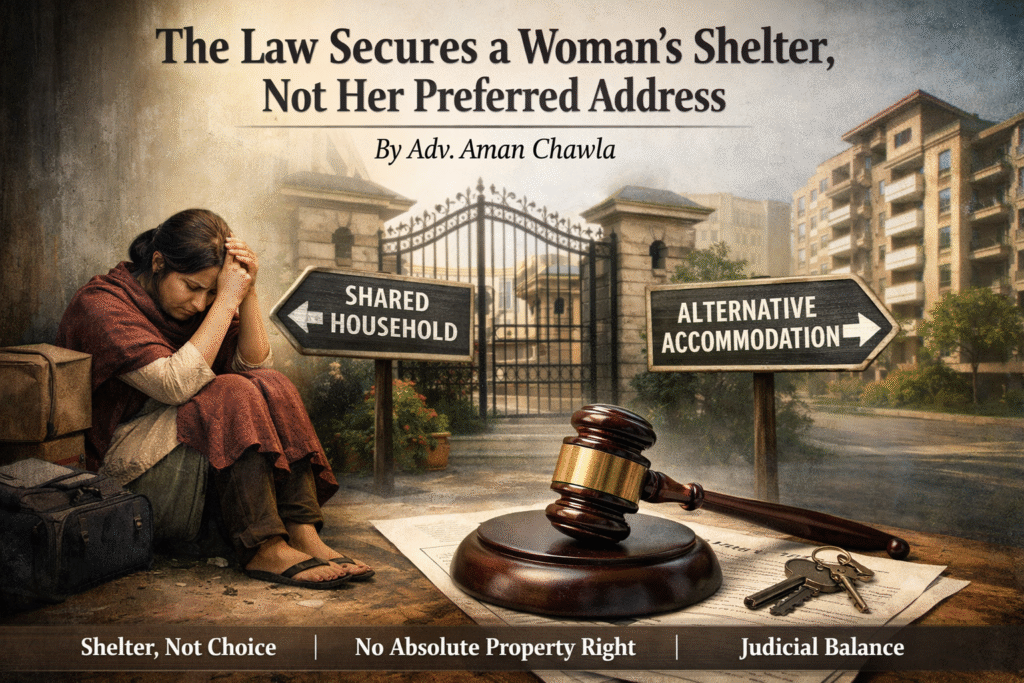
“The Law Secures a Woman’s Shelter, Not Her Preferred Address”
By Adv. Aman Chawla
I. Introduction: The True Contours of Residential Protection: The Right to Residence under the DV Act
The Protection of Women from Domestic Violence Act, 2005, was enacted to address the lived realities of women facing abuse within domestic relationships, including the often-overlooked dimension of economic abuse and forced dispossession. One of its most significant protections is the recognition of a wife’s right to residence. However, this right has frequently been misunderstood, overstated, or strategically invoked beyond its legislative intent.
The law draws a deliberate and principled distinction: it ensures that a woman is not rendered shelterless due to domestic violence, but it does not guarantee her the right to reside in a particular property of her choosing. The statutory promise is of shelter and security, not of address selection or property control.
II. Statutory Framework: Sections 17 and 19 of the Domestic Violence Act
Section 17 of the Act declares that every woman in a domestic relationship has the right to reside in the “shared household,” irrespective of her ownership or proprietary interest. This provision is declaratory and protective in nature. It seeks to prevent a situation where a woman is summarily ousted from the matrimonial home and left without immediate residential support.
Section 19 operationalises this right by empowering the Magistrate to pass appropriate residence orders. These orders may include restraining dispossession, directing the respondent to remove himself from the shared household, or, crucially, directing the respondent to provide alternative accommodation or rent in lieu thereof under Section 19(1)(f).
Read together, these provisions establish that the right to residence is not absolute or rigid, but flexible and responsive to circumstances.
III. Nature of the Right: Personal Protection, Not Proprietary Interest
Judicial interpretation has consistently clarified that the right to residence under the Act is not a property right. It does not confer ownership, title, or permanent possessory interest in any immovable property. Rather, it is a right in personam, enforceable against the respondent to prevent homelessness and destitution.
The courts have repeatedly cautioned that the Domestic Violence Act cannot be used as a surrogate forum for deciding title disputes, succession claims, or property entitlements. To permit such use would distort the remedial purpose of the statute and unsettle settled principles of property law.
Thus, the right protects residence, not ownership.
IV. The Concept of Shared Household: Judicially Balanced
While the definition of “shared household” under the Act is broad, judicial interpretation has imposed necessary discipline on its application. Courts have emphasised that not every property connected to the husband, or belonging to his relatives, automatically becomes enforceable as a residence by the wife.
Where the premises are owned exclusively by third parties, or where the wife has no subsisting domestic nexus with the household, courts have been cautious in directing continued residence. The emphasis has remained on fairness, safety, and feasibility rather than formalistic entitlement.
In such cases, insistence on residence in a specific property has been viewed as exceeding the protective purpose of the Act.
V. Section 19(1)(f): Alternative Accommodation as Substantive Relief
Section 19(1)(f) represents a crucial statutory balance. It empowers the Magistrate to direct the respondent to secure alternative accommodation of a similar standard, or to pay rent sufficient for such accommodation.
This provision acknowledges a practical truth: in many cases, continued cohabitation in the shared household may be unsafe, impracticable, or legally impermissible. Alternative accommodation, therefore, is not a denial of the wife’s right, it is its effective realisation.
Courts have treated this relief as a substantive measure that:
• Preserves the wife’s dignity and residential security,
• Avoids unjust intrusion into third-party property rights, and
• Reflects proportionality based on the standard of living during the marriage.
VI. No Absolute Right to Insist on a Particular Premises
A recurring misconception in matrimonial litigation is the belief that once a right to residence is established, the wife may insist upon living in a specific house, irrespective of ownership, equity, or surrounding circumstances.
Judicial precedent has firmly rejected this notion. The law does not compel the husband to provide residence at a location dictated solely by the wife’s preference. What it compels is that he ensures she is not left without reasonable and lawful shelter.
The difference is fundamental: the right is to housing security, not to housing selection.
VII. Judicial Discretion and Balancing of Competing Rights
Residence orders under the Act are not automatic. They are passed after careful consideration of multiple factors, including:
• The nature of the domestic relationship,
• Safety and well-being of the aggrieved woman,
• Ownership and possessory rights involved,
• Financial capacity of the respondent, and
• Overall equities between the parties.
The courts have consistently underscored that the Act is a welfare legislation, but not a tool for coercion or strategic pressure. Its remedies are meant to protect, not to penalise beyond necessity.
VIII. Conclusion: A Roof Assured, an Address Not Guaranteed
The domestic violence framework rests on a humane and constitutionally informed principle: no woman should be rendered homeless because a domestic relationship has broken down. At the same time, the law consciously refrains from converting this protection into an instrument for asserting control over specific property.
By recognising alternative accommodation under Section 19(1)(f) as a valid and often appropriate remedy, the law preserves the delicate balance between compassion and legality. It secures the roof over a woman’s head, while leaving the choice of address within the bounds of justice, ownership, and proportionality.
Written by Adv. Aman Chawla, practising in Delhi, focuses on matrimonial and family law matters.