Uniform Civil Code (UCC) – What It Means for Marriage & Divorce in India

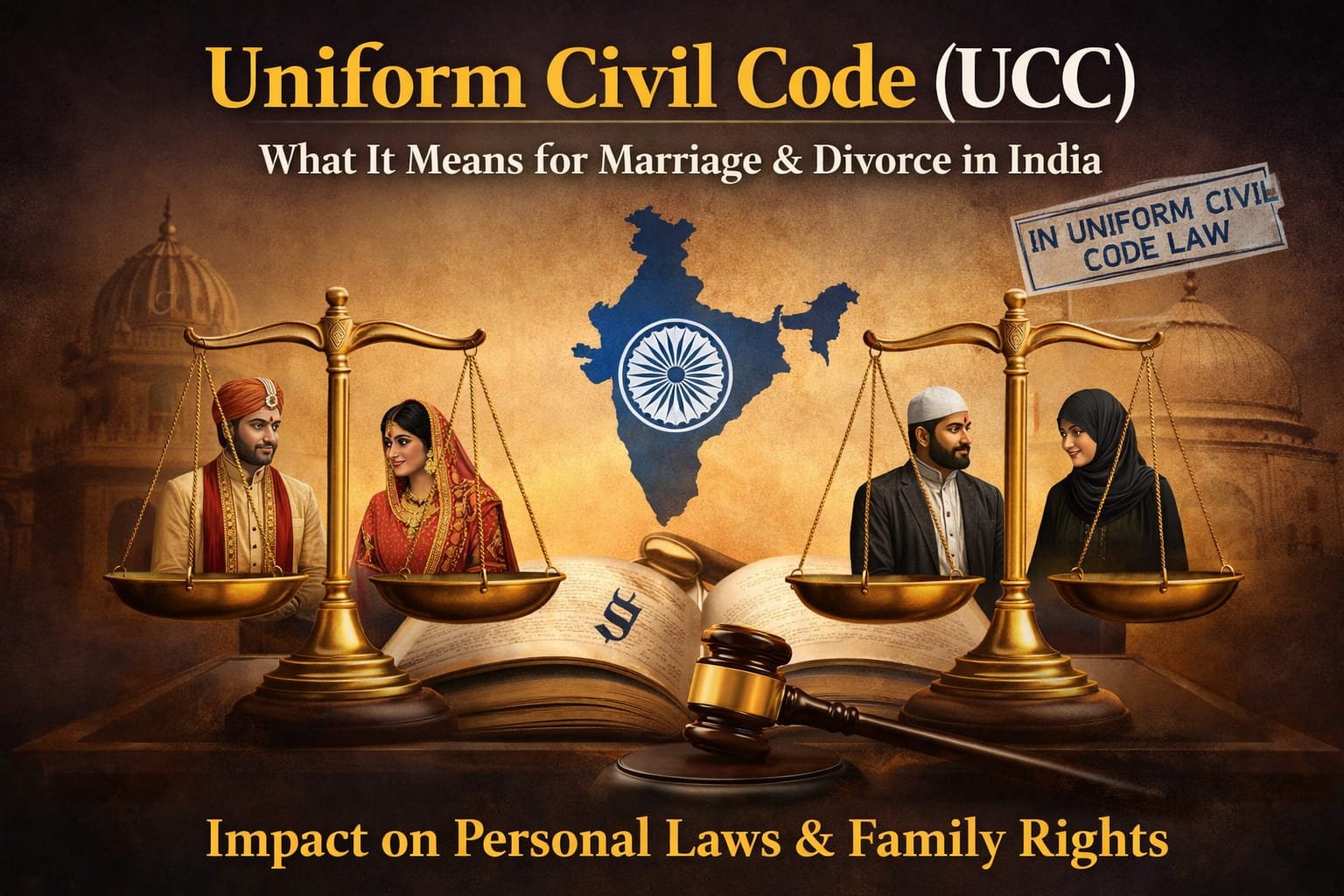
The concept of a Uniform Civil Code (UCC) has once again come into focus in India, sparking nationwide discussions. The idea behind UCC is to bring uniformity in personal laws governing marriage, divorce, maintenance, inheritance, and adoption—irrespective of religion.
With recent developments and state-level implementation efforts, many people are asking:
How will UCC impact marriage and divorce laws in India?
Will personal laws change completely?
Let’s break it down in a simple and practical way.
What is the Uniform Civil Code?
The Uniform Civil Code refers to a common set of laws that would apply to all citizens of India in matters such as:
- Marriage
- Divorce
- Maintenance (alimony)
- Inheritance
- Adoption
Currently, these matters are governed by different personal laws based on religion, such as:
- Hindu Law
- Muslim Personal Law
- Christian Law
- Parsi Law
UCC aims to replace these differences with a single, uniform legal framework.
Why is UCC Being Discussed Now?
The debate around UCC is not new. It is mentioned in Article 44 of the Constitution of India, which encourages the State to implement a uniform civil code.
However, recent developments—especially state-level initiatives—have brought it back into the spotlight.
Key reasons for renewed focus:
- Need for gender equality in personal laws
- Elimination of legal complexities and conflicts
- Simplification of legal processes
- Growing demand for uniform rights across communities
Impact of UCC on Marriage Laws
If implemented, UCC could bring significant changes in how marriages are legally recognized:
-
Uniform Marriage Age
A standard legal age for marriage across all communities.
-
Mandatory Registration
Marriage registration may become compulsory for all, improving legal clarity and reducing disputes.
-
Abolition of Certain Practices
Practices that conflict with constitutional values may be reviewed or removed.
This could lead to greater transparency and legal protection in matrimonial matters.
Impact on Divorce Laws
One of the biggest impacts of UCC would be on divorce procedures.
-
Common Grounds for Divorce
Instead of religion-specific rules, there may be uniform grounds such as:
- Cruelty
- Desertion
- Mutual consent
-
Standardized Procedure
Divorce proceedings could become more structured and consistent across all communities.
-
Faster Resolution
Uniformity may help reduce delays caused by conflicting legal interpretations.
This can make divorce laws more predictable and accessible.
Maintenance & Alimony Under UCC
Maintenance laws are currently one of the most debated areas.
Under UCC:
- Courts may follow a uniform approach to determine maintenance
- Focus could shift to financial fairness and dependency, rather than religious provisions
- Both spouses’ financial status may be equally considered
This could lead to more balanced and consistent decisions.
Impact on Child Custody & Adoption
UCC is expected to emphasize the “best interest of the child” principle.
- Possible changes include:
- Uniform custody rules
- Equal parental rights
- Simplified adoption process
This ensures that child welfare remains the top priority, irrespective of religion.
Challenges & Concerns
While UCC offers many benefits, it also raises important concerns:
-
Cultural Sensitivity
India is a diverse country with deeply rooted traditions. A uniform law must balance legal reform with cultural respect.
-
Implementation Complexity
Transitioning from multiple personal laws to one code requires careful drafting and execution.
-
Public Acceptance
Awareness and understanding will play a key role in successful implementation.
What Does This Mean for Individuals?
If UCC is implemented:
- Legal processes may become simpler and more uniform
- Rights and obligations could be more clearly defined
- Individuals may face fewer legal ambiguities
However, since implementation may vary and evolve over time, legal guidance will remain essential.
Conclusion
The Uniform Civil Code represents a significant step toward legal uniformity and equality in India. While it has the potential to simplify laws related to marriage and divorce, its success will depend on balanced implementation and public understanding.
For individuals dealing with matrimonial issues, staying informed about these developments is crucial.
Because when laws evolve, awareness becomes your strongest advantage.
Frequently Asked Questions (FAQs)
1. What is the Uniform Civil Code (UCC) in India?
The Uniform Civil Code (UCC) refers to a proposed common set of laws that would govern personal matters like marriage, divorce, maintenance, and inheritance for all citizens, regardless of religion.
2. Is the Uniform Civil Code implemented in India?
Currently, UCC is not implemented nationwide. However, discussions and developments are ongoing, and some states are taking steps toward introducing a uniform framework.
3. How will UCC affect marriage laws in India?
UCC may introduce uniform rules for marriage, such as:
Standard marriage age
Mandatory registration
Equal legal rights for all communities
4. Will divorce laws change under UCC?
Yes, UCC may bring uniform grounds for divorce across all religions, making the process more consistent and easier to understand.
5. Will personal laws be abolished after UCC?
If implemented fully, UCC may replace or significantly modify existing personal laws to create a single legal framework for all citizens.
6. How will maintenance (alimony) be decided under UCC?
Maintenance may be decided based on:
Financial condition of both spouses
Standard of living
Fairness and dependency
Instead of religion-based rules.
7. What impact will UCC have on child custody cases?
UCC is expected to focus on the best interest of the child, ensuring fair custody decisions and equal parental rights.
8. Is UCC mandatory for all citizens?
If enacted, UCC would generally apply to all citizens, but its implementation may depend on legislative decisions and framework.
9. What are the benefits of the Uniform Civil Code?
Legal uniformity
Gender equality
Simplified legal process
Reduced conflicts between personal laws
10. What are the challenges of implementing UCC?
Cultural and religious diversity
Public acceptance
Legal and administrative complexities
Written by Adv. Aman Chawla, practising in Delhi, focuses on matrimonial and family law matters.