Written by Adv. Aman Chawla | Matrimonial Law Specialist | Delhi High Court & Supreme Court of India 8 Years Exclusive Practice in Family & Matrimonial Law | July 2026
In January this year, I wrote about the specific and growing problem of AI-generated fake photographs being used as evidence in divorce cases. I warned then that deepfake images, AI-crafted screenshots, and algorithmically generated “recordings” were making their way into matrimonial proceedings and that courts were only beginning to develop the tools to identify and reject them.
Six months later, the Supreme Court of India has moved from caution to action — twice in five weeks.
On June 4, 2026, the Supreme Court released its Draft Regulations for Use of Artificial Intelligence in Courts, 2026 for public consultation. These draft rules, if adopted, will require mandatory disclosure every time AI is used to prepare any pleading, document, submission, or piece of evidence placed before any court in India.
Then, on July 2, 2026, a bench of Justice PS Narasimha and Justice Alok Aradhe set aside two tribunal orders — of the NCLT and NCLAT — after finding that both had relied on AI-hallucinated case citations that did not exist. The Court compared AI hallucinations to “methyl isocyanide in law” — a reference to one of the most toxic industrial chemicals known, released in the Bhopal disaster: “invisibly insidious and catastrophic by the time anyone notices.”
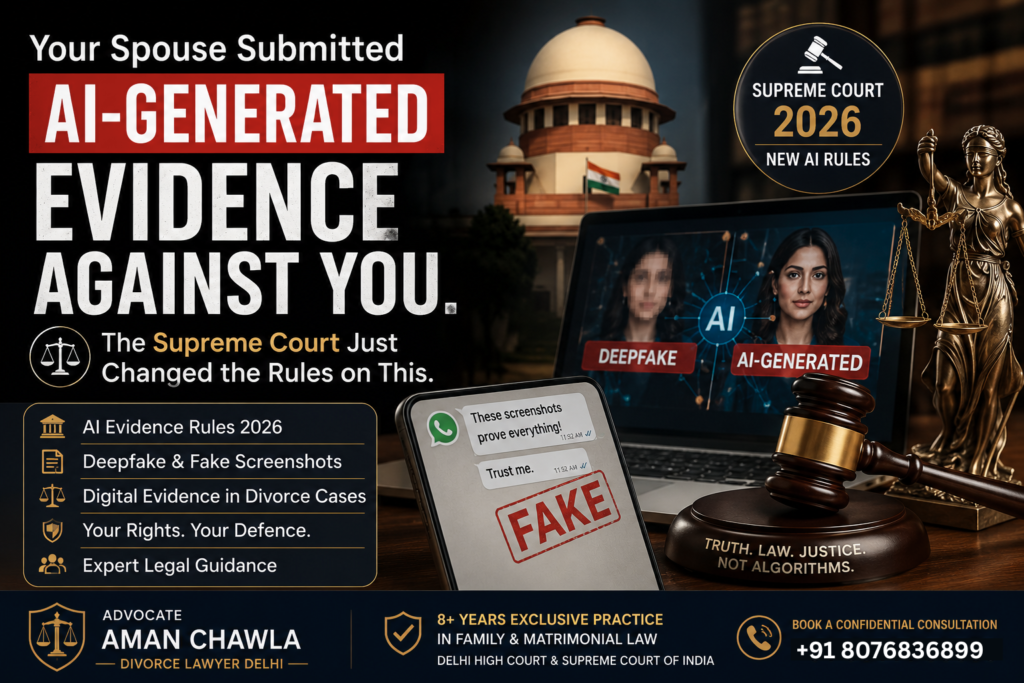
These two developments together significantly change the evidentiary landscape in Indian courts — including in matrimonial courts in Delhi. This article explains what has happened, what it means for the evidence in your divorce, maintenance, or custody case, and what you can do if you suspect AI-generated or AI-assisted material is being used against you.
1. What the Supreme Court’s July 2, 2026 Ruling Actually Held
The case (Pooja Ramesh Singh v. Jammu and Kashmir Bank Ltd. & Anr.) was not a matrimonial case — it was an insolvency dispute. But the legal principle it established applies to every court and tribunal in India, including Delhi’s family courts.
The NCLT had decided an insolvency matter by relying on six precedents. When these were checked, three of the six citations did not exist anywhere in any recognised legal database. The other three were real cases, but the paragraphs attributed to them had been invented — the actual judgments said nothing of the kind.
The Supreme Court’s findings:
First: A judicial or quasi-judicial decision founded on hallucinated, non-existent precedents is “no decision in the eyes of the law.” It cannot be sustained. The Court was not willing to treat this as a mere “error” to be overlooked.
Second: Reliance on AI-generated fake citations is not just a mistake — it is “misconduct” with “legal consequences” for the lawyer or party responsible. The Court had already issued notices to the Attorney General, Solicitor General, and Bar Council of India on this issue in February 2026. The July ruling follows up on that warning with consequences.
Third: The Court directed the Bar Council of India to constitute a formal expert committee to examine the full scope of AI use in legal practice and prescribe guiding principles and disciplinary norms.
Fourth: The strongest language in the ruling: “For those in the province of adjudication and determination of disputes, this by-product of AI — the production of fake, non-existing and hallucinated material and its utilisation as precedence in law — is like the release of methyl isocyanide in the province of law and justice, invisibly insidious and catastrophic by the time anyone notices.”
2. What the Supreme Court’s June 2026 Draft AI Rules Require
The Draft Regulations for Use of Artificial Intelligence in Courts, 2026 — released on June 4, 2026 by the SC’s AI Committee chaired by Justice PS Narasimha — are open for stakeholder consultation. They are not yet final rules. But they signal with great clarity where Indian court practice is going, and prudent lawyers and clients are already aligning their conduct with these principles.
The key provisions directly relevant to matrimonial litigation:
Mandatory AI Disclosure: Any party — including a litigant, lawyer, or legal representative — who uses AI to prepare any pleading, petition, affidavit, document, submission, or evidence must disclose this at the time of filing. Courts may additionally require the party to identify the AI platform used, the extent of its assistance, and the steps taken to verify the accuracy of its output.
AI Cannot Replace Human Judgment in Core Functions: AI is explicitly prohibited from performing functions that require judicial discretion: bail eligibility decisions, assessment of witness credibility, risk scoring, and any function that involves weighing of facts, context, and human circumstances. These remain exclusively in the domain of the human judge.
Responsibility Cannot Be Shifted to the Machine: Where AI generates an error, hallucination, or inaccuracy that finds its way into proceedings, responsibility rests with the human lawyer or party who used the AI and placed the material before the court. You cannot say “the AI made this up” as a defence. The lawyer is accountable for everything they file, regardless of how it was prepared.
AI Tools Permitted With Oversight: Research assistance, drafting of arguments, translation, transcription — these functions remain permitted. The Court itself runs several AI tools (SUPACE for research assistance, SUVAS for translation, TERES for transcription). The principle is assistance and efficiency, not replacement of judgment.
3. What This Means Specifically for Matrimonial Cases in Delhi
Matrimonial disputes are one of the areas most affected by the growing availability of AI tools to ordinary people — not just to lawyers. WhatsApp, email, and social media platforms are the primary evidential battlefield in most divorce and maintenance cases. And AI tools capable of generating fake screenshots, fabricating call records, creating convincing voice notes, and producing deepfake photographs are now accessible to anyone with a smartphone.
I covered the specific problem of AI-generated fake photographs in divorce cases in January 2026. The June and July SC developments change the picture in three important ways.
First — disclosure is now an approaching legal obligation: Under the draft rules, any party who used AI to prepare evidence must disclose this. This includes AI-generated screenshots that are being passed off as genuine chat records, AI-crafted voice notes being presented as real recordings, and AI-assisted documents. If a party presents AI-generated material without disclosure, the July ruling makes clear this is misconduct — not a procedural slip.
Second — challenging AI evidence just became easier: Before these rulings, challenging AI-generated evidence required complex technical arguments about authenticity. The July 2 ruling gives family court lawyers a direct, accessible ground: any material that is AI-generated and was not properly disclosed is procedurally defective, and any decision built on it can be challenged. “This citation does not exist” — or “this photograph has the characteristics of AI generation” — can now be raised with a clear legal consequence attached.
Third — courts must now actively verify, not passively accept: The SC’s observation that multiple courts relied on hallucinated material “on their own” — without the parties even submitting those citations — signals that the judiciary is being asked to exercise active scepticism rather than passive acceptance. Delhi’s family courts, which already receive large volumes of social media screenshots and digital evidence, are expected to apply this same scrutiny.
4. The Specific AI Risks in Your Divorce, Maintenance, or Custody Case
Fake WhatsApp screenshots: The most common AI-assisted evidence fabrication I see in matrimonial cases. WhatsApp message generators have existed for years. Now, AI tools can generate entire conversations with consistent timestamps, formatting, and even profile pictures that are indistinguishable to the naked eye from genuine screenshots. Courts increasingly require Section 65B certificates for electronic evidence — but even proper Section 65B certification of a fake screenshot does not make the underlying content genuine. Challenge through forensic authentication of the device, not just the certificate.
AI-generated voice recordings: Voice cloning technology has reached the point where a 30-second sample of someone’s voice can generate convincing audio in their voice saying anything. A husband or wife who denies saying something in a recording placed on evidence now has a stronger factual basis to demand forensic audio analysis before the court accepts the recording. The SC’s new rules require disclosure if AI was used to create or enhance recordings.
Deepfake photographs: Courts were already grappling with this before January 2026, and I covered it at the time. The mandatory disclosure requirement means that a party who submits AI-generated or AI-enhanced photographic evidence without disclosing AI use can now be confronted with the disclosure obligation directly. Ask: “Has the party disclosed whether AI was used to generate or enhance any photograph submitted as evidence?” If they haven’t, this is now a formal procedural deficiency.
AI-assisted maintenance affidavits: Less dramatic but equally important — AI tools can generate plausible-sounding financial affidavits based on prompts. An affidavit of assets and expenses prepared substantially by an AI tool, without human review or verification of the actual numbers, may contain invented figures or fabricated descriptions of expenses. The draft rules require disclosure of AI assistance even in document preparation.
5. What to Do If You Suspect AI-Generated Evidence in Your Case
Step 1 — Formally object and ask for disclosure: Once the draft rules are finalised (which is expected before the end of 2026), you will be able to formally require the other side to confirm whether AI was used to generate or assist in preparing any piece of evidence submitted. Even before finalisation, the July 2 ruling gives courts the authority to demand this disclosure. Put the question formally on record.
Step 2 — Apply for forensic examination: The family court has the power under Section 14 of the Family Courts Act to direct examination of electronic evidence by a court-appointed forensic expert. The same power that the SC affirmed for hotel records and CDRs (July 2, 2026 — a different ruling) applies here. A formally filed application requesting forensic authentication of specific photographs, recordings, or digital documents is the procedurally correct route.
Step 3 — Build a parallel factual record: The best defence against fabricated AI evidence is genuine evidence of what actually happened. Contemporaneous messages, witness accounts, photographs with verifiable metadata, and financial records that corroborate your version create a factual picture that is much harder to dislodge with a single piece of AI-generated material, however convincingly it is presented.
Step 4 — Consult a lawyer who understands both the legal and technical dimensions: Challenging AI-generated evidence requires knowing which arguments to make in what order — forensic objection, disclosure objection, reliability objection, Section 65B objection — and how to build your own affirmative case alongside the challenge. This is not a generic matrimonial law question; it requires current awareness of the court’s own evolving rules.
6. A Word of Caution in the Other Direction
If you are asking a lawyer to help you prepare your case and that lawyer is using AI to draft your pleadings, affidavit, or evidence summary — the June 2026 draft rules make clear that this use must be disclosed. If it isn’t disclosed and the AI produces something inaccurate or hallucinated, you and your lawyer bear the consequences. Ask your lawyer directly: “Are you using AI to prepare any part of my case? If so, how is that being verified and disclosed?”
A lawyer who cannot answer this question clearly is not managing the AI risk in your case adequately.
Consult Adv. Aman Chawla, Matrimonial Law Specialist, practising before the Supreme Court of India, Delhi High Court, and all Delhi district courts. Available for urgent matters, outstation clients, and online consultations across India.
Call / WhatsApp: +91-8076836899 | Email advocateamanchawla@gmail.com Office: O-11A Basement, Jangpura Extension, New Delhi – 110014
7. Frequently Asked Questions
Q1. Can my spouse use AI-generated screenshots as evidence against me in a divorce case?
They can attempt to submit them, but the Supreme Court’s July 2, 2026 ruling makes clear that AI-generated material — particularly fake or hallucinated content — submitted without disclosure is misconduct with legal consequences. The SC’s June 2026 draft rules require disclosure whenever AI is used to prepare any evidence. A formally filed objection and a forensic authentication application are the appropriate responses if you suspect AI-generated evidence has been submitted.
Q2. What are the Supreme Court’s new AI rules for courts in 2026?
The Supreme Court’s AI Committee (chaired by Justice PS Narasimha) released draft regulations on June 4, 2026 for public consultation. Key provisions: mandatory disclosure whenever AI is used to prepare any pleading, document, submission, or evidence; prohibition on AI performing adjudicatory functions (bail, credibility, risk scoring); personal accountability on lawyers/parties for AI errors; and courts can require details of the AI tool used and verification steps taken.
Q3. What happened in the Supreme Court’s July 2, 2026 AI ruling?
The Supreme Court set aside orders of the NCLT and NCLAT in an insolvency matter after finding they had relied on AI-hallucinated case citations — three of which did not exist, and three which were real cases with invented paragraphs attributed to them. The Court held that any decision built on hallucinated AI material is “no decision in the eyes of the law,” declared reliance on fake AI citations to be “misconduct,” and directed the Bar Council of India to establish a committee on AI use in legal practice.
Q4. How do I prove that a WhatsApp screenshot submitted against me in court is AI-generated?
Through a forensic authentication application filed before the family court under Section 14 of the Family Courts Act, requesting a court-appointed forensic expert to examine the digital authenticity of the screenshot — including metadata, device fingerprints, and generation patterns that distinguish AI-created content from genuine device screenshots. You can simultaneously request the other side to disclose whether AI was used in preparing the evidence, relying on the SC’s June 2026 draft disclosure requirement.
Q5. Can a court actually set aside a family court order if it was based on AI-generated fake evidence?
Yes. The July 2, 2026 ruling explicitly holds that any decision founded on hallucinated or fake AI material is “no decision in the eyes of the law.” This principle — developed in the context of tribunal orders — applies to judicial decisions generally, including family court orders that rely on evidence subsequently proved to be AI-generated without proper authentication or disclosure.
Q6. Is my lawyer required to disclose if they used AI to draft my maintenance or divorce petition?
Under the draft rules (not yet final), yes — AI-assisted preparation of any pleading or document requires disclosure at the time of filing. Even before these rules are finalised, best practice requires verification of all AI-assisted content. As a client, you are entitled to ask your lawyer whether they used AI tools in preparing your case documents and how the accuracy of the output was verified.
Q7. What is an AI “hallucination” in the legal context?
When AI tools (particularly large language models) generate responses to legal queries, they sometimes produce case citations, legal principles, or factual statements that sound authoritative but are entirely fabricated — they do not exist in any real judgment or legal source. The AI “hallucinates” a plausible-sounding but false answer. The SC’s July ruling addressed cases where courts had relied on these fabricated citations as if they were real precedents.
Q8. Do these AI rules apply to Delhi family courts?
Yes. The SC’s draft regulations explicitly cover all courts and tribunals in India — Supreme Court, High Courts, subordinate courts, family courts, and statutory adjudicatory bodies. The July 2 ruling’s principle (fake AI material = no valid decision) applies to any court’s reliance on AI-generated content, including Delhi’s family courts. When these draft rules are finalised, they will apply uniformly across all Indian courts, including Saket, Dwarka, Karkardooma, Rohini, and Tis Hazari family courts.
Q9. My spouse submitted a voice recording that I believe was AI-generated. What should I do?
File a formal objection to the admission of the recording and a simultaneous application for forensic audio examination by a court-appointed expert. Voice cloning technology is now sophisticated enough that visual inspection is insufficient — a proper forensic analysis looks at acoustic patterns, frequency signatures, and processing artefacts that distinguish AI-generated audio from genuine recordings. Document your objection formally and as early as possible in the proceedings; delayed objections to evidence are harder to sustain.
Q10. If I use an AI tool to draft my affidavit or evidence list, do I need to tell the court?
Under the draft rules (when finalised), yes — this will be a mandatory disclosure. Currently, it is a matter of professional responsibility: if AI-assisted content contains inaccuracies, you as the deponent bear responsibility for the contents of your affidavit. Every affidavit contains a declaration that the contents are true to the best of your knowledge. Using AI to draft content you have not personally verified and then swearing to it creates a potential perjury risk if the AI has hallucinated or fabricated any factual content. Verify every AI-drafted statement before signing.
Written by Adv. Aman Chawla. This article is for informational purposes only and does not constitute legal advice. Every case is fact-specific. Please consult a qualified lawyer before taking any legal action.