Written by Adv. Aman Chawla | Matrimonial Law Specialist | Delhi High Court & Supreme Court of India Practice in Family & Matrimonial Law | July 2026
Most people who come to me with matrimonial problems have one word in mind: divorce.
But a significant number of clients — once they understand what their full options are — choose something different. Or they choose judicial separation as the first step, with divorce as the logical destination if reconciliation doesn’t happen.
The problem is that most people have a vague, half-formed idea of what judicial separation is. They know it is “not quite a divorce.” They are not sure what rights it gives them, what it takes away, and why anyone would choose it over a full divorce.
This guide answers those questions directly, in practical terms.
1. What Judicial Separation Is — and What It Isn’t
Judicial separation is a court order — granted under Section 10 of the Hindu Marriage Act, 1955 — that formally recognises that the two spouses are no longer obligated to live together. It is, in legal terms, a “legal separation” rather than a dissolution of the marriage.
After a judicial separation decree:
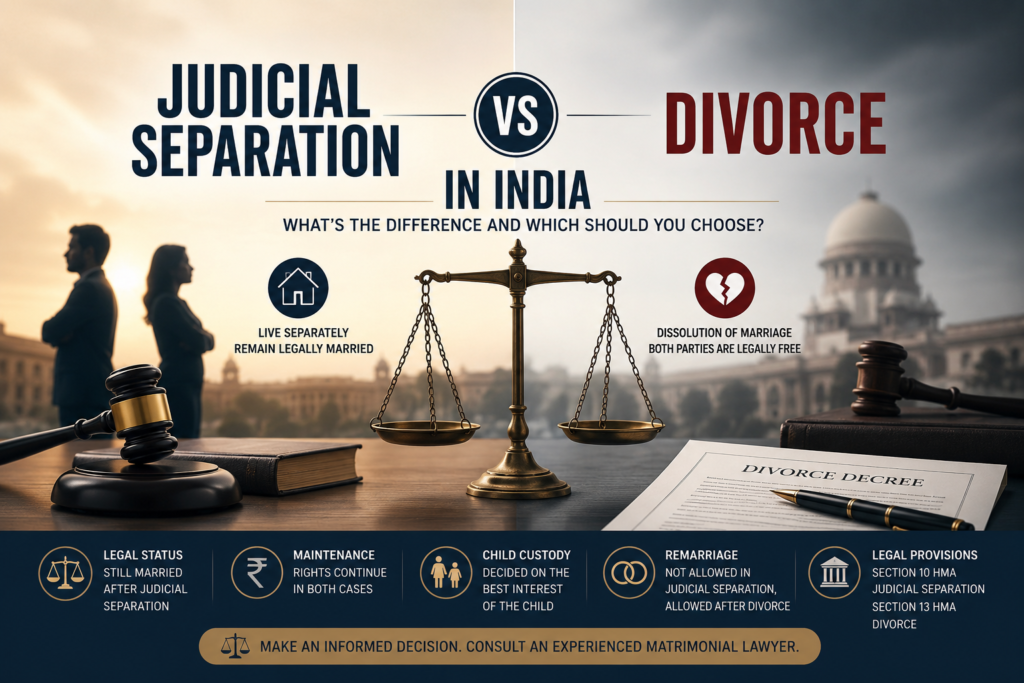
The marriage is NOT dissolved. Both parties remain legally married to each other. Their marital status in law — for purposes of succession, inheritance, employment benefits, passport, and social recognition — is still “married.”
Neither party can remarry. Because the marriage still legally exists, a second marriage contracted after judicial separation (without a subsequent divorce) would be bigamous — a criminal offence under Section 82 BNS 2023.
Neither party is obligated to cohabit. The decree formally releases both parties from the obligation to live together. They can and generally do live separately, in different homes.
Maintenance rights continue. A wife separated by judicial decree retains her full right to claim maintenance from her husband. The judicial separation does not end the financial relationship — it clarifies and potentially strengthens it.
DV Act protections continue. The domestic relationship that gives rise to DV Act protections (including residence orders and monetary relief) continues throughout a judicial separation.
Compare this with divorce — which dissolves the marriage entirely. After a divorce decree:
The marriage no longer exists. Both parties are legally single. Either can remarry. Succession rights change. Financial obligations (beyond what is agreed or ordered) generally end.
2. The Grounds — Are They the Same?
Yes. The grounds for judicial separation under Section 10 HMA are the same as the grounds for divorce under Section 13 HMA. Both proceedings can be filed on the basis of: cruelty, desertion, adultery, conversion, mental disorder, leprosy, venereal disease, renunciation of the world, or presumption of death.
A wife additionally has the grounds available exclusively to her: bigamy, rape/sodomy/bestiality, non-resumption of cohabitation after maintenance order or RCR decree, and marriage before age 15.
This means that if you have grounds to file for divorce, you also have grounds to file for judicial separation, and vice versa. The grounds do not differ. What differs is the OUTCOME you are asking the court for.
3. The Critical Pathway: From Judicial Separation to Divorce
This is the most underappreciated aspect of judicial separation law, and it is what makes judicial separation genuinely strategic rather than merely a halfway measure.
Section 13(1A) HMA provides that after a decree of judicial separation has been granted, either party can petition for divorce if:
(a) There has been no resumption of cohabitation between the spouses for a period of one year or more after the decree was passed.
This is a standalone, independent ground for divorce. You do not need to prove cruelty, desertion, adultery, or any other fault ground. You simply show the decree was passed, one year has elapsed, and cohabitation has not resumed.
Why this matters strategically:
A spouse who cannot, at the time of the initial petition, gather sufficient evidence to prove a contested divorce ground — or who faces a spouse likely to vigorously contest every specific allegation — can file for judicial separation on the same grounds. If the separation holds for one year (which, given that neither party is obligated to cohabit, it almost certainly will), the divorce follows as of right.
The Section 13(1A) divorce is also less contested in practice: there is no longer a dispute about who did what or whose fault it was. The only question is whether cohabitation resumed or not — which is typically easy to establish.
4. Who Should Choose Judicial Separation?
Judicial separation is not a consolation prize. It is the more appropriate choice in several specific circumstances.
Reason 1 — Religious, cultural, or personal objection to divorce:
Some individuals — from particular religious or cultural backgrounds — have strong personal objections to the finality of divorce, even where the marriage has completely broken down. Judicial separation gives them the legal protection, physical separation, and financial independence they need without requiring them to sever the legal bond entirely.
Reason 2 — Preserving marriage-linked benefits:
Some financial and employment benefits are tied to the existence of a legal marriage. Insurance policies, pension survivor benefits, certain spousal employment perks, and visa status in some countries depend on being legally married. Where the dissolution of the marriage would cost the economically weaker spouse valuable benefits, judicial separation preserves those benefits while providing physical and legal separation.
Reason 3 — Protecting maintenance rights during uncertainty:
A wife who is genuinely unsure about whether she wants to divorce but needs immediate financial protection can file for judicial separation. This secures her maintenance rights formally and legally — without committing to a permanent dissolution of the marriage. If she later decides she wants a divorce, the Section 13(1A) pathway is available after one year.
Reason 4 — Time needed for reconciliation attempts:
Where one or both parties genuinely believe reconciliation may be possible — but the current situation is too hostile to continue cohabiting — judicial separation provides a breathing space. Couples who have separated under a judicial decree have, in some cases, successfully reconciled and resumed cohabitation. If reconciliation happens, the decree loses its operative effect.
Reason 5 — Protecting succession rights while negotiations continue:
During a judicial separation, if either spouse dies before divorce proceedings are completed, the surviving spouse’s succession rights under the marriage may still apply (unless specifically overridden by will or settlement). Where significant assets or estate planning is involved, the timing and nature of the legal status change matters.
5. Who Should Choose Divorce?
Divorce is the appropriate choice where:
You want a complete, final clean break. If the marriage is over and both you and your spouse want to move on entirely — including the possibility of remarrying — divorce is the clear answer. Judicial separation leaves the door technically open and may create complications if either party enters a new relationship.
You plan to remarry. Judicial separation does not enable remarriage. If this is your goal or a realistic future possibility, divorce is what you need.
There is no realistic possibility of reconciliation. Where the marriage has irretrievably broken down — years of separation, bitterness, no ongoing relationship — judicial separation serves no practical purpose. It adds a step without adding benefit.
Your spouse will likely resist any form of proceedings equally. Where the opposing spouse will contest both judicial separation and divorce with equal vigour, there is no tactical advantage to choosing judicial separation. A contested judicial separation proceeding is not faster or easier than a contested divorce.
You want your maintenance to be assessed as permanent alimony (Section 25 HMA) rather than as ongoing judicial-separation-period maintenance. Permanent alimony under Section 25 is available at or after a divorce decree. During a judicial separation, maintenance continues as a matrimonial obligation, not as permanent alimony.
6. Maintenance During Judicial Separation
Maintenance during a judicial separation is assessed under Section 24 HMA (during the pendency of the judicial separation proceedings) and continues post-decree under Section 18 of the Hindu Adoptions and Maintenance Act (HAMA) or under Section 144 BNSS.
The critical point: a judicial decree of separation does not end the husband’s maintenance obligation. The marriage is not dissolved, and the wife remains entitled to maintenance from the marriage.
In practice, courts have awarded substantial maintenance during judicial separations. The Supreme Court’s approach in long-separation cases — including the May 27, 2026 ruling where the SC awarded ₹50 lakh final alimony in a case involving years of separation — demonstrates that courts assess maintenance based on the duration of the separation and the wife’s needs for future financial security, not just on the current stage of legal proceedings.
7. Judicial Separation vs RCR vs Divorce: The Three Options Compared
Clients considering judicial separation are sometimes confused about how it differs from a Restitution of Conjugal Rights (RCR) petition. Here is the clearest comparison of all three options:
Restitution of Conjugal Rights (Section 9 HMA): One spouse petitions the court to ORDER the other to return to the matrimonial home. It requires the parties to currently be living separately. If the court grants it and the other spouse does not return within one year, this non-compliance itself becomes a ground for divorce under Section 13(1A)(i). Rarely grants any financial relief on its own.
Judicial Separation (Section 10 HMA): Court recognises the right of both parties to live separately. Does not dissolve the marriage. Maintains maintenance rights. Can lead to divorce after one year of non-cohabitation.
Divorce (Section 13 HMA): Dissolves the marriage. Enables remarriage. Ends the matrimonial relationship. Financial settlement or ongoing maintenance may be ordered depending on the specific grounds and the parties’ situation.
The typical progression in cases where parties are uncertain: Separation → Judicial Separation → (if no reconciliation) → Divorce under Section 13(1A).
This is not mandatory — you can go directly to divorce if that is what you want. But the judicial separation pathway exists precisely for cases where that certainty is not yet present.
8. Children and Custody in Judicial Separation
Judicial separation proceedings — like divorce proceedings — can and should address child custody arrangements. The court can make custody and access orders as part of the judicial separation decree, and these orders apply during the period of separation.
The child welfare standard (Section 13 HMGA — welfare of the minor is paramount) applies equally whether the parents are divorced or judicially separated. Courts assess the same factors: primary caregiver history, residential stability, the quality of each parent’s proposed arrangement, and the child’s own expressed preferences where age-appropriate.
One practical consideration in judicial separation: where custody is established during the judicial separation period and is working well, courts are likely to preserve the same arrangement when divorce proceedings eventually follow. The interim custody arrangement in a judicial separation can become the de facto standard that the divorce decree formalises.
9. A Word on Mutual Consent and Judicial Separation
Judicial separation, unlike divorce, is not available by mutual consent as a specifically defined joint petition under the HMA. Section 13B provides for mutual consent DIVORCE, not mutual consent judicial separation. However, where both parties agree that they want to live separately without immediately divorcing, they can:
File a consent decree of judicial separation — where both parties agree on the fact of separation and the terms (maintenance, custody) without contesting the grounds. This is not technically a “mutual consent judicial separation” in the Section 13B sense, but courts can accommodate agreed judicial separation terms.
OR, if they are certain about eventual divorce: file a mutual consent divorce directly (Section 13B), which remains the faster and cleaner route to a legally settled conclusion where both parties are agreed.
Consult Adv. Aman Chawla, Matrimonial Law Specialist, practising before the Supreme Court of India, Delhi High Court, and all Delhi district courts. Available for urgent matters, outstation clients, and online consultations across India.
Call / WhatsApp: +91-8076836899 | Email: info@thematrimoniallawyers.com Office: O-11A Basement, Jangpura Extension, New Delhi – 110014
10. Frequently Asked Questions
Q1. What is the key difference between judicial separation and divorce?
Judicial separation (Section 10 HMA) releases both spouses from the obligation to cohabit but does NOT dissolve the marriage. Both parties remain legally married, cannot remarry, and maintenance obligations continue. Divorce (Section 13 HMA) dissolves the marriage entirely — both parties are legally single, free to remarry, and the matrimonial financial relationship is settled or ended.
Q2. Can I remarry after judicial separation?
No. Because the marriage is not dissolved by a judicial separation decree, a second marriage contracted after judicial separation is bigamous — a criminal offence under Section 82 BNS 2023 (up to seven years). To remarry, you must obtain a full divorce decree.
Q3. Can judicial separation automatically convert to divorce?
Not automatically, but there is a clear pathway. Under Section 13(1A) HMA, if there has been no resumption of cohabitation for one year after a judicial separation decree, either party can petition for divorce on this ground alone — without needing to prove any fault like cruelty or desertion. The divorce is not automatic; you must file a petition, but the ground is essentially established by the passage of time.
Q4. Does my husband still have to pay maintenance after judicial separation?
Yes. A judicial separation decree does not end the maintenance obligation. The marriage continues to exist, and the wife’s entitlement to maintenance from her husband continues throughout the period of judicial separation. Courts can make specific maintenance orders as part of the judicial separation decree, and these continue to be enforceable.
Q5. What are the grounds for judicial separation?
The grounds for judicial separation under Section 10 HMA are identical to the grounds for divorce under Section 13 HMA: cruelty, desertion, adultery, conversion, mental disorder, leprosy, venereal disease, renunciation, or presumption of death. Wives additionally have the special grounds available under Section 13(2) HMA. Having grounds for divorce also means having grounds for judicial separation.
Q6. Is judicial separation faster or easier than divorce?
Not inherently. A contested judicial separation proceeding follows the same evidence and hearing process as a contested divorce. Where the grounds are disputed, the difficulty of the case depends on the facts, not on whether you have labelled it judicial separation or divorce. The advantage of judicial separation is strategic (the Section 13(1A) pathway), not procedural.
Q7. I don’t want a divorce but I need to live separately and get maintenance immediately. Is judicial separation right for me?
It is one option. However, for immediate maintenance, you can also file under Section 144 BNSS before a Magistrate — which requires no matrimonial proceeding (including no judicial separation petition) to already be pending. See our guide on maintenance without filing divorce for the fastest maintenance routes. Judicial separation may be the right longer-term strategy, but it is not necessary to get immediate maintenance.
Q8. After judicial separation, what happens to our jointly owned property?
Judicial separation does not automatically alter property ownership. Joint property remains jointly owned. The judicial separation decree addresses the personal relationship — the obligation to cohabit — and maintenance obligations. Property division, if needed, requires separate civil proceedings or a specific arrangement in the judicial separation order. Property is typically fully addressed only at the divorce stage.
Q9. Can my spouse oppose my application for judicial separation?
Yes. A spouse can contest the grounds for judicial separation in the same way they can contest divorce grounds. However, there is an important additional defence specific to judicial separation: under Section 10(2) HMA, where the petitioner has been guilty of adultery or has on good grounds been deserted by the respondent, the court has discretion to refuse judicial separation even where the stated grounds are established. This reflects the equitable nature of the remedy.
Q10. Should I file for judicial separation or go directly to divorce?
The right answer depends entirely on your specific situation. Choose judicial separation if: you have religious or personal objections to full divorce, you want to preserve marriage-linked financial benefits temporarily, you are not fully certain you want a permanent dissolution, or you are building toward a Section 13(1A) clean-pathway divorce. Choose divorce directly if: you are certain the marriage is over, you want to remarry, or there is no practical purpose to a waiting period. A first consultation with a divorce lawyer who understands both options will give you a tailored recommendation for your specific facts.
Written by Adv. Aman Chawla. This article is for informational purposes only and does not constitute legal advice. Every case is fact-specific. Please consult a qualified lawyer before taking any legal action.