Can Your Spouse’s Secret Call Recordings Be Used Against You in Divorce? The Supreme Court Finally Has an Answer

June 2026 | Author: Advocate Aman Chawla, The Matrimonial Lawyers | Divorce Law, Evidence, Supreme Court
Picture this: for months — maybe years — your spouse has been secretly recording your phone calls. Every argument. Every frustrated outburst. Every word spoken in the raw privacy of a marriage falling apart.
Now they want to play those recordings in family court in Delhi to prove mental cruelty — and get a divorce on that basis.
Can they?
Until 2025, courts across India gave contradictory answers. The Punjab & Haryana High Court said no. Family courts in other states said yes. The law was a muddle.
On 14 July 2025, the Supreme Court of India settled the question in Vibhor Garg v. Neha (2025 INSC 829) — and the answer will surprise many people on both sides of a matrimonial dispute.
What the Supreme Court Actually Decided
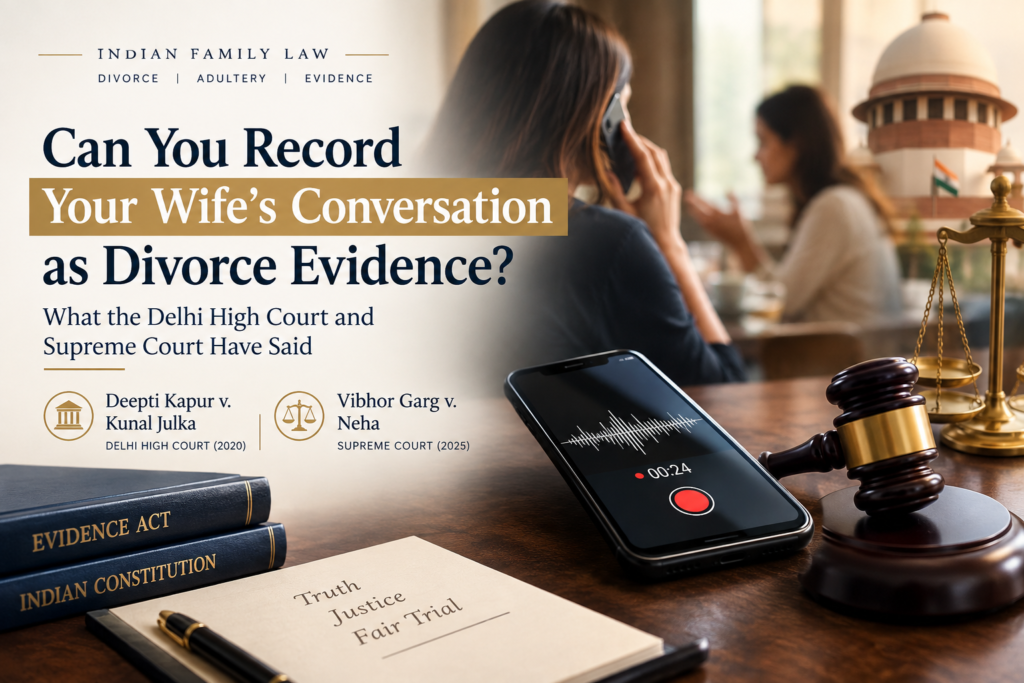
The Supreme Court held that secretly recorded telephone conversations between spouses are admissible as evidence in divorce and matrimonial proceedings.
A bench of Justice B.V. Nagarathna and Justice Satish Chandra Sharma delivered the ruling, setting aside the Punjab & Haryana High Court’s 2021 order and restoring the Family Court’s original decision to allow the recordings.
In plain language: if your spouse secretly recorded your calls — and wants to use those recordings in your divorce case — a court in India can admit them as evidence.
The Case Behind the Ruling: What Happened
The facts in Vibhor Garg v. Neha are straightforward and, for many people, painfully familiar.
A husband sought divorce under Section 13 of the Hindu Marriage Act, 1955, alleging mental cruelty. To support his case, he submitted secretly recorded telephone conversations with his wife — audio files he had recorded over years of a deteriorating marriage.
The Family Court in Bathinda initially allowed the recordings in 2020. The Punjab & Haryana High Court overturned that decision in 2021, holding that the husband’s recording of his wife’s private conversations amounted to a violation of her privacy.
The Supreme Court reversed the High Court and restored the Family Court’s order.
The Legal Reasoning: Why the Court Said Yes
The Supreme Court’s reasoning turned on a careful reading of Section 122 of the Indian Evidence Act (and its equivalent under the Bharatiya Sakshya Adhiniyam, 2023, which now governs evidence law in India).
Section 122 generally bars a spouse from disclosing communications made by the other spouse during marriage. This is the principle of spousal privilege — it exists to protect the intimacy of marriage.
But Section 122 contains a critical exception: the bar on disclosure does not apply when the litigation is between the spouses themselves.
The Supreme Court held that a divorce petition is exactly that — litigation between the spouses. Therefore, the Section 122 bar on disclosure is lifted, and the recordings can be admitted.
The Court further observed that a phone recording device acts like an eavesdropper — and that the evidence captured by such a device does not fall within the scope of what Section 122 was designed to prevent.
The Court also noted — with remarkable candour — that snooping between spouses is itself a symptom of a broken marriage. It reflects a collapse of trust so fundamental that it often signals the very cruelty being alleged.
What This Means for Divorce Cases in Delhi Right Now
This ruling has immediate, practical implications for anyone involved in matrimonial proceedings across Delhi’s family courts and the Delhi High Court.
If Your Spouse Has Recorded You
You need to take this seriously. Recordings that capture angry words, threats, abusive language, or admissions — even made in the heat of a private argument — can now be placed before a family court judge in Delhi.
Your lawyer’s task is to:
- Challenge the authenticity of the recordings (are they genuine? unedited?)
- Question the context (what was said before and after? was the conversation manipulated?)
- Argue that isolated statements do not constitute a sustained pattern of cruelty
- Demonstrate that the recordings were made as part of a deliberate strategy of entrapment rather than genuine evidence of wrongdoing
Recordings are not automatically conclusive. They must be weighed alongside all the other evidence in the case. A skilled matrimonial lawyer can significantly limit the damage a recording can do — or have it excluded on grounds of tampering.
If You Have Recordings of Your Spouse
You may now rely on authenticated call recordings to support a case of mental cruelty. This is significant if your spouse’s conduct was confined largely to private conversation — abusive language, threats, humiliation — and you have limited other documentary evidence.
However, the recordings must be:
- Authentic — genuinely recorded, not edited or spliced
- Certified — properly authenticated under the Bharatiya Sakshya Adhiniyam
- Relevant — directly connected to the allegations in your petition
How a recording is presented in court matters enormously. A matrimonial lawyer must ensure the evidence is technically admissible, properly formatted, and strategically deployed — not just handed across the court counter.
The Privacy Question: What About WhatsApp Chats and Video Recordings?
The Vibhor Garg ruling focused on telephone call recordings, but it has opened a much wider conversation about digital evidence in matrimonial cases.
Clients at The Matrimonial Lawyers increasingly ask:
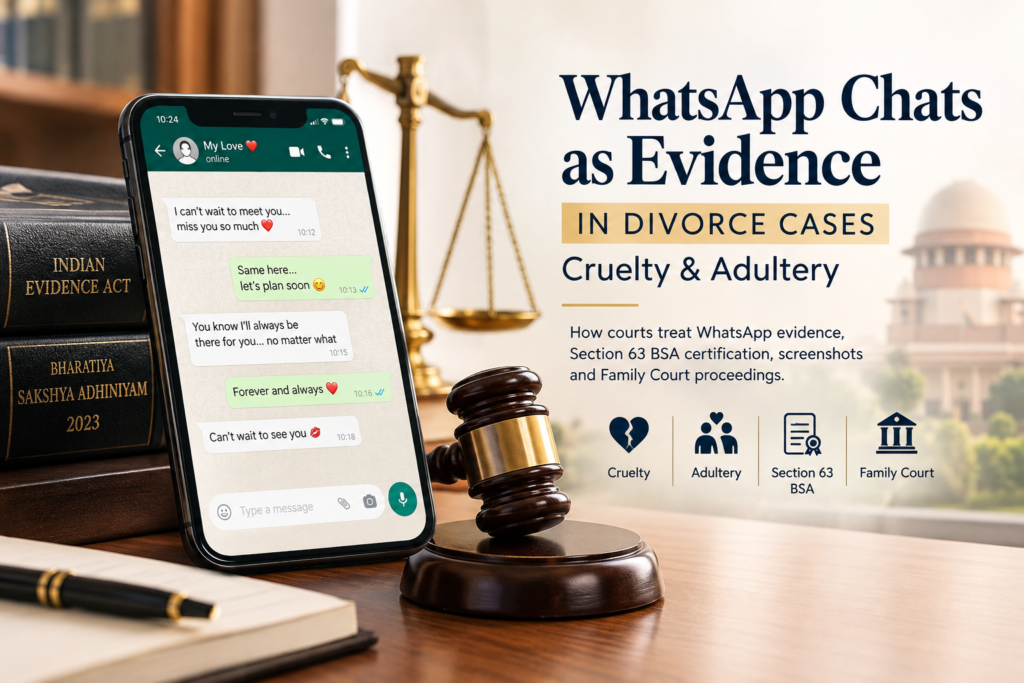
Can WhatsApp messages be used in my divorce case?
Yes — WhatsApp messages are routinely admitted as evidence in family courts across Delhi, subject to authentication.
What about screenshots of chats or social media posts?
Screenshots can be admitted but are more easily challenged for tampering. Courts look at metadata and context carefully.
Can video recordings be used?
Video recordings captured without consent raise similar issues as call recordings. The Vibhor Garg logic — that the spousal litigation exception applies — would likely extend to video recorded by one spouse of the other.
What about recordings made outside the matrimonial home — in a car, at a restaurant?
The same principle applies: if the recording captures a communication between the spouses and is tendered in matrimonial litigation between them, Section 122’s exception operates.
The legal landscape around digital evidence in Indian divorce proceedings is evolving rapidly. Every case turns on its specific facts, and the guidance of a specialist matrimonial lawyer is essential.
The Bigger Picture: Evidence Law and Modern Divorce
The Supreme Court’s ruling reflects something the bench acknowledged directly: modern marriages live and break on digital platforms. The legal framework for evidence cannot be frozen in 1872 — the year the original Indian Evidence Act was enacted.
Conversations that once happened across a kitchen table now happen on WhatsApp calls, Instagram DMs, and voice notes. Marriages collapse in digital spaces, and courts must be able to see what actually happened.
At the same time, the Court recognised that digital evidence must be handled with care. Entrapment, editing, and fabrication are real risks — and courts will scrutinise recordings carefully before giving them weight.
What this ruling does is clear the path. It removes a blanket rule that had the perverse effect of protecting abusive conduct that happened to be recorded.
How The Matrimonial Lawyers Can Help
Whether you are the spouse who made the recordings or the one being recorded, Advocate Aman Chawla has handled digital evidence in matrimonial cases across Delhi’s family courts, the Delhi High Court, and the Supreme Court.
We advise clients on:
- Whether their recordings meet the admissibility standard under the Bharatiya Sakshya Adhiniyam
- How to present digital evidence effectively in family court proceedings
- How to challenge the authenticity and context of recordings made by the other side
- Whether additional evidence — maintenance claims, DV proceedings, 498A — is affected by what the recordings contain
Your first consultation is free, completely confidential, and carries no obligation.
📞 Call or WhatsApp: +91-8076836899 📧 Email: info@thematrimoniallawyers.com 📍 O-11A Basement, Jangpura Extension, New Delhi – 110014
Monday–Saturday, 9am–7pm. WhatsApp available after hours.
FAQ
Q1: Can my spouse use a secretly recorded call as evidence in our Delhi divorce case?
Yes, following the Supreme Court’s July 2025 ruling in Vibhor Garg v. Neha, secretly recorded telephone conversations between spouses are admissible as evidence in divorce and matrimonial proceedings in India. The Court held that the spousal privilege under Section 122 of the Evidence Act does not apply when the litigation is between the spouses themselves.
Q2: Does this ruling apply only to phone calls, or also to WhatsApp messages and videos?
The ruling specifically addressed telephone recordings, but its underlying logic — that the Section 122 exception applies to all spousal litigation — is likely to extend to WhatsApp voice notes, video recordings, and other forms of recorded communication between spouses. Each case turns on its specific facts and the admissibility standards under the Bharatiya Sakshya Adhiniyam, 2023.
Q3: Can I challenge a recording my spouse wants to use against me in court?
Yes. Recordings can be challenged on grounds of authenticity (was it edited or manipulated?), context (does it reflect an isolated moment rather than a pattern?), and proper certification. A skilled matrimonial lawyer can examine the recording’s technical metadata and argue against the weight a court should give it.
Q4: What is Section 122 of the Indian Evidence Act, and does it still protect me?
Section 122 protects private communications between spouses from disclosure. However, it expressly does not apply to proceedings between the spouses themselves — such as a divorce petition. The Supreme Court confirmed in 2025 that this exception allows secretly recorded spousal conversations to be admitted in matrimonial cases.
Q5: My spouse recorded me saying things in anger during an argument. Can that be used to prove mental cruelty?
Potentially, yes. Courts have accepted recordings of abusive, threatening, or humiliating language as evidence of mental cruelty in divorce petitions. However, context matters — an isolated outburst during a single argument carries less weight than a consistent pattern of conduct. Your lawyer can argue about proportionality and context in how the recording is interpreted.
Q6: I have recordings of my spouse threatening me. Will they help my divorce case?
Recordings of threats, abuse, or harassment by a spouse can be powerful evidence of mental cruelty or even domestic violence. Properly authenticated and presented, they can significantly strengthen both a divorce petition and a protection application under the Domestic Violence Act. Speak to a matrimonial lawyer about how to introduce them correctly.
Q7: Does this ruling affect 498A or domestic violence cases, or only divorce?
The ruling was made in the context of a divorce petition, but its reasoning — that the spousal litigation exception under Section 122 applies — could extend to other matrimonial proceedings such as maintenance applications and domestic violence cases where the parties are the spouses. The position in criminal proceedings (such as 498A) may differ and should be assessed separately with your lawyer.
Q8: How do I know if recordings my spouse made are genuine or have been edited?
Authenticity of digital recordings is assessed through technical examination of file metadata, hash verification, and expert analysis. Courts can order forensic examination of audio files. If you suspect recordings presented against you have been tampered with, your lawyer can apply for forensic scrutiny — and challenge the weight of the evidence accordingly.
Consult Adv. Aman Chawla, Matrimonial Law Specialist, practicing before the Supreme Court of India, Delhi High Court, and all Delhi District Courts. Available for urgent matters, outstation clients, and online consultations across India.
Call: +91-8076836899 | WhatsApp | Email: info@thematrimoniallawyers.com Office: O-11A Basement, Jangpura Extension, New Delhi – 110014
Written by Adv. Aman Chawla. This article is for informational purposes only and does not constitute legal advice. Every case is fact-specific. Please consult a qualified lawyer before taking any legal action.