By Advocate Aman Chawla | The Matrimonial Lawyers, New Delhi | June 2026
Every month, clients call me from the US, UK, UAE, and Canada with a version of the same story.
They married in India—sometimes in a temple, sometimes at a court, sometimes at a five-hundred-person wedding in Delhi or Chandigarh. Then they moved abroad. The marriage fell apart. They got divorced in the country where they were living—a clean, court-stamped decree, processed in weeks. They remarried. They moved on.
Then something happened—a property dispute, a visa issue, a new relationship that produced a child, an inheritance question—and someone, somewhere, pointed out a problem: their Indian marriage may never have been legally dissolved.
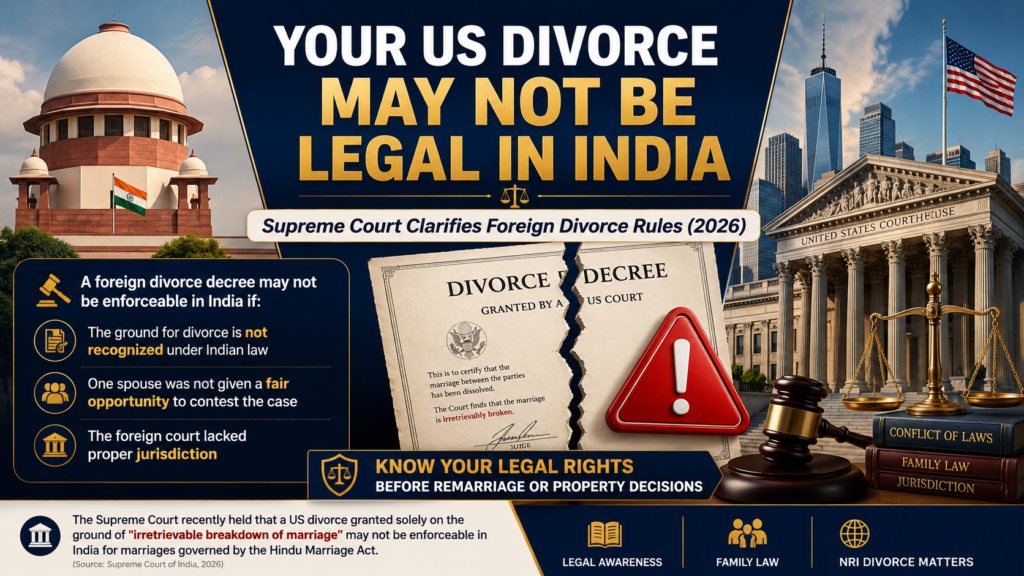
On January 15, 2026, the Supreme Court of India made this point in a formal judgment that every NRI, every Indian married abroad, and every lawyer advising them needs to understand. The ruling in KM v. KK (Civil Appeal No. 1342 of 2013, decided 15-1-2026) by a Bench of Justice Vikram Nath and Justice Sandeep Mehta is direct: a divorce granted by a US court on the ground of “irretrievable breakdown of marriage” is not enforceable in India. Not partially enforceable. Not enforceable unless you do something extra. Not enforceable, full stop.
1. The Case: An 18-Year Marital Deadlock Caused by Two Divorce Systems
The parties in this case were married in Mumbai in December 2005 according to Hindu rites and customs. They were living in the United States. After a brief period of cohabitation — including a visit to Pune in 2007 — the marriage broke down in 2008. The wife initiated divorce proceedings in an American court. That court granted a divorce decree on the ground of irretrievable breakdown of marriage, along with property division and financial orders. For the wife, the marriage was over. For the law of India, it wasn’t.
The husband filed divorce proceedings before the Family Court in Pune under the Hindu Marriage Act. The wife contested the jurisdiction of the Indian court, arguing that the American decree had already dissolved the marriage and that the parties were domiciled in the US. The Pune Family Court upheld its jurisdiction. The Bombay High Court reversed that, finding the parties domiciled abroad and the foreign court legitimately having jurisdiction. The husband appealed to the Supreme Court.
By 2026, the parties had been separated for eighteen years. No matrimonial bond existed between them in any real sense. But on paper, in the eyes of Indian law, the marriage had never ended.
2. What the Supreme Court Held — and Why It Matters
The Supreme Court examined the foreign decree against the test under Section 13 of the Code of Civil Procedure, 1908, which governs when a foreign court judgment is conclusive in India. A foreign judgment is not conclusive—and therefore not enforceable—if it was given on a ground not recognized by Indian law or if the party against whom it is sought to be used was not given a meaningful opportunity to contest it.
Both problems applied here.
First: “Irretrievable breakdown of marriage” is not a recognized statutory ground for divorce under the Hindu Marriage Act, 1955. Section 13 of the HMA lists the grounds on which a marriage can be dissolved — cruelty, desertion, adultery, conversion, unsoundness of mind, and others. Irretrievable breakdown is not among them. The Supreme Court has, under its extraordinary Article 142 powers, dissolved marriages on this basis — but that is the Supreme Court’s exclusive constitutional power. No family court in India, and no foreign court, can grant a valid Indian divorce on this ground.
Second: The Court looked at whether the husband had effectively participated in the US proceedings. Receiving a summons is not enough. The opposite party must have had a real and meaningful opportunity to contest the matter. On the facts, the Court was not satisfied that this had happened.
The foreign decree was, accordingly, held to be inconclusive and unenforceable as a valid divorce between these parties under Indian law.
Then the Court did something only the Supreme Court can do: having held that no valid divorce existed, it exercised its inherent powers under Article 142 of the Constitution and dissolved the marriage itself on the basis that eighteen years of separation with no prospect of reconciliation made it impossible to maintain any pretense of a subsisting marriage. It also directed that the proceedings pending before the Pune Family Court would stand closed.
The outcome was just. But the reasoning tells every NRI exactly where they stand.
3. The Three Tests a Foreign Decree Must Pass to Be Valid in India
Section 13 CPC sets up a checklist. A foreign court judgment is conclusive in India only if all of these are satisfied:
Test 1 — Competent jurisdiction: The foreign court must have had jurisdiction that Indian law recognizes. Typically, this requires that the parties were domiciled in that country, or that the marriage was solemnized there, or that both parties submitted to the foreign court’s jurisdiction.
Test 2 — Merits, not default: The case must have been decided on its merits, not by default of the defendant or on technical grounds alone.
Test 3—Recognized ground: The decree must be on a ground that exists under the applicable Indian matrimonial law. For Hindus married under the HMA—even if living abroad—”irretrievable breakdown” is not a recognized ground. “No-fault divorce,” “irreconcilable differences,” “breakdown of “marriage”—regardless of what the foreign jurisdiction calls it, if Indian law doesn’t recognize it, the Indian marriage is not dissolved.
Test 4 — Natural justice: The other party must have had a genuine opportunity to be heard.
If any one of these tests fails, the foreign decree is not enforceable in India. In KM v. KK, Tests 3 and 4 both failed.
4. What This Means If You Are an NRI
Let me be direct about who this ruling affects, because the answer is more people than realize it.
If you got divorced abroad and your original marriage was in India: Unless your foreign divorce decree was granted on a ground that Indian law recognizes—and the other party had a genuine opportunity to contest—you may still be legally married in India, regardless of what your foreign court says.
If you have remarried after a foreign divorce: If the first marriage was not validly dissolved under Indian law, the second marriage has a serious legal problem. This doesn’t resolve itself with time. It’s a status question, and courts and authorities treat it as one.
If you have property or financial interests in India: Marital status affects inheritance, succession, and property rights under Indian law. An ambiguous status is a genuine legal risk.
If you are in the middle of a transfer petition or related Indian proceedings: The validity of any foreign decree will be a central issue. Your Indian lawyer needs to know exactly what ground the foreign court granted the divorce on.
If you are going through an NRI divorce now: This ruling underscores why the Indian proceedings cannot simply be abandoned or treated as optional if a foreign divorce has been or is being obtained.
5. The Grounds Indian Law Does Recognise for Divorce
Since the enforceability of a foreign decree turns on whether the ground is recognized under Indian law, it helps to know what those grounds actually are. Under the Hindu Marriage Act, Section 13, a marriage can be dissolved on the following grounds:
- Cruelty — including mental cruelty, which our contested divorce practice area covers in depth
- Desertion — continuous absence for not less than two years with an intention to permanently abandon
- Adultery — though the party must not have condoned the conduct
- Conversion to another religion
- Unsoundness of mind or mental disorder of a specified degree
- Leprosy or venereal disease (both communicable and incurable)
- Renunciation of the world by entering any religious order
- Presumption of death — not heard of as alive for seven years
Under Section 13B, both parties can jointly petition for mutual consent divorce—which remains the single fastest and most practical route for NRIs where both spouses genuinely agree and the marriage has effectively ended.
What is not on this list: irretrievable breakdown, irreconcilable differences, no-fault divorce, or any equivalent. This is why a US court’s standard “no-fault” decree routinely fails the Section 13 CPC test.
6. The Only Two Ways to Validly End an Indian Marriage
There is no shortcut. If your marriage was solemnized under Indian law:
Option A—Mutual consent divorce under Section 13B HMA: Both spouses agree, file jointly before a competent Indian Family Court (jurisdiction is based on where the marriage took place, where the parties last resided together, or where the wife currently resides), complete the cooling-off period, and obtain a formal decree. This can often be handled efficiently even where both parties are abroad, through authorised representation and power of attorney, with proper legal guidance.
Option B—Contested divorce before an Indian family court: Where one spouse will not agree, the other must file on one of the recognized grounds listed above — typically cruelty or desertion in most NRI disputes—and pursue the matter through the Indian judicial process. The transfer petition procedure exists precisely for situations where parties are in different cities or countries and need to consolidate proceedings in one court.
A foreign decree can be a useful piece of evidence in Indian proceedings—it shows the marriage has broken down, that the foreign court found certain facts, and that there was a separation. But it is not a substitute for an Indian decree.
7. A Note on Article 142 — Why This Isn’t a Permanent Safety Net
The Supreme Court in KM v. KK saved the parties from an indefinite deadlock by exercising its Article 142 powers. This is a constitutional provision that lets the Supreme Court pass any order necessary to do complete justice—including dissolving a marriage on irretrievable breakdown, even though that ground doesn’t appear in the HMA.
But Article 142 is only the Supreme Court’s power. It cannot be exercised by a High Court. It cannot be exercised by a family court. It is not available on demand—you have to get your matter to the Supreme Court, which takes years, and even then, the Court exercises the power at its discretion based on the specific facts. Eighteen years of separation with no hope of reconciliation is an extreme case. Most situations won’t reach that threshold.
Do not plan your life around the assumption that Article 142 will rescue you. Plan it around getting a valid Indian decree.
8. Frequently Asked Questions
Q: I got divorced in the US. Do I need to do anything in India?
A: If your original marriage was solemnized in India under the Hindu Marriage Act or another Indian personal law, and your US divorce was granted on grounds like “irretrievable breakdown” or “irreconcilable differences,” there is a real risk that the Indian marriage has not been legally dissolved. You should have your specific foreign decree reviewed against Section 13 CPC by a matrimonial lawyer familiar with cross-border cases before making any assumptions.
Q: My US divorce decree was on “irreconcilable differences.” Is that valid in India?
A: Almost certainly not, if your marriage was governed by the Hindu Marriage Act. “Irreconcilable differences” is the American equivalent of irretrievable breakdown—and the Supreme Court held in January 2026 (KM v. KK) that this ground is not recognised under Indian law. A decree on this basis does not satisfy the Section 13 CPC test and is not conclusive in India.
Q: Both my spouse and I live abroad. Can we file for a mutual consent divorce in India?
A: Yes. Mutual consent divorce under Section 13B HMA can be filed before a competent Indian family court even where both parties reside abroad. Jurisdiction attaches where the marriage was solemnised, where the parties last resided together in India, or where the wife is currently residing (if in India). With properly executed powers of attorney, many stages of the process can be handled through authorized representatives. Speak to an NRI divorce specialist about how this works in your specific state.
Q: What if we both appeared in the foreign court? Does Indian participation help?
A: It helps with the natural justice test—but it doesn’t fix the ground problem. Even where both parties genuinely participated in foreign proceedings, the decree is still not enforceable in India if it was granted on a ground that the HMA doesn’t recognize. Both conditions under Section 13 CPC must be satisfied simultaneously.
Q: I have remarried after a foreign divorce. What is my position?
A: If the first marriage was not validly dissolved under Indian law, the second marriage is legally problematic. This does not automatically trigger criminal proceedings — the specific facts, timing, and circumstances matter — but it is a genuine legal risk that needs to be assessed urgently with a qualified advocate, not assumed away.
Q: The foreign court also divided our property in India. Is that order valid?
A: A foreign court’s order regarding property situated in India is generally not directly enforceable in India. Enforcement requires a separate process before Indian courts, and the same Section 13 CPC scrutiny applies to any foreign judgment sought to be enforced here. Immovable property in India is governed by Indian law, and foreign orders regarding it are treated with particular care.
Q: Does this ruling apply to divorces obtained in the UK, UAE, Canada, or Australia?
A: Yes. The legal principle—that a foreign decree is not conclusive in India if it is based on a ground not recognized under the applicable Indian personal law—applies regardless of which country granted the decree. It is not specific to US courts. Any foreign divorce on an unrecognized ground, from any jurisdiction, faces the same enforceability problem under Section 13 CPC.
Q: If the Supreme Court can dissolve a marriage using Article 142, why can’t I just appeal there?
A: The Supreme Court exercises Article 142 powers sparingly, on specific and extreme facts—in KM v. KK, the parties had been separated for eighteen years with zero prospect of reconciliation. It is not a routine remedy; it requires escalating all the way to the Supreme Court (years of litigation), and there is no guarantee the Court will exercise the power in your specific case. The correct and reliable path is an Indian family court proceeding—mutual consent if possible, contested if necessary.
Q: My spouse refuses to cooperate with Indian proceedings. What can I do?
A: A contested divorce petition can be filed unilaterally before a competent Indian family court. If the responding spouse is abroad and cannot or will not appear, Indian procedural law provides for service of summons on foreign parties and for proceedings to continue in their absence once proper service is established. A transfer petition may also be relevant if there are parallel proceedings in different locations. Get specialist advice early — the earlier you file, the sooner the clock starts running.
Q: Can we settle everything — maintenance, property, custody — in India as part of the divorce?
A: Absolutely, and this is usually the cleanest approach. A mutual consent divorce filed in an Indian family court can incorporate a comprehensive settlement agreement covering maintenance, property division, and child custody—all confirmed by a binding Indian decree. This avoids any future question about which jurisdiction’s order applies to which asset or obligation.
Final Words
The law hasn’t changed overnight. Section 13 CPC has always said what it says, and the Hindu Marriage Act has always listed its grounds. What KM v. KK has done is remind everyone—NRIs, foreign spouses, Indian courts, and the lawyers advising them—that the rules will be applied as written, even where applying them creates an inconvenient mismatch between what a foreign court ordered and what Indian law recognizes.
If you are carrying a foreign divorce decree and have Indian ties—property, children, family, or plans to return—get it checked. Not because you have done something wrong, but because the rules of two systems don’t always produce the same result, and the gap between them is exactly where the most expensive legal problems hide.
Consult Adv. Aman Chawla, Matrimonial Law Specialist, practicing before the Supreme Court of India, Delhi High Court, and all Delhi district courts. Available for NRI consultations online, urgent matters, and outstation clients across India.
Call: +91-8076836899 | WhatsApp | Email: info@thematrimoniallawyers.com Office: O-11A Basement, Jangpura Extension, New Delhi – 110014
Written by Adv. Aman Chawla. This article is for informational purposes only and does not constitute legal advice. Every case is fact-specific. Please consult a qualified lawyer before taking any legal action.