Written by Adv. Aman Chawla | Matrimonial Law Specialist | Delhi High Court & Supreme Court of India | 8 Years Exclusive Practice in Family & Matrimonial Law | Jangpura, New Delhi
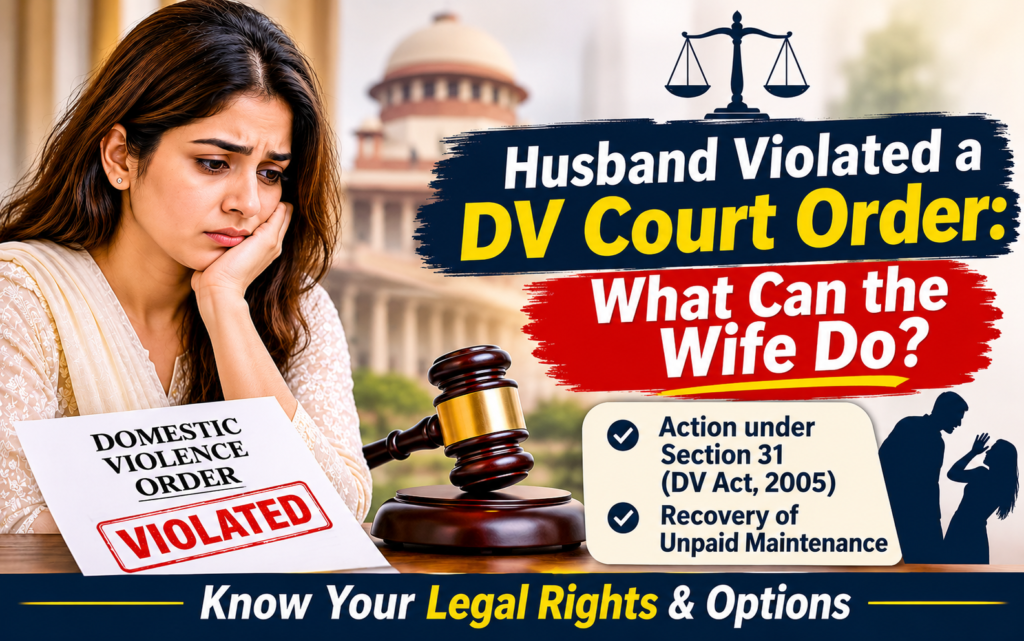
A breach of DV order can have serious legal consequences for a husband. However, the legal action depends on the type of court order he has violated. If he breaches a protection order under Section 18 of the Protection of Women from Domestic Violence Act, 2005, the wife can seek action under Section 31. However, if he stops paying maintenance, she must pursue the appropriate recovery proceedings instead.
“Sir, the court ordered my husband to stay away and pay me every month. He keeps calling, and he has not paid for three months. Can he be sent to jail?”
This question often arises after a court passes a Domestic Violence (DV) order. The answer depends on the exact directions in that order. A violation of a protection order can amount to a criminal offence. However, failure to pay DV maintenance requires a different legal remedy. The wife can still approach the court to recover unpaid amounts through the appropriate enforcement process.
Quick Answer: What Happens After a Breach of DV Order?
A breach of a protection order or interim protection order under Section 18 of the DV Act can attract Section 31. The punishment may extend to one year of imprisonment, a fine of up to ₹20,000, or both.
However, non-payment of maintenance under Section 20 does not, by itself, amount to an offence under Section 31. The Delhi High Court clarified this distinction in 2023. Instead, the wife can seek enforcement through appropriate recovery proceedings. Depending on the circumstances and applicable procedure, the court may consider attachment of property and other lawful recovery measures.
Facing a domestic violence order violation? Seek legal advice after reviewing the exact directions in the court order.
For a wider understanding, read our guide on domestic violence cases in India.
Which DV Orders Does Section 31 Cover?
Section 31(1) of the Protection of Women from Domestic Violence Act, 2005, provides punishment for breaching a protection order or an interim protection order. These orders fall under Section 18 of the Act.
For example, a protection order may direct the husband not to:
- Commit or threaten any act of domestic violence.
- Contact or communicate with the wife.
- Enter her workplace or another place she regularly visits.
- Dispose of assets or interfere with her financial interests.
A breach of DV order must therefore be examined in light of the particular direction passed by the Magistrate. Section 31 does not automatically apply to every order under the DV Act.
| Type of DV order | Legal position if the husband violates it |
|---|---|
| Protection order (Section 18) | Section 31 may apply. Punishment can extend to one year, a fine of up to ₹20,000, or both. |
| Residence order (Section 19) | Not automatically a Section 31 offence. The wife can seek enforcement through the Magistrate. |
| Maintenance and monetary relief (Section 20) | Non-payment is not a Section 31 offence by itself. The wife can pursue recovery through appropriate proceedings. |
| Custody order (Section 21) | Not automatically a Section 31 offence. The wife can approach the Magistrate for enforcement. |
| Compensation (Section 22) | The wife can seek recovery through appropriate court proceedings. |
Section 32 makes an offence under Section 31 cognizable and non-bailable. It also provides that the court may convict the accused on the sole testimony of the aggrieved person.
Where Should the Wife Go After a Breach of DV Order: Police or Court?
In Delhi, a woman can approach the Magistrate under Section 12 of the DV Act to seek relief under the Act. She does not have to begin by visiting a police station to file an application before the Magistrate.
If the court has already passed a protection order and the husband violates it, she should bring the violation to the attention of the court that passed the order. She should also preserve documents and other evidence that demonstrate the violation.
The wife should first identify the exact direction the husband has breached. This step helps determine whether she should seek action under Section 31 or pursue another enforcement remedy.
If You Are the Wife: What Evidence Should You Keep?
If your husband has violated a DV court order, maintain a written record of every incident. Note the date, time, location and details of each violation.
In addition, preserve available evidence, such as:
- Call records and phone logs.
- WhatsApp messages, SMS and emails.
- Screenshots of unwanted communication.
- Bank statements showing missed maintenance payments.
- Copies of the protection order and other court directions.
This evidence can help the Magistrate understand the nature and frequency of the breach. In a breach of DV order case, clear records can also help the court identify the specific direction that the husband allegedly violated.
If You Are the Husband: What Should You Do?
Follow every court direction exactly as written, even if you intend to challenge the order before a higher court.
For maintenance payments, use the wife’s bank account rather than cash wherever the court has directed payment through that method. This creates a clear payment record and helps prevent disputes about whether you paid the amount.
Most importantly, do not assume that a breach has no consequences simply because the wife has not approached the police. You should seek legal advice if you believe a court direction is unclear or needs modification. Do not ignore the order.
What If the Husband Stops Paying DV Maintenance?
Non-payment of maintenance is a common problem after a DV court order. However, the wife should distinguish a maintenance default from a breach of a protection order.
In Delhi, the wife may prepare a calculation sheet showing the unpaid amount for each month. She should also attach her bank statement to establish which payments she received and which amounts remain outstanding.
The Magistrate has legal enforcement options, depending on the nature of the order and the applicable procedure.
1. Attachment of Property and Bank Accounts
The wife can seek appropriate recovery proceedings for unpaid maintenance. Where the law and procedure permit, the court may consider attachment of the husband’s property, bank accounts or other assets to recover arrears.
2. Direct Payment Under Section 20(6)
Section 20(6) of the DV Act allows the Magistrate to direct the husband’s employer or a person who owes him money to pay the wife directly.
For example, where the legal requirements are met, the court may direct an employer to deduct the maintenance amount from the husband’s salary and pay it to the wife.
3. Enforcement and Imprisonment for Default
The wife can seek enforcement of the maintenance order through the appropriate proceedings. Where the law permits and the necessary legal requirements are satisfied, the court may also order imprisonment for default.
For maintenance under the general criminal procedure framework, Section 144 of the Bharatiya Nagarik Suraksha Sanhita (BNSS) is the current provision corresponding to the earlier Section 125 of the Code of Criminal Procedure (CrPC).
For more information, read our guides on recovering maintenance arrears in India and what happens if you do not pay maintenance.
Worked Example: Husband Stops Paying ₹25,000 Maintenance
Suppose a Delhi court orders the husband to pay interim maintenance of ₹25,000 per month in a DV case.
He pays for the first two months but then stops making payments. Six months later, the wife approaches the court with an application for recovery.
Her calculation sheet shows ₹1,50,000 in outstanding maintenance. Her bank statement also confirms that she received no payment after the second month.
The court can issue notice and consider appropriate recovery measures. Depending on the circumstances and applicable procedure, these may include attachment of his bank account or a direction to his employer to deduct the outstanding amount from his salary.
Thus, the wife should maintain a month-by-month record instead of relying only on verbal claims.
How Long Does a DV Case Take in Delhi?
The time required for DV proceedings depends on the facts, court workload, evidence and urgency of the case. Some proceedings may take several months to reach an order.
However, the wife does not always need to wait for the final decision to seek protection.
If she faces a real threat of violence, she can request an interim or ex parte order under Section 23 of the DV Act. The Magistrate can consider urgent interim relief under the Act, depending on the circumstances.
How Do High Courts Handle a Breach of DV Order?
High Court decisions have clarified that Section 31 applies to breaches of protection orders and interim protection orders. It does not automatically cover every type of direction passed under the DV Act.
Delhi High Court: Non-Payment of Maintenance Is Not a Section 31 Offence
On 1 December 2023, the Delhi High Court, in a decision by Justice Swarana Kanta Sharma, set aside a summons issued under Section 31 for non-payment of interim maintenance.
The Court clarified that the wife should pursue the recovery of monetary relief through the appropriate enforcement process, including Section 20(6), rather than prosecute the husband under Section 31 merely for non-payment.
Read the Delhi High Court judgment and case details.
You can also read the LawBeat report on the Delhi High Court decision.
Himachal Pradesh High Court: Section 31 Applies to Protection Orders
In Akshay Thakur v. State of H.P., decided on 25 April 2025, the Himachal Pradesh High Court considered an FIR under Section 31 involving alleged breaches of maintenance and residence orders.
The Court quashed the FIR and clarified that Section 31 applies to breaches of protection orders or interim protection orders. It does not automatically apply to violations of residence or maintenance directions.
Read the Akshay Thakur judgment or the LiveLaw report.
These decisions help explain why a breach of DV order must be examined according to the specific type of order and the legal provision involved.
What I Advise Clients in Delhi
If your husband has violated a DV court order, consider the following steps:
- Review the court order: Identify the exact direction that the husband has allegedly violated.
- Approach the Magistrate: Bring the violation to the attention of the court that passed the order.
- Request interim protection: If you face a risk of violence, ask the Magistrate to consider interim relief under Section 23.
- Preserve evidence: Keep messages, call records, bank statements and other documents that show the violation.
- File for maintenance recovery: If the husband has stopped paying maintenance, prepare a clear month-by-month calculation sheet and attach your bank statement.
- Keep payment records: If you are the husband, follow the court’s payment directions and retain every receipt.
In a breach of DV order case, the correct legal remedy depends on the exact direction the husband has violated. Therefore, review the wording of the court order before filing an application.
Common Mistakes in DV Order Violation Cases
Some common mistakes can make enforcement more difficult.
- Wives report violations but do not preserve documentary evidence.
- Husbands pay maintenance in cash and later struggle to prove that they made the payment.
- Husbands assume that Section 31 does not apply to every DV order and therefore believe they can ignore other court directions.
- Wives treat unpaid maintenance as a Section 31 offence instead of pursuing the appropriate recovery process.
- Parties fail to read the exact wording of the Magistrate’s order before deciding what legal action to take.
As a result, both sides can face avoidable legal complications. Clear records and the correct application can make a significant difference.
The Law Behind It: Important DV Act Provisions
The following provisions govern protection orders, maintenance and enforcement under the DV Act:
- Section 18: Protection orders.
- Section 19: Residence orders.
- Section 20: Monetary relief, including maintenance.
- Section 20(6): Direct payment by an employer or debtor.
- Section 23: Interim and ex parte orders.
- Section 31: Penalty for breach of a protection order or interim protection order.
- Section 32: Cognizable and non-bailable nature of the Section 31 offence and the provision concerning the wife’s sole testimony.
- Section 144 BNSS: Maintenance provision corresponding to the earlier Section 125 CrPC.
- Section 28: Procedure under the DV Act.
You can read the Protection of Women from Domestic Violence Act, 2005 for the statutory provisions.
Important Judgments
Delhi High Court decision, 1 December 2023: The Court clarified that a person cannot be summoned under Section 31 merely for non-payment of DV maintenance. The wife must pursue the appropriate recovery remedy, including Section 20(6).
Akshay Thakur v. State of H.P., Himachal Pradesh High Court, Cr.MMO No. 1079 of 2024, 25 April 2025: The Court clarified that Section 31 applies to breaches of protection or interim protection orders.
Frequently Asked Questions
Q: Is a breach of DV order a criminal offence?
Yes, if the husband breaches a protection order or interim protection order under Section 18. Section 31 provides for imprisonment of up to one year, a fine of up to ₹20,000, or both. However, other DV orders require their own enforcement process.
Q: Can a husband be jailed for not paying DV maintenance?
Not under Section 31 merely for non-payment. However, the wife can pursue appropriate enforcement proceedings. The court may consider recovery measures, including attachment of property and, where the law permits, imprisonment for default.
Q: Does the wife have to go to the police first?
No. She can approach the Magistrate under Section 12 of the DV Act and seek relief under the relevant provisions. If an order already exists, she should bring the alleged violation to the attention of the appropriate court.
Q: What proof does the wife need to show a breach of DV order?
She should preserve relevant documents, such as call records, messages, emails, screenshots and copies of the court order. For unpaid maintenance, she should also prepare a calculation sheet and submit bank statements.
Q: How long does a DV order take in Delhi?
The time depends on the facts, court workload and urgency of the case. However, the wife can request interim protection under Section 23 if she faces a threat of violence.
Q: Is the Section 31 offence bailable?
No. Section 32 describes the offence under Section 31 as cognizable and non-bailable. It also contains a provision concerning conviction on the sole testimony of the aggrieved person.
Adv. Aman Chawla’s Practical Note
Many wives expect the police to arrest the husband immediately after he violates a DV order. However, the legal remedy depends on the type of order and the evidence available.
In my practice, I have not yet seen a conviction for breach in a DV case. In maintenance disputes, the appropriate enforcement process often becomes particularly important. A clear calculation sheet, bank statements and a properly filed recovery application can help the court consider the available remedies.
Similarly, husbands who ignore maintenance directions may face recovery proceedings involving their bank accounts, salary or property, subject to the applicable law and procedure. Neither side should treat a court order lightly.
Final Words
A DV order is not just a piece of paper. It gives the wife legal protection and access to remedies when the other party fails to comply.
If your husband has committed a breach of DV order by violating a protection direction, preserve the evidence and seek advice about the appropriate remedy under Section 31. If he has stopped paying maintenance, pursue recovery through the correct legal process instead.
Most importantly, do not delay seeking legal advice when the situation involves threats, repeated violations or unpaid maintenance. The correct legal step depends on the wording of the order and the facts of the case.
Office: O-11A Basement, Jangpura Extension, New Delhi – 110014
Phone: +91-8076836899
Email: info@thematrimoniallawyers.com
Written by Adv. Aman Chawla. This article is for informational purposes only and does not constitute legal advice. Every case is fact-specific. The examples in this article are illustrative, and names and details have been changed or simplified. Please consult a qualified lawyer before taking legal action.
Disclaimer: As per the rules of the Bar Council of India, advocates are not permitted to solicit work or advertise. This article is for general information only and is not legal advice. Reading it does not create an advocate-client relationship. Please consult a lawyer about your own facts.