Written by Adv. Aman Chawla | Matrimonial Law Specialist | Delhi High Court & Supreme Court of India | 8 Years Exclusive Practice in Family & Matrimonial Law | Jangpura, New Delhi
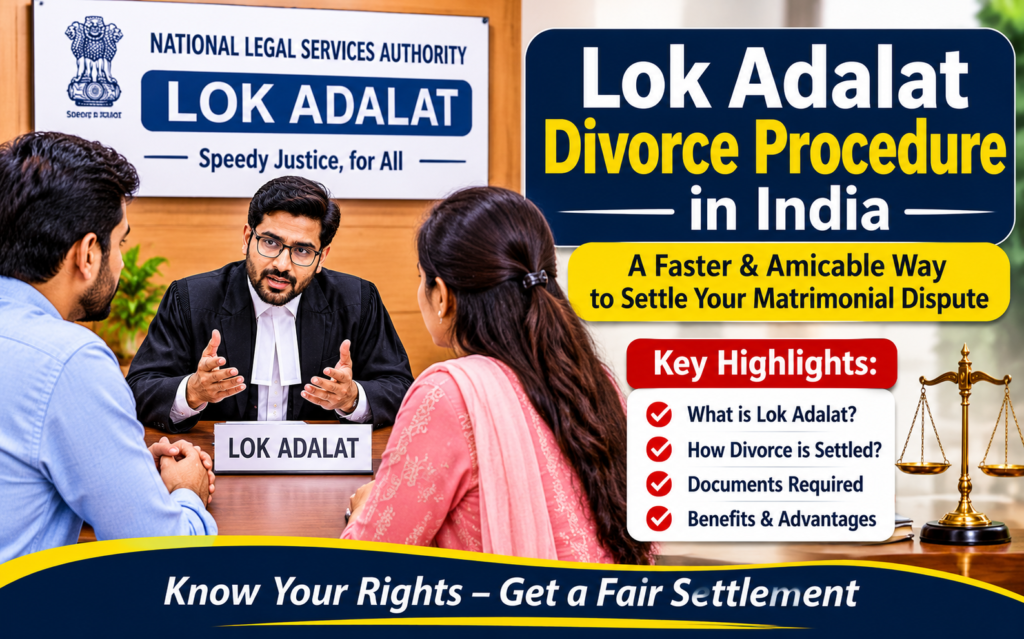
The Lok Adalat divorce procedure in India can help couples settle certain matrimonial disputes amicably. However, many people misunderstand the powers of a Lok Adalat and assume that it can grant a divorce. While it can facilitate settlements involving maintenance, financial claims and other eligible disputes, only the competent Family Court can pass a divorce decree under the applicable matrimonial law.
“Sir, we have agreed on everything. Someone told us we can get a divorce in one day at the National Lok Adalat. Is that true?”
“Sir, our maintenance case has been listed in the Lok Adalat next month. Should I settle there?”
Lok Adalats are among the most useful features of our legal system. They offer free, fast and friendly dispute resolution. Moreover, they clear lakhs of cases every year. However, divorce proceedings often create confusion. Some people have learnt this lesson the hard way: a “divorce” settled in a Lok Adalat may not amount to a legal divorce at all.
This article explains what a Lok Adalat can and cannot do in matrimonial matters. It also covers the correct procedure if you want to use a Lok Adalat as part of your divorce.
Quick Answer
A Lok Adalat cannot grant a divorce decree. Under the NALSA (Lok Adalats) Regulations, 2009, parties cannot refer divorce matters to Lok Adalats. Furthermore, in April 2026, a Division Bench of the Allahabad High Court held that neither a Lok Adalat nor a District Legal Services Authority can grant a divorce. Only the Family Court has that authority.
However, a Lok Adalat can help couples settle related disputes, such as maintenance. After reaching an agreement, the parties can use those terms to file a mutual consent divorce petition under Section 13B of the Hindu Marriage Act before the Family Court.
A Lok Adalat award in matters within its jurisdiction is final and binding. No regular appeal lies against it. However, an affected party can challenge the award through a writ petition before the High Court.
1. What Is a Lok Adalat?
The Legal Services Authorities Act, 1987 provides for Lok Adalats. Legal services authorities organise them at national, state, district and taluka levels. National Lok Adalats also take place on fixed dates across the country several times a year.
Key features:
No adjudication: A Lok Adalat does not decide who is right or wrong. Instead, it helps parties reach a settlement. In State of Punjab v. Jalour Singh (Supreme Court, 2008), the Supreme Court explained that Lok Adalats perform a conciliatory role rather than a judicial one. Therefore, if the parties cannot reach an agreement, the case returns to the regular court.
Award as decree: Once the parties reach a settlement, the Lok Adalat passes an award. Section 21 treats that award as a decree of a civil court.
Final and binding: The award binds the parties, and no regular appeal lies against it.
Free: Parties do not pay court fees for Lok Adalat proceedings. Moreover, when parties settle a pending case, they may receive a refund of the court fee already paid, subject to the applicable court-fee law.
2. Can a Lok Adalat Grant a Divorce?
No. This is the most important point to understand.
In Sushma Devi v. State of U.P. (Allahabad High Court, Lucknow Bench, Division Bench of Shekhar B. Saraf and Abdhesh Kumar Chaudhary JJ., decided 30 April 2026, 2026:AHC-LKO:31501-DB), a husband approached the District Legal Services Authority in a pre-litigation matter. The authority disposed of the matter through a so-called divorce settlement. Later, the husband relied on that settlement to justify his second marriage. However, the wife alleged that someone had obtained her signatures through fraud.
The High Court held that:
- The NALSA (Lok Adalats) Regulations, 2009 do not allow parties to refer divorce matters to Lok Adalats. The Regulations also prohibit Lok Adalats from granting divorce by mutual consent.
- Neither the Lok Adalat nor the DLSA had the authority to grant a divorce. Therefore, no formal divorce decree existed between the parties.
- A clause allowing the parties to remarry was illegal. Consequently, the husband’s claim that the settlement amounted to a divorce had no legal basis.
- Only the Family Court has the power to grant a divorce decree.
The High Court also directed authorities to circulate its judgment among all Lok Adalats and DLSAs in Uttar Pradesh. Although the Allahabad High Court delivered this judgment, it relies on the national NALSA Regulations. Therefore, the same legal principle applies across India.
Real-life example: Mohit and Shalini signed a “settlement” at a pre-litigation sitting. They agreed to separate and claimed that both could remarry. Six months later, Mohit married again. When Shalini filed a complaint, Mohit produced the settlement as proof of divorce.
However, that document did not dissolve their first marriage. Mohit’s first marriage still subsisted, his second marriage was void, and he could face a bigamy prosecution. Thus, one legal shortcut created years of litigation.
3. What Can a Lok Adalat Do in Matrimonial Matters?
Although a Lok Adalat cannot grant a divorce decree, it can help couples resolve several related matrimonial disputes.
For example, parties can use a Lok Adalat for:
- Settling a maintenance case under Section 144 BNSS (old Section 125 CrPC) at an agreed monthly or lump-sum amount. Read more about maintenance for wife in India.
- Settling recovery claims and arrears of maintenance.
- Recording terms for the return of stridhan and other articles.
- Reaching an understanding about child custody and visitation, subject to the court’s assessment of the child’s welfare.
However, Lok Adalats cannot settle non-compoundable criminal offences. Therefore, parties cannot simply close a 498A case through a Lok Adalat. Instead, they usually need to approach the High Court for quashing after reaching a settlement. I have explained this process in my article on quashing a 498A FIR on settlement.
4. The Correct Procedure: Lok Adalat Settlement to Divorce
If you and your spouse want to use a Lok Adalat as part of an overall settlement, follow this route:
Step 1: Settle the related disputes
First, check whether a maintenance or another eligible case remains pending. You can request the court to refer that case to the Lok Adalat.
Next, record clear settlement terms. Mention the amount, payment method, payment dates, return of articles and the treatment of other pending cases.
Step 2: File a mutual consent divorce in the Family Court
After settling the related disputes, file a joint petition under Section 13B of the Hindu Marriage Act before the Family Court. Attach or refer to the settlement terms.
The law requires one year of separation, along with the first and second motions. For a detailed explanation, read my article on how long a mutual divorce takes in India.
Step 3: Seek waiver of the cooling-off period if eligible
The law normally provides a six-month cooling-off period between the two motions. However, the Supreme Court recognised the possibility of waiving this period in Amardeep Singh v. Harveen Kaur (2017).
Therefore, if your case meets the conditions laid down by the Supreme Court, you can request the Family Court to waive the six-month period.
Step 4: Structure payments around the divorce decree
Next, plan the settlement payments carefully. Pay the bulk of the agreed amount at the second motion, when the Family Court passes the divorce decree.
This arrangement protects both parties if either spouse withdraws consent before the court grants the divorce. You can also understand the financial aspects through my guide on how much to pay in a mutual divorce settlement.
Step 5: Withdraw or quash the remaining cases
Finally, complete the withdrawal of civil cases and pursue the quashing of criminal cases as agreed in the settlement. Remember that a settlement does not automatically close every pending proceeding.
Real-life example: Deepika’s maintenance case against her husband Sachin was listed in the National Lok Adalat at Saket. During the discussions, they agreed on a one-time payment of ₹18 lakh for all claims, including stridhan.
The Lok Adalat recorded their settlement in the maintenance case. Within a week, they filed a joint petition for mutual divorce in the Family Court. They divided the payment into two parts: ₹6 lakh at the first motion and ₹12 lakh at the second.
The court later waived the cooling-off period and passed the divorce decree. The parties then completed the agreed payment through the court process.
5. Lok Adalat, Mediation or Family Court Settlement?
Each forum serves a different purpose. Therefore, couples should understand the difference before choosing a route.
Lok Adalat: It offers a fast and free way to settle eligible disputes, including maintenance cases. However, it cannot grant a divorce decree.
Court-annexed mediation: In Delhi, courts refer many matrimonial disputes to their attached mediation centres. During mediation, the parties can discuss and draft a complete settlement, including mutual divorce terms. The settlement then goes to the Family Court for the divorce proceedings.
Family Court: Under the Hindu Marriage Act, the Family Court grants the divorce decree. No Lok Adalat settlement can replace that decree.
In practice, mediation followed by a Section 13B petition offers a standard route for a complete matrimonial settlement. Meanwhile, a Lok Adalat can help resolve specific pending cases.
6. Can a Lok Adalat Award Be Challenged?
A Lok Adalat award is final and binding. No regular appeal lies against it. However, an affected party can approach the High Court through a writ petition under Articles 226 and 227 of the Constitution.
In Dilip Mehta v. Rakesh Gupta (Supreme Court, 18 November 2025, Vikram Nath and Sandeep Mehta JJ.), the Supreme Court reaffirmed that a writ petition provides an effective remedy against a Lok Adalat award. It also clarified that objections in execution proceedings cannot replace this remedy.
However, courts generally recognise limited grounds for such challenges. These include fraud, absence of genuine consent and action beyond the Lok Adalat’s legal powers.
7. Mistakes to Avoid
Couples should avoid these common mistakes when settling matrimonial disputes:
Treating a Lok Adalat settlement as a divorce: It is not a divorce decree. Therefore, do not remarry without obtaining a valid divorce decree from the Family Court.
Using vague settlement terms: A statement such as “Husband will pay a suitable amount” can create future disputes. Instead, mention exact amounts, payment methods and dates.
Paying everything upfront: Link settlement payments to the divorce proceedings and the agreed milestones.
Signing without legal advice: A Lok Adalat award is final and binding. Therefore, read every clause carefully before signing.
Forgetting the criminal cases: A settlement does not automatically end a 498A or domestic violence case. Follow the appropriate legal procedure for each pending matter.
Frequently Asked Questions
Q: Can a Lok Adalat grant a divorce in India?
A: No. The NALSA Regulations do not permit parties to refer divorce matters to Lok Adalats. Moreover, the Allahabad High Court held in 2026 that only the Family Court can grant a divorce decree.
Q: Can a maintenance case be settled in a Lok Adalat?
A: Yes. Parties can settle maintenance and similar eligible disputes through a Lok Adalat. The resulting award binds both parties.
Q: Is a Lok Adalat settlement enough to remarry?
A: No. You need a valid divorce decree from the Family Court. Remarrying on the basis of a Lok Adalat settlement alone can make the second marriage void and expose you to a bigamy case.
Q: How do I get a divorce after settling in a Lok Adalat?
A: File a mutual consent divorce petition under Section 13B of the Hindu Marriage Act in the Family Court. You can attach or refer to the agreed settlement terms.
Q: Can I appeal against a Lok Adalat award?
A: No regular appeal lies against the award. However, you can challenge it through a writ petition in the High Court on limited grounds, such as fraud.
Q: Is there any fee in a Lok Adalat?
A: No court fee is payable for Lok Adalat proceedings. Furthermore, parties may receive a refund of court fees already paid in a pending case when they reach a settlement, subject to the applicable law.
Adv. Aman Chawla’s Practical Note
I am a strong supporter of Lok Adalats. Many of my clients have settled maintenance disputes there in a single day. Otherwise, those disputes might have taken years to resolve.
However, I always tell couples the same thing: a Lok Adalat can close the dispute, but only the Family Court can close the marriage.
Therefore, use the Lok Adalat for what it does best. Settle financial claims and related disputes on clear terms. Then complete the divorce properly under Section 13B.
This combination can make the process faster, less expensive and, most importantly, legally safe.
Final Words
There is no such thing as a “Lok Adalat divorce” in the strict legal sense. However, a Lok Adalat can play an important role in a quick and peaceful divorce when couples use it correctly.
First, settle the disputes that fall within its jurisdiction. Next, record precise terms and link payments to the divorce decree. Finally, obtain your divorce from the Family Court.
That is the procedure that protects both parties.
Consult Adv. Aman Chawla, Matrimonial Law Specialist, practising before the Supreme Court of India, Delhi High Court and all Delhi District Courts. He is available for urgent matters, outstation clients and online consultations across India.
Call: +91-8076836899 | WhatsApp | Email: info@thematrimoniallawyers.com
Office: O-11A Basement, Jangpura Extension, New Delhi – 110014
Written by Adv. Aman Chawla. This article is for informational purposes only and does not constitute legal advice. Every case is fact-specific. The examples in this article are illustrative, and names and details have been changed or simplified. Please consult a qualified lawyer before taking any legal action.