
How the Maintenance Amount Is Calculated Payable to the Wife by the Husband under Indian Law
This article examines the maintenance calculation in India as undertaken by courts, where judicial discretion is exercised to determine a fair and reasonable amount payable by the husband to the wife.
1. Introduction: The Legal Mandate for Spousal Support
The determination of maintenance payable by a husband to his wife is a cornerstone of family law in India, designed to uphold the principles of social justice and prevent destitution following marital discord. While various statutes confer upon a wife the right to claim financial support, the law deliberately refrains from prescribing a rigid mathematical formula for its calculation. This legislative wisdom entrusts the judiciary with the profound responsibility of quantifying maintenance on a case-by-case basis. The process is a discretionary exercise, meticulously guided by established legal principles, judicial precedents, and the unique factual matrix of each case. This article elucidates the comprehensive framework and judicial reasoning employed by Indian courts in calculating the quantum of maintenance.
2. The Statutory Framework: A Multi-Pronged Approach
The obligation of a husband to maintain his wife is enshrined in several key statutes, providing multiple avenues for seeking relief. The primary legal provisions include:
• Section 144 of the Bharatiya Nagarik Suraksha Sanhita, 2023: A secular and summary provision aimed at providing swift relief to prevent vagrancy and destitution. It is applicable to all persons irrespective of their religion and serves as a vital social welfare measure.
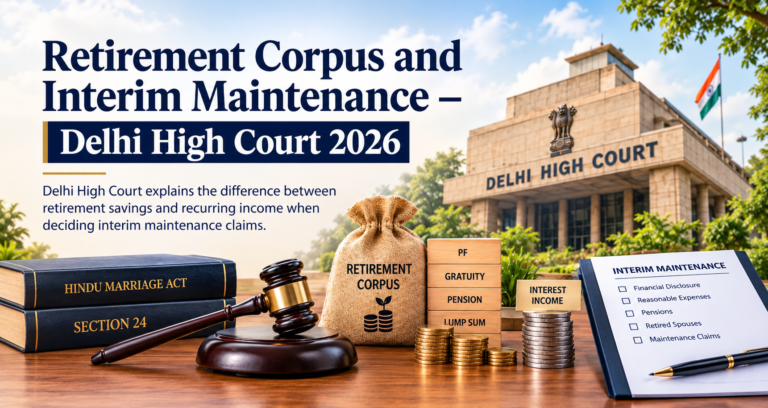
• Section 24 and Section 25 of the Hindu Marriage Act, 1955: These sections provide for maintenance pendente lite (interim maintenance during the pendency of proceedings) and permanent alimony, respectively, in proceedings for divorce, judicial separation, or restitution of conjugal rights.
• Section 18 of the Hindu Adoptions and Maintenance Act, 1956: This provision recognizes the substantive right of a Hindu wife to be maintained by her husband during her lifetime, even while living separately under justified circumstances.
• The Protection of Women from Domestic Violence Act, 2005: Under Sections 20 and 23, a Magistrate can grant monetary reliefs, including maintenance, to an aggrieved woman, which can be in addition to any order passed under other laws.
The common thread running through these statutes is the absence of a fixed formula, thereby empowering the courts to ensure that the awarded amount is just, fair, and reasonable in the given circumstances.
3. The Judicial Compass: Guiding Principles for Assessment
The Supreme Court of India and various High Courts have, through a catena of judgments, laid down the fundamental principles that govern the calculation of maintenance. The overarching objective is not to penalize the husband but to ensure that the wife can live with dignity, approximating the standard of living she was accustomed to in her matrimonial home.
In the landmark case of Rajnesh v. Neha, (2021) 2 SCC 324, the Hon’ble Supreme Court streamlined the entire process and reiterated the criteria for determining the quantum of maintenance, which include:
• Status of the parties: The social and economic standing of both the husband and the wife.
• Reasonable needs of the wife and dependent children: This encompasses not just bare necessities like food, clothing, and shelter, but also expenses related to medical care, transportation, and other incidentals consistent with their lifestyle.
• Income and property of the claimant: The wife’s own income, if any, is a relevant factor. However, the mere fact that the wife is earning does not automatically disentitle her from receiving maintenance, especially if her income is insufficient to support herself in a manner consistent with the marital standard of living.
• Income, property, and earning capacity of the husband: The court scrutinizes the husband’s actual income, assets, and his potential to earn. In cases of suspected concealment of income, courts are empowered to draw adverse inferences based on the husband’s lifestyle, qualifications, and financial dealings.
• Liabilities of the husband: The husband’s financial obligations, including the maintenance of other dependents such as aged parents, are also taken into consideration.
4. The Affidavit of Disclosure: A Mandate for Transparency
A significant procedural reform institutionalized by the Supreme Court in Rajnesh v. Neha is the mandatory filing of an Affidavit of Assets and Liabilities by both parties in all maintenance proceedings. This comprehensive disclosure document requires parties to truthfully declare their income, assets (movable and immovable), liabilities, and monthly expenditure. This mandate ensures transparency, prevents concealment of financial information, and enables the court to make an objective and informed assessment of the appropriate maintenance amount, thereby expediting the disposal of such cases.
5. Quantum of Maintenance: A Holistic and Fact-Dependent Exercise
The final determination of the maintenance amount is a delicate balancing act. While no arithmetical exactitude is possible, courts are guided by certain practical considerations:
• Earning Capacity vs. Actual Income of the Wife: Courts have consistently held that a wife who is qualified but has not been employed, having dedicated her time to the family, cannot be denied maintenance on the ground of her “earning capacity.” The court considers the practical realities, including the long hiatus from a professional career and the responsibilities of child-rearing.
• Reasonable Apportionment of Husband’s Income: Although not a rigid rule, a judicial benchmark often considered, particularly for interim maintenance, is to award between 25% to 33% of the husband’s net monthly income to the wife. This serves as a guiding principle to ensure a fair and equitable distribution of resources, subject to the specific facts of the case.
• Expenses of Minor Children: The educational, medical, and other developmental needs of minor children are a paramount consideration. The court typically quantifies the children’s expenses separately and directs the husband to bear them, often in addition to the maintenance awarded to the wife. The non-custodial parent’s responsibility towards the children remains absolute.
• Modification of Maintenance Orders: An order of maintenance is not immutable. Under Section 127 of the Cr.P.C now 146 BNSS). and corresponding provisions in other personal laws, either party can approach the court for alteration of the maintenance amount upon proving a material change in their circumstances, such as a significant increase or decrease in income or a change in liabilities.
6. Conclusion
The calculation of maintenance in India is not a mechanical process but a nuanced judicial function rooted in principles of equity, fairness, and social justice. The courts undertake a holistic evaluation of the financial capacities and needs of both parties, the standard of living enjoyed during the marriage, and the overall circumstances of the case. The legal framework, fortified by judicial pronouncements like Rajnesh v. Neha, strives to ensure that the process is transparent, fair, and effective in providing dignified subsistence to the dependent spouse, thereby upholding the sanctity of the marital obligation to support.
Written by Adv. Aman Chawla, practising in Delhi, focusing on matrimonial and family law matters.