This Article is written by Adv. Aman Chawla, Family Law Expert | Delhi High Court & Supreme Court of India
Practising in Family & Matrimonial Law | Jangpura, New Delhi
Quick Answer
A false income affidavit in maintenance cases can significantly affect the amount of maintenance determined by a court, but simply alleging that an affidavit is false is not enough. The stronger approach is to compare the disclosure line by line against documents such as ITRs, Form-26AS, AIS, bank statements, GST filings, property records and other reliable financial evidence. Under Rajnesh v. Neha, courts have mechanisms to examine disputed financial disclosures and require further information where necessary.
Introduction
Nearly every maintenance case I handle reaches the same moment. My client reads the other side’s income affidavit, and the first word out of their mouth is “false.” Sometimes they’re right. Often they’re right about the instinct but wrong about how to act on it.
The mistake I see most, even among lawyers, is treating the affidavit as something you argue against in submissions. You don’t. You dismantle it with documents, one line at a time, or you leave it standing no matter how loudly you object to it in court.
Rajnesh v. Neha changed the starting point for every maintenance case in India, whether it’s filed under the Hindu Marriage Act, the Domestic Violence Act, Section 144 BNSS (formerly Section 125 CrPC), or the Special Marriage Act. Financial disclosure is no longer optional or informal. But the judgment did something lawyers on the ground sometimes forget to use , it gave courts real mechanisms to verify what’s disclosed, not just a form to fill in. That’s where your objection actually lives.
The First Rule: Never File a General Objection
I tell every client the same thing before we draft anything: “the respondent has concealed his income” is not an objection, it’s a complaint, and courts have heard that sentence a thousand times with nothing behind it.
An objection that actually moves a judge does four things, every time:
- Names the exact line in the affidavit you’re disputing,
- Says precisely why it’s wrong,
- Attaches the document that contradicts it, and
- States the specific relief you want from the court.
Skip any one of these four and you’re back to making noise, not making a case. Courts respond to documentary contradiction, not to the volume of your suspicion.
Where the Concealment Actually Hides
Over the years, I’ve noticed the same handful of places income and assets go missing from these affidavits, again and again. Building your objection means working through each of these methodically, not picking the one that feels most satisfying.
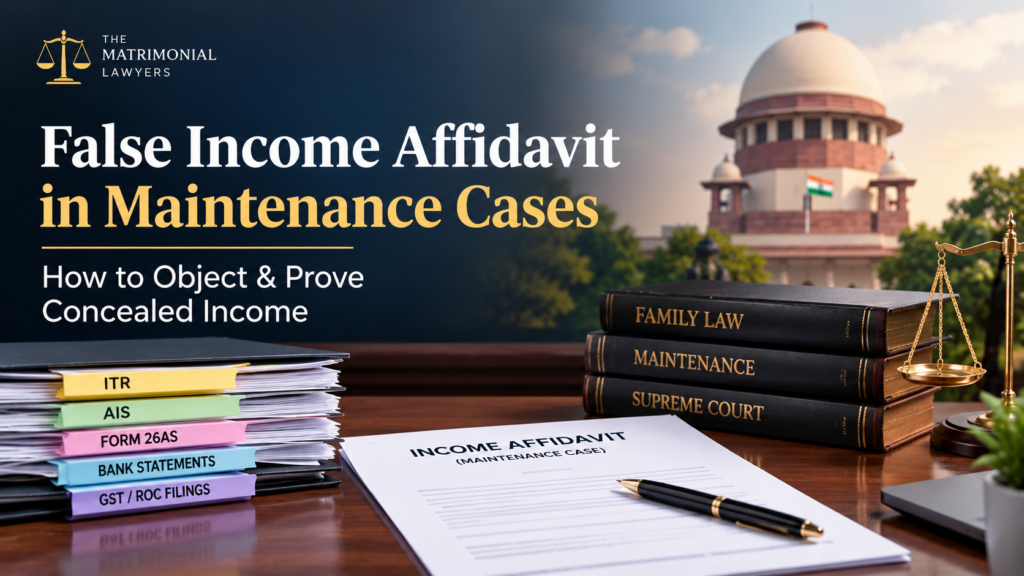
Start with the tax record, but don’t stop there. The ITR is only the headline figure. I ask clients to pull the Form-16, Form-26AS, the Annual Information Statement, and the Taxpayer Information Summary alongside it, because the AIS in particular has become the single most useful document in this exercise , it pulls in what banks, mutual funds, employers, registrars, and market intermediaries have separately reported, independent of what your spouse chose to disclose. When the salary in the affidavit doesn’t match Form-16, or the AIS shows interest income, mutual fund activity, or securities transactions that never made it into the affidavit, that gap is your objection, already written for you.
Look past the salary slip, into the bank statement. Most litigants stop at “what does he earn.” I push clients to go further , monthly credits, cash deposits, UPI receipts, RTGS and NEFT transfers, recurring payments, rent receipts, business collections, and anything withdrawn suspiciously close to the date proceedings began. Unexplained, repeated credits routinely establish an income well above what the affidavit admits, and where business receipts are being routed through a personal account, that account becomes the centrepiece of your case.
Check whether every account has even been named. A single disclosed bank account, when the financial profile obviously involves more, is itself a red flag. Cross-reference Form-26AS, the AIS, interest certificates, loan paperwork, and cheque leaves against the accounts actually listed , undisclosed accounts surface here more often than people expect, and the fact of non-disclosure damages the whole affidavit’s credibility, not just that one line.
Test the “no rental income” claim against reality. Ownership records, municipal tax filings, lease deeds, electricity bills, and bank credits that land like clockwork every month , these rarely lie the way an affidavit can. If there’s a tenant in a property the affidavit insists is generating nothing, that contradiction doesn’t need much argument, it makes itself.
Where the spouse runs a business, look at turnover, not just salary. Self-employed respondents, proprietors, partners, and directors are where I see the widest gap between declared and actual income. GST returns, balance sheets, profit and loss statements, partnership deeds, ROC filings, director remuneration, and dividend income tell a very different story than a modest personal tax return sometimes does. Courts have made clear they’re assessing earning capacity, not merely the number on a tax form, and that distinction is often where a weak-looking affidavit actually falls apart.
Let lifestyle do the work documents can’t. The Supreme Court itself recognised that income can’t always be read off a form , the overall financial standard of living matters too. Foreign holidays, luxury vehicles, premium memberships, expensive schooling, branded purchases, frequent flights, a destination wedding, even social media, none of this replaces documentary proof on its own, but stacked against a modest declared income, it builds an inference no judge ignores entirely.
Chase the investments the affidavit conveniently skipped. Mutual funds, SIPs, shares, demat holdings, ESOPs, bonds, fixed deposits, PPF, EPF, VPF, NPS, ULIPs, insurance policies carrying surrender value, even cryptocurrency , these are exactly the categories that go missing, and exactly the categories AIS and bank statements tend to expose regardless of what the affidavit says.
Don’t let inflated expenses pass unchallenged either. Concealment isn’t only about hiding income, it’s equally about manufacturing expenditure , inflated groceries, exaggerated fuel costs, unrealistic domestic help charges, EMIs that don’t match any loan on record, medical costs with no bills behind them. Every rupee of claimed expenditure should have an invoice, a bank entry, or a repayment schedule sitting behind it. An expense with no paper trail deserves no weight, and I say that to judges as plainly as I’m saying it to you.
Watch for debts invented for the occasion. Undocumented family loans, cash borrowings from friends, private liabilities with no agreement anywhere , these tend to appear right around the time litigation starts, and not before. Unless there’s credible documentation behind a liability, courts are entitled to, and often do, simply decline to deduct it.
Finally, remember salary is not the whole package. Accommodation, a company vehicle, fuel reimbursement, a driver, medical cover, travel allowance, stock options, education benefits, bonus, and performance incentives are all part of the real financial picture. A respondent earning one lakh in salary with sixty thousand in employer benefits sitting on top of it is not, honestly, presenting a complete affidavit by naming only the smaller number.
What the Court Can Actually Do Once You’ve Built the Case
This is the part of Rajnesh v. Neha that gets underused. The judgment didn’t stop at prescribing a form, it gave courts real procedural weapons to test what’s in it. Once your documentary objection is on record, you can ask the court to direct production of further financial records, permit discovery and interrogatories under Order XI CPC, examine the deponent under Order X CPC, invoke Section 165 of the Evidence Act to clarify disputed financial facts, draw an adverse inference where documents are being deliberately withheld, and, where fresh information surfaces mid-case, direct a supplementary affidavit. The Court also made an important observation worth remembering , a spouse’s own financial position is often within that spouse’s exclusive knowledge, which is precisely the kind of situation Section 106 of the Evidence Act was built for.
Courts are increasingly unwilling to look past this. In one recent matter, the Gujarat High Court went as far as initiating contempt proceedings against a husband for failing to make truthful disclosures in his affidavit, making clear that non-compliance with the Supreme Court’s own disclosure framework isn’t a technical lapse to be waved away.
A Realistic Example
A wife’s counsel receives the husband’s income affidavit declaring a salary of ₹90,000 a month and no other assets. Instead of arguing “this is too low” in open court, they pull his Form-26AS and AIS , both show recurring dividend credits and a demat account never mentioned in the affidavit. His bank statement shows monthly UPI credits that don’t correspond to any declared income source. None of this alone proves he’s lying, but laid out together, line by line against the affidavit, it becomes an objection built entirely on paper, not persuasion. The court directs him to file a supplementary affidavit accounting for the demat holdings and the unexplained credits. Whether the final maintenance figure moves, and by how much, depends on how well that paper trail was assembled , not on how convinced the wife was that he was hiding something.
What To Do Next
If you believe the affidavit in front of you is incomplete, don’t start with an application accusing the other side of dishonesty. Start with the documents , ITR, Form-16, Form-26AS, AIS, TIS, twelve to twenty-four months of bank statements, property records, and, where relevant, GST and ROC filings. Match every one of them against a specific line in the affidavit before you draft a single objection. An objection built this way rarely gets brushed aside, because there’s nothing in it for the other side to simply deny.
FAQ
Can I object to my spouse’s income affidavit just because I believe it’s false?
Not on belief alone. Your objection needs to point to a specific statement in the affidavit and a specific document that contradicts it , general accusations of concealment carry little weight before Family Courts.
What is the most useful document for exposing concealed income?
The Annual Information Statement, since it draws directly from what banks, employers, and financial institutions have independently reported, rather than relying on what the affidavit-filer chose to disclose.
Can lifestyle evidence alone prove someone is hiding income?
No, but it supports an inference when paired with documentary gaps. Courts consider standard of living relevant to assessing financial capacity, but it works alongside proof, not instead of it.
What can a court do if it believes the affidavit is incomplete?
The court can direct production of further records, permit discovery and interrogatories, examine the deponent directly, and draw an adverse inference where relevant documents are deliberately withheld.
Can undisclosed bank accounts by themselves weaken an affidavit’s credibility?
Yes. Even a single undisclosed account, once identified through Form-26AS, AIS, or interest certificates, raises doubt about the completeness of the entire affidavit, not just that account.
Conclusion
An objection to an income, assets and expenditure affidavit is rarely a formality , in my experience, it’s often the single most decisive stage of the entire maintenance case. It is never won on suspicion. It’s won through a methodical, document-by-document comparison , tax records against AIS, bank statements against declared income, property records against claimed rental status, lifestyle against declared means. Get that comparison right, and you’re not accusing anyone of lying, you’re simply giving the court what it needs to arrive at the real number.
Adv. Aman Chawla practices matrimonial and family law before the Delhi High Court, Delhi Family Courts (Saket, Rohini, Dwarka, Karkardooma, Patiala House), and the Supreme Court of India. For a consultation on your specific situation, reach out through the contact details on this website.
Disclaimer: This article is for general informational purposes only and does not constitute legal advice. As per the Rules of the Bar Council of India, advocates are not permitted to advertise or solicit work, and nothing in this article should be construed as advertising, solicitation, or an invitation to engage this firm. Readers should consult a qualified advocate regarding their specific circumstances before taking any legal action.