By Advocate Aman Chawla | The Matrimonial Lawyers, New Delhi | Published: August 2026
Here’s a version of a conversation we have more often than you’d think. A summons arrives, or a call comes from the police station, and the instinct is to just… not deal with it. Maybe it feels unreal. Maybe there’s a hope it’ll blow over if enough time passes. Maybe someone’s told you, wrongly, that skipping it means the case has no teeth without you physically showing up.
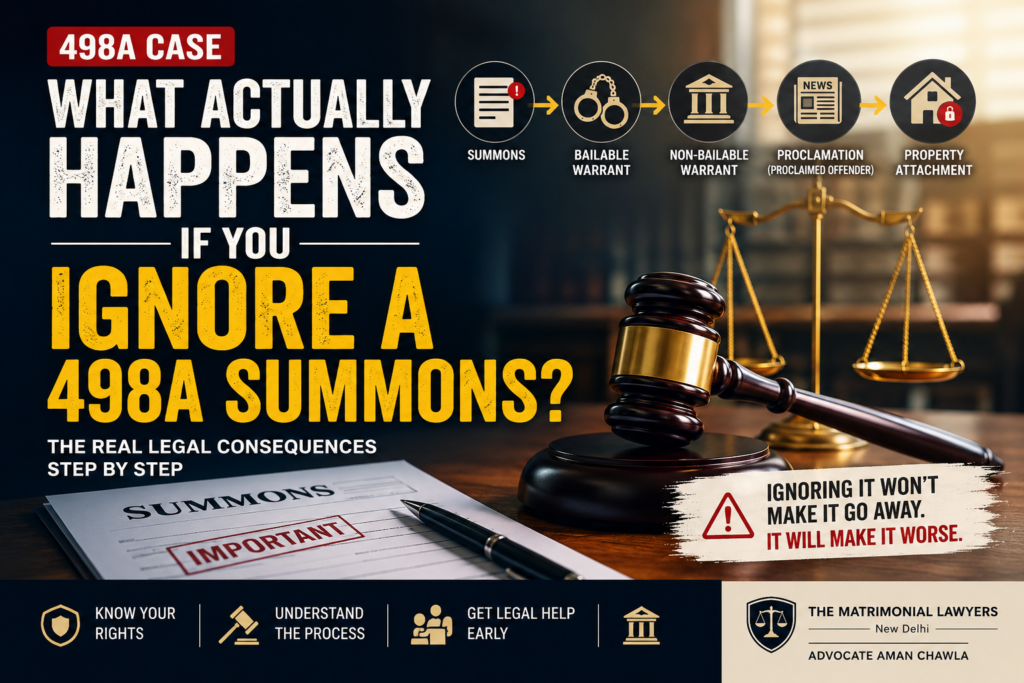
It doesn’t work that way. Ignoring a 498A summons doesn’t slow the case down or make it quietly disappear — it accelerates things, and not in your favour. Let’s walk through exactly what happens, in the actual order it happens, so you know precisely what you’re risking if you keep avoiding it.
Step One: The Summons Itself Isn’t the Scary Part
Worth saying clearly: receiving a summons or a notice to appear, on its own, isn’t the crisis moment. Under Section 35 of the Bharatiya Nagarik Suraksha Sanhita, 2023, and consistent with the Supreme Court’s guidance in Arnesh Kumar v. State of Bihar, police are generally expected to issue a notice of appearance rather than making an arrest outright, particularly in offences like Section 85 BNS (formerly 498A IPC) that carry up to seven years’ imprisonment. If you show up, cooperate, and engage properly — ideally with a lawyer alongside you — this stage passes without your life turning upside down.
The trouble starts specifically when that notice gets ignored.
Step Two: A Bailable Warrant
If you don’t appear after being properly summoned, the next step is usually a bailable warrant. This is still an arrest warrant, but a comparatively gentle one — if you’re picked up on a bailable warrant, you can generally secure release by furnishing bail right there, without needing to go through a fuller court process first.
This is the point where a lot of people think they’ve dodged something serious just because they weren’t personally arrested on the spot. That’s a mistake. A bailable warrant is a clear signal from the court that your non-appearance has already been noticed and is already working against you. It’s also, genuinely, your last relatively easy off-ramp before things escalate meaningfully.
Step Three: The Non-Bailable Warrant
Ignore that too, and the court moves to a non-bailable warrant. This is a different category of problem entirely. Under an NBW, the police can arrest you and you don’t get an automatic right to be released at that point — any bail application has to be made before the court itself, after you’re already in custody. There’s no quick, on-the-spot resolution the way there is with a bailable warrant.
This is also the stage where things stop being theoretical. An NBW is active — it doesn’t wait for a convenient time. It can be executed whenever and wherever you’re found, and depending on how it’s flagged in police systems, it can genuinely disrupt travel, employment checks, and other everyday parts of life you wouldn’t expect a court summons to touch.
Here’s the Part Most Guides Skip: NBWs Aren’t Supposed to Be Automatic
This matters, and it’s worth knowing even if you’re currently facing exactly this situation. Courts aren’t meant to issue non-bailable warrants just because someone missed a date. The Supreme Court, going back to Inder Mohan Goswami v. State of Uttaranchal (2007), has held that an NBW should only be issued where the accused is deliberately evading the process or genuinely poses a flight risk — not as an automatic, mechanical response to non-appearance.
More recently, in Sachin Dev Duggal v. Directorate of Enforcement (2025:DHC:11624), the Delhi High Court set aside an NBW issued against a UK-based businessman purely for not responding to summons, reinforcing the same principle: mere non-appearance doesn’t, by itself, automatically justify a non-bailable warrant. That case arose in a different statutory context, but the underlying reasoning — courts are supposed to actually assess whether someone is genuinely evading the process, not just tick a box because a date was missed — is exactly the kind of argument your lawyer can, and should, be making if an NBW has been issued or is being sought against you, particularly if there’s a legitimate reason you weren’t there.
This isn’t a loophole. It’s a real, recognised judicial safeguard. But it only helps you if someone actually raises it — courts don’t apply it on their own initiative on your behalf.
Step Four: The Proclamation — Becoming a “Proclaimed Offender”
If an NBW can’t be executed because the police simply can’t locate you, the court can move to Section 84 of the BNSS (the old Section 82 CrPC), issuing a public proclamation. This typically means a notice published in a newspaper or affixed at your last known residence, formally declaring that you’re required to appear by a set date or be treated as having absconded.
Being declared a proclaimed offender is genuinely serious, and not just because of how it sounds. It’s a public record. It affects how the case against you is perceived by the court going forward. And under certain circumstances, deliberately absconding after proclamation can itself become a separate offence layered on top of whatever you were originally facing.
Step Five: Property Attachment
If proclamation doesn’t bring you back into the process, the court can move to Section 85 BNSS (the old Section 83 CrPC) and order attachment of your property. This is exactly what it sounds like — the court can take steps to attach assets, which is a genuinely severe consequence for what, at this point, started as simply not showing up to a notice.
It’s worth being honest about how rarely people actually reach this exact stage in a 498A matter specifically — most cases resolve one way or another well before property attachment becomes a live issue. But the fact that the law provides for it, and that it has been used, should tell you something about how seriously the system treats sustained, deliberate non-appearance.
The Part Nobody Warns You About: Background Checks and Everyday Life
Here’s something that surprises a lot of clients, usually too late. An active warrant, and especially proclaimed-offender status, doesn’t just sit quietly in a court file waiting for your next hearing. It can surface in police verification for a new job, in visa applications, in property transactions that require a police clearance certificate, and in a dozen other ordinary moments where you’d never expect a matrimonial matter to suddenly matter.
We’ve had clients come to us not because the original 498A complaint itself alarmed them, but because a police verification for a new job came back flagged, and they had no idea an NBW had quietly been sitting active against them for months. By that point, what should have been a straightforward response to a summons has turned into an urgent, embarrassing scramble — explaining the situation to an employer, or delaying a property deal, over something that could have been resolved cleanly at the very first notice.
This is really the core point of this entire article: the cost of ignoring a summons isn’t contained to the courtroom. It leaks into parts of your life that have nothing to do with the original dispute, and it does so quietly, without warning, until it doesn’t.
What This Looks Like If You’re an NRI
We hear this question constantly from clients based abroad, and it deserves its own honest answer rather than a generic one. Being outside India doesn’t put you outside this process — it just changes how it plays out.
If summons aren’t being responded to, courts can, and do, proceed with the same escalation described above, often ending in proclamation and, in serious cases, a request for a Look Out Circular restricting your movement through Indian airports and border checkpoints. We’ve had clients discover an active legal problem only when trying to fly into India for a family event, which is about the worst possible moment to learn about it.
If you’re abroad and a 498A matter is active or developing against you, the single most useful thing you can do is not go quiet. Engage a lawyer in India who can appear on your behalf, respond to notices, and — where appropriate — pursue anticipatory bail or other protective steps, even while you remain overseas. Distance doesn’t protect you from this process; it just makes silence a lot more expensive to fix later.
What If You Genuinely Never Received the Summons?
This happens more than people expect, and it’s a real, legitimate defence to non-appearance, not an excuse. Summons sent to an old address, sent to a residence you’d already moved out of, or served on a family member who never actually passed it along — these are all situations where a warrant or proclamation can be challenged and, often, recalled.
If this describes your situation, don’t just quietly show up hoping it sorts itself out, and don’t panic and go silent either. Get a lawyer to formally bring this to the court’s attention — proper service of process matters legally, and a warrant issued on the back of defective service is genuinely vulnerable to being set aside, provided it’s raised properly and promptly.
The CAW Cell Stage Is Different — And Comes Before Any of This
It’s worth clarifying something that trips a lot of people up. Many 498A matters begin not with a court summons at all, but with a notice from the Crime Against Women Cell, where the complaint is first examined and mediation is often attempted before any FIR is even registered. Ignoring a CAW Cell notice doesn’t trigger warrants or proclamation the way ignoring a court summons does — but it does mean you lose the opportunity to potentially resolve or narrow the matter at its earliest, least formal stage, and it can also affect how the matter is characterised once it does proceed to an FIR. If you’re at this earlier stage, our guide on how CAW Cell complaints work — written from the complainant’s side, but genuinely useful for understanding the process you’re now part of — is worth reading alongside this article.
Why People Actually Ignore These Notices — And Why It Backfires
We think it’s worth being honest about the psychology here, because understanding why avoidance feels tempting is part of actually avoiding it. Most people who ignore a 498A summons aren’t being reckless. They’re overwhelmed, embarrassed, or genuinely hoping the whole situation resolves itself if they just don’t engage with it directly. Sometimes there’s a belief, usually incorrect, that showing up somehow validates the complaint, or that staying invisible means the case can’t really move forward without them.
None of that holds up in practice. The legal process doesn’t pause because you’re avoiding it — if anything, your absence becomes its own separate problem, layered on top of whatever the original complaint involved. And the emotional relief of not dealing with it today is almost always outweighed, badly, by how much harder the same conversation becomes a few months and several missed hearings later. If you’re in this position right now, the discomfort of engaging immediately is genuinely the easier path, even though it doesn’t feel that way in the moment.
What You Should Actually Do Instead
- Respond to the very first notice, not the third one. Every stage past the initial summons narrows your options and raises the stakes. The earliest response is always the cheapest, easiest one.
- Get a lawyer involved before you engage with police or the court, not after something’s already gone wrong. This isn’t about needing someone to speak for you at every step — it’s about not accidentally saying or doing something that weakens your position before you’ve had proper advice.
- If you missed a summons for a genuine reason, document that reason immediately — travel records, medical records, proof of an address change, whatever’s relevant. This becomes the basis for challenging any resulting warrant.
- If an NBW has already been issued, don’t wait for it to be executed. Your lawyer can move to have it recalled or converted, particularly where you can show you weren’t deliberately evading the process — this is exactly where the reasoning from cases like Sachin Dev Duggal becomes directly useful.
- If you’re abroad, don’t assume distance is protection. Engage counsel in India promptly so someone is actually representing your position while you sort out the practical logistics of dealing with this from overseas.
A Realistic Example
A husband receives a 498A summons but is travelling for work and, in the chaos of it, simply doesn’t respond in time. A bailable warrant follows, which he also misses because he genuinely never saw it — it was sent to an address he’d moved out of eight months earlier. By the time he learns an NBW has been issued, he’s understandably panicked. His lawyer moves quickly, filing an application demonstrating the defective service at the old address, providing his current address and travel records showing no intent to evade, and specifically arguing — drawing on the same reasoning courts have applied elsewhere — that mechanical issuance of an NBW isn’t appropriate where there’s no genuine evidence of deliberate avoidance. The warrant is recalled, and he’s able to engage with the underlying case properly, rather than carrying an active warrant into what should have been a manageable legal matter.
What Not to Do
- Don’t assume moving, changing your number, or simply staying quiet makes the problem go away. It doesn’t — it just adds a proclamation and potentially an absconding-related complication to whatever you were already facing.
- Don’t try to explain your absence directly to the police or the court without a lawyer present. What feels like a reasonable, human explanation in the moment can easily be recorded in a way that doesn’t serve you later.
- Don’t wait for an NBW to be executed before doing anything. By then, you’ve lost the easier options — recall applications and challenges to service are far more effective before you’re picked up than after.
- Don’t assume a lawyer can only help once you’re already in serious trouble. The earlier we’re involved, the more options are actually available — this genuinely isn’t just something we say to get clients in the door.
If your matter has reached the point of anticipatory bail being the live issue, our detailed guide on securing anticipatory bail in a 498A matter covers that process step by step. And if you’re past the summons stage entirely and thinking about how to actually defend the underlying complaint, our guide on fighting a false 498A case picks up from there.
Frequently Asked Questions
1. What’s the very first thing that happens if I miss a 498A summons?
Generally, a bailable warrant — still an arrest warrant, but one where you can typically secure release by furnishing bail immediately, without a fuller court process first.
2. How long does it take to escalate from a summons to a non-bailable warrant?
There’s no fixed timeline — it depends on the court and how the matter is being handled, but it can move relatively quickly if notices continue to go unanswered. This is exactly why early engagement matters.
3. Can a non-bailable warrant be cancelled after it’s issued?
Yes, particularly where you can show you weren’t deliberately evading the process — a genuine reason for missing the summons, or defective service of the original notice, are both real grounds for a recall application.
4. What does it actually mean to be declared a “proclaimed offender”?
It’s a formal court declaration, made after a non-bailable warrant can’t be executed, that you’re required to appear or be treated as having absconded. It’s a serious, public step that can affect how your case is viewed going forward.
5. Can my property really be attached just for missing court dates?
In theory, yes, under Section 85 BNSS, if matters escalate all the way through proclamation without resolution. In practice, most 498A matters resolve well before reaching this stage — but it’s a real, available consequence of sustained non-appearance.
6. I’m an NRI — does ignoring a summons actually affect me if I’m not planning to visit India?
It can, more than people expect. Courts can proceed with the same escalation regardless of your location, and in serious cases, a Look Out Circular can restrict your entry through Indian airports — something we’ve seen catch clients off guard when they least expect it.
7. What if I never actually received the summons?
This is a legitimate, real defence to non-appearance, not just an excuse — but it needs to be formally raised with the court through your lawyer, ideally with supporting evidence like proof of an address change, rather than simply asserted after the fact.
8. Is it better to just show up late than not at all?
Generally, yes — appearing late, with a genuine explanation, is a considerably better position than continued non-appearance, which is what actually triggers the escalation described in this article.
9. Can an old, unresolved warrant affect things like job applications or property deals years later?
Yes, and this is one of the more overlooked consequences. Police verification for employment, visa processing, and property transactions requiring clearance certificates can all surface an active warrant or proclaimed-offender status you may have forgotten about, sometimes at a genuinely inconvenient moment.
10. If I’ve been avoiding this for a while already, is it too late to fix it cleanly?
It’s very rarely too late to improve your position, even if things have already escalated somewhat. The sooner you engage a lawyer, the more options remain available — recall applications, challenges to defective service, and negotiated appearances all become harder, not impossible, the longer avoidance continues.
Disclaimer: This article is for general informational purposes only and does not constitute legal advice. As per the Rules of the Bar Council of India, advocates are not permitted to advertise or solicit work, and nothing in this article should be construed as advertising, solicitation, or an invitation to engage this firm. Every case is fact-specific — consult a qualified advocate regarding your specific circumstances before taking any legal action.