By Advocate Aman Chawla | The Matrimonial Lawyers, New Delhi | May 2026
Crime Against Women Cell, Complete Practical Guide (Delhi, 2025)
Delhi Police | For Women Facing Cruelty, Dowry Harassment & Domestic Violence
You have been harassed. You are ready to take action. But you don’t know where to start , or what happens after you walk through that door. This guide tells you exactly that, step by step, in plain language.
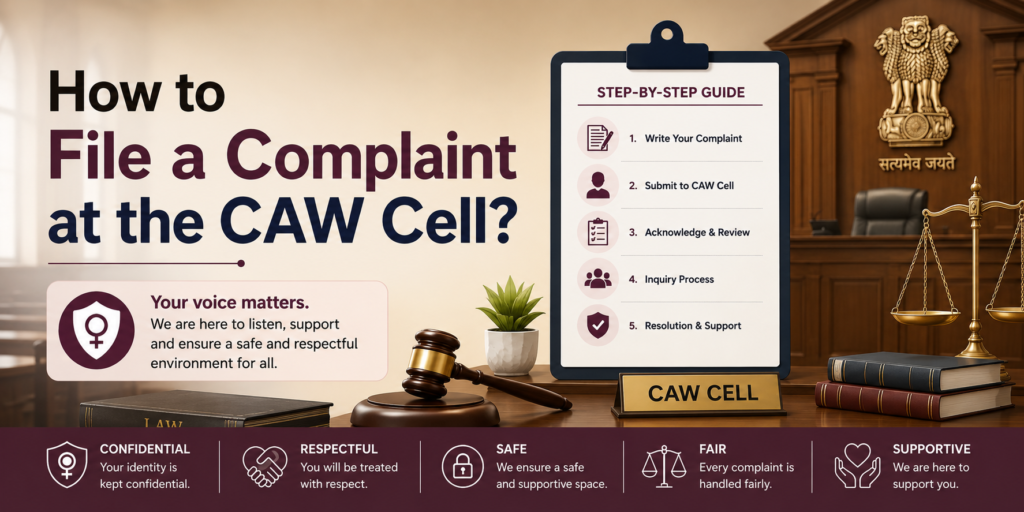
Step 1: Write Your Complaint, And Write It Right
Everything begins with a written complaint. Before you visit the CAW Cell, put your entire account on paper. This is the most critical step; a well-drafted complaint sets the tone for everything that follows.
Write with dates, not just feelings. “My in-laws tortured me” will not carry the same weight as “On 3rd November 2024, my mother-in-law slapped me and demanded ₹2 lakh in front of two neighbours.” Be specific, specific dates, incidents, and demands. The more precise you are, the more credible your complaint becomes.
Cover every person involved. Write the full name, full address, and mobile number of your husband and every in-law you are naming. Missing details cause delays in summoning them.
Make two copies. Carry both when you visit. Submit one to the official, and get the second copy stamped and signed , called taking receiving. That receipt is your proof of filing. Never leave without it
Step 2: Visit the CAW Cell , What Happens on Day One
On the day you arrive, the officials will not directly take your complaint and send you home. They will first sit with you, explain your rights and limitations, and then formally accept your written complaint.
After this, your complaint goes to the Legal Cell of the CAW Cell, which reviews it and makes its recommendations. Once cleared, a female Enquiry Officer (EO) is appointed by the DCP in charge. The EO will meet you personally, hear your account once more, and take the matter forward. You will also receive your first date on the very same day you file.
Step 3: Husband Gets Summoned
The Enquiry Officer sends a notice to your husband asking him to appear at the CAW Cell. This is not a court summons , it is a request letter. However, not appearing is a serious mistake, as it can create significant problems if he later seeks anticipatory bail.
This is typically the first time the husband formally learns of the complaint against him.
Step 4: Counselling, Mediation, and Multiple Dates
When the husband appears, a trained counsellor meets both parties , sometimes together, sometimes separately , and attempts reconciliation. If there is any possibility of saving the marriage, further dates are given and more sessions are held.
If reconciliation is not possible, discussions shift to settlement terms: maintenance, return of Stridhan, separation, and related matters. This process moves through multiple levels:
Counsellor Level , initial joint sessions
Enquiry Officer Level , formal proceedings, Stridhan discussions
ACP (Assistant Commissioner of Police) Level
DCP (Deputy Commissioner of Police) Level , final review
Each level carries higher authority. Typically, 5 to 7 sessions take place before a final outcome is reached.
Step 5: The Stridhan List , A Crucial Stag
At some point during the hearings, the EO will ask you to submit your Stridhan list , a detailed inventory of all jewellery, cash, clothes, gifts, and valuables that belong to you and are currently in your husband’s or in-laws’ custody.
The husband is then given a few days to respond with an “admit list” , the items he acknowledges holding. The gap between what you claim and what he admits becomes a key point of negotiation.
Important: Be honest and thorough in your Stridhan list. Exaggerated or false claims can backfire and damage your credibility at later stages.
Step 6: Mediation Cell
After the Stridhan exchange, both parties are referred to the Mediation Cell, where a trained High Court lawyer mediator facilitates structured discussions on all outstanding issues , custody, maintenance, Stridhan return, and whether the marriage should continue or not.
Step 7: Final Outcome , Settlement or FIR
After all sessions, one of two things happens:
If settlement is reached: The agreed terms are recorded in writing before the officials. This written record is legally significant and enforceable.
If no settlement is reached: The CAW Cell sends a failure report to its superiors and forwards your complaint to the nearest police station for registration of an FIR under relevant sections , most commonly Section 498A BNS, Section 406, or the Domestic Violence Act.
Things You Must Never Do at the CAW Cell
Do not share all your evidence at this stage. The CAW Cell is not a court. Save your strongest proof for the investigation or trial.
Do not react emotionally or make verbal threats during counselling sessions , what happens there can be noted on record.
Do not assume one date will resolve everything. Budget your time and patience.
Do not exaggerate your Stridhan list. It will come back to hurt you
Do not go without consulting a lawyer at least once before your first session.
Emergency Helplines
| Service | Number |
| Women’s 24-Hour Helpline | 1091 |
| Delhi Legal Services Free Aid | 12525 |
| Legal Services Clinic (24 Hrs), Gole Market | 011-23341111 |
| Delhi Police Emergency | 100 |
Delhi CAW Cell , District-Wise Directory
Your CAW Cell is determined by the district where your matrimonial home (husband’s address) is located , not where you currently live.
| HEADQUARTERS , Special Police Unit for Women & Children
Nanakpura, Moti Bagh, New Delhi | Phone: 011-24673366 | Jurisdiction: Oversight & escalation for all district CAW Cells |
||||
| # | District | Address | Phone | Key Areas / Jurisdiction |
| 1 | North | CAW Cell, P.S. Sarai Rohilla, 1st Floor, Delhi – 110007 | 011-23962201 | Model Town, Sarai Rohilla, Subzi Mandi, Timarpur, Mukherjee Nagar, Shalimar Bagh (N), Alipur |
| 2 | North-West | CAW Cell, P.S. Pitampura, Delhi – 110052 | 011-27232353 | Pitampura, Kanjhawala, Prashant Vihar, Sultanpuri, Mangolpuri, Rohini (partial) |
| 3 | North-East | CAW Cell, Old Bldg, P.S. Nand Nagri, Delhi | 011-22137210 | Nand Nagri, Seemapuri, Karawal Nagar, Gokalpuri, Seelampur, Yamuna Vihar |
| 4 | Central | CAW Cell, P.S. Prasad Nagar, Delhi | 011-25737951 Ext. 7411 | Karol Bagh, Prasad Nagar, Rajender Nagar, Patel Nagar, Anand Parbat, Paharganj |
| 5 | New Delhi | CAW Cell, Parliament Street, New Delhi – 110001 | 011-23361231 Ext. 3447 | Connaught Place, Tughlak Road, Chanakyapuri, Parliament Street, Mandir Marg |
| 6 | South | CAW Cell, Old P.S. Malviya Nagar Bldg, Behind PVR Saket, New Delhi | 011-26562731 | Malviya Nagar, Hauz Khas, Greater Kailash, Saket, Vasant Kunj, Mehrauli, Chattarpur |
| 7 | South-West | CAW Cell, P.S. Dwarka Sector 9, 1st Floor, Near ITL Public School, New Delhi | 011-25088987 | Dwarka, Palam, Kapashera, Uttam Nagar, Bindapur, Najafgarh |
| 8 | South-East | CAW Cell, P.P. Sriniwas Puri, New Delhi | 011-26841500 | Sriniwas Puri, Lajpat Nagar, Okhla, Kalkaji, Greater Kailash (partial), Badarpur |
| 9 | East | CAW Cell, P.S. Krishna Nagar, Delhi | 011-22207950 | Krishna Nagar, Preet Vihar, Vivek Vihar, Shakarpur, Geeta Colony, Gandhi Nagar, Laxmi Nagar |
| 10 | West | CAW Cell, P.S. Kirti Nagar, New Delhi | 011-25447100 Ext. 4205 | Kirti Nagar, Ramesh Nagar, Rajouri Garden, Janakpuri, Vikaspuri, Tilak Nagar, Hari Nagar |
| 11 | Outer | CAW Cell, Old P.S. Bldg, Near JIMS Institute, Sector 3, Rohini, Delhi | 011-27511753 | Rohini Sectors, Bawana, Narela, Budh Vihar, Samaypur Badli, Mongolpuri (outer) |
Frequently Asked Questions
Can the CAW Cell arrest my husband?
No. The CAW Cell has no power to arrest or take coercive action. Arrest can only happen after an FIR is registered at a police station.
Is a lawyer necessary at the CAW Cell?
Not mandatory, but strongly advisable. What you say during sessions can affect later court proceedings.
What if my husband refuses to attend?
Refusal creates serious problems for the husband when seeking anticipatory bail. It also speeds up referral of your complaint for FIR registration.
How long does the entire process take?
After 5 to 7 counselling sessions, if no resolution is found, the matter is referred for FIR registration. Usually 1 to 4 months total.
Which CAW Cell should I approach?
The CAW Cell in the district where your matrimonial home (husband’s address) is located , not where you currently live.
Consult Adv. Aman Chawla, Matrimonial Law Specialist, practicing before the Supreme Court of India, Delhi High Court, and all Delhi District Courts. Available for urgent matters, outstation clients, and online consultations across India.
Call: +91-8076836899 | WhatsApp | Email: info@thematrimoniallawyers.com Office: O-11A Basement, Jangpura Extension, New Delhi – 110014
Written by Adv. Aman Chawla. This article is for informational purposes only and does not constitute legal advice. Every case is fact-specific. Please consult a qualified lawyer before taking any legal action.