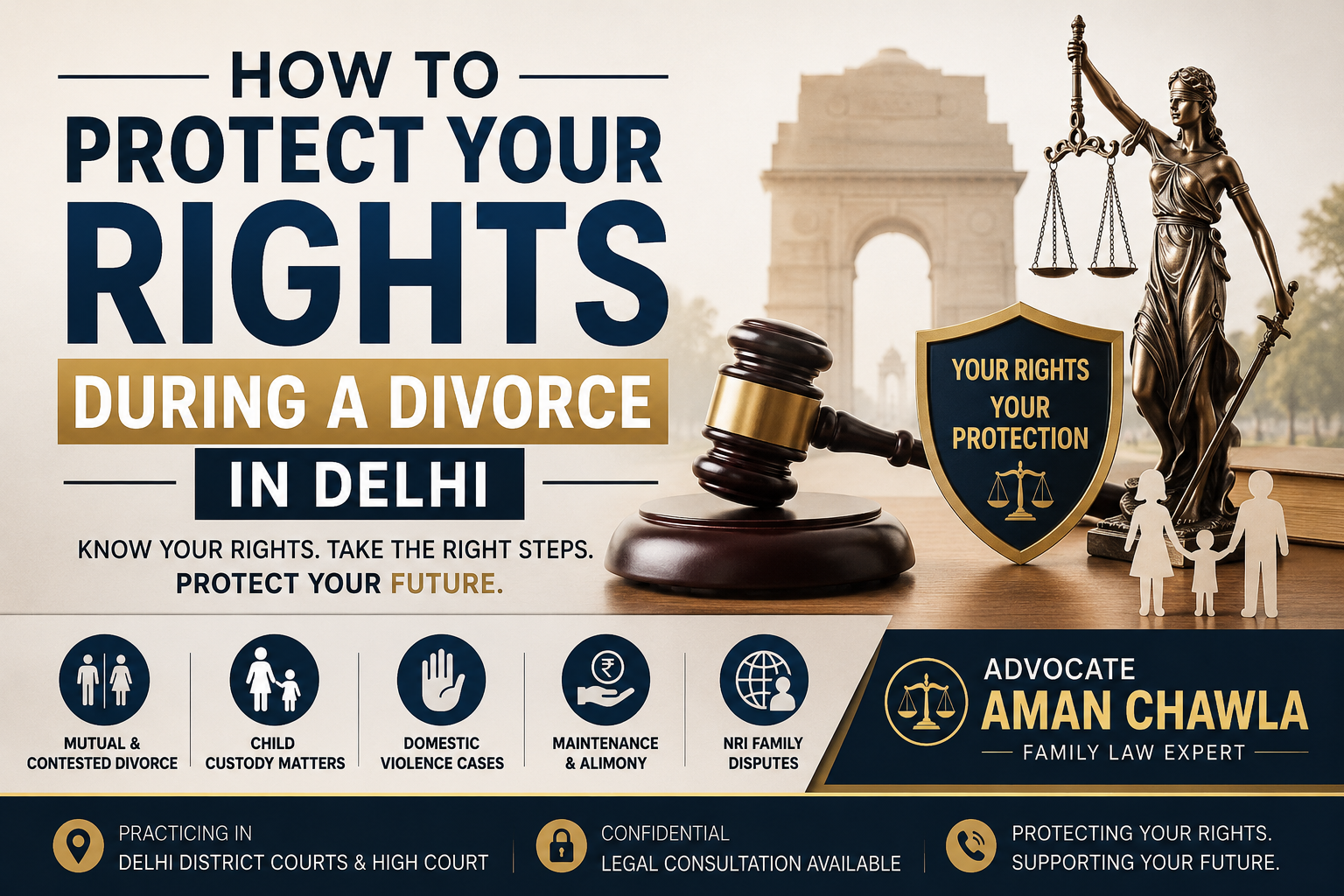
How to Protect Your Rights During a Divorce in Delhi

A Complete Legal Guide for 2026
Written by Adv. Aman Chawla | Matrimonial Law Specialist | Delhi High Court & Supreme Court of India
Introduction: When Marriage Reaches a Legal Crossroads
Divorce and matrimonial disputes are among the most emotionally charged legal challenges a person can face. Whether you are navigating a mutual separation, fighting for child custody, dealing with domestic violence, or responding to a false 498A case — having the right matrimonial lawyer in Delhi by your side can be the single most important decision you make.
This guide covers everything you need to know about protecting your rights, understanding Indian family law, and choosing the best divorce lawyer in Delhi for your specific situation.
1. Understanding Your Legal Rights in a Divorce Under Indian Law
Grounds for Divorce in India
Under the Hindu Marriage Act, 1955, a spouse can file for divorce on the following grounds:
- Cruelty (physical or mental)
- Adultery or extramarital affair
- Desertion for a period of two or more years
- Conversion to another religion
- Mental disorder or unsound mind
- Leprosy or venereal disease (in certain cases)
- Renunciation of the world (sanyas)
- Presumption of death (missing for 7+ years)
For couples married under the Special Marriage Act, 1954, similar grounds apply irrespective of religion. Muslim, Christian, and Parsi personal laws have their own provisions, which an experienced matrimonial lawyer in Delhi will evaluate based on your specific faith and circumstance.
Contested vs. Mutual Consent Divorce: Which Path Is Right for You?
One of the first questions people ask a divorce lawyer in Delhi is whether to pursue a contested or mutual divorce. Here’s a clear comparison:
| Factor | Mutual Consent Divorce | Contested Divorce |
| Timeline | 6–18 months (waiver possible) | 2–5 years or longer |
| Cost | Lower legal fees | Higher due to prolonged litigation |
| Emotional Strain | Minimal | High — court battles involved |
| Requirement | Both spouses must agree | One spouse files against the other |
| Best For | Amicable separations | Cases involving abuse, fraud, desertion |
2. Child Custody: What Every Parent Must Know
Child custody is often the most emotionally contested aspect of a divorce. Indian courts apply the ‘best interests of the child’ standard under the Guardians and Wards Act, 1890 and the Hindu Minority and Guardianship Act, 1956.
Types of Custody Recognised in India
- Physical Custody — the child lives primarily with one parent
- Legal Custody — decision-making rights over education, health, and religion
- Joint Custody — both parents share time and responsibilities
- Sole Custody — granted in cases of abuse, neglect, or parental incapacity
Key Factors Courts Consider
- The child’s age (especially important for children under 5 — typically remain with the mother)
- Financial stability and living conditions of each parent
- Emotional bond between parent and child
- The child’s own preference (if above 9–12 years of age)
- History of domestic violence or substance abuse
A skilled child custody lawyer in Delhi can help you build a compelling case that puts your child’s welfare front and centre, while protecting your parental rights.
3. Maintenance and Alimony: Know What You’re Entitled To
Maintenance — commonly called alimony — is a legal right for financially dependent spouses and children after separation. It is governed by Section 125 of the Code of Criminal Procedure (CrPC) and personal law statutes.
Who Can Claim Maintenance?
- Wife (during divorce proceedings and after)
- Minor children (including daughters until marriage, sons until adulthood)
- Parents who are unable to maintain themselves
How Is Maintenance Amount Determined?
Courts consider income, lifestyle, responsibilities, and the duration of marriage. There is no fixed formula — which is why experienced legal counsel is vital to ensure a fair outcome. Maintenance can be interim (during proceedings) or permanent (after divorce decree).
4. Domestic Violence & the Protection of Women from Domestic Violence Act, 2005
Domestic violence is not limited to physical harm. Under the PWDVA 2005, it includes:
- Physical abuse — hitting, beating, restraining
- Emotional and verbal abuse — threats, humiliation, controlling behaviour
- Sexual abuse within marriage
- Economic abuse — withholding money, denying employment
A victim can approach a domestic violence lawyer in Delhi to seek:
- Protection Orders (preventing abuser from contact)
- Residence Orders (right to stay in the shared household)
- Monetary Relief (compensation for losses)
- Custody Orders (temporary child custody)
These remedies are available without filing for divorce, offering immediate protection to victims.
5. Section 498A IPC: Understanding Cruelty Complaints and False Case Defense
Section 498A of the Indian Penal Code deals with cruelty by a husband or his relatives towards a wife. While it was enacted to protect women from dowry harassment, cases of misuse and false 498A complaints have become a real concern.
If You Are Accused Under 498A
- Do not ignore the notice — respond immediately through a qualified lawyer
- Approach the Crime Against Women (CAW) Cell before arrest if possible
- Gather documentary evidence: messages, emails, financial records
- Seek anticipatory bail immediately
- Engage a lawyer experienced in 498A defense — not just any criminal lawyer
If You Are a Genuine Victim
A matrimonial lawyer in Delhi can help you file the complaint properly, gather evidence, and pursue both criminal action and civil remedies simultaneously under the Domestic Violence Act.
6. NRI Divorce: A Special Category With Complex Jurisdiction Issues
Divorce cases involving Non-Resident Indians (NRIs) present unique challenges — dual jurisdiction, foreign court orders, enforcement of decrees, and visa/custody complications.
Common NRI Divorce Scenarios
- Husband files for divorce abroad while wife remains in India
- Foreign divorce decree — is it valid in India?
- Child taken abroad without the other parent’s consent (international parental abduction)
- Maintenance enforcement across borders
An NRI divorce lawyer in India with experience in international matrimonial law can handle cross-border proceedings, challenge ex-parte foreign decrees, and ensure your rights under Indian law are fully protected.
7. Court Marriage in Delhi: Procedure, Documents & Timeline
Court marriage under the Special Marriage Act, 1954 is a secular, legally binding marriage available to couples of any religion, caste, or nationality. Here is the step-by-step process:
- Submit Notice of Intended Marriage at the Marriage Officer’s office
- 30-day public notice period (for objections)
- Appear before the Marriage Officer with three witnesses
- Solemnisation and signing of the marriage certificate
Required documents include age proof, address proof, passport-size photos, and affidavit of marital status. A court marriage lawyer in Delhi ensures paperwork is complete and the process is smooth and legally airtight.
FREQUENTLY ASKED QUESTIONS (FAQ)
Answers by Adv. Aman Chawla — Matrimonial Law Specialist, Delhi
Q: How long does a mutual divorce take in Delhi?
A: A mutual consent divorce typically takes 6 to 18 months. The court requires a minimum 6-month ‘cooling off’ period between the first and second motion, though this can be waived by the Supreme Court in cases where the marriage has irretrievably broken down. With proper documentation and legal guidance, the process can be completed efficiently.
Q: Can a wife claim maintenance even before the divorce is finalised?
A: Yes. Under Section 24 of the Hindu Marriage Act and Section 125 CrPC, a wife can claim interim maintenance (pendente lite) during the pendency of divorce proceedings. The amount is determined based on the husband’s income, the wife’s needs, and the lifestyle maintained during the marriage.
Q: What is the difference between alimony and maintenance in India?
A: Maintenance is a broader concept covering financial support during and after divorce proceedings, while alimony typically refers to the final settlement amount paid after the divorce decree. Maintenance can be monthly or as a lump sum, and courts have wide discretion in determining the amount.
Q: Who gets custody of the child after divorce in India?
A: There is no fixed rule. Courts prioritise the best interests of the child. For children below 5 years, the mother is usually preferred. For older children, courts consider stability, parental conduct, financial capacity, and — increasingly — the child’s own preference. Joint custody arrangements are also becoming more common.
Q: What should I do if a false 498A case is filed against me?
A: Do not panic, but act immediately. Consult a matrimonial lawyer in Delhi experienced in 498A defense. You may seek anticipatory bail, file a quashing petition before the High Court if the allegations are baseless, and file a counter-complaint for defamation or malicious prosecution if the complaint is demonstrably false. Every step must be taken with legal guidance.
Q: Is a foreign divorce valid in India for an NRI couple?
A: A foreign divorce decree may or may not be valid in India depending on several factors — whether both parties were domiciled abroad, whether the other party was given proper notice and appeared in proceedings, and whether the decree violates Indian public policy. An NRI divorce lawyer can advise on enforceability and whether Indian courts would recognise the foreign decree.
Q: Can I transfer my divorce case to a court near my residence?
A: Yes. A Transfer Petition can be filed before the High Court or Supreme Court to move matrimonial proceedings from one court to another — typically when a spouse finds it difficult to travel to the court where the case is filed. This is a common remedy used by women in particular to avoid hardship.
Q: What documents are required to file for divorce in Delhi?
A: Essential documents include your marriage certificate, proof of address, identity proof of both parties, wedding photographs, evidence supporting your grounds for divorce (in contested cases), and details of children (if applicable). For NRI divorces, passport and visa documents are also required. Your lawyer will provide a complete checklist tailored to your case.
Q: How much does a divorce lawyer in Delhi charge?
A: Legal fees vary based on the complexity of the case, the lawyer’s experience, and whether it is a mutual or contested divorce. Mutual divorces are generally less expensive. It is best to discuss fees transparently during the first consultation. Avoid making decisions based solely on the lowest fee — quality legal representation protects your long-term interests.
Q: Can a husband claim maintenance from the wife in India?
A: Yes. Under Section 24 of the Hindu Marriage Act, either spouse — including the husband — can claim maintenance if they are unable to support themselves. While less common, courts do grant maintenance to unemployed or incapacitated husbands where the circumstances justify it.
Q: What is a Protection Order under the Domestic Violence Act?
A: A Protection Order is a court directive under the Protection of Women from Domestic Violence Act, 2005, prohibiting the respondent (abuser) from committing further acts of violence, entering the victim’s workplace or home, contacting the victim, or alienating assets. Violation of a Protection Order is a criminal offence.
Q: Can I get a divorce if my spouse is missing?
A: Yes. Under Indian law, if your spouse has been missing and not heard from for a continuous period of seven years, they are presumed to be legally dead. This allows the other spouse to file for divorce or remarriage. A court declaration of presumed death is typically required.
Consult Adv. Aman Chawla, Matrimonial Law Specialist, practicing before the Supreme Court of India, Delhi High Court, and all Delhi District Courts. Available for urgent matters, outstation clients, and online consultations across India.
Call: +91-8076836899 | WhatsApp | Email: info@thematrimoniallawyers.com Office: O-11A Basement, Jangpura Extension, New Delhi – 110014
Written by Adv. Aman Chawla. This article is for informational purposes only and does not constitute legal advice. Every case is fact-specific. Please consult a qualified lawyer before taking any legal action.