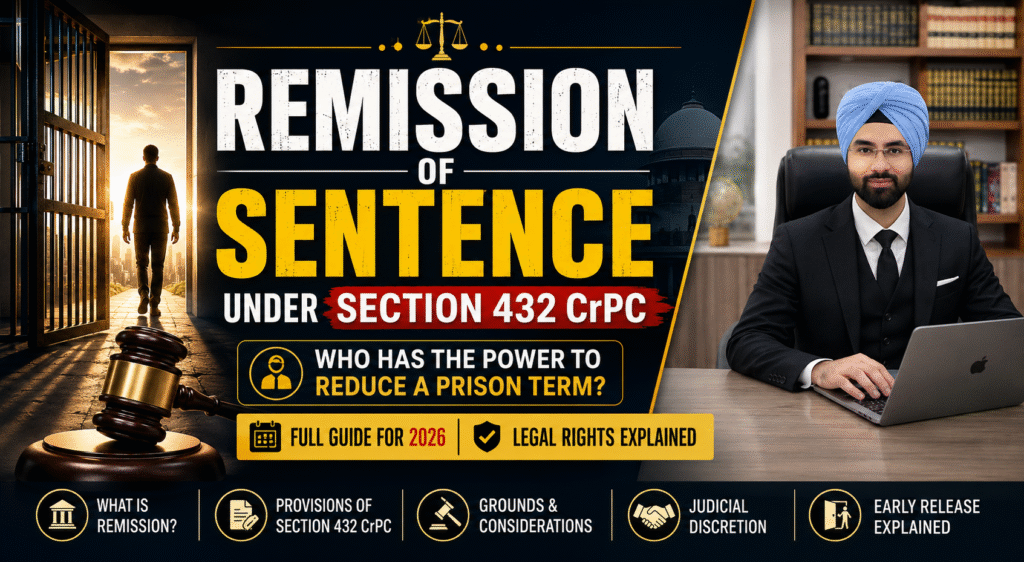
What Is Remission of Sentence?
Remission of sentence refers to the act of reducing or cancelling the remaining portion of a sentence imposed on a convicted person, without altering the conviction itself. It is a discretionary power vested in the executive — typically the State or Central Government — and must be exercised in accordance with law.
It is distinct from pardon, commutation, or suspension of sentence, though all fall under the broader concept of executive clemency under Articles 72 and 161 of the Constitution of India.
Code of Criminal Procedure, 1973 (CrPC) — Power to suspend or remit sentences
Bharatiya Nagarik Suraksha Sanhita, 2023 (BNSS) — Same power, renumbered
Key Provisions of Section 432 CrPC
Under Section 432, the appropriate government (State or Centre, depending on the offence) has the power to:
- Suspend the execution of a sentence for a period
- Remit the whole or any part of the punishment to which the person was sentenced
- Grant remission with or without conditions
- Cancel a previously granted remission if conditions are violated
What happens when remission is wrongly granted?
A critical legal issue arises when the government releases a detenu (prisoner) based on a wrong interpretation of its own order. Courts have held that in such situations, re-arrest is permissible — but only if it is done through due process.
Legality of Re-Arrest After Wrong Remission
The question of whether the government can re-arrest a person after incorrectly granting remission has been addressed by several High Courts. The settled legal position is:
- There must be a corresponding order of cancellation of the remission before re-arrest
- The detenu must be produced before a court for seeking remand
- Re-arrest without cancellation order and court remand is illegal
- Such illegal re-arrest violates Article 21 of the Constitution — the Right to Life and Personal Liberty
Landmark Case: Naseem Bibi v. The Principal Secretary, Govt. of A.P.
The court held that re-arrest of a detenu after release on wrong interpretation of a government order — without a cancellation of remission order and without producing the person before a court — is illegal and violative of fundamental rights guaranteed under Article 21 of the Constitution.
Conditions for Valid Remission
For a remission order to be legally valid, it must satisfy the following:
- It must come from the “appropriate government” as defined under CrPC/BNSS
- It must be consistent with the judgment and order of the court
- In certain cases (especially life imprisonment), prior consultation with the Presiding Judge is required under Section 432(2)
- It must not be arbitrary or motivated by extraneous considerations
Remission vs. Other Forms of Clemency
Many people confuse remission with other legal remedies. Here is how they differ:
- Remission — reduces the remaining portion of the sentence; conviction stands
- Commutation — substitutes a lesser form of punishment (e.g., death → life imprisonment)
- Suspension — temporarily postpones the execution of sentence
- Pardon — wipes out the conviction entirely; granted by President/Governor only.
Frequently Asked Questions
What is Section 432 CrPC in simple terms?
Section 432 CrPC (now Section 473 BNSS 2023) gives the State or Central Government the power to reduce or cancel a convicted person’s sentence. This is called remission. It does not erase the conviction — only the remaining punishment is reduced or removed.
Illegal re-arrest — especially without a valid cancellation order and without court remand — violates Article 21 of the Constitution of India, which guarantees the right to life and personal liberty. No person can be deprived of liberty except in accordance with procedure established by law.
Consult Adv. Aman Chawla, Matrimonial Law Specialist, practicing before the Supreme Court of India, Delhi High Court, and all Delhi District Courts. Available for urgent matters, outstation clients, and online consultations across India.
Call: +91-8076836899 | WhatsApp | Email: info@thematrimoniallawyers.com Office: O-11A Basement, Jangpura Extension, New Delhi – 110014
Written by Adv. Aman Chawla. This article is for informational purposes only and does not constitute legal advice. Every case is fact-specific. Please consult a qualified lawyer before taking any legal action.