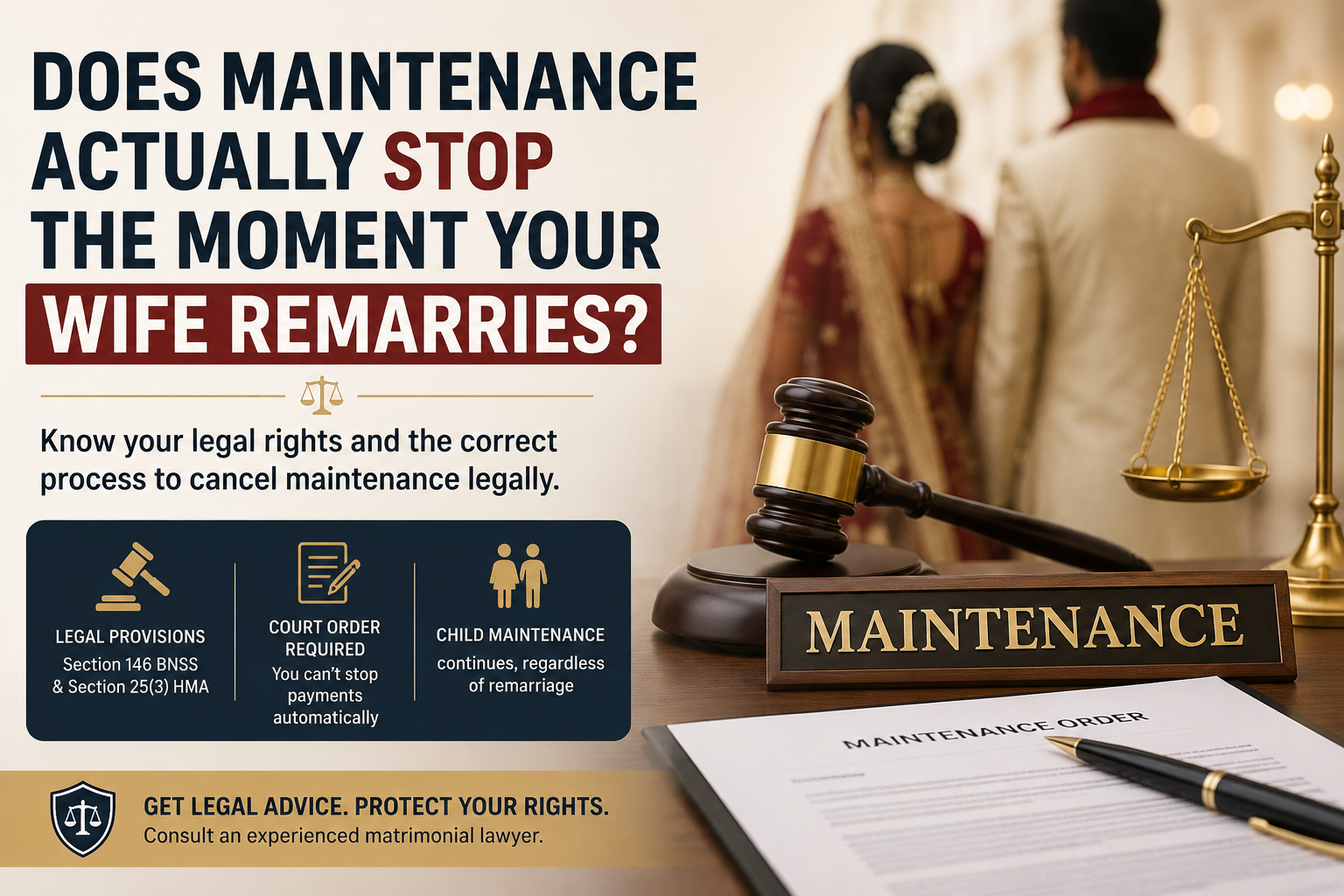
Does Maintenance Actually Stop the Moment Your Wife Remarries?

By Advocate Aman Chawla | The Matrimonial Lawyers, New Delhi | Published: September 2026
Short answer: it can, but not automatically, and definitely not the moment you find out. If you’ve just learned your ex-wife has remarried and you’re already planning to stop your next payment, hold on — doing that without going through the court can put you in a worse position than continuing to pay would. Let’s walk through what actually happens, because the gap between “she remarried, so I don’t owe anything” and the legal reality is exactly where a lot of husbands get themselves into avoidable trouble.
We get versions of this question constantly, and it usually comes with real, understandable frustration behind it. You’ve heard, sometimes reliably, sometimes through a chain of relatives and mutual friends, that she’s moved on and remarried, and it feels obvious that your obligation should end right there. Legally, that instinct is broadly correct — but the path from “she remarried” to “I’ve stopped paying, properly and legally” has a few steps in between that matter enormously, and skipping them is where things go wrong.
The Short, Slightly Misleading Answer
Yes, remarriage is a recognised, well-established ground for ending a maintenance obligation. Under Section 146 of the Bharatiya Nagarik Suraksha Sanhita, 2023 (the successor to Section 127 CrPC), and under Section 25(3) of the Hindu Marriage Act for permanent alimony specifically, a wife’s remarriage generally ends her entitlement to ongoing spousal support.
But “generally ends her entitlement” and “you can just stop paying” are two very different statements, and conflating them is exactly the mistake that turns a straightforward situation into a genuinely costly one.
Why You Can’t Just Stop Paying
This is the part that catches people off guard. Even where remarriage has genuinely happened, the maintenance order that’s currently in place remains legally binding until a court formally modifies or cancels it. If you simply stop sending payment because you’ve heard, or even confirmed, that she’s remarried, you’re technically in violation of an existing court order — which exposes you to enforcement action, including potential contempt proceedings, regardless of whether your underlying belief about the remarriage turns out to be correct.
The correct process is to file an application under Section 146 BNSS before the same court that issued the original order (or the equivalent Section 25(3) HMA application if you’re dealing with permanent alimony), asking the court to formally rescind or modify the order based on her remarriage. Until that application is decided, the existing order stands, and your obligation to comply with it stands along with it.
We understand the frustration here — if she has genuinely remarried, it can feel absurd that you still have to keep paying while the paperwork catches up. But the alternative, unilaterally deciding you’re no longer bound by a court order, creates a much bigger problem than the temporary inconvenience of continuing to pay while your application is pending.
What About Permanent Alimony Under Section 25(3) HMA?
If you’re paying permanent alimony rather than ongoing Section 144 BNSS maintenance, the relevant provision is Section 25(3) of the Hindu Marriage Act, which allows the court to rescind an alimony order specifically where the recipient has remarried. This provision is, in practical terms, considered one of the stronger tools available to a paying spouse, precisely because remarriage is treated as a fairly clear, objective triggering event — assuming, of course, you can actually prove it, which we’ll get to.
The process here mirrors the Section 146 BNSS route: you file a formal application asking the court to rescind the order, rather than simply treating the alimony as ended on your own determination. The underlying principle is the same across both provisions — remarriage is a recognised basis for ending the obligation, but a court has to formally act on it.
Why It Matters Which Provision Actually Governs Your Order
Before you file anything, it’s worth being clear about exactly which provision your existing maintenance order was actually made under, since this determines the correct route for cancellation. An order made under Section 144 BNSS (the general maintenance provision, formerly Section 125 CrPC) is cancelled through Section 146 BNSS. An order for permanent alimony made under Section 25 of the Hindu Marriage Act is rescinded through Section 25(3) of the same Act. These aren’t interchangeable procedurally, even though the underlying principle — remarriage ends entitlement — is broadly similar across both.
If you’re unsure which provision your original order actually falls under, this is exactly the kind of detail worth confirming with your lawyer before filing anything, since filing under the wrong provision, or before the wrong court, can cost you time you don’t need to lose. Some maintenance arrangements also combine interim and permanent elements, or shift from one provision to another as a case progresses from interim orders through to a final divorce decree — meaning the correct route can genuinely change over the life of a single matter.
The Live-In Trap: Why “She’s With Someone New” Isn’t the Same as “She Remarried”
Here’s where a lot of husbands genuinely get this wrong, and it’s worth understanding the distinction carefully before you assume you have grounds to stop paying anything.
Remarriage, for the purposes of Section 146 BNSS and Section 25(3) HMA, means an actual, legally recognised marriage — a real ceremony, generally with the legal formalities that make a marriage valid under whichever personal law applies. If your ex-wife is now living with someone, in a relationship that looks and functions like a marriage, but hasn’t actually gone through a legal marriage ceremony, that is not the same thing as remarriage for these specific provisions, and courts have been consistently careful about this distinction.
There’s a separate, different provision — the “living in adultery” ground under Section 144(4) BNSS — that can potentially apply to an ongoing relationship outside marriage, but this operates under a different legal standard entirely, generally requiring more substantial proof of an ongoing, continuous relationship of that specific nature, not simply cohabitation or a new partner in her life. Treating cohabitation as automatically equivalent to remarriage, and stopping payment on that basis, is a mistake that can leave you exposed if the distinction matters to how your specific application is ultimately decided.
This is genuinely one of the most common points of confusion we see, and it’s worth getting right before you act, rather than assuming any new relationship in her life automatically ends your obligation the same way an actual marriage would.
What If She’s Deliberately Hiding the Remarriage?
This happens more than you’d expect, and it’s worth understanding your position if you suspect it’s happening to you. There’s no independent obligation on her to proactively notify you the moment she remarries — the burden is generally on you to discover it and bring it to the court’s attention through a formal application. This can feel unfair, particularly if you have reason to believe the remarriage is being deliberately concealed specifically to keep maintenance payments flowing.
If you have genuine, credible reason to suspect this — rather than mere suspicion — it’s worth actively investigating rather than simply waiting for confirmation to fall into your lap. Social media has made this considerably easier than it once was; wedding-related posts, changed relationship statuses, and tagged photographs from mutual connections are all legitimate starting points. Where deliberate concealment can later be established as part of your application, this can also be relevant to how a court views the overall situation, including the question of retroactive effect discussed below.
What Actually Counts as Proof of Remarriage
Assuming an actual remarriage has genuinely occurred, you’ll need real, credible evidence to support your Section 146 BNSS or Section 25(3) HMA application — a court isn’t going to rescind an existing order on the strength of rumour or secondhand information. Useful evidence generally includes:
- A marriage certificate, if the new marriage was formally registered, which is generally your strongest, most direct proof.
- Wedding photographs, invitation cards, or ceremony records showing the marriage actually took place, particularly useful where formal registration hasn’t happened or hasn’t yet been obtained.
- Social media evidence — genuinely a significant category in practice now. Wedding announcements, tagged photos, relationship status changes, and similar public posts have increasingly become accepted supporting evidence in these applications.
- Witness testimony from people who attended or have direct knowledge of the marriage ceremony.
- Any official record reflecting her new marital status — updated documents, changed surnames on official records, or similar administrative evidence.
The stronger and more varied your evidence, the more straightforward your application is likely to be. A single, disputed claim without supporting documentation is a considerably weaker starting position than a well-documented application drawing on multiple, corroborating sources.
Can You Recover What You Paid After She Remarried But Before the Court Acted?
This is a genuinely practical question worth understanding, because there’s often a real gap between when a remarriage actually happens and when a court formally acts on your application. If you continued paying maintenance during that gap — which, as discussed above, you generally need to keep doing until the order is formally modified — you’re not necessarily just out that money permanently.
Courts have shown willingness to make the cancellation effective from the date of remarriage itself, rather than only from the date of the court’s order, in appropriate cases. Where this happens, any payments made during that intervening period can potentially be treated as an overpayment, which may be adjustable against future obligations, particularly if child maintenance continues to run separately. This is worth raising specifically with your lawyer as part of your application — it’s not automatic, and how it plays out depends on the specific facts and how your application is framed.
What Happens to Child Maintenance? It Doesn’t Stop
This is worth being completely clear about, because it’s a common and understandable point of confusion. Your ex-wife’s remarriage affects her own entitlement to spousal maintenance — it has no bearing on your ongoing obligation to support your children. Child maintenance continues regardless of either parent’s marital status, remarriage, or new relationships, because it’s rooted in your parental obligation to your children, not in your former spousal relationship.
If your maintenance order covers both spousal support and child support in a single combined figure, your Section 146 BNSS or Section 25(3) HMA application needs to specifically address only the spousal portion — this is exactly the kind of distinction worth getting right in how the application is drafted, rather than assuming the entire payment simply ends.
What If the “Remarriage” Is Later Found Invalid?
This is a genuinely complicated scenario, but worth knowing about if it applies to your situation. If a court rescinds maintenance based on a remarriage that later turns out to have been invalid — because, for instance, her new husband was already married himself, making that second marriage void — the original maintenance obligation could potentially be revived, since the triggering event (a valid remarriage) never actually, legally occurred. This is a fact-specific, complex situation that’s genuinely worth dedicated legal advice if it comes up, rather than something to assume resolves itself automatically in either direction.
Getting the Application Itself Right
The way your Section 146 BNSS or Section 25(3) HMA application is actually drafted matters more than people expect. A strong application doesn’t just assert that remarriage happened — it lays out the specific evidence clearly, addresses the date of remarriage explicitly (since this matters for the retroactive question discussed above), and clearly separates any spousal maintenance component from child maintenance if your original order combined both.
It’s also worth anticipating the other side’s likely response. If there’s any ambiguity in your evidence — an informal ceremony without full documentation, for instance — expect this to be contested, and prepare your application accordingly rather than assuming it will go unchallenged. A well-prepared application anticipates pushback rather than being surprised by it, which is exactly why working through this carefully with your lawyer before filing, rather than rushing to file the moment you hear the news, tends to produce a cleaner, faster outcome overall.
Common Mistakes We See Husbands Make
- Stopping payment the moment they hear about a remarriage, without filing anything. This exposes you to enforcement action regardless of whether the remarriage claim is ultimately correct.
- Treating a new live-in relationship as equivalent to remarriage. As discussed above, this is a real, meaningful legal distinction, not a technicality to brush past.
- Filing an application without adequate proof. A weak, undocumented application is likely to be dismissed or delayed, extending the exact period you’re trying to shorten.
- Assuming child maintenance ends too. It doesn’t, and treating it as though it does can create a separate, serious enforcement problem layered on top of your spousal maintenance situation.
- Waiting too long to file once you have solid proof. The sooner you act on genuine evidence, the sooner the financial relief actually arrives — delay only extends the period you’re paying an obligation that may no longer be legally justified.
A Realistic Example
A husband learns, through a mutual acquaintance and confirmed by social media wedding photographs, that his ex-wife remarried several months earlier — information he hadn’t previously had confirmed. Rather than simply stopping his next payment, his lawyer files a Section 146 BNSS application immediately, supported by the social media evidence, a copy of the marriage announcement, and witness confirmation from the mutual acquaintance. The application specifically requests the cancellation take effect from the actual date of remarriage, and separately clarifies that child maintenance payments, which are part of the same original order, should continue unaffected. The court grants the application, rescinding the spousal portion effective from the remarriage date, and the husband’s lawyer separately negotiates an adjustment for the months of spousal maintenance paid during the period before the court’s order — while confirming the child maintenance obligation continues exactly as before.
Frequently Asked Questions
1. Can I just stop paying maintenance the moment I find out my ex-wife has remarried?
No. Even with genuine proof of remarriage, the existing order remains legally binding until a court formally modifies or cancels it through a proper application. Stopping payment unilaterally exposes you to enforcement action.
2. What’s the actual process to stop maintenance after remarriage?
File an application under Section 146 BNSS (for ongoing maintenance) or Section 25(3) HMA (for permanent alimony) before the court that issued the original order, supported by proof of the remarriage.
3. Does a live-in relationship count the same as remarriage for this purpose?
No, and this is a genuinely important distinction. Remarriage requires an actual, legally recognised marriage. Cohabitation without formal marriage doesn’t automatically trigger the same cancellation grounds, though a separate “living in adultery” provision may potentially apply under different, generally more demanding evidentiary standards.
4. What evidence do I need to prove remarriage?
A marriage certificate is strongest, but wedding photographs, invitation cards, social media posts, and witness testimony can all support your application, especially combined together.
5. Does my child maintenance obligation also stop if my ex-wife remarries?
No. Child maintenance is entirely separate from spousal maintenance and continues regardless of either parent’s marital status.
6. Can I get back the maintenance I paid after she remarried but before the court acted on my application?
Potentially, if the court makes the cancellation effective from the actual date of remarriage rather than only the date of its order. This isn’t automatic and is worth specifically raising with your lawyer as part of your application.
7. What if it turns out the “remarriage” wasn’t actually legally valid?
This is a complex, fact-specific situation — if maintenance was cancelled based on a remarriage that later turns out to be void, the original obligation could potentially be revived. This is worth dedicated legal advice if it applies to you.
8. How long does this process typically take once I file?
It varies by court and how well-documented your application is, but a well-supported application with clear, credible evidence generally moves more efficiently than one relying on disputed or thin proof — which is exactly why gathering solid documentation before filing matters so much.
9. What if my ex-wife is deliberately hiding her remarriage from me?
There’s no independent legal obligation on her to disclose it proactively — the burden is on you to discover it and bring it to the court’s attention. Social media and mutual connections are often useful starting points if you have genuine reason to suspect concealment.
10. Which specific provision governs my situation — Section 146 BNSS or Section 25(3) HMA?
It depends on which provision your existing order was made under. Ongoing maintenance under Section 144 BNSS is cancelled via Section 146 BNSS; permanent alimony under Section 25 HMA is rescinded via Section 25(3) of the same Act. Confirm this with your lawyer before filing, since it affects the correct procedural route.
Disclaimer: This article is for general informational purposes only and does not constitute legal advice. As per the Rules of the Bar Council of India, advocates are not permitted to advertise or solicit work, and nothing in this article should be construed as advertising, solicitation, or an invitation to engage this firm. Every case is fact-specific — consult a qualified advocate regarding your specific circumstances before taking any legal action.