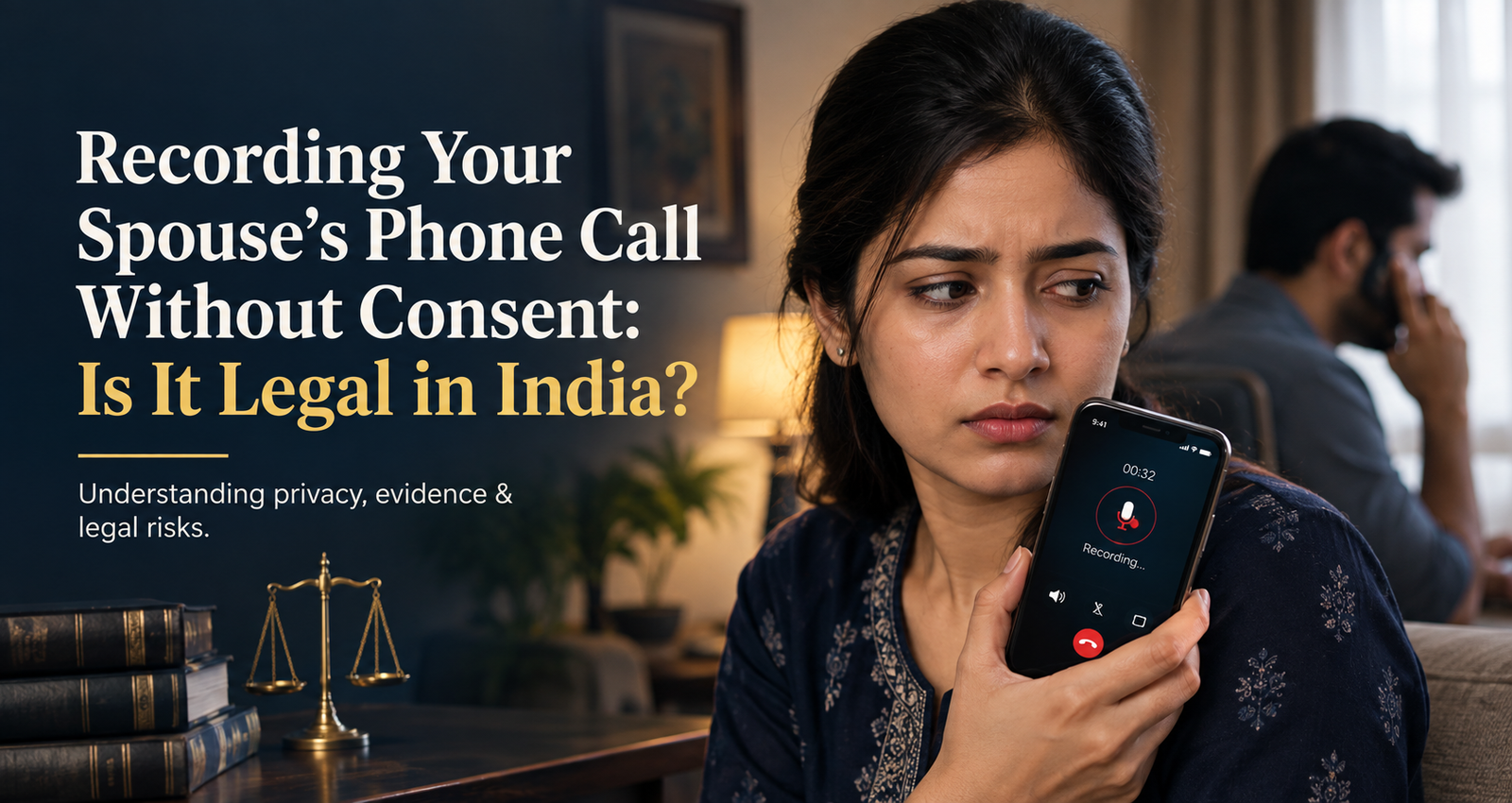
Is Recording Your Spouse’s Phone Call Without Consent Legal in India?

This Article is written by Adv. Aman Chawla, Family Law Expert | Delhi High Court & Supreme Court of India
Practising in Family & Matrimonial Law | Jangpura, New Delhi
Quick Answer
Recording your spouse without consent is a common question in matrimonial disputes in India. Whether such a recording can be legally made and used in court depends on an important distinction: whether you were personally part of the conversation or were recording your spouse’s conversation with someone else.
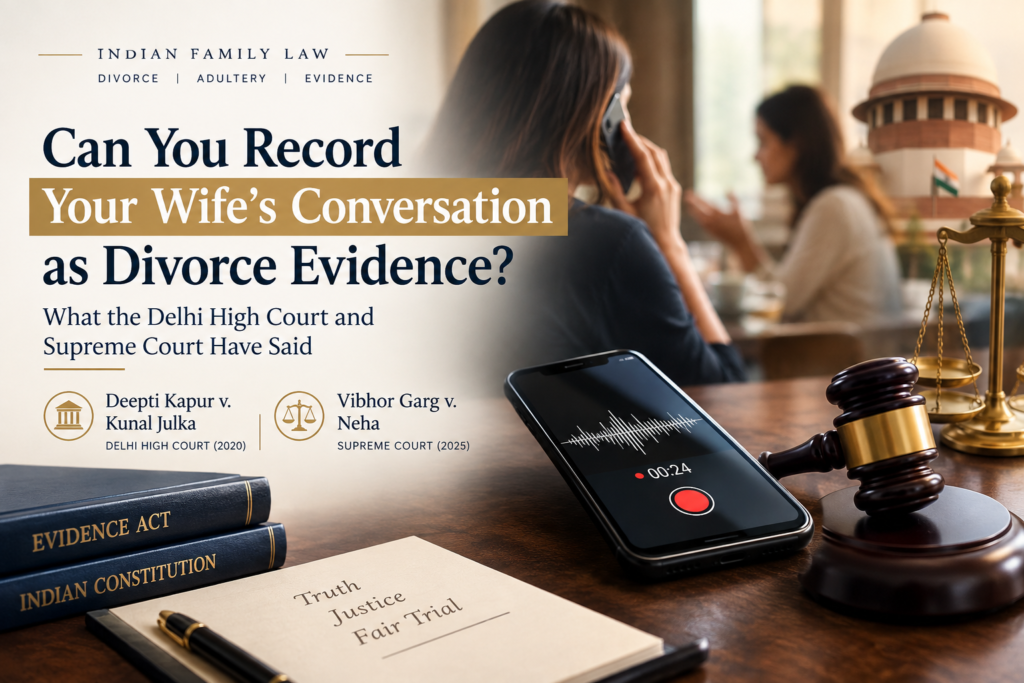
The Supreme Court’s decision in Vibhor Garg v. Neha, decided on 14 July 2025, is particularly relevant to recordings made by one spouse of conversations with the other spouse. However, the legal position can be different when the recording involves a conversation in which you were not a participant.
Let’s Start With the Question You’re Actually Asking
I’d guess you’re here for one of two reasons. Either you’ve already recorded your husband or wife, or you’re thinking about it, and something in you is asking, “wait, can this actually be used against me, or can I actually use this?” That’s a fair question, and the honest answer isn’t a flat yes or no, it depends entirely on where you were standing when the conversation happened.
So let’s ask it properly. Were you actually part of that conversation, talking to your spouse directly, or were you listening in on something they said to someone else? That single question decides almost everything that follows, and it’s the question I ask every client who brings me a recording before I tell them anything about how to use it.
If You Recorded a Conversation You Had With Your Spouse
This is the situation most husbands and wives are actually in when they come to me with this question, and here, the law is genuinely on your side. There’s no Indian statute that makes it a crime to record a phone call or conversation you had directly with your own spouse. You were there. You heard everything that was said. The recording is simply a more accurate version of your own memory of that conversation.
The Supreme Court settled the evidentiary groundwork for this decades ago, in Yusufalli Esmail Nagree v. State of Maharashtra, AIR 1968 SC 147, holding that a conversation, freely and voluntarily made, doesn’t become inadmissible in court just because it was recorded without the other person’s knowledge. This was refined into a clear, three-part test in R.M. Malkani v. State of Maharashtra, (1973) 2 SCR 417, a recording can be relied on where it’s relevant to what’s actually in dispute, the voices on it can be properly identified, and its accuracy can be established, meaning nobody can show it’s been cut, edited, or tampered with.
This principle was applied squarely to a husband and wife in Vibhor Garg v. Neha, 2025 INSC 829, decided 14 July 2025 by Justices B.V. Nagarathna and Satish Chandra Sharma. The husband had secretly recorded phone conversations with his wife over several years and wanted to rely on them in his divorce petition. The Supreme Court allowed it, holding that Section 122 of the Evidence Act, which normally protects communications between spouses as privileged, carries a built-in exception, that privilege simply doesn’t apply in a legal proceeding between the two spouses themselves, exactly what a divorce case is. The Court went further, holding that the recording wasn’t even a breach of privacy in the way the wife had argued, since Section 122 was designed to protect the institution of marriage, not to shield one spouse’s own conduct from being examined in a dispute against the other. If the Supreme Court is willing to accept this kind of evidence in the middle of a contested divorce, that tells you clearly where the law stands on a husband or wife recording their own conversation with the other.
If You Recorded Your Spouse Talking to Someone Else
Here’s where the ground genuinely shifts, and I think this is the situation a lot of husbands and wives searching this question are actually in, without quite framing it that way. Wanting to know what your spouse is saying to someone else, a suspected affair, a friend, a family member, is a completely different act from recording a conversation you were personally having. It’s interception, not participation, and Indian law has always treated the two differently.
The Indian Telegraph Act, 1885, and the Information Technology Act, 2000, build a framework around unauthorised interception of communications, and the Supreme Court examined the seriousness of this in People’s Union for Civil Liberties v. Union of India, (1997) 1 SCC 301, decided 18 December 1996, holding that listening in on someone’s private conversations without lawful authorisation is a serious invasion of the right to privacy under Article 21. That case was about government surveillance, but the underlying principle, that intercepting a conversation you weren’t part of engages privacy far more seriously than recording your own, matters here too. Indian courts on this specific question have actually gone both ways, some have allowed a spouse’s chats or calls with a third party into evidence anyway under the special powers Family Courts have, while others have excluded them as a privacy violation. What’s settled is that recording your own conversation with your spouse rests on much firmer ground than recording, or tapping, what your spouse says to somebody else.
What About Using the Recording Afterwards?
This is the part husbands and wives think about least, and it’s often where real trouble starts. Having a lawful recording of your own conversation with your spouse doesn’t mean you can do whatever you like with it afterwards. The Supreme Court’s decision in K.S. Puttaswamy v. Union of India, (2017) 10 SCC 1, confirmed privacy as a fundamental right, and courts increasingly recognise that this matters between spouses too, not just against the state. Using a recording to threaten your spouse into a settlement, playing it to family members to embarrass them, or forwarding it beyond what’s needed for your actual court case can create legal exposure of its own, separate entirely from whether making the recording in the first place was lawful.
Why This Comes Up So Often in Matrimonial Cases
In my practice, this question arises constantly, and for understandable reasons. A wife wants to record her husband’s threats to use as evidence of cruelty. A husband wants to record a conversation where his wife makes admissions relevant to maintenance or custody. Someone suspects an affair and wants proof. In every one of these situations, the same core question decides where you stand: was this a conversation you were personally part of, or were you capturing something said to someone else?
What This Means Practically for You
If you’ve recorded a conversation you had directly with your spouse, keep the original file completely untouched, don’t trim it, don’t re-save it in a different format, and don’t forward it around casually, since accuracy and a clean, provable history are exactly what a Family Court will test before relying on it. If what you’re actually considering is finding out what your spouse says to someone else, pause before you act, and get advice specific to your situation first, since this is where a case built on good intentions can create legal complications of its own. And whatever you’ve recorded, use it for your actual case, not to threaten, humiliate, or pressure your spouse outside of it.
A Realistic Example
A wife records a phone call with her husband in which he makes threatening and abusive statements, part of a pattern she intends to raise in her cruelty petition. She’s a participant in that call, she recorded it on her own phone, and she preserves the original file untouched rather than sharing edited clips with her family. When her lawyer later places this before the Family Court, relying on the reasoning in Vibhor Garg v. Neha, the recording is accepted as relevant evidence, subject to her husband’s opportunity to challenge its accuracy. Had she instead installed a hidden recording device to capture her husband’s phone calls with his friends, conversations she wasn’t part of, she would have been in a fundamentally different, and far less certain, legal position.
What To Do Next
Work out, honestly, which side of that line you’re actually on before you rely on anything you’ve recorded. If it’s a conversation you personally had with your spouse, you’re generally on solid legal ground, so focus your energy on preserving the recording properly rather than worrying about whether making it was permitted. If what you’re holding is a recording of your spouse’s conversation with someone else, treat that as a genuinely different question, and get advice on your specific situation before you decide how, or whether, to use it.
Frequently Asked Questions
Can I record my husband or wife without telling them?
Generally yes, if you were personally part of that conversation. Indian courts, including the Supreme Court in 2025, have allowed exactly this kind of recording as evidence in matrimonial cases.
Is it illegal to record a conversation with my spouse for use in my divorce case?
Not automatically. The Supreme Court has confirmed that a recording of a conversation between spouses can be used as evidence in a divorce or cruelty case, even where it was made without the other spouse’s knowledge.
Can I record my spouse’s phone calls with someone else, like a suspected affair partner?
This is legally much riskier than recording a conversation you had directly with your spouse. Courts have taken different views on this specific situation, and it’s treated closer to interception, which carries real legal uncertainty.
Will a secretly recorded conversation actually help my case in court?
It can, provided it’s relevant to your case, the voices on it can be identified, and you can show it hasn’t been tampered with. These three requirements have applied since the 1970s and were reaffirmed by the Supreme Court in 2025.
Can my spouse use a recording of me against me in our case?
Yes, under the same principles. If your spouse recorded a conversation they had directly with you, that recording can potentially be used against you too, the rule works the same way for both husband and wife.
Can I get in trouble for how I use a recording, even if I was allowed to make it?
Yes, potentially. Making the recording and using or sharing it afterwards are two separate legal questions. Using a lawfully made recording to threaten, humiliate, or pressure your spouse outside your actual case can create legal exposure of its own.
Does this apply the same way to video calls or WhatsApp voice notes, not just phone calls?
Yes, the same underlying principles apply. What matters is whether you were a participant in the communication, and separately, whether the recording is relevant, identifiable, and unaltered.
Conclusion
The question “can I record my spouse” almost always has a more useful question hiding underneath it: were you part of that conversation, or were you listening in on something said to someone else? Recording a conversation you personally had with your husband or wife is, in the vast majority of matrimonial situations, legally sound in India, and the Supreme Court said so plainly in 2025. Recording what your spouse says to somebody else sits on far less certain ground. And how you use any recording afterwards is a third question entirely, separate from whether making it was fine in the first place. Know which question you’re actually asking, and the answer becomes a lot clearer.
Adv. Aman Chawla practices matrimonial and family law before the Delhi High Court, Delhi Family Courts (Saket, Rohini, Dwarka, Karkardooma, Patiala House), and the Supreme Court of India. For a consultation on your specific situation, reach out through the contact details on this website.
Disclaimer: This article is for general informational purposes only and does not constitute legal advice. As per the Rules of the Bar Council of India, advocates are not permitted to advertise or solicit work, and nothing in this article should be construed as advertising, solicitation, or an invitation to engage this firm. Readers should consult a qualified advocate regarding their specific circumstances before taking any legal action.