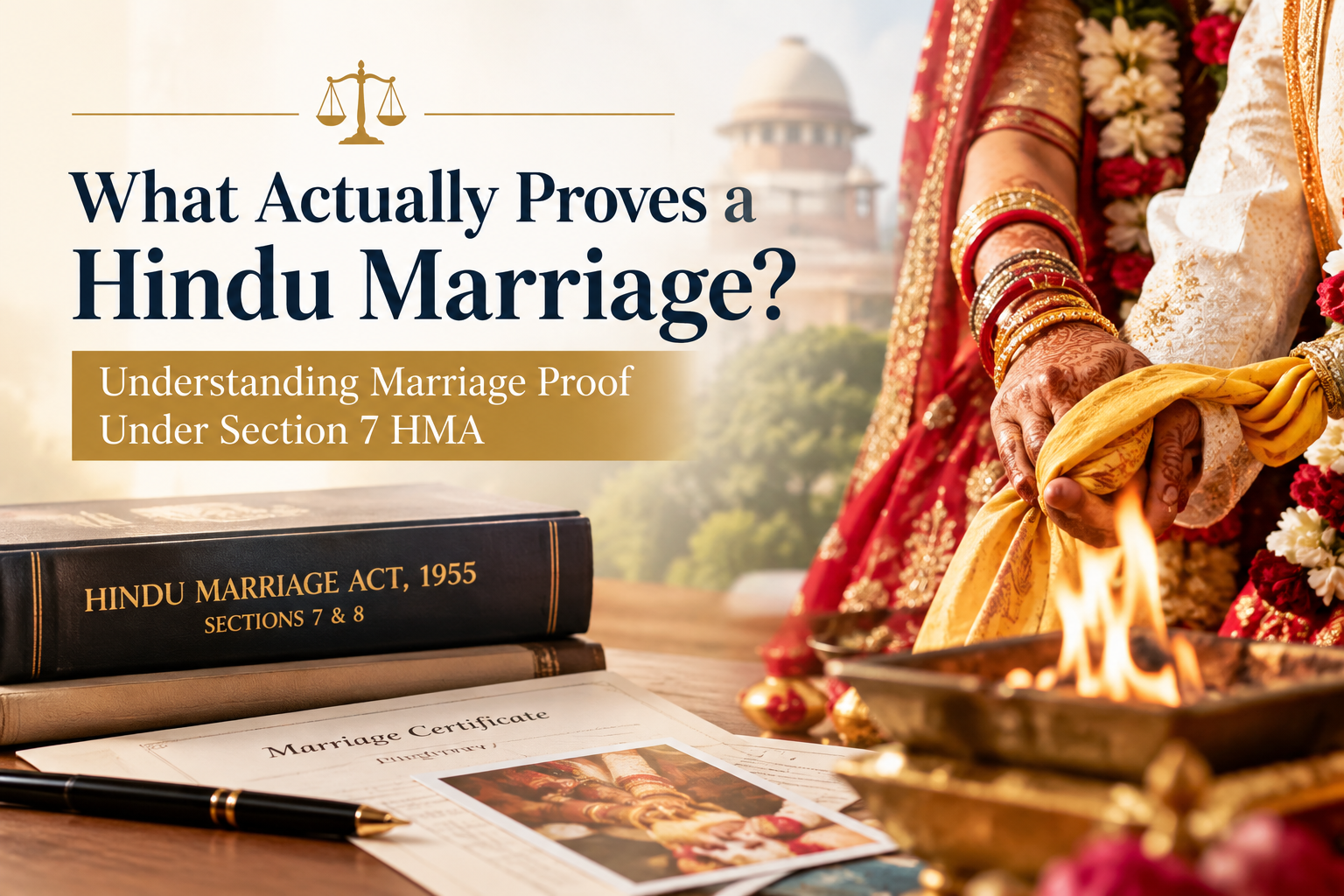
What Actually Proves a Hindu Marriage Happened?

This Article is written by Adv. Aman Chawla, Family Law Expert | Delhi High Court & Supreme Court of India
Practising in Family & Matrimonial Law | Jangpura, New Delhi
Proof of Hindu marriage is not established simply because a government document lists someone as a husband or wife. Voter lists, ration cards and other administrative records may support a claim, but they do not by themselves prove that a valid Hindu marriage was solemnised. The Patna High Court recently examined this issue and explained why proof of the actual marriage ceremony can become crucial when marital status is disputed.
The Case: A Voter List, a Maintenance Order, and a Marriage the Court Wouldn’t Recognise
The matter, X v. Y (2026 SCC OnLine Pat 8373), decided on August 5, 2026, by a division bench of Justice Bibek Chaudhuri and Justice Rana Vikram Singh, involved a woman claiming to be the legally wedded wife of her respondent. Her account was that she had first been married to the respondent’s elder brother, who died in 1997, and subsequently married the respondent — his younger brother — in 2002. She had, at an earlier stage, even obtained a maintenance order from the Family Court under Section 125 of the CrPC.
When the underlying marriage itself came to be directly disputed, her evidence largely rested on entries in the electoral voter list — one from 2004 showing her listed as the respondent’s wife, another from 2009 showing something different — along with the fact that she’d previously secured maintenance. The Family Court found this insufficient to establish that any marriage had actually taken place according to the required Hindu ceremonies, and the Patna High Court agreed, dismissing her appeal.
The Court’s Reasoning, In Its Own Words
The bench was direct about why this kind of secondary documentation doesn’t settle the question: “Entries made in the voter-list is not a conclusive proof with respect to any kind of valid or subsisting marriage, save and except the oral evidence, no other corroborative piece of evidence, which could indisputably evince the factum of marriage being solemnized between the appellant and the respondent.” In plain terms — a voter list reflects what someone told an electoral office at a point in time. It says nothing, on its own, about whether an actual, legally recognised marriage ceremony ever took place.
Why Even a Prior Maintenance Order Wasn’t Enough
This is genuinely the most useful, and most surprising, part of the ruling for anyone currently dealing with a maintenance dispute. The appellant had already obtained a maintenance order under Section 125 CrPC at an earlier stage — you might reasonably assume this would settle the marriage question once and for all. It didn’t. An interim or earlier maintenance determination, made on the evidence available at that specific stage of proceedings, doesn’t function as a final, conclusive finding on marital status if the underlying validity of the marriage is properly and separately contested later.
This matters enormously if you’re a husband facing a maintenance claim from someone whose actual marital status to you is genuinely disputed. The fact that a maintenance order was granted at some earlier point doesn’t foreclose a proper challenge to the marriage’s validity itself — these are, in the Court’s own treatment, separable questions, and winning one doesn’t automatically settle the other.
What Section 7 of the Hindu Marriage Act Actually Requires
This is the statutory core of the entire dispute, and it’s worth understanding precisely. Section 7 of the Hindu Marriage Act, 1955, provides that a Hindu marriage may be solemnised in accordance with the customary rites and ceremonies of either party — and specifically notes that where such rites and ceremonies include the saptapadi (the taking of seven steps by the bride and bridegroom jointly before the sacred fire), the marriage becomes complete and binding when the seventh step is taken.
This means the law doesn’t require a single, universal ceremony — different communities and families genuinely observe different customary rites. What it does require is that whatever specific ceremonies are customary to the parties’ own tradition were actually, demonstrably performed. Sindurdaan — the application of vermillion to the bride’s hair parting — is another commonly recognised ritual element courts look to, alongside saptapadi, depending on the specific community’s customs.
Section 8 of the Act separately allows for registration of a Hindu marriage, but registration itself is generally treated as evidentiary and administrative rather than a substantive requirement for the marriage’s validity — meaning a marriage can be valid without registration, provided the actual customary ceremonies were performed, but a properly registered marriage gives you considerably easier, cleaner proof if the marriage’s existence is ever challenged.
Why This Genuinely Matters If You’re Defending Against a Maintenance Claim
If you’re facing a maintenance claim, or any other matrimonial obligation, from someone whose actual marriage to you is genuinely disputed — perhaps a relationship that never involved a real ceremony, or one you believe was never properly solemnised — this ruling gives you real, current authority to challenge the claim at its foundation:
- Don’t assume secondary documentation settles the question. A voter list, a ration card, or similar administrative records naming someone as your spouse aren’t, by themselves, sufficient proof of a valid marriage, and this ruling confirms that directly.
- Don’t assume a prior maintenance order forecloses this challenge. As this case shows clearly, an earlier maintenance determination doesn’t function as a final finding on marital validity if that question is properly, separately contested.
- Focus your defence on the absence of actual ceremonial proof. If no genuine saptapadi, sindurdaan, or other customary rite specific to your community was ever performed, this is the central gap in the other side’s case, and it’s worth building your challenge around demonstrating exactly that absence.
- Gather your own evidence of what didn’t happen. Witness testimony from people who would have been present at any genuine ceremony but weren’t, the absence of typical wedding documentation — invitations, photographs, priest or officiant records — and any inconsistencies in the other side’s own account of when and how the “marriage” supposedly occurred all support this kind of challenge.
Why This Matters Equally If You Need to Prove Your Own Marriage
If you’re the one who needs to establish that your marriage genuinely happened — for a maintenance claim, a property dispute, or any other matrimonial proceeding — this ruling is an equally important reminder that you need more than administrative paperwork to make your case:
- Gather direct evidence of the actual ceremony. Wedding photographs and videos showing saptapadi or other customary rites being performed are considerably stronger evidence than any government record listing you as married.
- Identify witnesses who were actually present. Family members, priests or officiants, and others who witnessed the ceremony directly can provide the oral evidence the Patna High Court specifically identified as necessary where documentary proof is thin.
- Obtain your marriage certificate if one exists, or pursue registration now if it doesn’t. While registration alone isn’t the substantive requirement, it provides exactly the kind of clean, difficult-to-dispute evidence that avoids ending up in a dispute like this one entirely.
- Don’t rely on administrative documents alone. Voter lists, ration cards, and similar records can support your case as corroborating evidence, but as this ruling makes clear, they cannot carry the case by themselves.
The Interesting Tension: What About Long Cohabitation?
Here’s a nuance worth understanding, because it shows this area of law isn’t entirely one-directional. Indian courts have, in separate lines of cases, recognised that prolonged cohabitation as husband and wife can, in appropriate circumstances, give rise to a legal presumption of marriage — particularly under Section 114 of the Indian Evidence Act (now reflected in the corresponding provision of the Bharatiya Sakshya Adhiniyam, 2023) — where a couple has lived together for a significant period, held themselves out publicly as married, and no clear evidence points the other way.
This might seem to sit in tension with the Patna High Court’s insistence on actual ceremonial proof, but the two principles are genuinely reconcilable once you understand what each is actually responding to. The cohabitation presumption exists as a practical evidentiary tool for situations where direct proof of a ceremony is genuinely unavailable, often because of the passage of time or the deceased status of witnesses — it’s a fallback, not a substitute of first resort. Where the underlying marriage is actively, directly disputed by the other party — as it was in the Patna case — and there’s no strong, unrebutted showing of prolonged, publicly acknowledged cohabitation to trigger that presumption in the first place, courts still expect the more direct route: actual proof that the required ceremonies took place.
This means your specific strategy — whether you’re proving or challenging a marriage — depends heavily on which of these two paths your actual facts support. A short-lived, actively disputed relationship with thin documentary evidence is a very different case from a decades-long, publicly acknowledged cohabitation where ceremonial proof has simply become difficult to locate after the fact.
Common Mistakes People Make in This Area
- Assuming a marriage certificate is the only thing that matters, and everything else is irrelevant. While a certificate is strong evidence, its absence doesn’t automatically defeat a genuine marriage claim if actual ceremonial proof and witness testimony are otherwise strong.
- Assuming administrative records alone will carry a marriage claim. As this ruling shows directly, they won’t, without more.
- Assuming a prior favourable ruling on one issue — like interim maintenance — permanently settles marital status. It doesn’t, if the underlying validity question is properly raised and contested separately.
- Failing to gather ceremony-specific evidence early, when witnesses are still available and memories are still fresh, rather than trying to reconstruct this evidence years later once a dispute has already begun.
A Realistic Example
A man is served with a maintenance claim from a woman asserting she is his legally wedded wife, pointing to a ration card and a voter list entry naming her as such, along with a brief cohabitation period several years earlier. He genuinely disputes that any marriage ceremony ever took place — the relationship, in his account, never progressed beyond an informal arrangement. Relying on the reasoning in this Patna High Court ruling, his lawyer builds the defence around the absence of any wedding photographs, any priest or officiant, any invitation cards, or any witness who can testify to an actual saptapadi or equivalent ceremony having occurred — arguing that the administrative documents she relies on, without more, don’t meet the standard of proof Section 7 of the Hindu Marriage Act actually requires.
What to Do If This Applies to Your S ituation
- If you’re defending against a claim, focus your evidence-gathering on the absence of ceremonial proof — what didn’t happen, documented as specifically as what should have happened if the marriage claim were genuine.
- If you’re establishing your own marriage, prioritise direct ceremonial evidence — photographs, videos, witness testimony, and registration — over administrative records alone.
- Understand that an earlier favourable or unfavourable ruling on maintenance doesn’t necessarily settle the underlying marriage question permanently. If your circumstances genuinely warrant it, this can be separately, properly contested.
- Consider whether the cohabitation presumption might apply to your specific facts, particularly in longer-term relationships where direct ceremonial proof has become genuinely difficult to locate — this is a different strategic path than direct ceremonial proof, and it’s worth discussing with your lawyer which one actually fits your situation.
Frequently Asked Questions
1. Does a voter list entry naming me as someone’s spouse prove we’re legally married?
No. The Patna High Court has confirmed directly that voter list entries alone aren’t conclusive proof of a valid marriage — actual proof that customary ceremonies were performed under Section 7 of the Hindu Marriage Act is required.
2. If I already have a maintenance order in my favour, does that mean my marriage is legally established for good?
Not necessarily. An earlier maintenance determination doesn’t function as a final, conclusive finding on marital validity if that question is properly and separately contested at a later stage.
3. What evidence actually proves a Hindu marriage took place?
Direct evidence of the ceremony itself — photographs, videos, and witness testimony showing saptapadi, sindurdaan, or other customary rites specific to the parties’ community — carries far more weight than administrative documents alone.
4. Is a marriage certificate legally required for a Hindu marriage to be valid?
No. Registration under Section 8 of the Hindu Marriage Act is generally treated as evidentiary rather than a substantive requirement — a marriage can be valid without registration if the customary ceremonies were genuinely performed, though registration makes proving the marriage considerably easier later.
5. Can long-term cohabitation alone establish that a marriage happened?
In some circumstances, yes — courts have recognised a presumption of marriage from prolonged, publicly acknowledged cohabitation where direct ceremonial proof is genuinely unavailable. This is a different evidentiary path than direct ceremony proof, and which one applies depends heavily on the specific facts.
6. If I’m defending against a maintenance claim, what should I focus on?
Building your case around the absence of genuine ceremonial proof — no wedding photographs, no priest or officiant, no witnesses who can testify to an actual ceremony — while noting that the other side’s administrative documents alone aren’t sufficient to establish the marriage.
7. What if the marriage happened decades ago and witnesses have passed away or evidence has been lost?
This is exactly the kind of situation where the long-cohabitation presumption becomes more relevant, since direct ceremonial proof may genuinely no longer be available. Discuss this specific strategic path with your lawyer if it applies to your circumstances.
8. Does this ruling apply to marriages under other personal laws, like Muslim or Christian marriage?
This specific ruling addresses Hindu marriages under the Hindu Marriage Act. Other personal law frameworks have their own distinct requirements for establishing a valid marriage, which differ from the Hindu Marriage Act’s ceremonial framework.
Disclaimer: This article is for general informational purposes only and does not constitute legal advice. As per the Rules of the Bar Council of India, advocates are not permitted to advertise or solicit work, and nothing in this article should be construed as advertising, solicitation, or an invitation to engage this firm. Every case is fact-specific — consult a qualified advocate regarding your specific circumstances before taking any legal action.
Adv. Aman Chawla practices matrimonial and family law before the Delhi High Court, Delhi Family Courts (Saket, Rohini, Dwarka, Karkardooma, Patiala House), and the Supreme Court of India. For a consultation on your specific situation, reach out through the contact details on this website.
Disclaimer: This article is for general informational purposes only and does not constitute legal advice. As per the Rules of the Bar Council of India, advocates are not permitted to advertise or solicit work, and nothing in this article should be construed as advertising, solicitation, or an invitation to engage this firm. Readers should consult a qualified advocate regarding their specific circumstances before taking any legal action.
About the Author
This article is written by legal experts at The Matrimonial Lawyers, a leading law firm in Delhi specializing in matrimonial disputes, family law, divorce proceedings, and child custody matters. Our team has extensive experience handling complex profile fraud cases and helping clients navigate the emotional and legal challenges of matrimonial disputes.