One Marriage, Five Court Cases: Divorce, Domestic Violence, 498A, Maintenance & RCR Explained

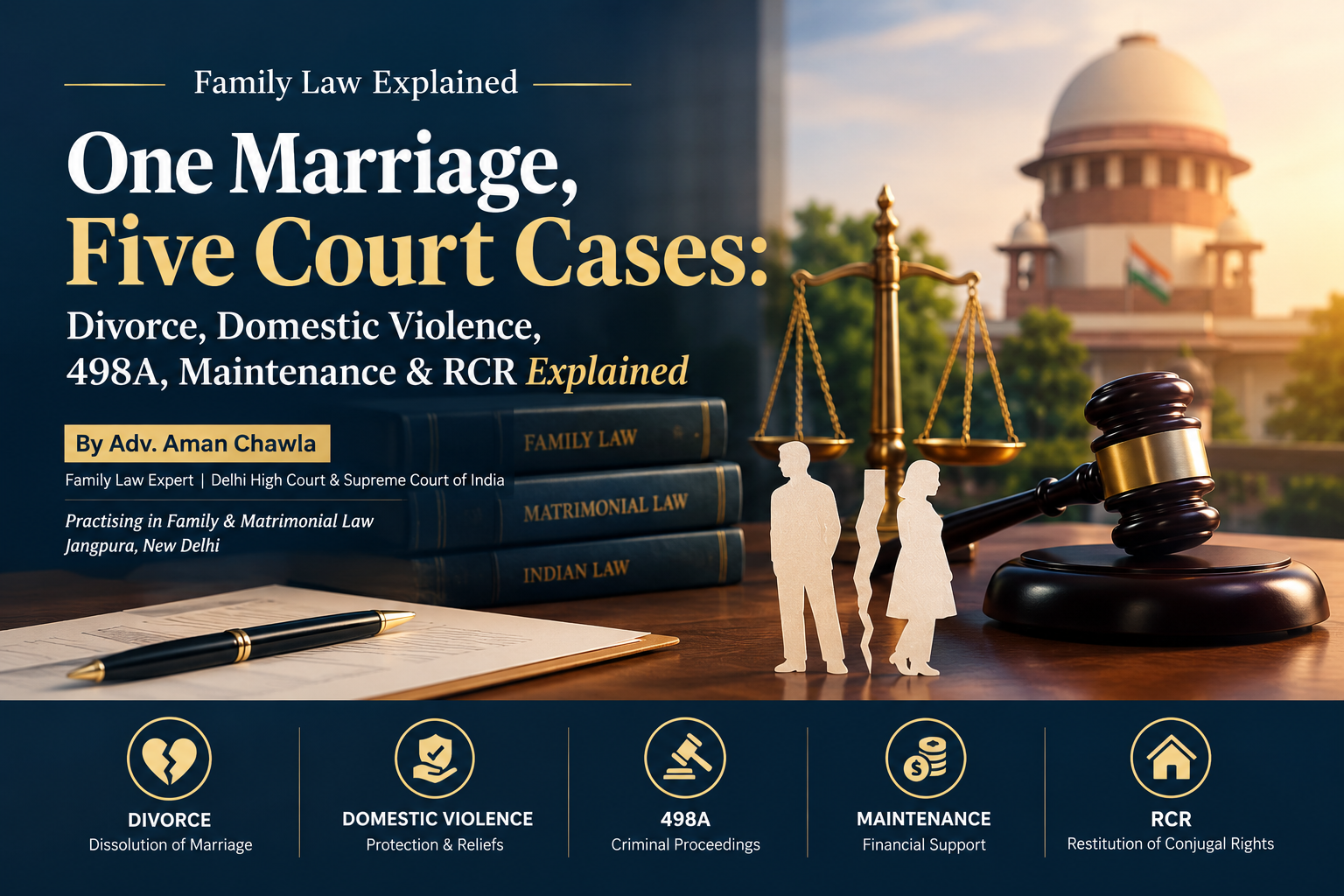
One Marriage, Five Court Cases: Divorce, Domestic Violence, 498A, Maintenance & RCR Explained
This Article is written by Adv. Aman Chawla, Family Law Expert | Delhi High Court & Supreme Court of India
Practising in Family & Matrimonial Law | Jangpura, New Delhi
Multiple matrimonial cases can arise from the same marriage. A couple may face divorce proceedings, a domestic-violence case, a maintenance claim, a 498A or corresponding criminal proceeding, and even a petition for restitution of conjugal rights (RCR). Although these proceedings may arise from the same relationship, each has its own legal purpose, procedure and possible relief.
Suddenly, one marriage has produced several legal proceedings.
For the husband or wife involved, this can be extremely confusing.
There may be different case numbers, different lawyers, different hearing dates and sometimes even different courts or cities. One proceeding may be civil or matrimonial in nature, another may involve a Magistrate, while a criminal proceeding may move through the criminal justice system.
The important point is that these proceedings do not necessarily become invalid simply because another matrimonial case is already pending.
Indian law allows different statutory remedies to operate in appropriate circumstances. But that does not mean a party can obtain duplicate financial reliefs or conceal an earlier proceeding from another court.
Recent Supreme Court decisions have placed renewed emphasis on overlapping proceedings, disclosure of earlier maintenance orders, adjustment of amounts and avoiding conflicting orders. In August 2026, a judgment dealing with maintenance claims under different statutes reiterated that a person may seek maintenance under more than one legal provision, but previously awarded amounts must be disclosed and taken into account when determining subsequent relief.
At the other end of the spectrum, the Supreme Court has also dealt with cases involving a large number of interconnected matrimonial and criminal proceedings. One 2026 matter involved more than 80 proceedings arising from a prolonged matrimonial dispute.
So, what happens when one marriage produces five different court cases?
This article explains how divorce, domestic violence, 498A, maintenance and restitution of conjugal rights can interact, what each proceeding is meant to achieve, and why strategy matters when multiple cases are pending.
Why Can One Marriage Lead to Multiple Court Cases?
Marriage creates legal relationships under several different laws.
When the relationship breaks down, the same underlying events may have consequences under more than one statute.
For example, an allegation that a spouse subjected the other spouse to cruelty may become relevant to:
- a divorce petition;
- a domestic-violence proceeding;
- a criminal complaint;
- a maintenance claim;
- a custody dispute;
- or other matrimonial proceedings.
That does not mean all these cases are identical.
Each proceeding has its own legal foundation, purpose, jurisdiction and available remedies.
This distinction is essential.
A divorce case asks whether the statutory grounds for dissolution of marriage have been established.
A domestic-violence proceeding deals with remedies available under the Protection of Women from Domestic Violence Act, 2005.
A maintenance proceeding concerns financial support under the applicable statutory framework.
A criminal case concerns alleged offences and follows criminal procedure.
A Section 9 petition seeks restitution of conjugal rights.
The facts may overlap, but the legal questions are not necessarily the same.
The Five Proceedings at a Glance
| Proceeding | Broad purpose | Nature |
|---|---|---|
| Divorce | Dissolution of marriage | Matrimonial |
| Domestic Violence | Statutory protection and reliefs | Magistrate/DV proceeding |
| 498A / corresponding criminal allegations | Criminal prosecution for alleged matrimonial cruelty | Criminal |
| Maintenance | Financial support | Statutory/matrimonial |
| RCR under Section 9 HMA | Restitution of conjugal rights | Matrimonial |
The Supreme Court’s case classification separately recognises divorce, restitution of conjugal rights and maintenance matters within family-law proceedings.
This separation is important because one proceeding does not automatically replace another.
1. Divorce Case
A divorce petition is generally filed seeking dissolution of the marriage under the applicable personal law.
For Hindu marriages, the Hindu Marriage Act, 1955 provides several grounds for divorce.
Depending on the case, allegations may include:
- cruelty;
- desertion;
- adultery;
- conversion;
- certain mental-health-related statutory grounds;
- renunciation;
- presumption of death;
- or other grounds recognised by the statute.
A divorce case is fundamentally about the legal status of the marriage.
The court is not simply deciding who was “right” or “wrong” in the relationship.
It examines whether the statutory requirements for the relief sought have been established.
This is why evidence becomes important.
Messages, emails, medical records, financial documents, photographs, recordings and witness testimony may become relevant depending on the allegations.
For example, if the petition is based on cruelty, the petitioner may need to establish the conduct relied upon as cruelty.
If you want to explain this subject separately, an internal link can be placed here:
[How to Prove Cruelty in a Divorce Case in India]
The divorce proceeding may continue even when other cases are pending.
2. Domestic Violence Proceeding
The Protection of Women from Domestic Violence Act, 2005 provides a statutory framework for relief to an aggrieved woman facing domestic violence within the scope of the Act.
The reliefs available under the Act can include, depending on the facts:
- protection orders;
- residence-related relief;
- monetary relief;
- custody-related relief;
- compensation;
- interim or other appropriate orders.
A DV proceeding is therefore not simply another version of a divorce case.
It has a different statutory purpose.
For example, a woman may not necessarily want immediate dissolution of marriage but may seek protection or financial relief.
Similarly, a pending divorce case does not automatically eliminate the possibility of relief under the DV Act.
However, the existence of other proceedings and orders can become highly relevant, particularly where monetary relief is concerned.
3. 498A and Criminal Proceedings
A matrimonial dispute can also enter the criminal justice system.
Historically, Section 498A IPC dealt with cruelty by a husband or his relatives.
After the introduction of the Bharatiya Nyaya Sanhita, 2023, the corresponding offence is addressed under the new criminal-law framework.
This means that articles and legal advice published today should distinguish between:
older cases governed by the IPC framework and newer cases governed by the BNS framework.
A criminal proceeding is fundamentally different from a divorce petition.
The criminal court is concerned with whether the ingredients of the alleged offence are established according to criminal law and procedure.
The Family Court, on the other hand, deals with matrimonial reliefs within its jurisdiction.
The same factual background may therefore appear in both proceedings without the two cases becoming legally identical.
4. Maintenance Proceedings
Maintenance is often one of the most complicated aspects of multiple matrimonial proceedings.
A spouse may seek financial support under more than one statutory provision, depending upon the circumstances.
For example, maintenance-related claims can arise under:
- the Hindu Marriage Act;
- the Bharatiya Nagarik Suraksha Sanhita;
- the Protection of Women from Domestic Violence Act;
- other applicable personal or statutory laws.
The existence of multiple legal routes does not mean that a claimant can simply collect completely independent amounts under every proceeding without adjustment.
The Supreme Court has recently reiterated this principle.
In Sri Suman Das v. Smt. Sampa Mandal, decided in August 2026, the Court discussed maintenance claims under different statutes and directed that earlier proceedings and orders must be disclosed, with adjustment or set-off considered where appropriate to avoid duplication and conflicting orders.
This is an extremely important point for anyone facing several maintenance proceedings.
The practical lesson
If a maintenance order already exists, do not hide it from the next court.
Likewise, if another maintenance proceeding is pending, the fact should be properly disclosed.
The court can then consider the overall financial position and previously granted relief.
5. Restitution of Conjugal Rights — Section 9 HMA
Section 9 of the Hindu Marriage Act deals with restitution of conjugal rights.
Broadly speaking, where one spouse has withdrawn from the society of the other without reasonable excuse, the aggrieved spouse may seek restitution of conjugal rights subject to the statutory requirements.
This can create an interesting situation.
Suppose:
Wife files divorce.
Then:
Husband files Section 9 RCR petition.
At the same time:
Wife files maintenance proceedings.
And:
A criminal complaint or DV proceeding is also pending.
Can all these cases exist at the same time?
The answer cannot be reduced to a simple “yes” or “no” for every case.
The legal effect depends upon the facts, pleadings, statutory requirements and orders passed in each proceeding.
The existence of an RCR case does not automatically terminate a divorce case.
Nor does filing RCR automatically establish that the other spouse is legally required to return immediately.
The court examines the statutory requirements and the evidence.
One Marriage, Five Cases: How Does the Court Look at Them Together?
This is where litigation strategy becomes important.
Suppose a couple separates in Delhi.
The wife files:
- Divorce proceedings;
- DV proceedings;
- Maintenance proceedings;
- Criminal complaint.
The husband files:
- Section 9 RCR.
There may now be several proceedings arising from the same relationship.
The court dealing with one case may need to know what has happened in the others.
Why?
Because an order in one proceeding can affect the practical position in another.
For example, if maintenance has already been granted, a later court deciding another maintenance claim should ordinarily be informed about that order.
This is one of the reasons the Supreme Court has emphasised disclosure and adjustment in overlapping maintenance claims.
Can Divorce and 498A Continue Together?
Yes, the mere filing of one proceeding does not automatically terminate the other.
They have different legal purposes.
A divorce petition is a matrimonial proceeding.
A criminal prosecution concerns alleged criminal conduct.
The same factual allegations may appear in both.
However, each court must apply the legal test relevant to the proceeding before it.
Therefore, an allegation made in a divorce petition is not automatically proof of a criminal offence.
Similarly, the existence of a criminal complaint does not by itself establish that the grounds for divorce have been proved.
Evidence must be evaluated according to the applicable legal standards.
Can Divorce and Domestic Violence Proceedings Run Together?
They can coexist.
A divorce petition determines the matrimonial relief sought under the applicable marriage law.
A DV proceeding can concern protection, residence, monetary and other statutory reliefs.
The two proceedings may involve overlapping factual allegations.
For example, allegations of physical or emotional abuse may appear in both.
But the court in each proceeding is dealing with the relief and statutory framework before it.
This is why simply saying “a divorce case is already pending, so the DV case should end” is not a complete legal argument.
The facts and applicable law have to be examined.
Can Maintenance Be Claimed During a Divorce Case?
Yes, depending upon the applicable statute and facts.
A divorce petition does not automatically eliminate a spouse’s ability to seek maintenance.
The financial circumstances of both parties, their income, assets, liabilities, needs and other relevant circumstances may become important.
But when multiple maintenance proceedings exist, disclosure becomes critical.
The Supreme Court’s 2026 discussion in Suman Das is particularly relevant because it addresses successive maintenance claims and the need for adjustment to prevent overlapping awards from becoming inequitable.
For readers dealing specifically with this issue, your existing article can be internally linked here:
[Maintenance for Wife in India: Rights, Eligibility and Important Court Principles]
What Happens When the Same Facts Appear in Five Cases?
This is one of the most common sources of confusion.
Suppose the allegation is:
“The husband repeatedly humiliated the wife and demanded money.”
That allegation might appear in:
- divorce pleadings;
- DV complaint;
- criminal complaint;
- maintenance proceedings;
- affidavit evidence.
But repetition does not automatically prove the allegation.
Each proceeding has its own evidentiary and legal requirements.
The parties and their lawyers therefore need to maintain consistency.
A statement made in one proceeding may become relevant in another.
Contradictions between pleadings, affidavits, complaints and testimony can become significant.
This is why matrimonial litigation should not be managed as five completely isolated cases.
Can Cases Pending in Different Cities Be Transferred?
Sometimes this becomes a major issue.
A matrimonial dispute may involve:
- Delhi;
- Gurugram;
- Noida;
- Mumbai;
- Bengaluru;
- another state;
- or even an NRI spouse living abroad.
One case may be pending where the marriage took place.
Another may be pending where the parties last lived together.
Another may have criminal jurisdiction based on the alleged offence.
A transfer petition may therefore become relevant in appropriate circumstances.
The Supreme Court has repeatedly dealt with transfer requests in matrimonial disputes.
For your website, this is a natural place to internally link:
[Transfer Petition in Matrimonial Cases: When Can a Case Be Transferred?]
The important point is that transfer is not automatic.
The court considers the circumstances of the parties, the nature of proceedings and other relevant factors.
What If There Are Cases in Different Courts?
The first step should be to create a complete litigation chart.
For example:
| Case | Court | Provision | Status | Next Date |
|---|---|---|---|---|
| Divorce | Family Court | HMA | Pending | — |
| DV | Magistrate | DV Act | Pending | — |
| Maintenance | Family/Magistrate | Applicable law | Pending | — |
| Criminal case | Criminal Court | IPC/BNS | Pending | — |
| RCR | Family Court | Section 9 HMA | Pending | — |
This sounds simple.
But in a multi-case matrimonial dispute, it can prevent serious mistakes.
The lawyer should know:
- every case number;
- every court;
- every order;
- every interim relief;
- every settlement;
- every maintenance award;
- every undertaking;
- every withdrawal;
- every pending appeal.
Why Disclosure Between Proceedings Matters
Suppose a wife obtains ₹30,000 per month under one maintenance proceeding.
She then files another maintenance application without mentioning the first order.
The second court may not have the complete financial picture.
This is exactly the type of problem that recent Supreme Court guidance seeks to address.
The Court has directed that previous maintenance proceedings and orders be disclosed in subsequent proceedings and that appropriate adjustment or set-off be considered.
Therefore:
Never assume that because two cases are technically separate, information from one case is irrelevant to the other.
Can Multiple Cases Be Settled Together?
Sometimes, yes.
Matrimonial disputes are particularly suitable for negotiated settlements where both parties voluntarily agree to resolve the outstanding issues.
A comprehensive settlement may address matters such as:
- divorce;
- permanent alimony;
- maintenance;
- return of articles;
- stridhan;
- child custody;
- visitation;
- withdrawal or disposal of appropriate proceedings;
- property disputes;
- pending criminal proceedings, subject to the law governing their closure.
But settlement language must be drafted carefully.
A vague sentence such as:
“All disputes are settled.”
may not be sufficient to safely address every pending proceeding.
Each case should be identified.
Each obligation should be recorded.
Payment schedules should be clear.
The consequences of default should be considered.
And where a criminal proceeding is involved, the legally appropriate mechanism for closure must be followed.
What Happens If Maintenance Was Waived in a Settlement?
This issue has become particularly important in recent Supreme Court litigation.
In August 2026, the Supreme Court dealt with a case where monetary and maintenance claims had been voluntarily relinquished as part of a matrimonial settlement. The Court held, on the facts before it, that the settled claims could not simply be revived through later DV proceedings without first challenging the settlement itself.
This does not mean every settlement automatically prevents every future claim.
The wording of the settlement, the facts, the nature of the claim, the timing and the legal rights involved all matter.
But it demonstrates why matrimonial settlement agreements need to be drafted with precision.
Can an RCR Case Be Filed While a Divorce Case Is Pending?
The existence of a divorce proceeding does not, by itself, provide a universal answer to whether a separate Section 9 petition can be maintained.
The specific facts and procedural posture matter.
There have been cases in which one spouse sought divorce while the other sought restitution of conjugal rights.
A recent Supreme Court decision records precisely such a situation: the wife sought divorce while the husband sought restitution of conjugal rights, alongside criminal proceedings arising from the matrimonial dispute.
This illustrates an important point:
Different matrimonial remedies can arise from the same breakdown of marriage.
The court then has to determine the legal consequences of the particular pleadings and evidence.
What About 498A After a Divorce Settlement?
A settlement does not automatically produce the same legal result in every criminal proceeding.
The effect depends on:
- the offence involved;
- the stage of the criminal case;
- whether the offence is compoundable;
- the terms of settlement;
- whether the High Court or Supreme Court’s inherent/constitutional jurisdiction is invoked;
- and the applicable legal principles.
Therefore, a settlement clause should never casually state that a criminal case will simply “automatically disappear.”
The proper legal procedure must be followed.
One Marriage, Different Standards of Proof
Another important misconception is that if an allegation fails in one proceeding, it automatically fails everywhere.
That is not necessarily correct.
Different proceedings may involve different statutory ingredients and evidentiary questions.
For example:
Divorce:
Has a statutory ground for divorce been established?
Criminal case:
Have the ingredients of the alleged offence been established according to criminal law?
DV proceeding:
Are the statutory conditions for the relief sought established?
Maintenance:
What financial support is legally justified after considering the relevant circumstances?
RCR:
Are the statutory requirements for restitution satisfied?
The same factual background can therefore produce different legal questions.
The Biggest Mistakes People Make in Multiple Matrimonial Cases
Mistake 1: Treating every case as completely separate
Your lawyer needs the complete litigation history.
Mistake 2: Hiding an earlier maintenance order
Recent Supreme Court guidance makes disclosure particularly important.
Mistake 3: Giving contradictory statements
Different pleadings should be prepared carefully and consistently.
Mistake 4: Signing a settlement without understanding every clause
A settlement can have consequences for future proceedings.
Mistake 5: Assuming divorce ends every other proceeding
Divorce and criminal/DV/maintenance proceedings have different legal foundations.
Mistake 6: Assuming 498A and divorce are the same case
They are not.
Mistake 7: Ignoring jurisdiction
Multiple proceedings may be spread across different courts or cities.
Mistake 8: Treating every allegation as automatically proved
A complaint is an allegation. Evidence and adjudication still matter.
A Practical Strategy When Five Cases Are Pending
If you are involved in multiple matrimonial proceedings, start with a master case file.
Keep:
1. Every petition and complaint
Do not rely only on memory.
2. Every interim order
Especially maintenance, residence, custody and protection orders.
3. Every settlement document
Including mediation agreements and undertakings.
4. Every financial disclosure
Income, assets, liabilities and previous maintenance orders.
5. Every important communication
Particularly communications relevant to settlement or admissions.
6. Every hearing date
Maintain one consolidated calendar.
7. A chronology
Write down the important events in date order.
A good chronology can save enormous time when several proceedings arise from the same relationship.
What Should a Lawyer Check Before Advising on Multiple Cases?
A proper review should consider:
- Which proceedings are pending?
- Where are they pending?
- Who filed each proceeding?
- What relief is sought?
- What interim orders already exist?
- Is maintenance already awarded elsewhere?
- Are any cases stayed?
- Has mediation occurred?
- Has there been a settlement?
- Are there children?
- Are property issues pending?
- Are criminal proceedings pending?
- Are there appeals?
- Is a transfer petition appropriate?
- Are any limitation or procedural issues involved?
The answer to these questions can materially change the strategy.
The 2026 Legal Trend: Courts Are Increasingly Dealing With Overlapping Litigation
Recent cases show why matrimonial lawyers increasingly need to look beyond the individual petition.
The Supreme Court has dealt with:
- multiple matrimonial and criminal proceedings;
- overlapping maintenance claims;
- settlements covering several disputes;
- proceedings across different courts;
- RCR alongside divorce;
- DV and maintenance proceedings;
- large-scale matrimonial litigation.
In one 2025 Supreme Court case, the Court recorded a particularly extensive set of matrimonial and criminal proceedings, including a Section 498A complaint, a Section 9 HMA petition and several other criminal complaints.
In 2026, the Supreme Court also considered a case involving divorce, maintenance and domestic-violence proceedings arising around a settlement.
The broader lesson is clear:
The modern matrimonial dispute is often not one case. It can be a network of connected proceedings.
Frequently Asked Questions
Can a husband and wife have divorce, DV and 498A cases at the same time?
Yes, different proceedings can arise from the same matrimonial relationship because they are based on different legal provisions and seek different forms of relief. The specific maintainability and outcome depend on the facts and applicable law.
Can maintenance be claimed under more than one law?
A spouse may have maintenance remedies under different statutory provisions. However, previous proceedings and awards must be properly disclosed, and courts can consider adjustment or set-off to prevent inequitable duplication.
Does filing for divorce cancel a DV case?
Not automatically. Divorce and DV proceedings serve different statutory purposes.
Does a 498A case stop divorce proceedings?
Not automatically. The criminal proceeding and matrimonial proceeding are legally distinct, although facts and evidence may overlap.
Can RCR and divorce proceedings exist together?
Different matrimonial remedies may arise from the same marital dispute. Whether a particular petition is maintainable and what effect it has depends on the facts and procedural circumstances.
Can all five cases be transferred to one court?
Not automatically. Transfer depends on the jurisdictional framework and the circumstances of the particular proceedings.
Can all matrimonial cases be settled together?
A comprehensive settlement can address multiple disputes, but each proceeding must be dealt with according to the applicable law and procedure.
What if there is already a maintenance order?
The existing order should be disclosed in subsequent maintenance proceedings. Recent Supreme Court guidance specifically addresses adjustment/set-off in overlapping maintenance claims.
Can a maintenance claim waived in a settlement be filed again?
The answer depends heavily on the terms and circumstances of the settlement. In a recent 2026 Supreme Court decision, a voluntarily relinquished maintenance claim could not simply be revived through later DV proceedings on the facts of that case.
What should I do if five cases are pending in different courts?
Prepare a complete litigation chart containing every case number, court, provision, relief, interim order, next date and settlement document. A matrimonial lawyer should review the proceedings together rather than treating each file in isolation.
Conclusion
Multiple matrimonial cases can make an already difficult marital dispute considerably more complicated. Divorce, domestic violence, 498A or corresponding criminal proceedings, maintenance and RCR may arise from the same relationship, but each proceeding has a different legal purpose.
The existence of several cases does not mean that every proceeding will produce the same result. Courts consider the applicable statute, evidence, pleadings, previous orders and the circumstances of the individual case.
Where several proceedings are pending, maintaining a complete record of every case, disclosing relevant previous orders and understanding how the proceedings interact can be extremely important.
One marriage may result in several case numbers, but the legal strategy should begin by understanding the complete matrimonial dispute, rather than looking at each proceeding in isolation.
Adv. Aman Chawla practices matrimonial and family law before the Delhi High Court, Delhi Family Courts (Saket, Rohini, Dwarka, Karkardooma, Patiala House), and the Supreme Court of India. For a consultation on your specific situation, reach out through the contact details on this website.
Disclaimer: This article is for general informational purposes only and does not constitute legal advice. As per the Rules of the Bar Council of India, advocates are not permitted to advertise or solicit work, and nothing in this article should be construed as advertising, solicitation, or an invitation to engage this firm. Readers should consult a qualified advocate regarding their specific circumstances before taking any legal action.
About the Author
This article is written by legal experts at The Matrimonial Lawyers, a leading law firm in Delhi specializing in matrimonial disputes, family law, divorce proceedings, and child custody matters. Our team has extensive experience handling complex profile fraud cases and helping clients navigate the emotional and legal challenges of matrimonial disputes.