Written by Adv. Aman Chawla | Matrimonial Law Specialist | Delhi High Court & Supreme Court of India | 8 Years Exclusive Practice in Family & Matrimonial Law | Jangpura, New Delhi
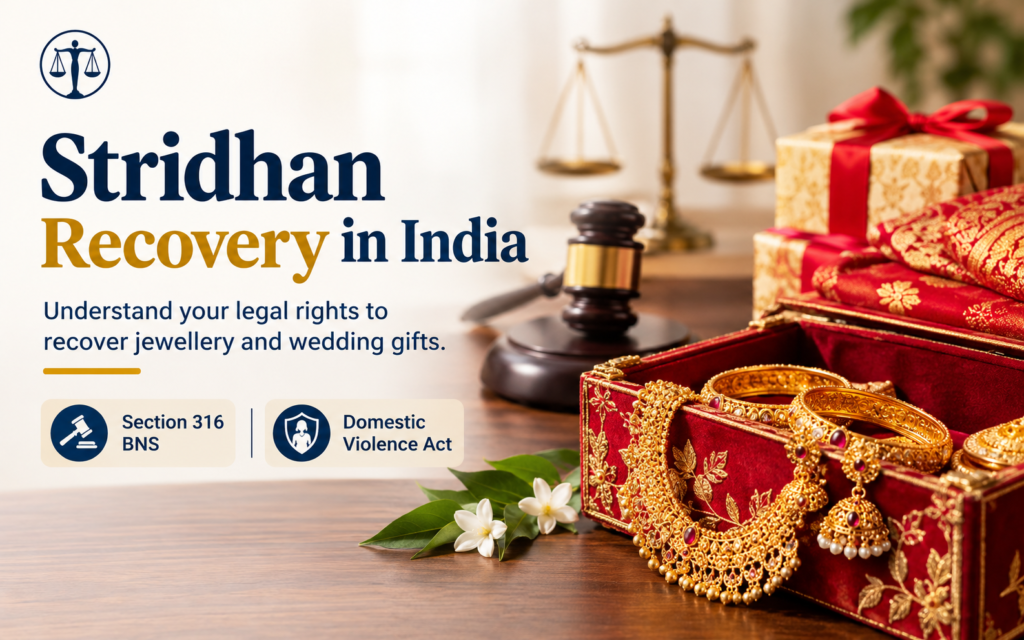
Stridhan recovery in India is an important legal issue when a husband or in-laws refuse to return a woman’s jewellery, wedding gifts or personal belongings. Indian law recognises a woman’s ownership of her stridhan and provides legal remedies to recover her property.
“Sir, my mother-in-law took all my jewellery on the first night ‘for safekeeping’. Now they say it belongs to the family.”
“Sir, I left with just two suitcases. My gold, my gifts, even my certificates are still in that house.”
I hear these words every single week. In most matrimonial disputes, the first fight concerns jewellery and gifts. This often happens before discussions about custody, maintenance or divorce. Many women also feel that asking for their own belongings makes them appear shameful or greedy.
It does not. The law is clear: stridhan belongs to the woman, and to no one else.
This article explains stridhan recovery in India, why the Supreme Court calls stridhan a woman’s absolute property, and the legal routes available to recover it. You can approach the police under Section 316 of the Bharatiya Nyaya Sanhita (old Section 406 IPC), seek relief under the DV Act or file a civil claim. I have also covered the mistakes that often cost women their stridhan.
Quick Answer: How Can You Recover Your Stridhan?
Stridhan includes everything given to a woman before, at or after marriage as her own property. It may include jewellery, cash, gifts, clothes, household items and property bought in her name.
It remains her absolute property. If her husband or in-laws keep it and refuse to return it, their conduct may amount to criminal breach of trust under Section 316 BNS (old Section 406 IPC).
You can take several legal routes:
- File a police complaint.
- Seek an order for return under Section 19(8) of the DV Act.
- Claim the property under Section 27 of the Hindu Marriage Act in a matrimonial case.
- File a civil suit for recovery.
The Supreme Court has also held that civil proceedings require proof on a balance of probabilities, not beyond reasonable doubt.
1. What Exactly Is Stridhan?
Stridhan literally means “woman’s wealth”. It includes:
- Jewellery and gold given by your parents, relatives, husband or in-laws at the time of marriage.
- Gifts received at engagement, mehendi, wedding and reception.
- Gifts received later on occasions such as Karva Chauth, baby showers or festivals.
- Cash or cheques given to you.
- Clothes, sarees and personal items.
- Household articles given in your name, such as furniture or appliances.
- Property, fixed deposits or investments bought in your name.
- Your own salary and savings.
What Is Not Stridhan?
Gifts given jointly to the couple for common use may qualify as joint property. Your husband’s own salary does not become your stridhan.
This distinction matters. Your stridhan list can help establish which articles belong to you and which items the couple received jointly.
2. Stridhan Is Your Absolute Property: What the Supreme Court Says
The law on this point has remained consistent for four decades.
Pratibha Rani v. Suraj Kumar (Supreme Court, 1985)
The Supreme Court held that stridhan remains the wife’s absolute property, even after she hands it to her husband or in-laws. They hold it only as trustees.
If they dishonestly refuse to return it, their conduct can amount to criminal breach of trust.
Rashmi Kumar v. Mahesh Kumar Bhada (Supreme Court, 1997)
The Court reaffirmed that stridhan is the woman’s absolute property. She has the right to dispose of it as she wishes. Her husband has no independent control over it.
Maya Gopinathan v. Anoop S.B. (Supreme Court, April 2024)
In this case, the husband had taken the wife’s jewellery for “safekeeping”. The Supreme Court held that stridhan does not become the couple’s joint property. The husband also acquires no title over it.
He may use it in times of distress, but he has a moral obligation to return the jewellery or its value.
Importantly, the Court said the High Court had applied the wrong standard by demanding proof at the level of a criminal trial in a civil matrimonial dispute. The correct standard is preponderance of probabilities.
Considering the time that had passed and the rise in the cost of living, the Supreme Court awarded her ₹25 lakh.
Real-Life Example
Ritu’s parents gave her about 60 tola of gold at her wedding. On the night of the reception, her mother-in-law collected all the jewellery and placed it in the family locker “so it stays safe”.
Two years later, Ritu left the house after facing harassment. Her in-laws then told her, “That gold is the family’s now.”
The law does not support that claim. Her mother-in-law received the jewellery as a trustee. Refusing to return it after a demand is the kind of conduct that Section 316 BNS addresses.
3. Your Legal Routes to Recover Stridhan
You have four main legal routes for stridhan recovery in India. Depending on the facts, you may use more than one route at the same time.
Route 1: Police Complaint Under Section 316 BNS (Old Section 406 IPC)
Section 316 BNS deals with criminal breach of trust. It applies when someone receives entrusted property and dishonestly misappropriates it or refuses to return it.
If you entrusted your stridhan to your husband or in-laws and they refuse to return it, you can file a complaint at the police station. In Delhi, you can also approach the CAW Cell.
Women often file stridhan complaints alongside allegations under Section 85 BNS (old Section 498A IPC) where cruelty forms part of the dispute. However, a stridhan complaint can also stand on its own.
In Delhi, the CAW Cell often attempts mediation first. Many stridhan disputes end when the parties agree to return the articles during counselling.
If the parties fail to resolve the dispute, the police may register an FIR. They can also seize and recover the articles in accordance with the law.
Route 2: Return of Stridhan Under the DV Act
Section 19(8) of the Protection of Women from Domestic Violence Act, 2005 empowers the Magistrate to direct the respondent to return your stridhan or any other property or valuable security to which you are entitled.
This route can be useful when you also seek protection, residence and maintenance in the same case. It offers a way to address these related issues together.
Route 3: Section 27 of the Hindu Marriage Act
In a divorce, judicial separation or another HMA proceeding, Section 27 allows the court to make provisions for property presented “at or about the time of marriage”.
This provision concerns property that may belong jointly to both the husband and wife. It can help when you want the court to address the property issue in the same case as the divorce.
Route 4: Civil Suit for Recovery
You can also file a civil suit to recover the articles or their value.
In Maya Gopinathan, the Supreme Court clarified that civil proceedings use the standard of a balance of probabilities. The claimant does not need to prove the case beyond reasonable doubt.
4. Who Can File: Not Your Father, Unless You Authorise It
In Mulakala Malleshwara Rao v. State of Telangana (Supreme Court, August 2024), a father filed an FIR under Section 406 IPC to recover gold he had given his daughter at her wedding more than 20 years earlier.
By then, his daughter had divorced abroad under a settlement and remarried.
The Supreme Court quashed the case. It held that a woman is the sole owner of her stridhan. Her father has no independent right to seek its recovery while she remains alive and capable of pursuing the claim herself, at least without her authorisation.
The Court also found that the complaint came hopelessly late. It lacked proof of entrustment or misappropriation.
Two Lessons From This Judgment
- You should file the complaint yourself or give someone clear authorisation to act on your behalf.
- Do not delay. Stale claims can become difficult to sustain, especially after a settlement that covers all financial matters.
5. The Single Most Important Document: Your Stridhan List
Evidence often determines the outcome of a stridhan dispute. Start preparing a detailed list today.
Include the following details:
- Item description: For example, “Gold kada, 2 pieces, approx. 40 grams”.
- Gift details: Identify who gave each item and on which occasion.
- Approximate value: Include the jeweller’s bill wherever available.
- Photographs and videos: Keep wedding photographs and videos that show you wearing the jewellery.
- Bank locker records: Collect records if someone kept your jewellery in a locker.
- Messages: Save messages where your husband or in-laws acknowledge keeping your jewellery.
- Witnesses: Note the names of people who saw someone give or take the articles.
Real-Life Example
Two women file stridhan complaints in the same month.
The first woman says, “They kept all my jewellery, around 50 lakh.”
The second woman submits a list of 32 items. She also provides jewellery bills, wedding photographs that show each piece, and a WhatsApp message from her husband stating, “Your gold is safe in Mummy’s locker.”
Which woman’s evidence gives the authorities a clearer picture of the missing articles?
A detailed list, supported by documents and messages, can make a significant difference to your claim.
6. Common Mistakes That Cost Women Their Stridhan
Avoid these common mistakes when you seek stridhan recovery.
Leaving Without Making a Demand
Send a clear written demand for the return of your stridhan. You can use email or a message.
A refusal to comply with a clear demand can provide important evidence.
Signing a Settlement Without a Stridhan Clause
Any mutual divorce or settlement should list the exact articles that the other party must return.
Confirm a full and final settlement only after the other party returns the articles as agreed.
Inflating the List
Do not add items that nobody gave you. An inflated list can damage your credibility and weaken genuine claims.
Waiting for Years
Delay makes recovery harder. It may also invite the argument that you raised the claim as an afterthought.
Letting Relatives File in Their Own Names
As the Supreme Court explained in Mulakala Malleshwara Rao, the claim belongs to you. File it yourself or give someone clear written authority to act for you.
7. For Husbands and In-Laws: What Should You Do?
If your wife has left the matrimonial home and her articles remain with you, return them through a documented process.
Prepare an inventory and ask both sides to sign it. Preferably, complete the handover in the presence of the CAW Cell, a mediator or the court.
If you genuinely do not have certain articles because your wife took them with her, explain this clearly and support your position with evidence.
Do not keep stridhan as “leverage” during negotiations. That approach can backfire and turn a property dispute into a criminal case.
Frequently Asked Questions About Stridhan Recovery
Q: What is Section 316 BNS?
Section 316 of the Bharatiya Nyaya Sanhita, 2023 deals with criminal breach of trust. It replaces Section 406 IPC. A dishonest refusal to return entrusted stridhan may fall under this provision.
Q: Is “406 BNS” the right section for stridhan?
No. Section 406 was the IPC provision. Under the new law, Section 316 BNS covers criminal breach of trust.
Complaints relating to the period before 1 July 2024 may still be registered under the IPC.
Q: Can my husband sell my jewellery?
No. Stridhan is your absolute property. The Supreme Court has said that a husband may use it in times of distress but has a moral obligation to return it or its value.
Q: What if I have no bills for the jewellery?
Bills help, but you do not need them in every case. Wedding photographs, videos, witness accounts and messages can also support your claim.
In civil proceedings, the court applies the standard of a balance of probabilities.
Q: Can I get stridhan back in a mutual divorce?
Yes. Include the articles in the settlement and ensure that the other party actually returns them before the final statement.
Q: Can my father file a stridhan complaint for me?
The Supreme Court in Mulakala Malleshwara Rao held that a father has no independent right to recover his daughter’s stridhan while she is alive and capable of pursuing the claim herself.
You should file the complaint yourself or give your father written authorisation.
Q: Is stridhan the same as dowry?
No. Stridhan is a woman’s property given to her. Dowry involves a demand connected with marriage and falls under a separate law: the Dowry Prohibition Act, 1961.
Adv. Aman Chawla’s Practical Note
Stridhan cases may look simple: “They have my jewellery, so they must return it.” In reality, the court examines the details.
Who received the jewellery? Where is it now? Did you demand its return? Did the other party refuse?
My advice is to treat your stridhan list as one of the most important documents in your case. Prepare it carefully and support it with photographs and messages. Make a clear written demand, then choose the right legal forum.
When you take these steps properly, stridhan can often become the first part of a matrimonial dispute to get resolved. A successful recovery can also change the course of the entire case.
Final Words
Your stridhan is not “the family’s gold”. It is yours.
The law has recognised this principle for decades. The Supreme Court reaffirmed it as recently as 2024.
Do not feel awkward about asking for your own property. Do not let anyone turn it into a bargaining chip. Prepare your list, make your demand and use the legal remedies available to you.
Consult Adv. Aman Chawla, Matrimonial Law Specialist, practising before the Supreme Court of India, Delhi High Court and all Delhi District Courts. Available for urgent matters, outstation clients and online consultations across India.
Call: +91-8076836899
WhatsApp: +91-8076836899
Email: info@thematrimoniallawyers.com
Office: O-11A Basement, Jangpura Extension, New Delhi – 110014
Written by Adv. Aman Chawla. This article is for informational purposes only and does not constitute legal advice. Every case is fact-specific. The examples in this article are illustrative, and names and details have been changed or simplified. Please consult a qualified lawyer before taking any legal action.