Written by Adv. Aman Chawla | Matrimonial Law Specialist | Delhi High Court & Supreme Court of India | 8 Years Exclusive Practice in Family & Matrimonial Law | Jangpura, New Delhi
Introduction
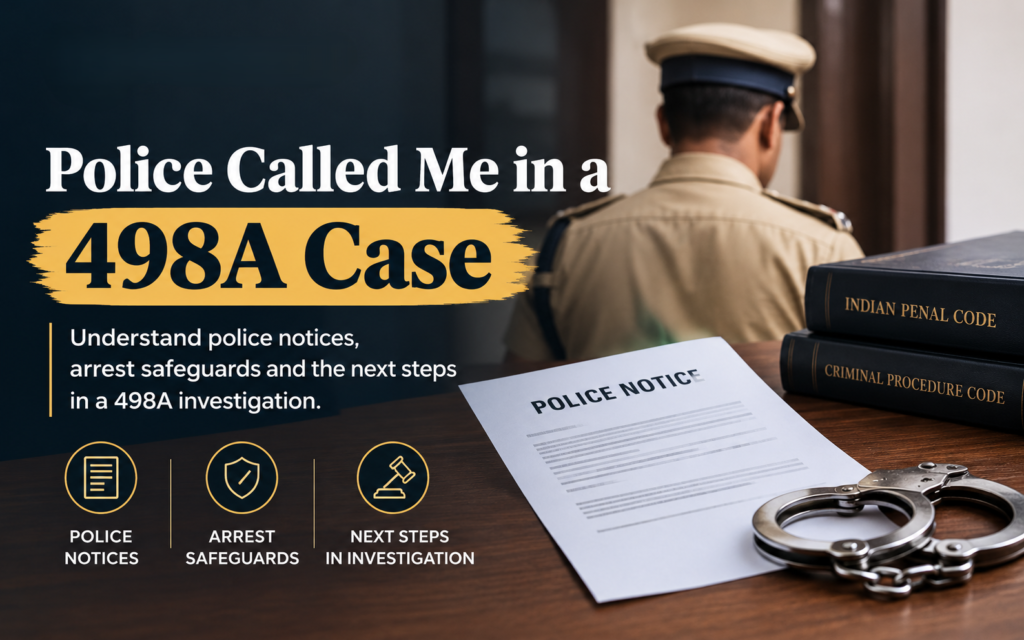
If the police called me in a 498A case, what should I do next? Understanding the police inquiry, notices under the Bharatiya Nagarik Suraksha Sanhita (BNSS), arrest safeguards and the importance of legal advice can help a person respond appropriately.
The phone rings.
“This is the Investigating Officer from the police station. Your wife has filed a complaint. Come to the station tomorrow at 11 o’clock and bring your parents.”
Your heart sinks. You have heard stories about entire families facing arrest in dowry cases. One friend tells you to “just go and settle it.” Another warns you not to go because the police might arrest you.
Your mother is crying, and you have less than 24 hours to prepare.
“Sir, should I go? Will they arrest me? Should I take my parents?”
This is one of the most frightening moments for a husband and his family. It is also when people make avoidable mistakes.
What happens when police call you to police station in a 498A case? In this article, I explain why the police may call you, what rights you have, whether they can arrest you, what documents to carry and what to say. I also explain what happens next, from the police inquiry to the chargesheet and court proceedings.
Quick Answer: What Happens When Police Call You to Police Station in a 498A Case?
In a 498A case, now covered by Section 85 of the Bharatiya Nyaya Sanhita, 2023 (BNS), the police may call the husband and his family for an inquiry, counselling at a Crime Against Women (CAW) Cell, or investigation after registering an FIR.
Arrest is not automatic. In Arnesh Kumar v. State of Bihar (Supreme Court, 2014), the Court issued directions against routine arrests in these cases. Section 35 of the Bharatiya Nagarik Suraksha Sanhita, 2023 (BNSS), also governs arrest and notices of appearance.
Ask for a written notice, consult a lawyer promptly and find out whether an FIR exists. Discuss anticipatory bail if necessary. Attend with relevant documents, remain calm and never sign a document you have not read.
1. First, Find Out Why the Police Are Calling You
Not every police call means the same thing. Before deciding what to do, establish the stage of the complaint.
Situation 1: A complaint exists, but no FIR has been registered
In Delhi and many other cities, a wife’s complaint alleging cruelty or dowry harassment may first go to the Crime Against Women (CAW) Cell for counselling and mediation.
The authorities may call both sides for sessions. This stage does not automatically mean that the police will arrest you.
Read my detailed guide on what to do when you receive a CAW Cell notice.
Situation 2: The police are conducting a preliminary inquiry
Section 173(3) BNSS allows the police, with permission from a senior officer, to conduct a preliminary inquiry into certain offences punishable with three years or more but less than seven years. The purpose is to determine whether a prima facie case exists before registering an FIR.
The article’s original legal analysis treats a 498A complaint as falling within this range. Ask your lawyer to verify the provision’s current application to the specific offences alleged in your case.
Situation 3: An FIR has been registered and the police have started an investigation
If the police register an FIR under Section 85 BNS, often alongside Sections 3 and 4 of the Dowry Prohibition Act, they may call you for questioning as an accused.
At this stage, you should take particular care. Discuss anticipatory bail with your lawyer if the circumstances warrant it.
How can you find out which situation applies?
Ask politely:
“Has an FIR been registered? Could you please provide the FIR number and a written notice?”
In many states, the police upload FIRs online. Your lawyer can check the relevant records and advise you about the next step.
2. Is 498A Bailable or Non-Bailable?
Section 85 BNS, which replaced the former Section 498A IPC, is a cognizable and non-bailable offence punishable with imprisonment of up to three years and a fine.
However, non-bailable does not mean that the court can never grant bail. It means you cannot claim bail as a matter of right at the police station. You may need to apply to the court.
That is why you should discuss anticipatory bail promptly if the police have registered an FIR and you fear arrest.
3. Can the Police Arrest You Immediately?
The police have arrest powers under the law. However, they cannot treat arrest as an automatic consequence of registering a 498A case.
In Arnesh Kumar v. State of Bihar (Supreme Court, 2 July 2014), the Supreme Court expressed concern about arrests without proper justification in 498A cases. The Court issued directions that include the following:
- No automatic arrest: Police must assess whether the law’s conditions for arrest are satisfied.
- Notice of appearance: When arrest is unnecessary, the police should issue a notice under Section 35(3) BNSS, corresponding to the former Section 41A CrPC.
- Judicial scrutiny: Magistrates must not authorise detention mechanically.
- Accountability: Officers who disregard the Court’s directions may face departmental action or contempt proceedings.
Section 35 BNSS also protects a person who complies with a notice of appearance. The police should not arrest that person for the same offence unless the officer records reasons showing why arrest has become necessary.
Your lawyer can assess whether the police have complied with these requirements in your case.
4. A Police Notice Must Follow the Prescribed Procedure
Many husbands tell me:
“Sir, the Investigating Officer sent me a WhatsApp message asking me to come to the police station.”
In Satender Kumar Antil v. CBI, in an order dated 21 January 2025, the Supreme Court addressed the service of notices under Section 41A CrPC, corresponding to Section 35 BNSS. The Court held that WhatsApp and other electronic means cannot replace the legally prescribed modes of service and directed States and Union Territories to issue standing orders accordingly.
This does not mean you should ignore a WhatsApp message or telephone call from the police.
Instead, contact your lawyer and ask for a proper written notice. Find out what the police require and respond responsibly. Ignoring the investigation altogether can make your position worse.
5. The Two-Month Cooling Period and Family Welfare Committees
In 2022, the Allahabad High Court issued guidelines for certain 498A cases. These included a two-month “cooling period” after the FIR or complaint, during which authorities should not take arrest or coercive action against the named accused, and referral to a district Family Welfare Committee to explore settlement.
In July 2025, the Supreme Court addressed these guidelines in a matter reported as 2025 INSC 883. According to the supplied article, the Court directed that the guidelines concerning Family Welfare Committees should remain in effect and that the appropriate authorities should implement them.
Implementation may vary by state, district and case. Ask your lawyer how these guidelines apply to your circumstances.
Where applicable, they may provide an important argument against hasty arrest. Do not assume, however, that a cooling period automatically protects every accused person in every 498A case.
6. Should You Go to the Police Station? Should Your Parents Go?
You should cooperate with a lawful investigation. Failure to comply with a valid notice can have serious consequences. Section 35(6) BNSS addresses the consequences of failing to comply with a notice of appearance.
However, cooperation does not mean attending unprepared.
Before you go, take these steps:
- Consult a lawyer: Speak to a matrimonial and criminal lawyer before attending, rather than waiting until after questioning.
- Discuss anticipatory bail: If an FIR exists, consider an application under Section 482 BNSS. This may be particularly important for elderly parents and relatives who live elsewhere.
- Ask for written notices: Check which family members the police have called. Do not assume that everyone must attend simply because the officer mentioned the family.
- Address health concerns: If an elderly or unwell parent cannot attend, your lawyer can request another date or appropriate arrangements, supported by medical records.
Real-life example
Arjun received a call from the Investigating Officer on Friday evening. The officer asked Arjun, his parents and his married sister to attend the police station on Monday.
His sister lived in Pune and had visited the couple only twice.
Arjun consulted a lawyer, who requested written notices. Since the police had registered an FIR, the lawyer also filed anticipatory bail applications for all four family members over the weekend.
The court granted interim protection on Monday morning. The family attended the police station that afternoon with documents, answered questions calmly and returned home.
Compare this with a family that walks into a police station in panic, without legal advice and without knowing whether an FIR exists. Preparation can make a significant difference.
7. What Should You Carry to the Police Station?
Prepare your documents before attending. Carry copies unless the police have a lawful reason to take an original document and follow the required procedure.
Use this checklist:
- The written notice and a photocopy.
- Your identity proof and identity proofs for family members who have been called.
- A copy of any anticipatory bail or interim protection order.
- A short, dated timeline of the marriage, prepared with your lawyer.
- Relevant messages, emails and call recordings stored on a pen drive, where legally appropriate.
- Proof of payments and other documents relevant to the allegations.
- Evidence showing that relatives lived separately, if that fact matters to the complaint.
- A list of stridhan items mentioned in the complaint, along with available proof of their location.
Do not casually hand over original documents. If the police need to seize an original, ask for the appropriate seizure memo or receipt.
8. What Should You Say—and What Should You Avoid Saying?
Your conduct matters. Remain calm, answer questions honestly and seek legal advice when you need it.
What you should do
- Be polite and patient. Avoid arguments with the Investigating Officer.
- Answer factual questions honestly and briefly.
- Explain that you are willing to cooperate with the investigation.
- If the matter remains at the CAW Cell stage, indicate your willingness to attend mediation where appropriate.
- Read every statement before signing it.
- Ask for a copy of any statement or document you sign, where applicable.
What you should not do
- Do not lose your temper or shout accusations at your wife in front of the officer.
- Do not make admissions merely to “end the matter quickly.”
- Never sign a blank paper.
- Do not sign a settlement or other document without reading it and discussing it with your lawyer.
- Do not offer money to anyone at the police station.
- Do not threaten, pressure or intimidate your wife or her family after receiving the call. Such conduct may lead to further allegations or legal consequences.
A calm, factual response is generally safer than an emotional argument.
9. What Happens After the Police Call?
The next step depends on whether the matter remains at the CAW Cell stage or the police have registered an FIR.
If the matter is at the CAW Cell stage
The parties may attend counselling sessions. The matter may settle, close or proceed to a recommendation for FIR registration, depending on the circumstances and applicable procedure.
Read my separate guide on what happens if mediation fails at the CAW Cell.
If the police have registered an FIR
The police investigate the allegations. They may:
- Record statements from the complainant, witnesses and accused.
- Collect documents and other evidence.
- Investigate allegations involving stridhan and seek recovery where appropriate.
- File a chargesheet under Section 193 BNSS if the evidence supports prosecution.
- Submit a closure report if they find insufficient grounds to proceed.
Your lawyer can help you understand the allegations and respond through the appropriate legal process.
What happens after the chargesheet is filed?
The Magistrate considers the police report and takes the next steps under the applicable procedure. The court may issue summons requiring you to appear.
If you have anticipatory bail, you must comply with the conditions of the order and complete any required bail formalities.
The case may then proceed through document supply, consideration of charges, evidence and final arguments. Where the law and facts permit, you may also discuss a discharge application or a petition to quash the proceedings before the High Court under Section 528 BNSS.
The right remedy depends on the allegations, the evidence and the stage of the case.
“The police have not filed a chargesheet for 18 months. What now?”
This is a common concern. Delay in investigation does not automatically end the case.
Keep records of your cooperation and comply with any bail conditions. Ask your lawyer whether a quashing petition or an application addressing the delay is appropriate in your circumstances.
Frequently Asked Questions
What happens when police call you to the police station in a 498A case?
The police may ask you to explain your side, provide documents or attend counselling. If an FIR exists, they may question you as part of the investigation. An arrest does not automatically follow a police call.
Will I be arrested if I go to the police station?
Not necessarily. Under Arnesh Kumar and Section 35 BNSS, the police must follow the applicable legal requirements before making an arrest. If you comply with a notice, the law restricts arrest unless the officer records reasons showing why it has become necessary. Anticipatory bail may provide additional protection where appropriate.
Can the police call my parents and sister?
The police may seek information from people relevant to the complaint and investigation. Ask for written notices for each person required to attend. Relatives who lived separately or had little involvement can provide supporting evidence of those circumstances.
Is a WhatsApp call or message a valid police notice?
The Supreme Court’s January 2025 ruling in Satender Kumar Antil addressed the prescribed mode of serving notices under Section 41A CrPC and Section 35 BNSS. Ask your lawyer to obtain a proper notice. Do not simply ignore contact from the police.
Should I apply for anticipatory bail?
If the police have registered an FIR and you reasonably fear arrest, discuss anticipatory bail with your lawyer immediately. This is especially important when elderly parents or relatives also face allegations. Whether you should apply depends on the facts and the stage of the case.
What happens after the chargesheet is filed in a 498A case?
The court considers the police report and follows the applicable procedure. You may receive summons, attend court and complete the required bail formalities. The case may then proceed to consideration of charges, evidence and judgment. Discharge or quashing may remain options in appropriate cases.
Can a 498A case be settled?
Section 85 BNS is non-compoundable. However, where the parties have genuinely settled their dispute, the High Court may consider quashing the proceedings under Section 528 BNSS, subject to the facts and applicable law.
Adv. Aman Chawla’s Practical Note
A police call is not the end of the world. It marks the start of a legal process, and the first 48 hours can matter more than people realise.
Families that remain calm, establish whether an FIR exists, seek prompt legal advice and prepare their documents are better placed to respond. By contrast, panic, arguments, signing papers without reading them or disappearing from the investigation can make matters worse.
Treat the police with respect. Assert your rights politely, and let your documents support your position.
Final Words
A 498A complaint is serious, but the law provides safeguards against hasty arrests. These include the directions in Arnesh Kumar, the requirements under Section 35 BNSS, the prescribed procedure for notices and any applicable safeguards concerning cooling periods or Family Welfare Committees.
Understand your rights and prepare before attending the police station. With proper legal advice and the right documents, you can approach the inquiry more confidently.
Consult Adv. Aman Chawla, Matrimonial Law Specialist, practising before the Supreme Court of India, Delhi High Court and all Delhi District Courts. He is available for urgent matters, outstation clients and online consultations across India.
Call: +91-8076836899
WhatsApp: Contact through the same number
Email: info@thematrimoniallawyers.com
Office: O-11A Basement, Jangpura Extension, New Delhi – 110014
Written by Adv. Aman Chawla. This article is for informational purposes only and does not constitute legal advice. Every case is fact-specific. The examples are illustrative, and names and details have been changed or simplified. Please consult a qualified lawyer before taking legal action.