Written by Adv. Aman Chawla | Matrimonial Law Specialist | Delhi High Court & Supreme Court of India | 8 Years Exclusive Practice in Family & Matrimonial Law | Jangpura, New Delhi
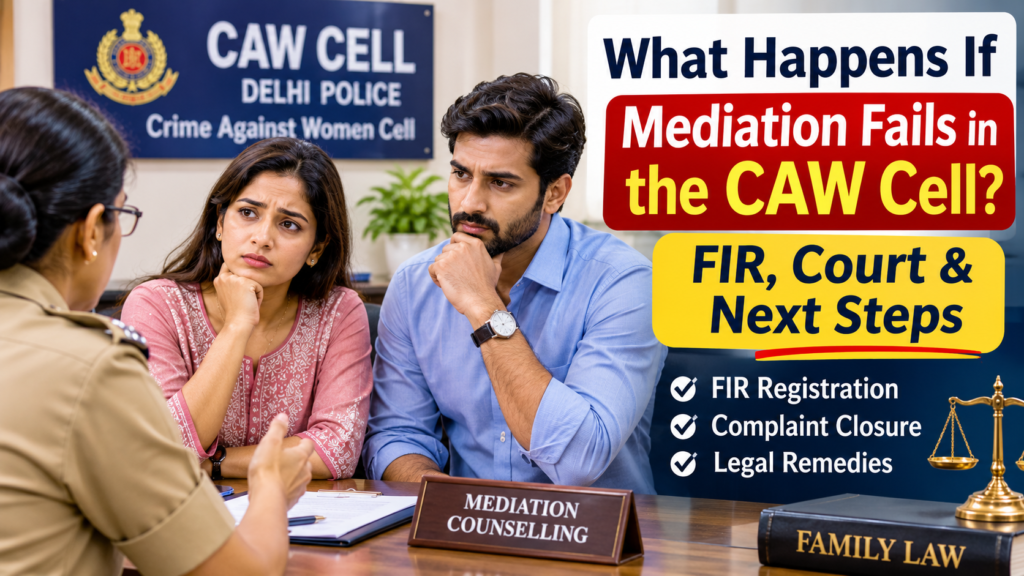
CAW Cell mediation plays an important role in resolving matrimonial complaints in Delhi. But what happens when CAW Cell mediation fails? The next step may involve FIR registration, complaint closure, further inquiry or court proceedings, depending on the allegations and available evidence.
After three or four counselling dates at the CAW Cell, the counsellor finally says the words both sides were dreading: “There is no possibility of settlement.”
For the wife, the question is: “Sir, now will the police finally register my FIR?”
For the husband and his family, the question is: “Sir, will we be arrested now?”
I deal with both sides of this moment regularly in Delhi, from Nanakpura to Rohini, Saket and Shahdara. What happens next is far less automatic than people think. Failed mediation does not end the process. Instead, it marks a turning point where the right next step can make a big difference.
This article explains the CAW Cell procedure, the possible outcomes when mediation fails, and the steps each side can take. It also covers the mistakes people should avoid at this stage.
Quick Answer
What happens if mediation fails in the CAW Cell? The officer examines the complaint and the material collected. The officer may recommend registration of an FIR, usually under Section 85 BNS (the old Section 498A IPC). The complaint may also involve Section 316 BNS for stridhan and the Dowry Prohibition Act.
Alternatively, the officer may close the complaint if the material does not disclose a cognizable offence. An FIR does not mean automatic arrest.
If the police do not act, the wife can approach the Magistrate. Both sides can also pursue civil remedies, including maintenance, a DV case, divorce, custody or a negotiated settlement through court-annexed mediation.
1. What Is the CAW Cell and Why Does It Try Mediation First?
CAW stands for Crime Against Women. In Delhi, the district CAW Cell usually receives complaints involving matrimonial cruelty and dowry harassment first. Trained officers and counsellors call both parties and try to resolve the dispute.
Why not register an FIR immediately?
In Lalita Kumari v. Government of U.P. (Supreme Court Constitution Bench, 2013), the Court held that police must register an FIR when information discloses a cognizable offence. However, the Court also recognised that officers may conduct a limited preliminary inquiry in certain categories of cases, including matrimonial and family disputes.
CAW Cell counselling forms part of this approach. Today, Section 173(3) BNSS also allows a preliminary enquiry, with permission from a senior officer, for offences punishable with three years or more but less than seven years.
The idea is simple: many matrimonial disputes can be settled or at least calmed before criminal law enters the picture.
For more details about the process, read our guide on how to file a complaint at the CAW Cell in Delhi.
2. What Happens When Mediation Fails: The Three Possible Outcomes
Outcome 1: FIR Is Recommended and Registered
If the CAW Cell finds that the complaint and supporting material disclose a cognizable offence, it recommends registration of an FIR. The police station concerned then registers the FIR and begins the investigation.
Outcome 2: The Complaint Is Closed or Filed
The officer may close the complaint if the dispute appears purely civil. For example, the dispute may concern only where the parties should live or who should keep the flat. The officer may also close it if the allegations lack supporting material.
The wife should be informed of the outcome.
Outcome 3: The Complaint Remains Pending or Goes Elsewhere
Sometimes, the officer keeps the complaint pending for further inquiry. The parties may also receive a referral to court-annexed mediation or another forum.
This can happen when both sides indicate that they still want to explore settlement on certain terms.
Real-life example: Ankita and Varun
Ankita and Varun attended four sessions at the CAW Cell. Varun agreed to return her jewellery but refused to pay a lump sum.
Ankita’s lawyer insisted that the parties record the jewellery return in writing. The lawyer also asked the officer to decide the remaining allegations separately.
Varun returned the jewellery against a signed inventory. Mediation on the remaining issues failed, and the CAW Cell recommended an FIR for cruelty. Since the parties had already resolved the stridhan issue, the criminal case that followed became narrower and simpler.
3. If You Are the Wife: Your Next Steps
If an FIR Is Registered
- Cooperate with the investigating officer. Give your statement and submit copies of your evidence.
- Keep a record of your stridhan list and any recovery.
- Remember that the criminal case does not provide maintenance by itself. File a separate maintenance case if you have not already done so.
If the Police Do Not Register an FIR
If you believe the complaint discloses a cognizable offence but the police have not acted, you can take these steps:
- Approach the Superintendent of Police or Deputy Commissioner of Police in writing.
- Apply to the Magistrate under Section 175(3) BNSS (old Section 156(3) CrPC). You can seek a direction to register an FIR and investigate. Under the BNSS, you should first approach the senior police officer. Keep a copy of that complaint.
- File a private complaint before the Magistrate.
Pursue Civil Remedies at the Same Time
Whatever happens on the criminal side, your civil rights remain separate.
You may consider:
- Maintenance under Section 144 BNSS or Section 24 HMA.
- Protection, residence, custody and monetary relief under the DV Act.
- Return of stridhan under Section 19(8) of the DV Act.
- Divorce or judicial separation, if you have decided that the marriage is over.
4. If You Are the Husband or His Family: Your Next Steps
Find Out the Outcome in Writing
Do not rely on what someone tells you over the phone. Ask your lawyer to check whether the CAW Cell has closed the complaint or whether the police have registered an FIR.
If the police have registered an FIR, obtain its number and a copy.
If you have received a CAW Cell notice, read our separate guide: CAW Cell Notice Received: What Should the Husband Do?.
If an FIR Is Registered, Act Immediately
- Consider anticipatory bail for yourself and named relatives, especially elderly parents and relatives who lived separately.
- Remember that arrest is not automatic. Under Arnesh Kumar v. State of Bihar (Supreme Court, 2014) and Section 35 BNSS, the police should ordinarily issue a notice of appearance in such cases rather than arrest.
- In July 2025, the Supreme Court (2025 INSC 883) directed that the Allahabad High Court’s guidelines on a cooling period and Family Welfare Committees in 498A cases remain in effect and be implemented by the authorities. Ask your lawyer how these guidelines apply in your district. Supreme Court judgment search: 2025 INSC 883
I have also written a detailed guide on what to do when the police call you to the station in a 498A case.
You can also read about 498A arrest after FIR under Section 85 BNS.
Keep the Door to Settlement Open
Failed CAW Cell mediation does not mean the parties can never settle. Many cases settle later through court-annexed mediation or after the court passes maintenance orders.
If the parties reach a genuine settlement after an FIR, the High Court can quash the proceedings under Section 528 BNSS.
5. What Is Said in CAW Cell Mediation: Can It Be Used Against You?
People often worry that the police or the court will use their counselling statements against them.
The CAW Cell records the complaint, replies and outcome. Formal mediation communications generally receive confidentiality protection. However, a written reply or document you submit to the police becomes part of the record.
So my advice is simple: speak sincerely, but do not make admissions you would not make in court. Also, do not submit written replies without legal advice.
6. Common Mistakes at This Stage
Not Attending CAW Cell Dates
Repeated absence can harm your position. It may also make the officer more likely to recommend an FIR based on the complainant’s version alone.
Settling Verbally
Record every settlement in writing. Even a partial settlement, such as the return of jewellery, should include a signed record.
Sending Threats After Mediation Fails
Messages to the other side’s family can become fresh evidence of harassment. Avoid threats, abusive messages and angry calls.
Assuming “Closed” Means “Finished”
If the CAW Cell closes the complaint, the wife can still approach the Magistrate or file civil cases. If the police register an FIR, the husband can still seek quashing on merits or on the basis of a genuine settlement.
Ignoring the Civil Side
The criminal case does not decide maintenance, custody or divorce. Both sides need a separate plan for these issues.
Real-life example: Rohit and Neha
After mediation failed, Rohit’s mother called Neha’s father and said, “Withdraw this or you will regret it.”
Neha’s family recorded the call. That recording later made it much harder for Rohit’s parents to obtain anticipatory bail because the call appeared to show intimidation.
Rohit had a reasonable defence against the original allegations. However, the call after mediation became the most damaging piece of evidence in the case.
Frequently Asked Questions
Q: What happens if mediation fails in the CAW Cell?
A: The CAW Cell may recommend registration of an FIR if the complaint discloses a cognizable offence. It may close the complaint if it does not. Sometimes, the officer keeps the matter pending or refers the parties for further mediation.
Q: Will the husband be arrested after CAW Cell mediation fails?
A: Not automatically. Even if the police register an FIR, Arnesh Kumar and Section 35 BNSS govern arrest in 498A cases. Consider anticipatory bail after an FIR, based on the facts and legal advice.
Q: How many dates does the CAW Cell give?
A: There is no fixed number. Usually, the CAW Cell holds a few counselling sessions over several weeks before the officer decides the next step.
Q: The CAW Cell closed my complaint. What can I do?
A: You can approach the senior police officer and then the Magistrate under Section 175(3) BNSS. You can also file a private complaint and pursue civil remedies, such as maintenance and a DV case.
Q: Can we settle after an FIR is registered?
A: Yes. Many cases settle later. Since Section 85 BNS is non-compoundable, the High Court can quash the case under Section 528 BNSS on the basis of a genuine settlement.
Q: Is it compulsory to go to the CAW Cell when called?
A: You should attend. Non-attendance is not a crime in itself. However, it can harm your position and may lead to an FIR based on the other side’s version alone.
Q: What documents should I take to the CAW Cell?
A: Carry your ID proof, the notice, a short timeline, and copies of relevant messages and documents. The wife should also carry a stridhan list. The husband should carry proof of the articles’ whereabouts, where relevant.
Adv. Aman Chawla’s Practical Note
I always tell clients that the CAW Cell offers one of the quickest and least expensive opportunities to resolve a matrimonial dispute. It is also a stage where people can cause avoidable damage to their own cases.
If mediation fails, do not panic and do not celebrate. Find out the exact outcome, take immediate legal steps on the criminal side, and prepare a proper plan for the civil side.
And whatever you do, do not send that angry message after the last session. I have seen it change the entire course of a case.
Final Words
A failed mediation at the CAW Cell is not the end of the road for either side. It marks the point where the dispute may move into a more formal phase: an FIR, a closure or court proceedings.
Knowing the possible outcomes and acting correctly in the next few days can help protect your rights, whichever side you are on.
Consult Adv. Aman Chawla, Matrimonial Law Specialist, practising before the Supreme Court of India, Delhi High Court and all Delhi District Courts. Available for urgent matters, outstation clients and online consultations across India.
Call: +91-8076836899 | WhatsApp | Email: info@thematrimoniallawyers.com
Office: O-11A Basement, Jangpura Extension, New Delhi – 110014
Written by Adv. Aman Chawla. This article is for informational purposes only and does not constitute legal advice. Every case is fact-specific. The examples in this article are illustrative, and names and details have been changed or simplified. Please consult a qualified lawyer before taking any legal action.