Written by Adv. Aman Chawla | Matrimonial Law Specialist | Delhi High Court & Supreme Court of India
8 Years Exclusive Practice in Family & Matrimonial Law | Jangpura, New Delhi
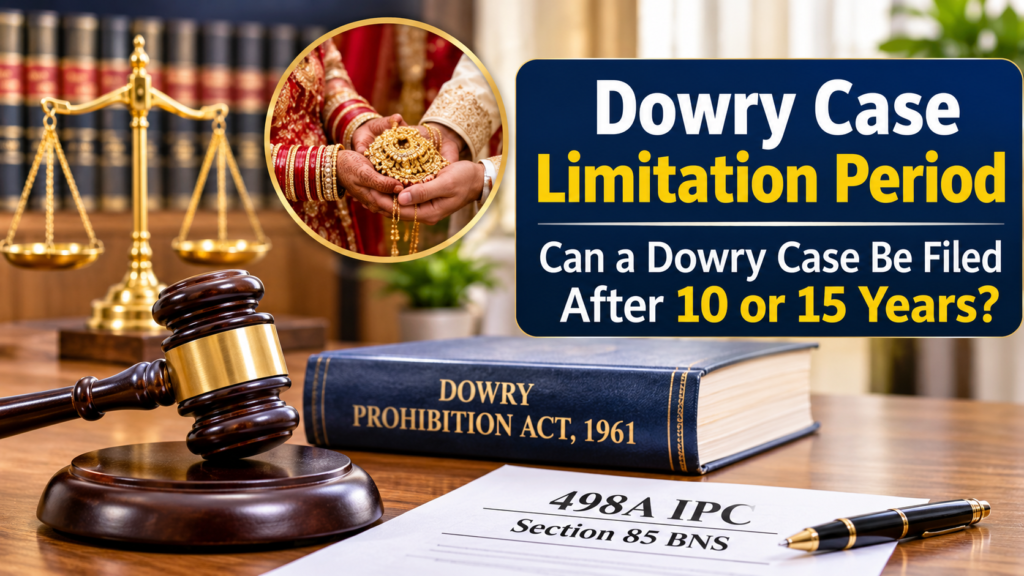
The dowry case limitation period in India depends on the nature of the alleged offence, the applicable legal provisions and the facts of the case.
“Sir, I have been married for 15 years. I tolerated everything for my children. Can I still file a dowry case now, or is it too late?”
And from the other side:
“Sir, we separated eight years ago and the divorce is over. Now she has filed a 498A case against my whole family. Isn’t there a time limit?”
Both questions are about the same thing: limitation, the time within which a criminal case must be started. It is one of the most misunderstood topics in matrimonial law. Some people think there is no time limit at all; others think anything older than three years is automatically dead. Both are wrong.
This article explains, in simple language, the time limits for 498A (now Section 85 BNS), dowry offences, stridhan cases and DV cases, how the clock is counted, when courts allow delay, and what both wives and husbands should know.
Quick Answer
For cruelty under Section 85 BNS (old 498A IPC), which is punishable with up to three years, the limitation period is three years under Section 514 BNSS (old Section 468 CrPC). But cruelty is treated as a continuing offence, so the three years are counted from the last act of cruelty, and the relevant date is the date the complaint is filed, not the date the court takes cognizance. Courts can also extend time where the delay is explained and it is in the interest of justice. Some dowry offences carry no limitation at all, and an application under the DV Act for reliefs like maintenance or residence has no limitation. So a dowry case after 10 or 15 years of marriage is not automatically barred; what matters is when the last act happened and how well the delay is explained.
1. First, Is a Dowry Case Criminal or Civil?
Both are possible.
- Criminal: cruelty (Section 85 BNS, old 498A), dowry demand or giving and taking dowry (Dowry Prohibition Act, 1961), criminal breach of trust for stridhan (Section 316 BNS, old 406 IPC), and dowry death (Section 80 BNS, old 304B).
- Civil-type reliefs: maintenance, residence, protection orders and return of stridhan under the DV Act, and recovery of stridhan through civil or family court proceedings.
The time limits are different for each, which is why the question “what is the limitation for a dowry case?” has more than one answer.
2. How Limitation Works in Criminal Cases
Section 514 BNSS (which replaced Section 468 CrPC) sets the limitation for taking cognizance based on the maximum punishment of the offence:
- Offence punishable with fine only: 6 months
- Imprisonment up to 1 year: 1 year
- Imprisonment more than 1 year but up to 3 years: 3 years
- Imprisonment more than 3 years: no limitation under this section
So the first question is always: what is the maximum punishment for the offence alleged?
3. Limitation for 498A / Section 85 BNS
Cruelty under Section 85 BNS is punishable with up to three years and fine. So the limitation is three years. But three important rules change how this works in practice.
Rule 1: Cruelty is a continuing offence
In Arun Vyas v. Anita Vyas (Supreme Court, 1999), the Court treated cruelty under 498A as a continuing offence, where each act of cruelty gives a fresh starting point for limitation. The three years are counted from the last act of cruelty, not from the date of marriage or the first incident.
In Musin Babulal Thengade v. State of Maharashtra (Bombay High Court, January 2025), the Court applied Arun Vyas and held that limitation for 498A commences from the last act of cruelty, while also noting that limitation does not run indefinitely.
What this means: a wife married for 15 years who faced cruelty right up to last year can file now. The question is not “how long ago did you marry?” but “when was the last act of cruelty?”
Rule 2: The date of filing the complaint is what counts
In Sarah Mathew v. Institute of Cardio Vascular Diseases (Supreme Court Constitution Bench, 2013), the Court held that for computing limitation, the relevant date is the date of filing the complaint or instituting the prosecution, not the date on which the Magistrate takes cognizance.
In a June 2025 judgment (2025 INSC 803), the Supreme Court applied this to a 498A case between two Delhi Police Sub-Inspectors. The wife’s last allegations related to 1999, and she filed her complaint with the CAW Cell in July 2002, within three years. The Court held the complaint was not time-barred even though cognizance was taken later. (The Court nevertheless quashed the case on merits, finding the allegations generic and unsupported, and noting the divorce had long become final.)
Rule 3: Courts can extend time
Section 519 BNSS (old Section 473 CrPC) allows the court to take cognizance after the limitation period if it is satisfied that the delay has been properly explained or that it is necessary in the interest of justice. The Supreme Court has said that in 498A matters, which are offences against society, limitation should be construed liberally, but any condonation must be justified and shown in the court’s order.
Real-life example: Seema faced years of taunts and demands. In 2023, she moved to her parents’ home after a final incident where her husband threw her out at night. She filed her complaint in 2025. Even though she had been married since 2008, her complaint is within limitation because the last act of cruelty was in 2023 and she filed within three years of it.
4. Limitation for Dowry Prohibition Act Offences
- Section 3 (giving or taking dowry): punishable with a minimum of five years. Since the punishment exceeds three years, there is no limitation under Section 514 BNSS.
- Section 4 (demanding dowry): punishable with six months to two years. The limitation is three years, counted from the demand.
- Section 6 (failure to transfer dowry to the woman): this is closely connected to stridhan and continues until the property is transferred to her, so timing has to be looked at on the facts.
5. Limitation for Stridhan Cases (Section 316 BNS / Old 406 IPC)
Under the old IPC, criminal breach of trust under Section 406 was punishable with up to three years, so a three-year limitation applied. Under the BNS, the basic punishment for criminal breach of trust under Section 316(2) extends to five years, which takes it outside the three-year limit in Section 514 BNSS. Offences committed before 1 July 2024 are generally governed by the old law, so the date of the refusal to return matters.
In practice, the trigger is usually a demand for return and a refusal. That is why I always advise a written demand.
But delay still matters, even where there is no strict bar. In Mulakala Malleshwara Rao v. State of Telangana (Supreme Court, August 2024), the Court quashed a stridhan FIR filed by the woman’s father more than 20 years after her marriage and years after a divorce settlement, calling it hopelessly belated and noting there was no proof of entrustment or misappropriation.
6. Limitation for DV Act Cases
This is very important and often missed. In Kamatchi v. Lakshmi Narayanan (Supreme Court, 2022), the Court held that the limitation under Section 468 CrPC does not apply to an application under Section 12 of the DV Act for reliefs like protection, residence, maintenance or compensation. Limitation applies only to the offence of breaching a protection order under Section 31.
So even if a criminal complaint is time-barred, a woman may still seek reliefs under the DV Act, subject to showing a domestic relationship and acts of domestic violence on the facts. Read more about the right to residence under the DV Act.
7. Dowry Death and Serious Offences
Dowry death under Section 80 BNS (old 304B) and abetment of suicide carry punishments far above three years, so there is no limitation under Section 514 BNSS.
8. For Husbands: When Does Delay Help You?
Delay is a genuine defence when:
- The last specific act of cruelty alleged is more than three years before the complaint, and the delay is not explained.
- The complaint is filed long after separation or divorce, with only general allegations, especially against relatives who lived elsewhere.
- A full and final settlement covered all claims.
- The complaint appears to be a counterblast to your divorce petition or other proceedings.
In such cases, your lawyer can raise limitation and delay at the stage of cognizance, discharge or a quashing petition under Section 528 BNSS. But do not assume a case is dead just because the marriage is old. The court will look for the last act alleged and the explanation for delay. If you are facing allegations, read our guide on what to do if a false 498A case is filed against you.
9. For Wives: How to Protect Your Complaint
- Write down a dated timeline, especially the most recent incidents.
- Preserve recent evidence: messages, call recordings, medical records, police calls.
- If there has been a long gap, explain it honestly in your complaint: fear, children, attempts at reconciliation, family pressure.
- Make a written demand for your stridhan and keep proof of the refusal.
- Remember the DV Act route, which has no limitation for reliefs.
For information about the complaint process, see our guide on how to file a complaint at the CAW Cell in Delhi.
Frequently Asked Questions
Q: What is the limitation period for a dowry case in India?
A: It depends on the offence. For cruelty under Section 85 BNS (old 498A), it is three years from the last act of cruelty. For giving or taking dowry under Section 3 of the Dowry Prohibition Act and for dowry death, there is no limitation. DV Act applications for reliefs have no limitation.
Q: Can a dowry case be filed after 15 years of marriage?
A: Yes, if the last act of cruelty or demand is within the limitation period, or the delay is explained and the court extends time. The length of the marriage itself is not the test.
Q: Can a 498A case be filed after divorce?
A: It can be filed, but courts examine it closely, especially if it relates to acts long before the divorce and has only general allegations. Limitation and delay are strong defences in such cases.
Q: Is the date of FIR or date of court cognizance used for limitation?
A: The date of filing the complaint or instituting the prosecution, as held by the Supreme Court Constitution Bench in Sarah Mathew.
Q: Can the court accept a late complaint?
A: Yes. Under Section 519 BNSS (old 473 CrPC), the court can extend time if the delay is properly explained or it is in the interest of justice.
Q: Is there any time limit for filing a DV case?
A: Not for an application under Section 12 of the DV Act seeking reliefs, as held in Kamatchi v. Lakshmi Narayanan (2022).
Q: Is a dowry case criminal or civil?
A: Dowry offences and cruelty are criminal. But many related reliefs, like maintenance, residence and return of stridhan, can be sought in civil-type proceedings under the DV Act or family law.
Adv. Aman Chawla’s Practical Note
In limitation questions, I always ask clients one simple thing first: “Tell me the last incident, with the date.”
For wives, that last incident is the anchor of the complaint. For husbands, it is the first thing your defence must test. Most limitation arguments are won or lost on that one date and on how honestly the delay is explained.
So do not rely on rumours like “after three years nothing can happen” or “there is no limit for dowry cases”. The truth is in between, and it depends on your facts.
Final Words
A long marriage does not close the door to justice, and an old dispute does not automatically mean an old case is valid. The law balances both: cruelty is a continuing offence, the filing date counts, courts can condone genuine delay, and some remedies have no limitation at all. At the same time, belated and vague complaints are examined strictly and can be quashed.
Understand where your case stands on this timeline, and you will make much better decisions.
Consult Adv. Aman Chawla, Matrimonial Law Specialist, practicing before the Supreme Court of India, Delhi High Court, and all Delhi District Courts. Available for urgent matters, outstation clients, and online consultations across India.
Call: +91-8076836899 | WhatsApp | Email: info@thematrimoniallawyers.com
Office: O-11A Basement, Jangpura Extension, New Delhi – 110014
Written by Adv. Aman Chawla. This article is for informational purposes only and does not constitute legal advice. Every case is fact-specific. The examples in this article are illustrative and names and details have been changed or simplified. Please consult a qualified lawyer before taking any legal action.