Written by Adv. Aman Chawla | Matrimonial Law Specialist | Delhi High Court & Supreme Court of India 8 Years Exclusive Practice in Family & Matrimonial Law | Jangpura, New Delhi
“Sir, I just found out my husband got a divorce decree last year. I never received any notice.”
“Sir, the police came with a warrant for ₹2.4 lakh maintenance arrears. I didn’t even know a case had been filed against me.”
“Ex-parte” means an order passed in the absence of one party. In matrimonial cases, it happens more often than people think: summons sent to an old address, a party working in another city, a notice refused by a family member, or simply a person who ignored the case hoping it would go away.
The good news is that an ex-parte order is not always final. The law gives specific remedies to set it aside. The bad news is that the time limits are short and the courts are strict about them.
This article explains how to set aside an ex-parte divorce decree and an ex-parte maintenance order, the time limits, what “sufficient cause” means, and the mistakes to avoid.
Quick Answer
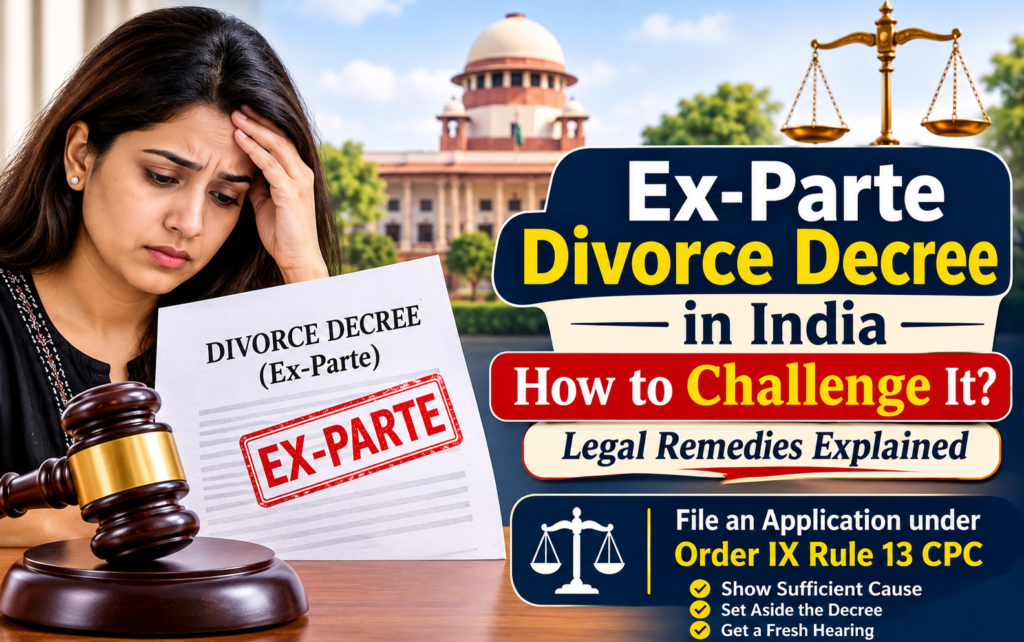
An ex-parte divorce decree from a Family Court can be challenged by an application under Order IX Rule 13 of the Code of Civil Procedure (usually within 30 days of the decree, or from the date of knowledge if summons were not duly served), and/or by an appeal. You must show either that summons were not duly served or that you were prevented by sufficient cause from appearing. An ex-parte maintenance order under Section 144 BNSS (old Section 125 CrPC) can be set aside on good cause shown on an application made within three months of the order. Act immediately; delay is the biggest reason these applications fail.
1. How Do Ex-Parte Orders Happen in Matrimonial Cases?
Common situations I see:
- The summons were sent to the matrimonial home after the wife had left, or to an old address of the husband.
- A family member refused or accepted the notice and never told the party.
- The party was working abroad or in another city.
- Service was done by publication in a newspaper the party never saw.
- The party knew of the case but stopped appearing, thinking it was not important.
The last situation is very different from the others. Courts are far more sympathetic to someone who genuinely did not know than to someone who chose not to appear.
2. Ex-Parte Divorce Decree: Your Remedies
Remedy 1: Application under Order IX Rule 13 CPC
Family Courts follow the civil procedure. Under Order IX Rule 13, a defendant against whom an ex-parte decree is passed can apply to the same court to set it aside by showing that:
- The summons was not duly served, or
- They were prevented by sufficient cause from appearing when the case was called for hearing.
There is an important limitation in the second proviso to Rule 13: the court will not set aside the decree merely because there was an irregularity in service, if it is satisfied that the defendant had notice of the hearing date and enough time to appear.
Remedy 2: Appeal
An appeal also lies against an ex-parte decree. In Bhanu Kumar Jain v. Archana Kumar (Supreme Court, 2005), the Court held that filing an appeal does not bar an application under Order IX Rule 13, but findings in one proceeding may affect the other, and pursuing both at the same time can lead to conflicting results. Your lawyer will decide which route is better on your facts, or the sequence in which to use them.
Time limits
- An application under Order IX Rule 13 must ordinarily be filed within 30 days from the date of the decree, or, where the summons was not duly served, within 30 days from the date you came to know of the decree (Article 123 of the Limitation Act, 1963).
- Delay can sometimes be condoned, but you must explain each day convincingly.
- Appeals against Family Court decrees have their own short limitation period. In Delhi, the High Court has held it to be 30 days.
3. What Is “Sufficient Cause”?
Courts have accepted causes such as:
- Serious illness or hospitalisation on the hearing date, with medical records
- Not receiving the summons at all, where service was on a wrong or old address
- Being abroad with no knowledge of the case
- A genuine mistake by the lawyer about the date, supported by facts
Courts usually do not accept:
- “I was busy” or “I didn’t think it was important”
- Repeated absence over many dates
- Refusing to accept a notice and then claiming no service
In Parimal v. Veena (Supreme Court, 8 February 2011), the husband had obtained an ex-parte divorce decree, and the wife later sought to set it aside, alleging improper service. The Supreme Court held that procedural irregularities alone do not justify setting aside an ex-parte decree; the applicant must show sufficient cause. The Court relied on the presumption that a letter sent by registered post to the correct address is received, which can be rebutted only by strong evidence, and restored the ex-parte decree.
Real-life example: Rekha’s husband filed for divorce in Rohini and sent summons to her parents’ house in Lucknow, where she had stayed for two months. By then she had moved to Pune for a job, and her brother signed for the registered letter but never told her. The court passed an ex-parte decree. Rekha found out eight months later when her husband’s remarriage photos appeared online. She applied within days of finding out, showing her Pune rent agreement, her employment letter and an affidavit from her brother. Her application has a real chance because she acted immediately on learning of the decree and can show she genuinely did not know. Compare this with a party who signed for the summons personally and then claims ignorance.
4. What If the Other Spouse Has Already Remarried?
This is a real complication. If an ex-parte divorce decree has been passed and the appeal period has passed, the other spouse may have remarried. Courts then weigh the consequences carefully. I have discussed remarriage and Section 15 of the Hindu Marriage Act in a separate article on when you can remarry after divorce. The lesson is the same: move quickly the moment you learn of an ex-parte decree.
5. Ex-Parte Maintenance Order: Your Remedy
Under Section 144 BNSS (old Section 125 CrPC), if the Magistrate is satisfied that the person against whom maintenance is sought is wilfully avoiding service or wilfully neglecting to attend, the case can be decided ex-parte. But the law provides that such an order may be set aside for good cause shown on an application made within three months from the date of the order, on terms (including costs) the Magistrate thinks just.
Practically:
- File the application within three months of the order, with an affidavit explaining why you did not appear.
- Attach proof: address change, employment elsewhere, medical records, proof of non-receipt.
- Be ready to pay some costs or deposit part of the amount; courts often impose such terms.
- Ask for the execution or recovery proceedings to be stayed while the application is decided.
Real-life example: Sandeep was posted in Guwahati when his wife filed for maintenance in Delhi. Notices went to his old Delhi flat, which he had vacated. An ex-parte order of ₹25,000 a month was passed. Six weeks later, his salary account received an attachment notice. He applied immediately under the proviso, showing his transfer order and new rent agreement. The Magistrate set aside the ex-parte order on the condition that he deposit two months’ maintenance as interim payment, and the case was heard afresh on merits.
6. Ex-Parte Orders in DV Cases
Magistrates can also pass ex-parte interim orders under the DV Act, especially protection orders in urgent situations. These can be challenged by appearing and seeking modification or vacation of the order, or by appeal where available. The same principles apply: act quickly and show genuine reasons.
7. Common Mistakes
- Waiting after finding out: Every day after knowledge counts against you.
- Filing without proof: “I didn’t get the notice” needs documents: address proofs, postal records, employment records.
- Attacking the other side instead of explaining yourself: The application is about why you could not appear, not about who is right in the marriage.
- Ignoring execution: If maintenance recovery has started, seek a stay at the same time.
- Choosing the wrong remedy: Appeal and Order IX Rule 13 have different scopes. Take advice before filing.
Frequently Asked Questions
Q: My spouse got a divorce without my knowledge. Is it valid?
A: An ex-parte decree is valid until it is set aside. You can apply under Order IX Rule 13 CPC and/or appeal, showing non-service or sufficient cause.
Q: What is the time limit to set aside an ex-parte divorce decree?
A: Usually 30 days from the decree, or from the date of knowledge if summons were not duly served (Article 123, Limitation Act). Delay may be condoned only with a convincing explanation.
Q: How do I set aside an ex-parte maintenance order?
A: Apply to the same Magistrate within three months of the order, showing good cause for your absence. The court may impose terms such as costs or an interim deposit.
Q: Can an ex-parte decree be set aside just because of a defect in service?
A: Not if the court is satisfied that you had notice of the hearing and enough time to appear (second proviso to Order IX Rule 13).
Q: Can I file an appeal and an Order IX Rule 13 application together?
A: The Supreme Court in Bhanu Kumar Jain held that both remedies exist but warned that pursuing both together can lead to conflicting results. Take advice on sequencing.
Q: Will setting aside the ex-parte order mean I win the case?
A: No. It only reopens the case so that you can be heard. The case is then decided on merits.
Adv. Aman Chawla’s Practical Note
In ex-parte matters, the clock is your biggest enemy. I have seen strong applications fail only because the client waited two months after learning of the order, trying to “sort it out” privately.
The day you learn of an ex-parte divorce decree or maintenance order, get the certified copy, collect proof of where you were and why you did not know, and file. Courts are generous to people who move fast and honestly; they are strict with those who sat on their rights.
Final Words
An ex-parte order can feel like a door slammed shut, but it often is not. The law gives you a way back in, provided you use it on time and with honest, documented reasons. Act quickly, choose the right remedy, and make sure your side of the story is finally heard.
Consult Adv. Aman Chawla, Matrimonial Law Specialist, practicing before the Supreme Court of India, Delhi High Court, and all Delhi District Courts. Available for urgent matters, outstation clients, and online consultations across India.
Call: +91-8076836899 | WhatsApp | Email: info@thematrimoniallawyers.com Office: O-11A Basement, Jangpura Extension, New Delhi – 110014
Written by Adv. Aman Chawla. This article is for informational purposes only and does not constitute legal advice. Every case is fact-specific. The examples in this article are illustrative and names and details have been changed or simplified. Please consult a qualified lawyer before taking any legal action.