Written by Adv. Aman Chawla | Matrimonial Law Specialist | Delhi High Court & Supreme Court of India | 8 Years Exclusive Practice in Family & Matrimonial Law | Jangpura, New Delhi
NRI mutual divorce without coming to India can save spouses the time and expense of repeated international travel. However, proper documentation, an apostilled SPA and compliance with the family court’s directions remain important. Take legal advice before filing to understand the procedure applicable to your circumstances.
“Sir, my wife and I both agree to divorce. I live in Canada and can’t take two months off to come to Delhi. Can it be done without me?”
This is one of the most common questions NRIs ask me. The answer is yes. In fact, if the couple follows the correct procedure, the NRI spouse may not need to travel to India at all.
Quick Answer
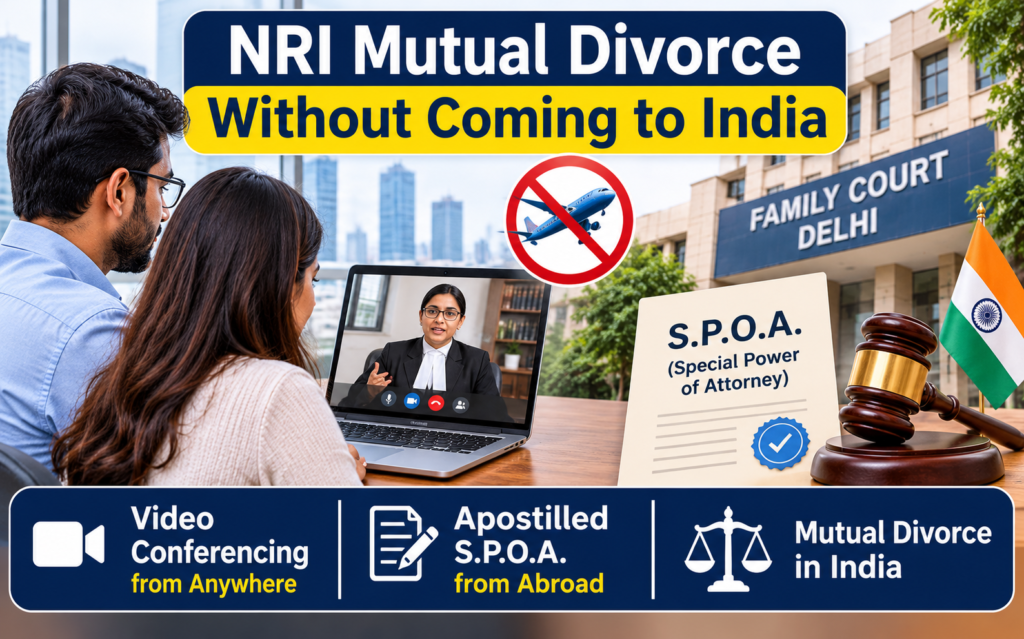
Yes. An NRI can get a mutual divorce under Section 13B of the Hindu Marriage Act without coming to India. Indian family courts may allow the first and second motion statements through video conferencing or through a Special Power of Attorney (SPA) holder. The SPA should be held by a blood relative and must carry the required apostille.
Also, if the couple has already lived apart for 18 months or more, the court may waive the 6-month waiting period. In such cases, the divorce may take around 30 to 50 days, depending on the court and the circumstances.
Facing this right now? Call or WhatsApp +91 80768 36899 for a consultation.
For the wider picture, start with my NRI divorce guide.
Can an NRI get a mutual divorce without travelling to India?
Yes. An NRI can complete a mutual divorce in India without travelling here. The process requires two statements before the family court: the first motion and the second motion. However, the NRI spouse does not always need to appear physically for either statement.
I have personally appeared in all Delhi district courts for such matters. I have also appeared in Agra, Bengaluru, Mumbai, Gurugram, Faridabad, Noida, Jaipur, Udaipur and a few other cities. So far, I have not encountered any problem with this route.
Can both motions be done by video conferencing?
Yes. In my experience, Delhi courts usually allow both the first and second motions through video conferencing or through an SPA holder. As a result, the court may not insist on the NRI’s personal presence in India. The entire matter may proceed through video conferencing, subject to the court’s directions.
The Supreme Court laid the foundation for this approach in Amardeep Singh v. Harveen Kaur (12 September 2017). The Court said family courts can use video conferencing. It also recognised that courts may permit “genuine representation of the parties through close relations”, such as parents or siblings, when a party cannot appear in person for a just and valid reason.
What can a power of attorney holder do?
A Special Power of Attorney allows a trusted person to act for the NRI in the divorce case. For example, the SPA holder may sign the petition, file documents and appear before the court where the court permits it.
Three rules matter:
- Choose a blood relative: The SPA holder should be a blood relative of the NRI, such as a parent, brother or sister.
- Get the SPA apostilled: The SPA must carry the proper apostille from the country where the NRI signs it. Notarisation alone is not enough.
- Attach identity documents: The SPA should include a copy of the NRI’s passport and a passport-size photograph.
However, the SPA does not replace the NRI’s personal consent. The court must still satisfy itself that the NRI freely agrees to the divorce. Therefore, the court may ask the NRI to appear on video, even when the SPA holder attends the hearing.
Which documents need apostille or embassy attestation?
Every document signed abroad needs the required apostille. Alternatively, the NRI may obtain consulate attestation. However, consulate appointments can be difficult to get. For that reason, an apostille often provides the more practical route.
| Document | What it needs |
|---|---|
| Special Power of Attorney | Apostille, with passport copy and passport-size photo attached |
| Affidavits signed abroad | Apostille |
| Settlement or memorandum of understanding signed abroad | Apostille |
| Passport and visa copies | Self-attested copies |
| Marriage proof (certificate or photographs) | Copies |
Read more about the documents required for mutual divorce in Delhi.
How long does an NRI mutual divorce take in Delhi?
The timeline depends on whether the court waives the 6-month waiting period.
| Situation | Usual time |
|---|---|
| Living apart for 18 months or more, waiver granted | Usually 30 to 50 days |
| No waiver | At least 6 months after the first motion |
| Outer limit for the second motion | 18 months from filing |
Under Section 13B(2) of the Hindu Marriage Act, the couple can move the second motion after 6 months and up to 18 months from the date of filing the petition.
However, in Amardeep Singh (2017), the Supreme Court held that the 6-month period is not mandatory. Therefore, a court may waive it when the parties have already lived apart for a sufficient period, reconciliation has failed, and they have settled all issues, including alimony and custody.
In Shiksha Kumari v. Santosh Kumar (17 December 2025), a Full Bench of the Delhi High Court went further. It held that a court may also waive the one-year separation requirement before filing under Section 14(1) of the Hindu Marriage Act in cases of exceptional hardship. However, neither waiver happens automatically. The court considers the facts and circumstances of each case.
Worked example: A couple separated in January 2025. The husband lives in Toronto, while the wife lives in Delhi. They file their petition in August 2026, after 19 months apart. The husband gives an apostilled SPA to his brother. The court records both statements and grants the waiver. In this example, the couple receives the decree about 40 days after filing.
For a broader timeline, read how long mutual divorce takes in India.
What if both spouses live abroad?
Both spouses can live abroad and still seek a mutual divorce in India, provided an Indian court has jurisdiction. Under Section 19 of the Hindu Marriage Act, jurisdiction usually depends on the place where the marriage took place or where the couple last lived together in India.
Each spouse can give an SPA to their own blood relative. They may also join the hearings through video conferencing, subject to the court’s permission.
Before filing, read more about jurisdiction and foreign decrees in NRI divorces.
How do other courts in India treat this?
Courts across India follow Amardeep Singh on video conferencing and representation. In my experience, the same route works in family courts in Uttar Pradesh, Karnataka, Maharashtra, Haryana and Rajasthan.
However, some judges may still ask to see the NRI on video before recording consent. I practise in Delhi courts and also consult online for clients across India and abroad.
What I advise clients in Delhi
Based on my experience, these steps can help NRIs avoid common procedural delays:
- Choose a blood relative as your SPA holder. Do not appoint a friend.
- Get the SPA and every affidavit apostilled. Also attach your passport copy and photograph to the SPA.
- Settle alimony, custody and stridhan in writing before filing. This can help the court consider the waiver request.
- If you have lived apart for 18 months or more, ask for the waiver at the first motion.
- Remain available on video for the hearing dates, even when your SPA holder attends court.
Mistakes I see every week
NRIs often face delays because of avoidable paperwork and procedural mistakes. Here are some common examples:
- Engaging a lawyer who does not regularly practise family law.
- Registering the SPA without attaching a passport copy and passport-size photograph.
- Getting the SPA notarised but failing to obtain an apostille.
- Giving the SPA to a friend instead of a blood relative.
- Expecting the divorce to finish in one week, which is not a realistic expectation.
Therefore, prepare the documents properly and understand the court’s process before filing.
The law behind it
- Divorce by mutual consent: Section 13B of the Hindu Marriage Act, 1955. Section 28 of the Special Marriage Act, 1954 is the equivalent provision for civil marriages.
- No petition within one year of marriage, subject to waiver: Section 14 of the Hindu Marriage Act.
- Jurisdiction: Section 19 of the Hindu Marriage Act.
- Amardeep Singh v. Harveen Kaur: Supreme Court (A.K. Goel and U.U. Lalit JJ.), 12 September 2017, (2017) 8 SCC 746 / 2017 INSC 896. The Court held that the 6-month period under Section 13B(2) is directory. It also recognised the use of video conferencing and representation through close relations. Read the SCC Online summary.
For a copy of this judgment, kindly WhatsApp me.
- Shiksha Kumari v. Santosh Kumar: Delhi High Court Full Bench (Navin Chawla, Anup Jairam Bhambhani and Renu Bhatnagar JJ.), 17 December 2025, 2025:DHC:11467-FB. The Court held that the one-year separation requirement under Section 13B(1) can be waived under the proviso to Section 14(1). Read the judgment.
For a copy of this judgment, kindly WhatsApp me.
You can also refer to the Hindu Marriage Act, 1955.
Frequently Asked Questions
Q: Can mutual divorce be done through power of attorney in India?
A: Yes. A Special Power of Attorney held by a blood relative can help the NRI file and pursue the mutual divorce. The SPA must be apostilled. However, the court will still need to satisfy itself about the NRI’s own consent, often through video conferencing.
Q: Can mutual divorce be done by video conferencing?
A: Yes. Following the Supreme Court’s decision in Amardeep Singh (2017), courts may allow the first and second motions through video conferencing. In my experience, Delhi courts usually allow the whole case to proceed on video.
Q: Does an NRI need to come to India for the second motion?
A: Usually not. Where the court permits, the NRI can give the second-motion statement through video conferencing or act through an SPA holder.
Q: Is notarisation enough for an SPA signed abroad?
A: No. An SPA signed abroad should carry an apostille or Indian consulate attestation. A notarised-only SPA can cause delays.
Q: How fast can an NRI get a mutual divorce?
A: If the couple has lived apart for 18 months or more and the court grants the waiver, the process may take around 30 to 50 days. Without a waiver, the couple must generally wait at least 6 months after the first motion.
Q: Who can be my power of attorney holder for divorce?
A: A blood relative, such as a parent, brother or sister. Do not give the SPA to a friend.
Adv. Aman Chawla’s Practical Note
NRIs often think the court process is the hardest part. In my experience, the paperwork abroad causes more difficulty. The SPA must carry the proper apostille, include the NRI’s passport copy and photograph, and name a blood relative as the representative.
Once the couple prepares these documents correctly and settles alimony and custody in writing, the court process can become smoother. As a result, the NRI may not need to board a flight to India.
Final Words
A mutual divorce from abroad is entirely possible. Get the SPA right, settle everything in writing, and keep realistic expectations about the timeline.
Facing this right now? Call or WhatsApp +91 80768 36899 for a consultation.
I practise in Delhi courts and consult online for clients across India and abroad.
Call: +91-8076836899 | WhatsApp | Email: info@thematrimoniallawyers.com
Office: O-11A Basement, Jangpura Extension, New Delhi – 110014
Written by Adv. Aman Chawla. This article is for informational purposes only and does not constitute legal advice. Every case is fact-specific. The examples in this article are illustrative and names and details have been changed or simplified. Please consult a qualified lawyer before taking any legal action.
Disclaimer: As per the rules of the Bar Council of India, advocates are not permitted to solicit work or advertise. This article is for general information only and is not legal advice. Reading it does not create an advocate-client relationship. Please consult a lawyer about your own facts.