Written by Adv. Aman Chawla | Matrimonial Law Specialist | Delhi High Court & Supreme Court of India | 8 Years Exclusive Practice in Family & Matrimonial Law | Jangpura, New Delhi
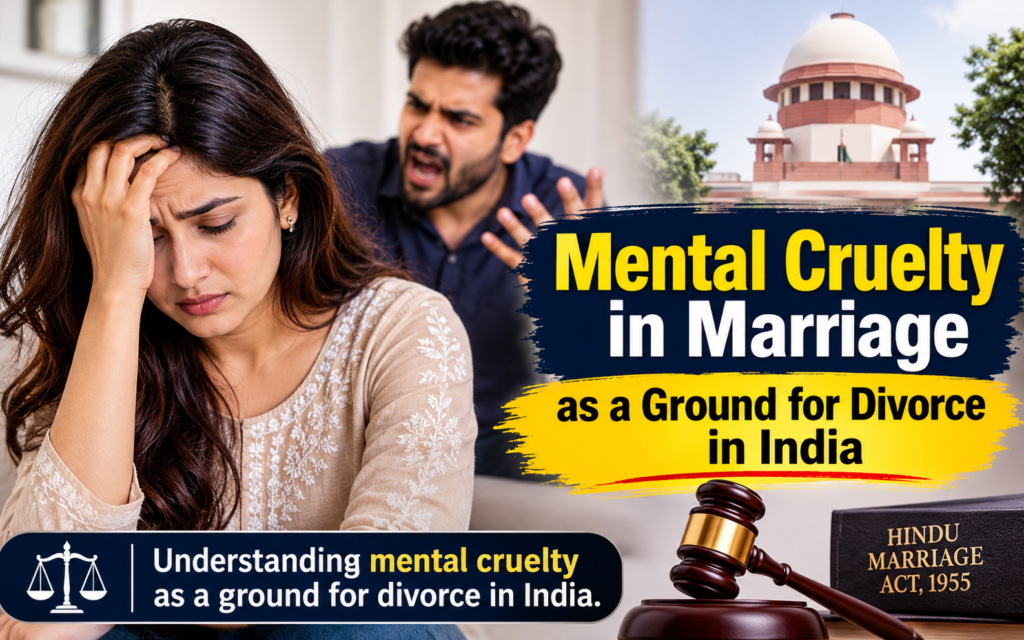
Mental cruelty in marriage can become a legal ground for divorce when one spouse’s conduct causes serious mental suffering and makes it unreasonable to continue the relationship.
“Sir, he has never hit me. But every day he insults me in front of his family, calls me useless, checks my phone and tells everyone I am mentally ill. Is that enough for divorce?”
“Sir, she filed a false dowry case against my 70-year-old parents. We spent four years in court. Can I get a divorce on that ground?”
In my practice, mental cruelty is the most common ground people raise in contested divorce cases. Yet, it remains one of the most misunderstood grounds. Some people think “mental cruelty” means any unhappiness in a marriage. Others believe that only physical violence counts.
The truth lies somewhere in between. Over the years, Indian courts have explained what mental cruelty means and what it does not mean. This article explains the law in simple language. It also covers real-life examples, important Supreme Court judgments and practical ways to prove mental cruelty.
Quick Answer
Under Section 13(1)(ia) of the Hindu Marriage Act, either spouse can seek a divorce if the other spouse treats them with cruelty after marriage.
Mental cruelty means conduct that causes such deep mental pain and suffering that the spouse cannot reasonably be expected to continue living with the other.
For example, courts have recognised several forms of mental cruelty. These include false criminal complaints, baseless allegations that harm a person’s reputation or career, repeated humiliation and abuse, and long-term refusal of marital relations without a valid reason. Repeated threats of suicide may also count. In some cases, long separation and a completely broken marriage can amount to cruelty.
However, ordinary arguments and everyday differences are not enough. The court examines the facts and evidence of each case.
1. What Does the Law Say?
Section 13(1)(ia) HMA allows a spouse to seek divorce if the other party treats them with cruelty after marriage. However, the Act does not define the word “cruelty”. As a result, courts have explained its meaning through several judgments.
Today, the law clearly recognises mental cruelty as separate from physical cruelty. Moreover, the Supreme Court has repeatedly said that no single formula can decide every case.
Instead, the court looks at the couple’s married life as a whole. It considers their background and the combined effect of each person’s conduct.
2. The Supreme Court’s Guide: Samar Ghosh v. Jaya Ghosh (2007)
In Samar Ghosh v. Jaya Ghosh (Supreme Court, 2007), the Court gave an illustrative list of conduct that may amount to mental cruelty. In simple words, the list includes:
- Acute mental pain, agony and suffering that makes it impossible for spouses to live together.
- Conduct that makes it unreasonable to expect the wronged spouse to continue the marriage.
- Repeated abusive and humiliating treatment.
- Serious and repeated misconduct or neglect.
- One spouse’s refusal to have marital relations for a considerable period, without physical incapacity or a valid reason.
- One spouse’s decision not to have a child after marriage.
- Long separation where the matrimonial bond has broken beyond repair.
The Court also explained what does not amount to mental cruelty. Mere coldness, small irritations, ordinary quarrels and everyday marital differences are not enough. The conduct must be serious and significant.
3. What Courts Have Accepted as Mental Cruelty
False criminal complaints and litigation
In K. Srinivas Rao v. D.A. Deepa (Supreme Court, 2013), the wife filed complaints against her husband and his family. Some complaints contained allegations that the court found false.
The Supreme Court held that false complaints and baseless, defamatory allegations against a spouse and their family can amount to mental cruelty.
Real-life example: Rakesh’s wife filed a 498A complaint against his parents and married sister, who lives in Bengaluru. After four years, the court acquitted all of them. It also found that the allegations against the sister had no support.
Rakesh can rely on the acquittal and the court’s findings in his divorce case. However, a simple acquittal due to lack of evidence carries less weight than a clear finding that the allegations were false.
Allegations that damage career and reputation
In Joydeep Majumdar v. Bharti Jaiswal Majumdar (Supreme Court, 26 February 2021), the husband served as an Army officer.
His wife made several complaints to his superiors and other people. She alleged misconduct and made defamatory claims that harmed his career and reputation.
The Supreme Court treated this conduct as mental cruelty and granted divorce.
Persistent humiliation and abuse
Constant insults can also amount to mental cruelty. For instance, one spouse may repeatedly call the other names in front of family or friends. They may mock their family background or appearance. Public humiliation can also count when it becomes serious and repeated.
Real-life example: Priya’s husband regularly called her “illiterate” and “a burden” in front of guests. He also posted sarcastic messages about her in family WhatsApp groups and stopped her from visiting her parents.
Priya kept screenshots of the messages. Her sister and a neighbour also witnessed several incidents. Together, this pattern may amount to mental cruelty, even though no physical violence took place.
Refusal of marital relations
A spouse’s prolonged and unilateral refusal of physical intimacy, without a valid reason such as a medical condition, may amount to mental cruelty.
The Supreme Court recognised this possibility in Samar Ghosh. However, courts examine such claims carefully because they can be difficult to prove. Therefore, consistent and reliable evidence matters.
Threats of suicide
Repeated threats to commit suicide can also amount to mental cruelty. This is especially relevant when one spouse uses such threats to pressure or control the other.
Long separation and a dead marriage
In Rakesh Raman v. Kavita (Supreme Court, April 2023), the parties had lived separately for about 25 years. They had also faced several cases against each other.
The Court held that a marriage which has completely broken down, along with continued bitterness and litigation, can amount to cruelty to both parties. On that basis, it granted divorce.
4. What Courts Usually Do Not Accept
Not every disagreement or argument amounts to mental cruelty. Generally, courts do not treat the following conduct as sufficient on its own:
- Ordinary quarrels and differences of opinion.
- Occasional outbursts or one-time incidents.
- Normal disagreements about money, household work or in-laws, unless they develop into continued harassment.
- Vague allegations without dates, details or witnesses.
- Conduct that the petitioner forgave and accepted, without any later repetition.
Therefore, the seriousness, frequency and overall effect of the conduct matter.
5. How to Prove Mental Cruelty
Evidence and consistency play an important role in mental cruelty cases. The following material can help support a claim:
- A detailed, dated petition: Mention specific incidents, dates, places and words used. Avoid general statements such as “she always harassed me”.
- Documents: Keep copies of complaints and their outcomes, such as acquittal, closure or discharge orders. Emails and letters to employers may also help.
- Electronic evidence: Preserve WhatsApp chats, emails, call recordings and social media posts. Follow the requirements of the Bharatiya Sakshya Adhiniyam, 2023, including the applicable certificate requirements. You can also read my article on WhatsApp chats as evidence in divorce cases.
- Witnesses: Family members, neighbours, friends or colleagues may support your account if they witnessed specific incidents.
- Medical records: These may help if the conduct caused anxiety, depression or a need for treatment.
- Your own conduct: Courts also examine your behaviour. If you also acted abusively, you may find it harder to prove your case.
In short, a clear timeline and reliable supporting evidence can make a significant difference.
6. Is Mental Cruelty Only for Husbands?
No. Section 13(1)(ia) gives both husbands and wives the right to seek divorce on this ground.
For example, wives may rely on repeated humiliation, controlling behaviour, financial deprivation, dowry taunts or false allegations about their character. A husband’s extramarital affair, when combined with abusive conduct, may also support a cruelty claim.
The same legal principles apply to both spouses.
7. How Long Does a Cruelty Divorce Take?
A contested divorce on the ground of cruelty can take two to four years in Delhi Family Courts if the parties pursue the case diligently. However, some cases take longer.
Many couples also settle during the proceedings. They may choose mutual divorce after the court records evidence and the parties understand their legal positions.
For more information, read my article on how to get a divorce fast in India.
Frequently Asked Questions
Q: What is mental cruelty in marriage?
A: Mental cruelty means conduct that causes such mental pain and suffering that a spouse cannot reasonably be expected to continue living with the other. It must be serious, not just ordinary marital disagreements.
Q: Is filing a false 498A case mental cruelty?
A: It can amount to mental cruelty. In K. Srinivas Rao, the Supreme Court explained that false complaints and baseless allegations against a spouse and their family may amount to cruelty.
Q: Can I get a divorce for mental cruelty without physical violence?
A: Yes. Mental cruelty is a separate ground for divorce. You do not need to prove physical violence.
Q: Is refusing intimacy mental cruelty?
A: A prolonged and unilateral refusal without a valid reason may amount to mental cruelty. Samar Ghosh recognises this possibility. However, you must support the claim with credible evidence.
Q: Can long separation alone amount to cruelty?
A: In Rakesh Raman v. Kavita (2023), the Supreme Court considered long separation, an irretrievably broken marriage and continued bitterness. The Court held that these circumstances can amount to cruelty. However, each case depends on its facts.
Q: What evidence do I need to prove mental cruelty?
A: Useful evidence may include specific incidents with dates, documents, electronic records, witnesses and the outcomes of false criminal cases. Vague allegations rarely help.
Q: Can a wife file for divorce on the ground of mental cruelty?
A: Yes. The law gives this right equally to both spouses.
Adv. Aman Chawla’s Practical Note
In my experience, the difference between a weak and a strong cruelty petition often comes down to detail.
For example, “She harassed me for years” tells a judge very little. However, “On 14 March 2024, in front of my parents and two guests, she said…” gives the court a specific incident to examine. A witness or supporting WhatsApp message can make that account stronger.
So, before filing your petition, prepare a timeline. Collect every relevant message, complaint and court outcome. Also, identify witnesses who can speak about the most important incidents.
Finally, be honest about your own conduct. The other side will certainly raise it.
Final Words
Mental cruelty does not simply mean that a marriage was unhappy. You must show, through specific facts, that your spouse’s conduct made it unreasonable to continue the marriage.
The Supreme Court has explained several examples. These include false complaints, allegations that damage a person’s career, repeated humiliation and marriages that have broken down after long separation.
Therefore, prepare your case carefully and collect reliable evidence before taking legal action. With the right preparation, mental cruelty can provide a strong ground for contested divorce in India.
Consult Adv. Aman Chawla, Matrimonial Law Specialist, practicing before the Supreme Court of India, Delhi High Court, and all Delhi District Courts. Available for urgent matters, outstation clients, and online consultations across India.
Call: +91-8076836899 | WhatsApp | Email: info@thematrimoniallawyers.com
Office: O-11A Basement, Jangpura Extension, New Delhi – 110014
Written by Adv. Aman Chawla. This article is for informational purposes only and does not constitute legal advice. Every case is fact-specific. The examples in this article are illustrative and names and details have been changed or simplified. Please consult a qualified lawyer before taking any legal action.