
By Adv. Aman Chawla | Matrimonial Law Specialist | Delhi High Court & Supreme Court of India
Introduction
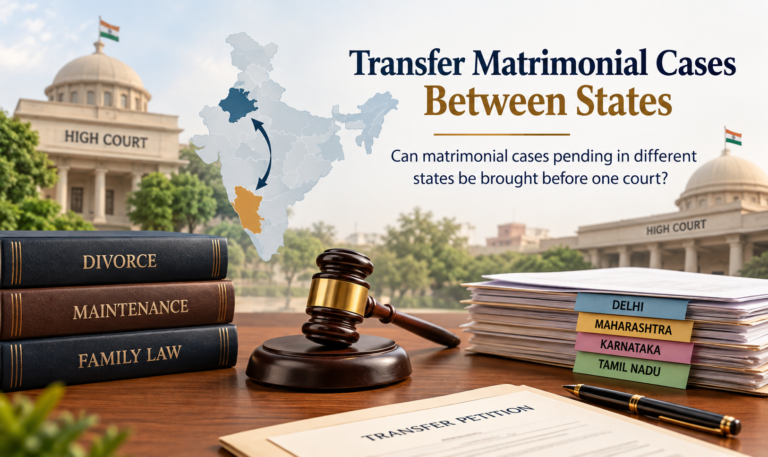
A Supreme Court transfer petition can help a party seek the transfer of a matrimonial proceeding from a court in one state to a court in another when the law and circumstances justify it. When divorce, maintenance and child custody disputes involve different cities, repeated travel can create financial and personal hardship. Understanding the legal grounds, applicable provisions and recent judgments can help you decide whether a transfer petition is appropriate.
A matrimonial dispute can begin with one case and gradually spread across several courts. One spouse may file for divorce in one city. The other may seek maintenance in another. Child custody, domestic violence proceedings or related criminal complaints can add further pressure.
For a family already dealing with separation, the practical burden can become overwhelming. Court dates mean travel, legal expenses, time away from work and difficult arrangements for children. When proceedings take place in different cities, even attending every hearing can become a serious challenge.
This is where a transfer petition in matrimonial cases may help. It asks a competent court to move a pending case from one court to another when the law permits and the circumstances justify the change.
A significant Supreme Court decision in Neha Lal v. Abhishek Kumar, decided on 20 January 2026, has brought renewed attention to the relationship between transfer petitions, maintenance proceedings and prolonged matrimonial litigation. The case involved multiple proceedings across different courts and the Supreme Court’s exercise of its extraordinary powers under Article 142 of the Constitution.
However, the judgment does not mean that every transfer petition will result in a divorce decree or that every pending case will automatically end. The outcome depends on the facts, the relief requested and the court’s legal powers.
This guide explains the law, the recent judgment, the connection between maintenance and transfer proceedings, and the practical steps a spouse should consider before filing an application.
What Is a Transfer Petition in a Matrimonial Case?
A transfer petition is a legal application asking a court with the necessary authority to transfer an existing proceeding from one court to another. In matrimonial disputes, a spouse may seek transfer because the current court creates genuine hardship or because connected proceedings would be handled more effectively in another location.
For example, a husband may file a divorce petition in Delhi while his wife lives with her parents in Lucknow. If she has no independent income, cares for a young child and must travel several hundred kilometres for repeated hearings, she may ask the appropriate court to transfer the divorce case.
The court will examine more than the distance between the two cities. It may consider the parties’ financial circumstances, childcare responsibilities, medical needs, the location of connected proceedings and the overall interests of justice.
Importantly, a transfer petition does not decide whether the allegations in a divorce or maintenance case are true. It addresses the appropriate forum for the proceeding. The court handling the substantive case must still decide the issues according to law, unless a competent higher court grants some separate relief.
You can read more about the procedure and legal grounds on our Transfer Petition Lawyer in Delhi page.
What Did the Supreme Court Decide in Neha Lal v. Abhishek Kumar?
In Neha Lal v. Abhishek Kumar, 2026 INSC 73, the Supreme Court considered a long-running matrimonial dispute involving several proceedings in different courts.
The wife had sought the transfer of a proceeding connected with an application for action relating to alleged perjury. She also sought relief under Article 142 of the Constitution to dissolve the marriage. The parties had been living separately for more than a decade, and their dispute had generated numerous proceedings.
The litigation involved maintenance, domestic violence proceedings, divorce petitions and other applications. The parties disagreed sharply about the history of their marriage and the merits of the cases they had filed against each other.
The Supreme Court examined the extensive litigation history, the length of separation and the unsuccessful efforts at reconciliation. It concluded that the marriage had irretrievably broken down and exercised its extraordinary power under Article 142 to dissolve the marriage.
The Court also directed that specified pending matrimonial-related proceedings should stand disposed of, subject to the terms of its order. It imposed costs of ₹10,000 on each party and disposed of the transfer petition without requiring any further order on that petition.
The decision is important because it shows how the Supreme Court may examine the wider circumstances of an unusually prolonged matrimonial dispute. It also demonstrates that a transfer petition can arise alongside other requests for relief.
But the distinction matters: the Supreme Court did not establish that filing a transfer petition automatically dissolves a marriage or terminates every case between spouses. Its directions arose from the particular facts and its constitutional powers.
Read the full judgment in Neha Lal v. Abhishek Kumar (2026 INSC 73).
Can a Wife Transfer a Divorce Case to the City Where She Lives?
A wife can seek transfer of a matrimonial case when the relevant court has jurisdiction to consider the request. Her residence, financial position and practical difficulties may carry significant weight, especially when the husband initiated proceedings in a distant location.
Suppose a wife lives in Delhi with her minor child, while her husband files a divorce petition in another state. She may explain that she cannot afford repeated journeys, arrange childcare and attend court without disrupting her employment or the child’s schooling.
These circumstances can support a transfer request. However, the court will assess the complete picture rather than apply an automatic rule based only on gender.
The wife should explain the actual hardship and support it with available documents. Relevant material may include proof of residence, the child’s school records, medical documents, details of her income and copies of related proceedings.
The husband may also seek a transfer if he faces genuine hardship or if the balance of convenience supports another forum. Courts must assess the facts of the individual case.
In short, the wife’s convenience is an important consideration, but it does not guarantee transfer in every case.
How Does Maintenance Affect a Transfer Petition?
Maintenance and transfer proceedings often intersect because the spouse seeking financial support may also need to defend a divorce case in another city.
Imagine that a wife lives in Delhi and has filed a maintenance application there. Her husband then starts divorce proceedings in another state. She may have to manage both cases, pay separate travel expenses and arrange legal representation in two places.
That situation can become especially difficult if she has little or no independent income. The existence of a maintenance case may help explain the practical difficulties she faces, particularly when connected proceedings already require the parties to attend court in her city.
However, a maintenance application and a transfer petition serve different purposes.
A maintenance application asks the court to assess entitlement to financial support under the applicable law. A transfer petition asks a competent court to change the forum of an existing proceeding. Filing one does not automatically decide the other.
A spouse should therefore avoid assuming that a transfer order will increase maintenance, cancel an existing maintenance order or resolve a dispute over arrears. Those issues require their own legal assessment.
For related guidance, see our page on Maintenance Law and Alimony.
Which Law Applies to a Matrimonial Transfer Petition in India?
The correct provision depends on the type of proceeding and whether the proposed transfer falls within one state or across state boundaries.
Section 25 of the Code of Civil Procedure, 1908
Section 25 CPC empowers the Supreme Court to transfer a civil suit, appeal or other proceeding from a court in one state to a court in another state when the statutory requirements are met and the transfer serves the ends of justice.
This provision may become relevant to civil matrimonial proceedings such as divorce, restitution of conjugal rights and other proceedings that fall within its scope.
The applicant must identify the proceeding and the court where it is pending. The petition should explain why the proposed transfer would serve the ends of justice.
Section 24 of the Code of Civil Procedure, 1908
Section 24 CPC gives the High Court and District Court specified powers to transfer or withdraw civil proceedings within their respective authority.
Where the proposed transfer concerns courts within the same state, the applicant should examine whether Section 24 CPC or another applicable provision supplies the correct route.
A person should not file a Supreme Court transfer petition merely because one court is inconvenient. The court’s territorial and statutory authority matters.
Section 446 of the Bharatiya Nagarik Suraksha Sanhita, 2023
Section 446 BNSS deals with the Supreme Court’s power to transfer criminal cases and appeals in the circumstances covered by the provision.
A criminal matrimonial proceeding may require a different transfer route from a civil divorce case. The nature of the case, the forum and the relief sought determine the appropriate provision.
Domestic violence proceedings can involve distinct statutory procedures, so a lawyer should assess the specific proceeding rather than assume that one transfer provision covers every case connected with a marriage.
Practical point: Before filing, confirm the case type, the current court, the proposed destination and the statutory basis for transfer. An incorrect provision can create avoidable procedural difficulties.
What Grounds Can Support a Transfer Petition?
The court looks for specific reasons showing why a transfer would be appropriate. General dissatisfaction with the current court or a bare statement that travel is inconvenient may not be enough.
Financial hardship and lack of independent income
Repeated travel can impose a substantial burden on a spouse who has limited financial resources. The applicant should explain the cost of travel, accommodation and lost working days, where relevant.
Financial hardship is more persuasive when the applicant connects it to the practical demands of attending the case.
Responsibility for a minor child
A parent who cares for a young child may face difficulties attending hearings in a distant city. School schedules, childcare arrangements and the absence of support from other family members may all be relevant.
The applicant should explain how the travel affects the child’s routine and why the proposed forum would reduce the difficulty.
Medical conditions or safety concerns
A genuine medical condition may make repeated travel difficult or unsafe. Medical records can help establish the nature of the problem.
Similarly, a safety concern may support transfer where the applicant provides credible details. The court will assess the evidence and the circumstances rather than rely only on a general allegation.
Connected proceedings in another city
If related matrimonial proceedings already take place in one city, the applicant may argue that transferring another case there would reduce unnecessary appearances and help coordinate the litigation.
This ground can be especially relevant when divorce, maintenance and custody proceedings overlap. Still, each case has its own procedural requirements, and a court must have authority to transfer it.
A Fresh 2026 Development: Why Coordinating Connected Cases Matters
A useful additional development comes from Veena Kanwar v. Vijendra Singh, decided by the Rajasthan High Court at Jodhpur on 13 August 2026.
The wife sought transfer of a proceeding from the Family Court at Jalore to the Family Court at Pali, where she resided. The distance between the locations was approximately 101 kilometres, and she raised concerns about repeated travel, expense and hardship.
The High Court allowed the transfer. It also emphasised the practical value of coordinating connected matrimonial proceedings and, to the extent administratively feasible, listing them on the same date to reduce unnecessary appearances.
The judgment illustrates a point that many general transfer-petition explanations overlook: the problem may not be simply the distance to one court. It may be the cumulative burden of attending several proceedings in different places.
This decision came from the Rajasthan High Court and concerned its own jurisdiction. It does not replace the rules governing transfers between states or make every request for consolidation successful.
Read the judgment in Veena Kanwar v. Vijendra Singh.
Can the Court Transfer Every Case Between Husband and Wife Together?
Not necessarily. A couple may have several proceedings under different laws, and each proceeding may follow its own transfer mechanism.
For instance, a civil divorce petition, a maintenance application and a criminal case may not all fall under the same statutory provision. A court must have the necessary authority over each matter before it can transfer or otherwise deal with it.
A lawyer should prepare a complete list of pending cases. The list should identify the court, case number, type of proceeding, applicable law and present status.
This step helps the applicant avoid overlooking a connected matter. It also allows the court to understand the practical problem and consider whether a coordinated approach would serve the interests of justice.
The Supreme Court’s directions in Neha Lal arose from its assessment of the particular litigation before it. A litigant should not treat that outcome as a blanket rule that every court must close every case once a transfer petition succeeds.
Can Video Conferencing Replace a Transfer Petition?
Video conferencing may reduce travel for some hearings. It does not automatically eliminate the need for a transfer petition.
The court may permit virtual participation where the applicable rules and circumstances allow it. However, a case may still require personal attendance for evidence, reconciliation, identification or another procedural purpose.
A party seeking transfer should explain why virtual attendance would not adequately address the hardship. For example, the applicant may need to attend repeated in-person hearings, care for a child during travel or respond to several connected proceedings.
On the other hand, if virtual participation or another practical arrangement resolves the difficulty, the court may consider that option when assessing the request.
The question is not simply whether technology exists. The question is whether the proposed arrangement fairly addresses the actual needs of the case.
What Documents Should You Prepare Before Filing?
A well-prepared petition explains the circumstances clearly and supports the important claims with documents.
Start with the petition or order that identifies the proceeding you want to transfer. Add the case number, court details and the latest order where available. The court needs to understand exactly which proceeding the request concerns.
Proof of residence can establish where you currently live. If you care for a minor child, school records or relevant custody orders may help explain the practical arrangements. Medical records can support a health-related ground.
If maintenance forms part of the wider dispute, include relevant orders and documents showing the status of the maintenance proceeding. These documents may help explain the financial circumstances, but they do not guarantee that the transfer court will decide the maintenance issue itself.
Where several cases are pending, prepare a clear list with each case number, court, statute and current status. Include copies of relevant orders and identify any connected proceedings that already take place at the proposed destination.
Finally, ensure that the petition accurately states the facts. Omitting material information or making unsupported allegations can weaken the request and complicate the litigation.
How Does the Transfer Petition Process Work?
The process begins with a review of the proceeding and the court that has authority to transfer it. A lawyer should first determine whether the application belongs before the Supreme Court, the High Court or another competent court.
The applicant then prepares the petition, explains the grounds and attaches the supporting documents. The petition must follow the filing requirements that apply to that court and type of case.
After filing, the court may examine the request at a preliminary hearing. It may issue notice to the other party, ask for a response, consider an interim request where legally appropriate or decide the matter according to the record and applicable procedure.
A transfer petition does not automatically stay the original proceedings. If the applicant needs a stay, the petition should address that relief separately, and the court must grant it before the proceedings are suspended.
If the court allows transfer, the relevant records must move to the receiving court in accordance with the order. The parties should then follow the directions of the original and transferee courts regarding future dates and procedural steps.
Timelines vary. The time required depends on the court’s schedule, service of notice, the complexity of the case and whether the other party contests the application. No fixed timeline can be guaranteed for every transfer petition.
What Should You Do If Your Divorce and Maintenance Cases Are in Different Cities?
The first step is to understand why the cases are pending in different locations and whether the current arrangements create a genuine legal or practical problem.
Prepare a list of all proceedings and identify the relief sought in each. Check whether a maintenance order already exists, whether the divorce case has reached an advanced stage and whether any court has issued directions about attendance or virtual hearings.
Next, gather evidence of the difficulties you face. This may include travel expenses, proof of residence, the child’s school schedule, medical records and relevant orders from connected proceedings.
A lawyer can then assess whether a transfer petition is appropriate or whether another procedural request would address the problem more effectively. In some cases, a transfer may be suitable. In others, the parties may need to seek virtual attendance, coordinated hearing dates or another lawful arrangement.
If the dispute also involves maintenance, review the financial documents and applicable maintenance orders separately. A transfer request should not replace the steps needed to claim, defend or enforce maintenance.
For additional information about divorce proceedings in Delhi, visit our Divorce and Family Lawyer in Delhi page.
What Most Transfer Petition Guides Miss
Many basic guides focus on the definition of a transfer petition, the relevant sections and the documents required for filing. Those details matter, but they do not always explain how transfer decisions affect families dealing with several connected proceedings.
A more useful assessment looks at the entire litigation picture. Does one spouse already attend court in the other spouse’s city? Is a minor child involved? Does the applicant have an independent income? Are maintenance proceedings pending? Would moving the case reduce repeated travel without causing unfair prejudice to the other party?
The 2026 decisions discussed above show why these practical questions matter. Neha Lal illustrates the extraordinary relief the Supreme Court may grant in a specific case involving prolonged litigation. Veena Kanwar highlights the practical value of coordinating related proceedings where the law and circumstances permit.
Neither decision creates an automatic right to transfer or a guaranteed outcome. Together, however, they underline the importance of presenting the full factual picture rather than relying on a generic statement of inconvenience.
That distinction can make the legal assessment more focused and help the court understand the relief the applicant actually needs.
Frequently Asked Questions
1. Can a wife transfer a divorce case to her hometown?
Yes, she can seek transfer if the competent court has authority and the circumstances support the request. Her residence, financial position, childcare responsibilities and the location of related proceedings may be relevant. The court decides each application on its facts.
2. Can a husband also file a transfer petition?
Yes. Transfer remedies are not restricted to wives. A husband may seek transfer where the applicable law permits and genuine circumstances support the request.
3. Does filing a transfer petition automatically stop the divorce case?
No. Filing the petition does not, by itself, suspend the original proceeding. A stay or other interim relief requires an appropriate order from the competent court.
4. Can I transfer a maintenance case along with a divorce case?
It may be possible, but the answer depends on the type of proceeding, the applicable statute and the authority of the court hearing the transfer request. A lawyer should examine each case separately before seeking transfer or coordinated handling.
5. Which section applies to an inter-state civil matrimonial transfer?
Section 25 of the Code of Civil Procedure, 1908, provides the Supreme Court’s power to transfer civil proceedings between states when its requirements are satisfied. Criminal proceedings may require a different provision, including Section 446 BNSS where applicable.
6. Which court handles a transfer between two cities in the same state?
For civil proceedings, Section 24 CPC may empower the High Court or District Court to transfer or withdraw a case within its jurisdiction. Criminal proceedings follow their own statutory rules. The correct forum depends on the type of case and the requested transfer.
7. Can the court reject a transfer petition even if the wife has no income?
Yes. Lack of income can support a hardship argument, but it does not guarantee transfer. The court assesses the complete circumstances, including travel difficulties, connected cases, available alternatives and the interests of justice.
8. Can video conferencing replace a transfer petition?
Sometimes virtual attendance can reduce the burden of travel. However, it does not automatically defeat a transfer request. The court considers whether video conferencing adequately addresses the specific hardship and procedural requirements.
9. What happens to the case after the court allows transfer?
The court’s order governs the next steps. The relevant records move to the transferee court, and the parties must follow the directions for future appearances and proceedings. The case does not automatically start from the beginning.
10. Can the Supreme Court grant divorce while considering a transfer petition?
The Supreme Court has extraordinary powers under Article 142 to do complete justice in appropriate cases. In Neha Lal v. Abhishek Kumar, it exercised that power in light of the exceptional facts and prolonged litigation. This does not mean that an ordinary transfer petition will result in divorce.
11. Does a transfer petition decide maintenance or alimony?
Not ordinarily. A transfer petition concerns the appropriate forum. Entitlement to maintenance, the amount payable and enforcement of an order require consideration under the applicable law. A higher court may grant additional relief where it has the necessary jurisdiction and the case justifies it.
12. What documents should I take to a lawyer for a transfer petition?
Bring the petition and latest orders from the existing case, proof of residence, details of connected proceedings, and documents supporting any financial, medical, safety or childcare difficulties. If maintenance is involved, bring the relevant applications and orders as well.
Conclusion: Choose the Right Legal Route Before Filing
A transfer petition can help address genuine hardship when matrimonial proceedings take place in different cities. However, success depends on the applicable law, the court’s authority and the evidence supporting the request.
The Supreme Court’s decision in Neha Lal v. Abhishek Kumar offers an important example of how a court may address exceptional matrimonial litigation involving multiple proceedings. The Rajasthan High Court’s decision in Veena Kanwar v. Vijendra Singh also highlights the value of considering connected cases and the practical burden of repeated travel.
Neither judgment guarantees transfer in every matter. A careful assessment should identify the proceedings, the correct legal provisions, the available evidence and the specific relief required.
If your divorce, maintenance, custody or related proceedings are pending in different cities, review the case history before taking the next step. A clear legal strategy can help you understand whether transfer, virtual participation or another procedural remedy best fits your circumstances.
Legal information disclaimer: This article provides general information about Indian law as of October 2026. It is not a substitute for advice on the facts of an individual case. The applicable procedure and outcome depend on the nature of the proceedings, the relevant court and the current law.
Written by Adv. Aman Chawla. This article offers general information and does not replace legal advice. Outcomes depend on the facts, the evidence, the statute and the court. Please consult a qualified lawyer before you act.
Talk to a Transfer Petition lawyer in Delhi. Call +91 80768 36899, email info@thematrimoniallawyers.com or request a confidential consultation. Office: Basement, O-11A, Block O, Jungpura Extension, New Delhi 110014.