Written by Adv. Aman Chawla | Matrimonial Law Specialist | Delhi High Court & Supreme Court of India | 8 Years Exclusive Practice in Family & Matrimonial Law | Jangpura, New Delhi
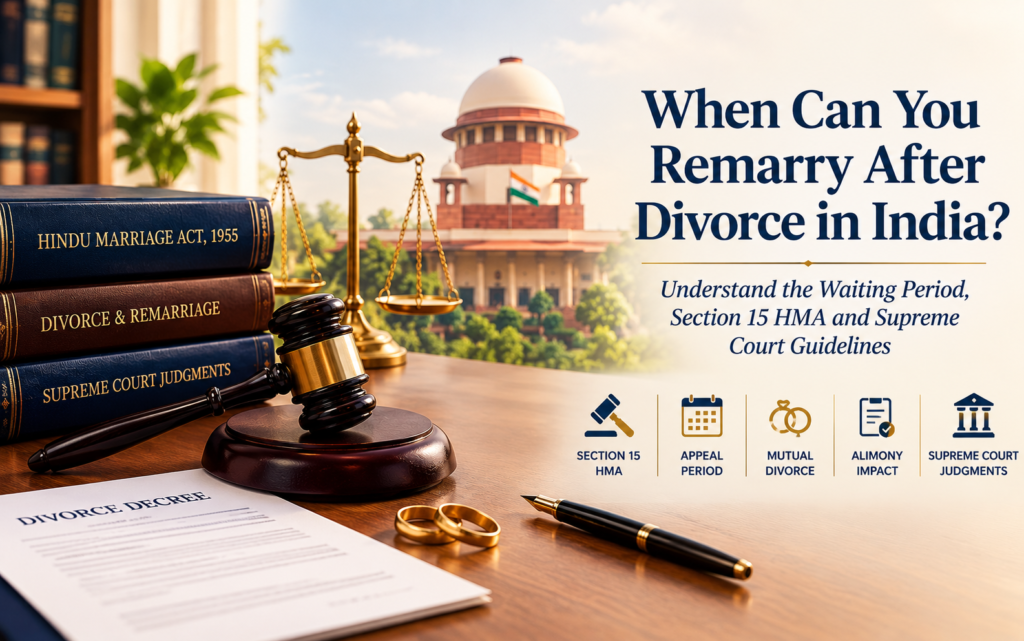
After divorce, when can I remarry in India? This is an important question for anyone planning a second marriage after receiving a divorce decree. Section 15 of the Hindu Marriage Act explains when remarriage may take place. The appeal period, pending court proceedings and type of divorce can all affect the timing.
The decree is finally in your hands. Years of hearings, adjournments, and anxiety are over. Almost immediately, a new question comes up:
“Sir, can I get married now? Next month? My family has already started looking.”
“Sir, our mutual divorce came through yesterday. The wedding date is fixed for next Sunday. Is that legal?”
This is one of the most practical questions in matrimonial law, yet people often overlook it. They may spend years fighting a divorce case and then make a mistake in the final few weeks. That mistake can put their new marriage, and sometimes their liberty, at risk.
This article explains when you can remarry after a divorce in India. It also covers the waiting period, the difference after a mutual divorce, and the courts’ approach when someone remarries too soon.
After Divorce, When Can You Remarry in India? Quick Answer
Under Section 15 of the Hindu Marriage Act, 1955, you can remarry after a divorce decree when no right of appeal remains, the appeal period expires without anyone filing an appeal, or the court dismisses an appeal that someone has filed.
After a contested divorce, the safer approach is to wait until the appeal period expires and confirm that nobody has filed an appeal. After a mutual consent divorce, an appeal is generally very unlikely. However, High Courts have taken different views on whether an appeal lies at all. Most lawyers therefore advise waiting until the appeal period expires and checking the court records before the wedding.
1. Why Is There a Waiting Period?
A divorce decree from the Family Court does not always end the matter. The other spouse can appeal to the High Court. If the High Court sets aside the divorce, the law treats the first marriage as still existing.
Now imagine that you have remarried in the meantime. You could find yourself facing a legal dispute over two marriages. Section 15 aims to prevent this problem.
In simple terms, Section 15 HMA allows a divorced person to marry again in these circumstances:
- No right of appeal exists against the decree.
- A right of appeal exists, but the appeal period has expired without anyone filing an appeal.
- Someone has filed an appeal, but the court has dismissed it.
The waiting period is not a punishment. It protects the person who may want to appeal. It also protects you from a second marriage that someone could later challenge.
2. How Long Is the Appeal Period?
Many people get confused because two laws appear to prescribe different appeal periods.
- Section 28(4) of the Hindu Marriage Act gives 90 days to file an appeal.
- Section 19(3) of the Family Courts Act, 1984, gives 30 days to appeal against a Family Court judgment.
In Pallavi Mohan v. Raghu Menon (2023), the Delhi High Court held that the appeal period for a divorce decree granted by a Family Court in Delhi is 30 days under the Family Courts Act. The court can still condone a delay if the applicant shows sufficient cause. Some other High Courts, including the Rajasthan High Court, have taken the view that the 90-day period under the Hindu Marriage Act applies.
What Should You Do Before Remarrying?
Do not calculate the shortest possible waiting period and immediately book a wedding venue. My standard advice is:
- Wait at least 90 days from the date of the decree, not the date you collected its copy.
- Ask your lawyer to check whether anyone has filed an appeal in the High Court.
- Proceed with the marriage and its registration only after completing these checks.
Real-life example: Rahul received a contested divorce decree from the Saket Family Court on 1 March on grounds of cruelty. His family fixed his second marriage for 15 April, counting 30 days plus a “buffer”.
On 10 April, he received notice of an appeal his ex-wife had filed on day 41. She had also applied for condonation of delay. The wedding then had to be called off. If the court condoned the delay and the appeal remained pending, his remarriage could face a legal challenge.
Waiting three months and checking the court records could have avoided this situation.
3. Remarrying After a Mutual Consent Divorce
Under Section 13B, both spouses agree to the divorce, sign the settlement, and give their statements before the court. But can either spouse still appeal?
Section 19(2) of the Family Courts Act says that no appeal lies against a decree or order passed by the Family Court with the parties’ consent. Section 96(3) of the Code of Civil Procedure also bars appeals against consent decrees.
Several High Courts, including the Delhi High Court, have treated a mutual divorce decree as a consent decree on this basis. However, some High Courts have held that an appeal can still lie because the court must satisfy itself before granting a mutual divorce. The law is not fully settled.
What Have Courts Said About Remarrying Soon After Mutual Divorce?
In a 2025 case, reported as 2025:KER:60941, the Kerala High Court considered a wife who remarried on the same day the court granted her mutual divorce. Her second husband later argued that Section 15 made the marriage void.
The High Court held that a marriage during the waiting period does not automatically become void. Nobody had challenged the mutual divorce decree, so the second husband could not use Section 15 to attack the marriage.
What is my advice? The practical risk after a mutual divorce is very low because the other spouse agreed to the divorce. However, “very low” does not mean “zero”.
If the other spouse later alleges fraud or coercion, they may try to have the decree recalled. If you can wait until the appeal period expires, do so. If you cannot wait, at least ensure that both sides have fully complied with the settlement terms. This leaves the other spouse with fewer reasons to return to court.
4. What If You Remarry While an Appeal Is Pending?
This situation can cause serious trouble. The Supreme Court has dealt with it directly.
In Anurag Mittal v. Shaily Mishra Mittal (Supreme Court, 24 August 2018), a divorce decree had dissolved the husband’s first marriage. He filed an appeal but later settled the matter and applied to withdraw it.
Before the High Court formally dismissed the appeal as withdrawn, he married again. His second wife then asked the court to declare the second marriage void. The High Court agreed with her.
The Supreme Court reversed that decision. It explained that Section 15 protects a person who pursues an appeal and prevents the other spouse from making that appeal meaningless. When the appellant has clearly decided not to pursue the appeal and has settled the dispute, he does not need to wait for the formal dismissal order. The Supreme Court held the second marriage valid.
Kerala High Court Ruling in June 2026
In June 2026, the Kerala High Court went further in a case where the husband filed his appeal late. The court later condoned the delay, but it did not grant a stay. Meanwhile, the wife remarried while the appeal remained pending.
The High Court held that the second marriage was not void. It also held that an appeal filed beyond the limitation period does not revive the Section 15 bar for the intervening period.
However, the court also set aside her ₹20 lakh permanent alimony award and sent the matter back to the Family Court. Her remarriage had changed the circumstances under Section 25(3) HMA.
These judgments offer two important lessons:
- Courts tend to avoid declaring a second marriage void on technical grounds, particularly when someone has withdrawn, settled, or filed an appeal late.
- Remarriage can still have significant consequences for alimony and maintenance.
5. How Does Remarriage Affect Your Alimony?
If you receive monthly alimony or maintenance, read this section carefully.
Under Section 25(3) HMA, the court may vary, modify, or rescind an order if the party receiving the benefit has remarried. The other party must apply to the court for this relief.
The change does not happen automatically. However, once the paying spouse applies, the court may reduce or cancel a monthly alimony order.
A one-time lump-sum settlement works differently. If you have already received the amount, you generally do not have to return it just because you remarry, unless your settlement agreement provides otherwise.
Real-life example: Sunita’s divorce decree granted her ₹30,000 a month as permanent alimony. Two years later, she remarried. Her ex-husband applied under Section 25(3), and the court stopped the monthly payments from the date of its order.
Her friend Kavita had chosen a different arrangement. She received a one-time settlement of ₹25 lakh during her mutual divorce. When Kavita remarried, nothing changed financially.
This is one reason I discuss the choice between lump-sum and monthly alimony with clients before they sign a settlement.
Remember that child maintenance is a separate matter. A child’s right to maintenance from a parent does not end because either parent remarries.
6. What About Muslim, Christian and Special Marriage Act Divorces?
The rules and practical considerations differ according to the applicable law.
- Special Marriage Act, 1954: Section 30 resembles Section 15 HMA. Wait until the appeal period expires or the court dismisses the appeal.
- Muslim law: A divorced Muslim woman observes the iddat period before she can remarry. A Muslim man is not bound by iddat. However, when a court grants the divorce, the same practical caution about appeals applies.
- Christians: Under the Divorce Act, 1869, remarriage is permitted after the decree becomes final and the appeal period expires or the court dismisses the appeal.
7. Can a Divorced Couple Remarry Each Other?
Yes. Indian law does not prevent former spouses from marrying each other again after a valid divorce. They can solemnise and register a fresh marriage.
I have seen this happen more often than people imagine, especially after couples obtain a mutual divorce in anger.
If you reconcile before the divorce becomes final, the better course is to withdraw the divorce petition or avoid giving your second-motion statement. I have explained this in my article on whether a mutual divorce can be withdrawn after filing.
8. Practical Checklist Before You Remarry
Before setting your wedding date, work through this checklist:
- Obtain a certified copy of the divorce decree, not just a printout from the website.
- Count at least 90 days from the date of the decree.
- Ask your lawyer to check the High Court records for an appeal or an application for condonation of delay.
- If an appeal is pending, do not remarry until the court withdraws or dismisses it. Obtain written legal advice if the parties have settled the dispute.
- Ensure that both sides have fully complied with the settlement terms, including alimony, stridhan, and custody arrangements. This reduces the scope for further disputes.
- Carry the divorce decree to the marriage registrar. You will need it to register the new marriage.
- If you receive monthly alimony, understand that remarriage can lead to cancellation of the order.
Frequently Asked Questions
After mutual divorce, when can I remarry in India?
An appeal against a mutual divorce decree is generally very unlikely, and many courts treat it as barred. However, High Courts have taken different views. The safest course is to wait for the appeal period—my advice is 90 days—and confirm that nobody has challenged the decree.
How many days after divorce can you remarry in India?
After a contested divorce, wait until the appeal period expires without an appeal or until the court dismisses the appeal. In Delhi, the High Court has held that the appeal period for a Family Court decree is 30 days. However, courts can allow delayed appeals, so waiting about 90 days and checking the records is safer.
Is a marriage void if I remarry during the appeal period?
Not automatically. In Anurag Mittal, the Supreme Court refused to declare the marriage void in circumstances where the appeal had been settled or withdrawn. However, if the court later reverses the divorce in a genuine pending appeal, you could face serious legal trouble, including allegations of bigamy.
Can I remarry if my ex-spouse has filed an appeal?
You should not remarry while a genuine appeal remains pending. Wait until the court withdraws or dismisses it.
Do I need to inform my ex-spouse before remarrying?
The law does not require you to inform your ex-spouse. However, if you receive monthly alimony, your remarriage gives the paying spouse grounds to seek cancellation of the order.
Can I register my second marriage in court?
Yes. You will need your certified divorce decree to prove that the earlier marriage has been legally dissolved.
What happens to my child’s maintenance if I remarry?
The child’s right to maintenance continues. It remains independent of either parent’s remarriage.
Adv. Aman Chawla’s Practical Note
Every year, I see at least a few clients who fight a divorce case for four or five years and then rush into a second marriage within four or five weeks.
In most cases, nothing goes wrong. But when problems arise, the consequences can be serious: a cancelled wedding, a challenge to the new marriage, a complaint, or a lost alimony claim.
Ninety days is a small price to pay for certainty. Wait, check the court records, and then begin your new life with a clean legal slate.
Final Words
The law does not stop you from starting again. It asks you to ensure that the old chapter has truly closed before you open a new one.
Know your appeal period, check the court records for appeals, and understand how remarriage affects alimony. These steps can help you move forward with greater confidence.
Consult Adv. Aman Chawla, Matrimonial Law Specialist, practising before the Supreme Court of India, Delhi High Court, and all Delhi District Courts. Available for urgent matters, outstation clients, and online consultations across India.
Call: +91-8076836899 | WhatsApp | Email: info@thematrimoniallawyers.com
Office: O-11A Basement, Jangpura Extension, New Delhi – 110014
Written by Adv. Aman Chawla. This article is for informational purposes only and does not constitute legal advice. Every case is fact-specific. The examples in this article are illustrative, and names and details have been changed or simplified. Please consult a qualified lawyer before taking any legal action.