Can I Get My Maintenance Amount Reduced or Stopped?

Written by Adv. Aman Chawla | Matrimonial Law Specialist | Delhi High Court & Supreme Court of India Exclusive Practice in Family & Matrimonial Law | July 2026
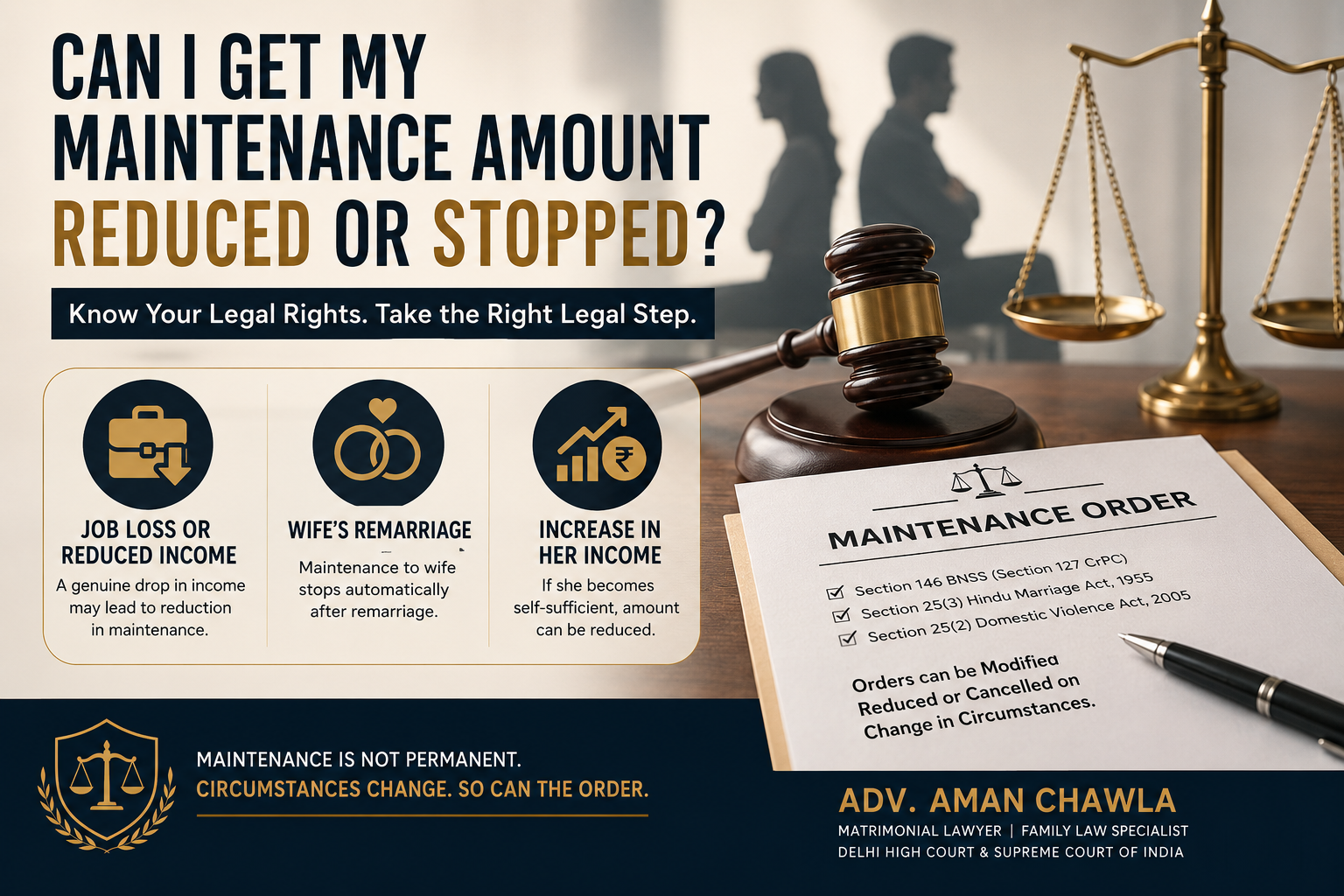
If you’re paying maintenance and something has genuinely changed, job loss, a drop in income, your wife’s remarriage, or a rise in her own income, the question is simple: can this order actually be reduced or stopped?
Yes, but not automatically, and not just because the amount now feels unfair. Indian law allows maintenance to be reduced, increased, or cancelled, but only on proof of a genuine change in circumstances, placed before the same court. Clients often assume they can simply stop paying once their situation changes , that’s the costliest mistake, since it turns a winnable modification case into a contempt and arrears-recovery problem.
This article covers the three most common grounds: job loss or reduced income, the wife’s remarriage, and a rise in her own income.
The Legal Route: Maintenance Orders Are Not Permanent
Every maintenance order, under the CrPC/BNSS, the Hindu Marriage Act, or the DV Act , has a built-in mechanism to revisit it once circumstances change:
- Section 146 BNSS (formerly Section 127 CrPC) , lets the Magistrate alter, increase, decrease, or cancel a maintenance order under Section 144 BNSS / Section 125 CrPC on proof of a change in either party’s circumstances.
- Section 25(3), Hindu Marriage Act, 1955 , lets the court vary, modify, or rescind permanent alimony if the recipient remarries, or on other specified changes.
- Section 25(2), Domestic Violence Act, 2005 , lets either party seek alteration or revocation of a monetary relief order on proof of changed circumstances.
The Supreme Court confirmed this in Vinny Parmar v. Paramvir Parmar ((2011) 13 SCC 112): parties remain free to approach the court to modify or rescind an order if circumstances change. Maintenance tracks reality , it isn’t a one-time, unchangeable verdict.
Ground 1: You’ve Lost Your Job or Your Income Has Genuinely Dropped
This is the most common , and most misunderstood , ground under Section 146 BNSS / Section 127 CrPC. Courts don’t look at whether your income dropped, but why , is the drop genuine and lasting, or engineered to dodge the order?
A 2024 Madhya Pradesh High Court ruling illustrates this. A bank Vice President in Dubai, paying ₹60,000/month interim maintenance, took a lower-paying role and sought a reduction. The Court reduced it to ₹40,000 , weighing his changed income alongside the wife’s own qualifications, applying the settled principle from Jasbir Kaur Sehgal v. District Judge, Dehradun, (1997) 7 SCC 7 and Kalyan Dey Chowdhary v. Rita Dey Chowdhary, (2017) 14 SCC 200, that maintenance should be reasonable, not excessive.
What gets a reduction approved: termination letters or layoff notices; updated ITRs and salary slips from the new role, filed with a fresh Rajnesh v. Neha affidavit; medical records if health-related; and proof the drop is likely to persist.
What sinks it: quitting or cutting hours around the time proceedings are filed (courts don’t reward strategic income reduction); simply stopping payments instead of filing for modification; and vague “business loss” claims with no ITRs or bank statements.
A genuine, provable income drop is a real ground for reduction. A convenient one, timed suspiciously, rarely survives cross-examination.
Ground 2: Your Wife Has Remarried
This is the cleanest of the three grounds , the law is direct about it.
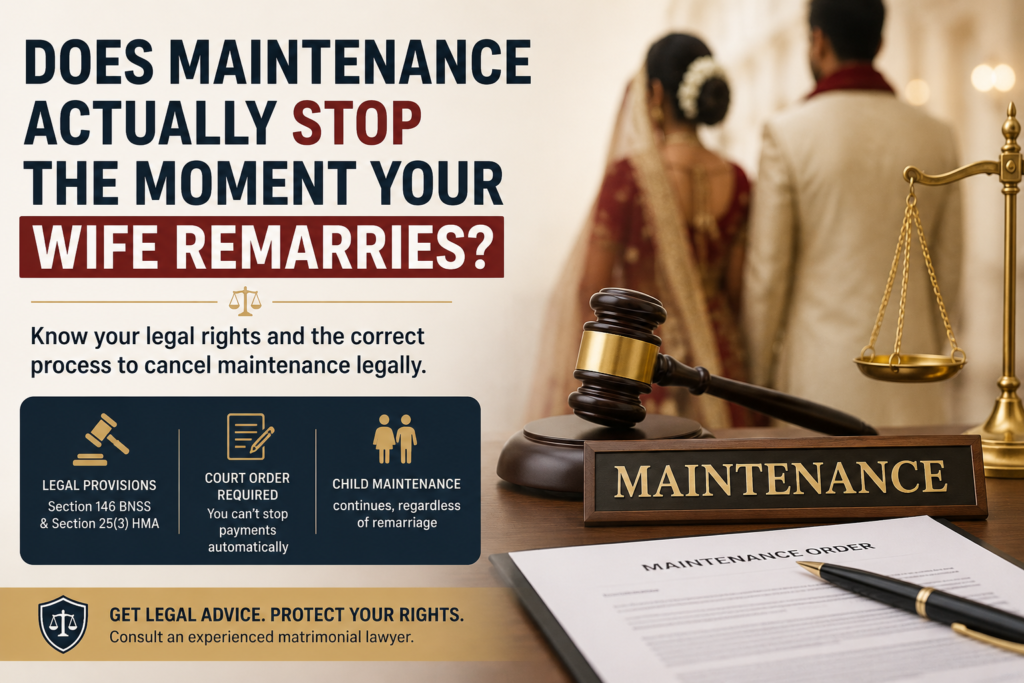
Under Section 125 CrPC / Section 144 BNSS, “wife” for maintenance purposes means a divorced woman who has not remarried. The moment she remarries, she falls outside that definition, and the order stands cancelled from the date of remarriage. The Supreme Court affirmed this in Rohtash Singh v. Smt. Ramendri (AIR 2000 SC 952). Section 25(3), Hindu Marriage Act carries the same principle for permanent alimony.
Proof of remarriage: a certified marriage certificate; or, absent formal registration, evidence of a ceremony (photographs, invitation cards, witnesses); plus corroborating evidence like changed surname or a joint bank account/address.
Live-in relationships are murkier. Some courts have examined whether a wife in a stable, marriage-like new relationship still needs maintenance, but this is far less settled than remarriage and turns heavily on the facts , don’t treat it as automatic.
One distinction: children’s maintenance is unaffected by the wife’s remarriage; only her own maintenance is cancelled.
Ground 3: Your Wife’s Income Has Increased or She’s Become Self-Sufficient
This applies where the order was passed before she started earning, or before her income grew , and you’re seeking a downward revision, not a fresh denial. The burden is on you to show a genuine, material change.
Be realistic about the ceiling here. In Chaturbhuj v. Sita Bai ((2008) 2 SCC 316, the Supreme Court held that “unable to maintain herself” doesn’t require complete destitution; some income doesn’t wipe out her claim entirely. Increased income typically earns a proportionate reduction, not automatic termination, unless it clearly exceeds her reasonable needs.
Evidence to gather: her current salary slips, ITRs, and bank statements; a comparison affidavit of her income then versus now; and any promotion letters or new employment contracts.
How to Actually File a Modification Application
- Don’t stop paying first. File under Section 146 BNSS / Section 127 CrPC (or Section 25(2) DV Act / Section 25(3) HMA) before or alongside raising the changed circumstances , never after cutting off payments unilaterally.
- Gather proof specific to your ground , termination letter and new salary slips for income loss; marriage proof for remarriage; her current salary slips and ITRs for increased income.
- File a fresh affidavit of assets and liabilities for both parties, so the court works off updated figures, not the original order’s numbers.
- Keep paying the existing order until it’s actually modified. Arrears accumulate on the original figure until the court passes a fresh order.
Frequently Asked Questions
Can I just stop paying maintenance if I lose my job?
No. The order stays enforceable until a court formally changes it. File first, keep paying what you can, and let the court revise it.
Does maintenance automatically stop the day my ex-wife remarries?
Legally, yes, from the date of remarriage. Practically, still file to have the order formally cancelled and place proof of remarriage on record.
If my wife gets a job after the order, can I get it reduced immediately?
You can apply immediately, but courts want a genuine, material improvement in her income, not a token job. Expect a proportionate reduction, not automatic termination.
What if my income dropped but I can’t prove it wasn’t intentional?
This is where documentation matters most , termination letters, medical records, or audited financials. Unsupported claims are treated with suspicion, especially near proceedings.
Is my children’s maintenance also reduced if my ex-wife remarries?
No. A child’s maintenance is independent of the mother’s marital status.
The Bottom Line
Maintenance orders are built to be revisited , incomes fall, people remarry, circumstances change. But every ground here works through documentation and a proper application, not a unilateral decision that the order no longer applies. File the right application, with the right proof, and keep honouring the existing order until the court actually changes it.
About the Author
Adv. Aman Chawla | Matrimonial Lawyer | Divorce & Family Law Specialist
Legal Disclaimer
This article is intended solely for informational and educational purposes and does not constitute legal advice. The legal position may vary depending upon the facts of each case, amendments in law, and judicial interpretation. Readers should seek independent legal advice before acting on any information contained herein. Reading this article or communicating through the website does not create an advocate-client relationship.
Written by Adv. Aman Chawla. This article is for informational purposes only and does not constitute legal advice. Every case is fact-specific. Please consult a qualified lawyer before taking any legal action.