How Long Does Mutual Divorce Take in India?

Written by Adv. Aman Chawla | Matrimonial Law Specialist | Delhi High Court & Supreme Court of India Exclusive Practice in Family & Matrimonial Law | July 2026
Quick Answer
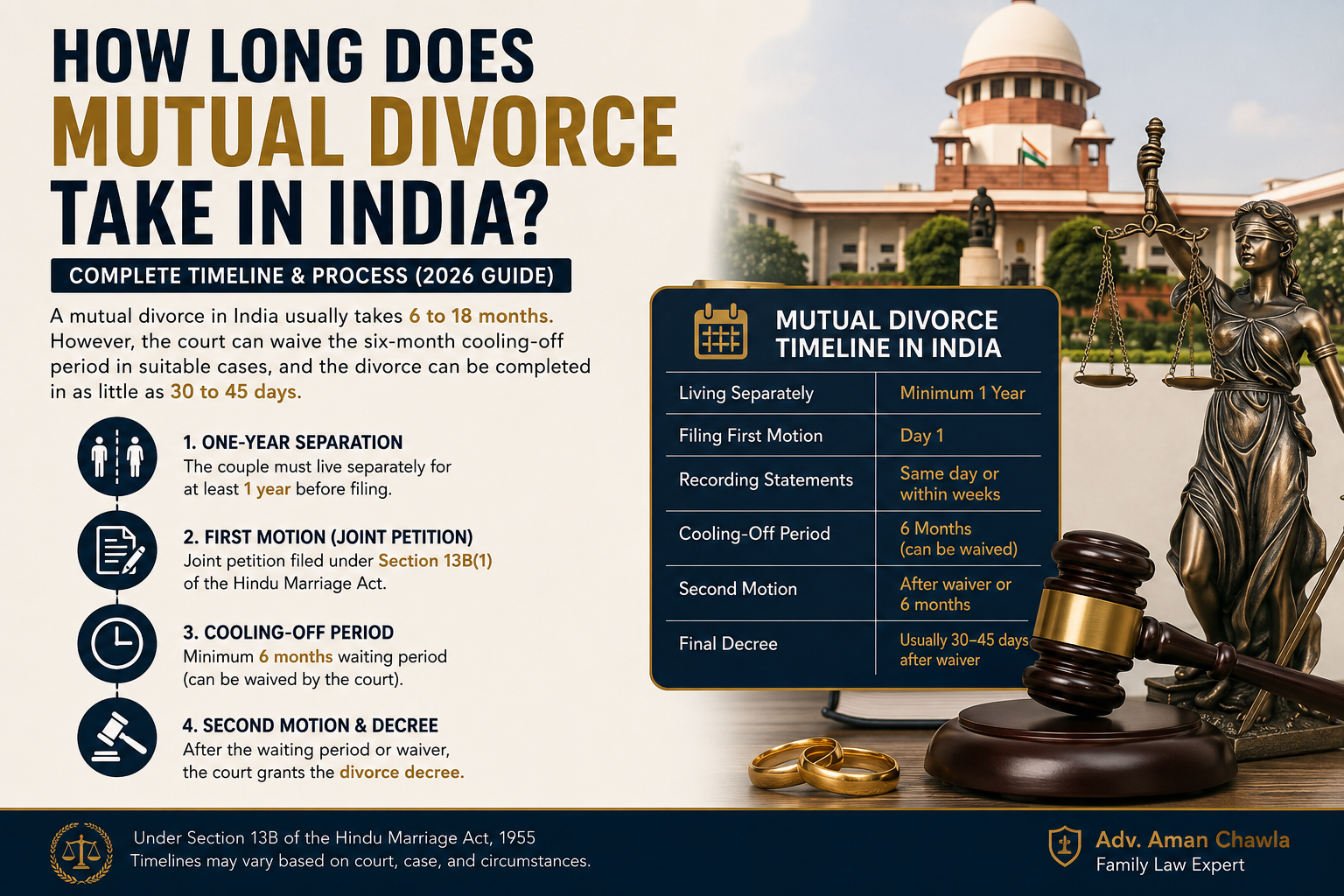
A mutual divorce in India typically takes between 6 to 18 months from the date of filing the first motion, though it can be completed in as little as 30 to 45 days if the court grants a waiver of the mandatory waiting period. Before filing, the couple must also have lived separately for at least one year, as required under Section 13B of the Hindu Marriage Act, 1955. The actual timeline depends heavily on how the case is drafted and argued, and how willing the specific judge is to grant an early waiver.
The Deeper Explanation
Mutual divorce in India is governed by Section 13B of the Hindu Marriage Act, 1955 (for Hindus; the Special Marriage Act, 1954 has a parallel provision under Section 28 for civil marriages). The timeline has two separate clocks running, and people frequently confuse them.
The first clock starts before you even file. Section 13B(1) requires that the husband and wife have been “living separately for a period of one year or more” before they can jointly petition for mutual divorce. This isn’t a formality — if you file before completing a full year of separation, the petition itself is premature and can be rejected or delayed until the requirement is met. Courts do check this carefully, since the entire premise of a mutual divorce petition rests on this separation period being genuine and complete.
The second clock starts after you file the first motion. Once the joint petition is filed and the court records both parties’ statements (the “first motion”), Section 13B(2) requires a waiting period — commonly called the cooling-off period — of a minimum of six months before the couple can move the “second motion,” which is when the court actually grants the decree. This period can extend up to 18 months from the date of the first motion; if the second motion isn’t filed within that 18-month window, the petition can lapse. This gap exists deliberately, to give both spouses a final window to reconsider before the marriage is legally dissolved.
So, under the standard timeline, you’re looking at a minimum of six months between the first and second motions, on top of whatever time the initial filing and first motion itself take.
Here’s where things have genuinely changed. In Amardeep Singh v. Harveen Kaur (2017), the Supreme Court held that the six-month cooling-off period under Section 13B(2) is directory, not mandatory — meaning courts have the discretion to waive it, not an obligation to. The Court laid down specific conditions that must be satisfied before a waiver can even be considered: the statutory one-year separation period under 13B(1) must already be complete before the first motion; all efforts at mediation and reconciliation between the parties must have genuinely failed with no realistic chance of success; the parties must have comprehensively settled all issues between them — alimony, custody, property, everything; and the court must be satisfied that continuing the waiting period would only prolong the couple’s suffering without serving any purpose.
Importantly, this waiver is not something you get simply by asking. The Supreme Court was explicit that it is entirely within the court’s discretion, and no party can claim it as a matter of right. A waiver application is typically filed along with, or shortly after, the second motion — usually about a week after the first motion is allowed — supported by a clear settlement and reasons for urgency. If the judge is satisfied that every condition is genuinely met, the divorce can be finalized remarkably fast — sometimes within 30 to 45 days of the first motion itself.
What Actually Happens in Court (Saket, Patiala House & Karkardooma)
In my experience across Saket, Patiala House, and Karkardooma, the waiver application is filed roughly a week after the first motion is allowed, and I’ve seen most judges grant it once they’re satisfied every Amardeep Singh condition is genuinely met — a clean settlement, no scope for reconciliation, and no ambiguity in the MOU. When that happens, couples routinely walk out with their decree within 30 to 45 days of the first motion, instead of waiting the standard six months. But this isn’t automatic — a poorly drafted settlement or an unconvinced judge means you default straight back to the standard six-to-eighteen-month timeline.
FAQ
Can I file for mutual divorce before completing one year of separation?
No. Section 13B(1) of the Hindu Marriage Act requires the couple to have lived separately for at least one year before filing a mutual divorce petition; filing earlier makes the petition premature.
What is the difference between the first motion and second motion in mutual divorce?
The first motion is the joint petition filed under Section 13B(1), where both spouses tell the court they’ve mutually agreed to separate and record their settlement. The second motion, filed after the cooling-off period, is when the court examines the parties again and grants the actual divorce decree.
How do I apply for a waiver of the six-month cooling-off period?
You file a waiver application, usually alongside or shortly after the second motion, showing that the statutory separation period was already complete, mediation efforts have failed, all issues are settled, and further delay would serve no purpose — the conditions set out in Amardeep Singh v. Harveen Kaur. The court has full discretion to grant or refuse it.
Is the six-month waiting period compulsory in every mutual divorce case?
No. Following Amardeep Singh v. Harveen Kaur, the Supreme Court clarified that this period is directory rather than mandatory, meaning family courts can waive it in appropriate cases, though it remains entirely at the court’s discretion.
What happens if the second motion is not filed within 18 months?
If the second motion isn’t filed within the outer limit of 18 months from the first motion, the mutual divorce petition can lapse, and the parties may need to start the process afresh or pursue a contested divorce instead.
Does a waiver of the cooling-off period mean the divorce is granted instantly?
No. A waiver only shortens the mandatory waiting period between the first and second motions — the court still needs to examine the settlement, record statements, and pass the decree, which typically takes an additional 30 to 45 days even after the waiver is granted.
— Adv. Aman Chawla, Family Law Expert
Disclaimer: This article is for general informational purposes only and does not constitute legal advice. As per the Rules of the Bar Council of India, advocates are not permitted to advertise or solicit work, and nothing in this article should be construed as advertising, solicitation, or an invitation to engage this firm. Readers should consult a qualified advocate regarding their specific circumstances before taking any legal action.
Written by Adv. Aman Chawla. This article is for informational purposes only and does not constitute legal advice. Every case is fact-specific. Please consult a qualified lawyer before taking any legal action.