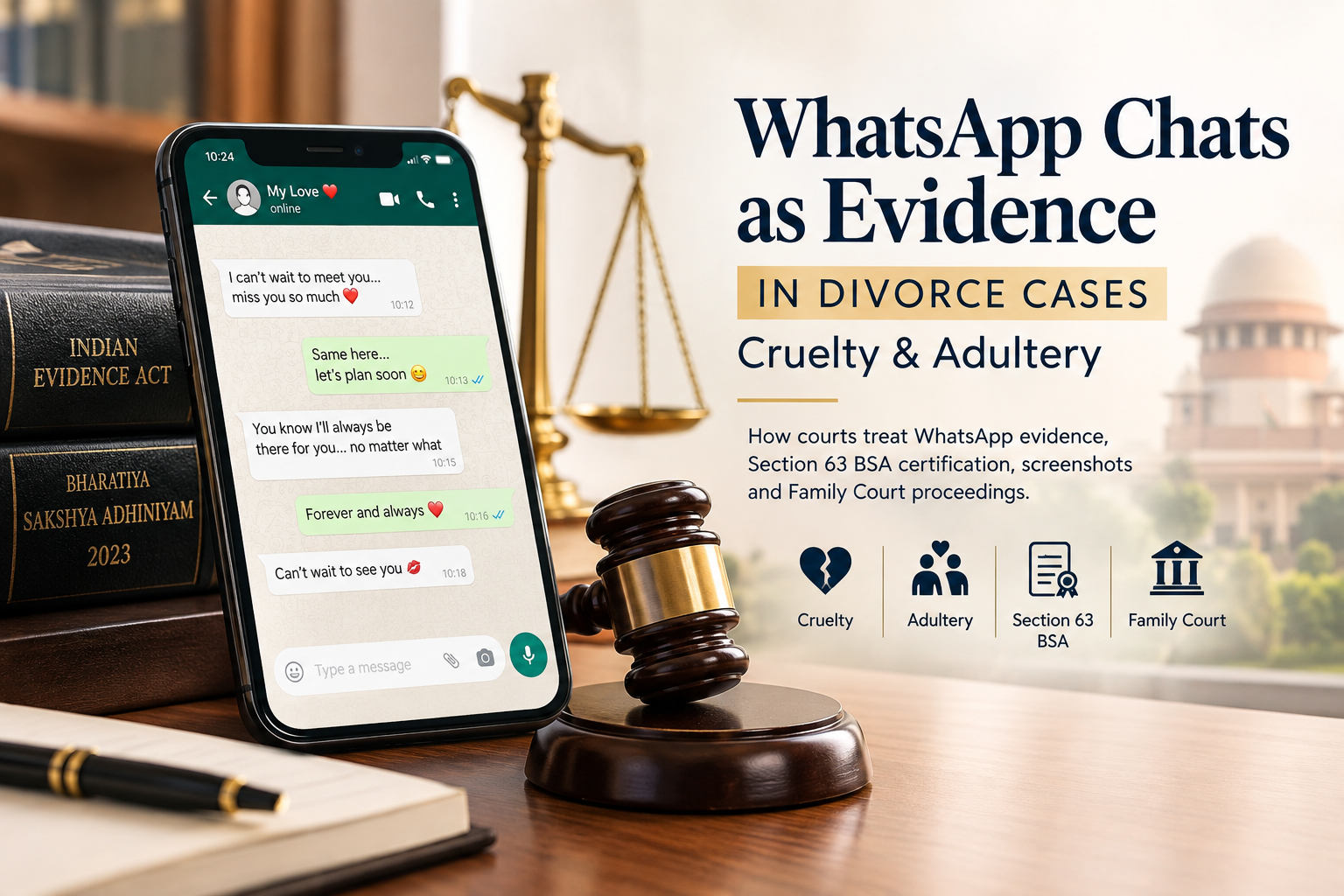
Can WhatsApp Chats Prove Cruelty or Adultery in Court? The Complete Guide

This Article is written by Adv. Aman Chawla, Family Law Expert | Delhi High Court & Supreme Court of India
Practising in Family & Matrimonial Law | Jangpura, New Delhi
Quick Answer
Yes, WhatsApp chats can be used to prove cruelty or adultery in an Indian court, and courts have accepted them even when they were obtained without the other spouse’s consent. The Madhya Pradesh High Court confirmed this directly in June 2025, in Smt. Anjali Sharma v. Raman Upadhyay, allowing a husband to use his wife’s WhatsApp chats with a third person to support an adultery allegation. But this isn’t unconditional. In August 2026, the Patna High Court set aside an entire divorce decree because the WhatsApp messages relied on hadn’t been properly certified under Section 65B of the Evidence Act. The difference between these two outcomes usually comes down to one thing, whether the chats were properly authenticated, not just screenshotted and printed. Get that step right, and WhatsApp evidence can carry real weight. Get it wrong, and it can cost you the entire case, even after you’ve won.
Why This Question Matters More Than People Realise
I get shown WhatsApp screenshots in my office more often than almost any other kind of evidence these days, and I understand why. A chat feels undeniable, it’s in writing, it has a timestamp, and it’s often the clearest record of exactly what was said, by whom, and when. But I’ve also seen genuinely strong cases weakened, and in one instance an entire decree overturned on appeal, because the person holding that evidence assumed a screenshot speaks for itself in court. It doesn’t, not without the right foundation underneath it. This guide walks through exactly what that foundation looks like, and what real, decided cases have said about it.
First, What the Law Actually Requires
A WhatsApp message is, legally speaking, an electronic record. Under Section 65B of the Indian Evidence Act, 1872 (now Section 63 of the Bharatiya Sakshya Adhiniyam, 2023), electronic records generally cannot be admitted as evidence unless accompanied by a certificate confirming how the record was produced and that the device it came from was functioning properly and hadn’t been tampered with. This isn’t a minor formality. The Supreme Court, in Anvar P.V. v. P.K. Basheer, (2014) 10 SCC 473, held clearly that this certificate is mandatory for secondary electronic evidence, a printed screenshot or a forwarded chat is secondary evidence, and without the certificate, it generally cannot be relied upon at all.
There was some confusion in the years that followed, with a few judgments suggesting the requirement could be relaxed in certain situations. The Supreme Court settled this decisively in Arjun Panditrao Khotkar v. Kailash Kishanrao Gorantyal, (2020) 7 SCC 1, decided 14 July 2020 by a three-judge Bench. The Court reaffirmed that the Section 65B(4) certificate is mandatory wherever secondary electronic evidence is produced, and clarified that this requirement cannot simply be sidestepped because obtaining the certificate feels inconvenient. If you take one thing from this article, let it be this: a WhatsApp screenshot, on its own, printed out and handed to the court, is not enough.
The Exception That Actually Helps You: Family Courts Think Differently
Here’s where it gets genuinely useful if you’re in a matrimonial case specifically. Family Courts operate under a different, more flexible framework than a regular civil or criminal court, because Section 14 of the Family Courts Act, 1984, allows a Family Court to receive evidence it considers helpful in resolving the dispute, even where that evidence wouldn’t strictly satisfy the Evidence Act’s normal requirements.
This is exactly what played out in Smt. Anjali Sharma v. Raman Upadhyay, M.P. No. 3395 of 2023, decided by Justice Ashish Shroti of the Gwalior Bench of the Madhya Pradesh High Court on 16 June 2025. The husband had obtained his wife’s WhatsApp chats with a third person, without her consent, through an application installed on her phone, and sought to use them to support an allegation of adultery in his divorce petition. The wife argued this was an outright violation of her privacy and should be excluded entirely. The Court disagreed, holding that Section 14 of the Family Courts Act permits evidence to be received “whether or not the same is otherwise admissible” under the Evidence Act, and that where privacy and the right to a fair trial are genuinely in conflict, privacy may have to yield. The Court was careful to add an important caution, though, admitting evidence onto the record is not the same as proving the underlying allegation, the chats still have to be weighed, tested, and found credible before they actually establish anything.
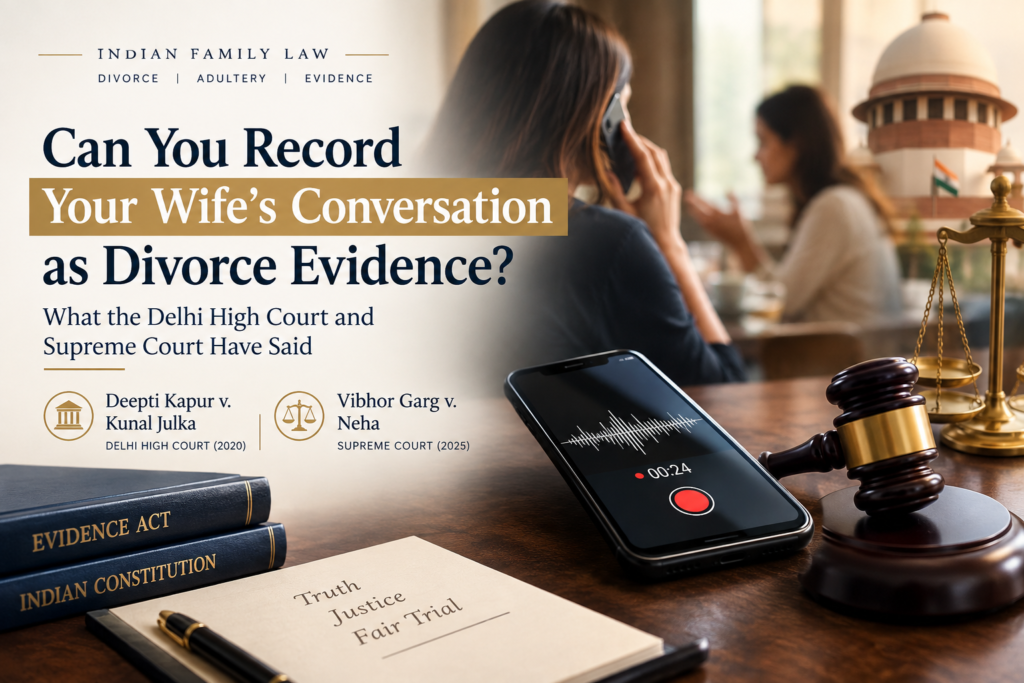
This lines up with the reasoning in Deepti Kapur v. Kunal Julka, 2020 SCC OnLine Del 672, a Delhi High Court decision that similarly allowed a husband to use a covertly recorded conversation as evidence in his divorce case, on the basis that a privacy violation alone doesn’t automatically make evidence inadmissible in a Family Court setting. Both judgments explicitly part ways with Rayala M. Bhuvaneswari v. Nagaphanender Rayala, AIR 2008 AP 98, where the Andhra Pradesh High Court had taken the opposite view. The Madhya Pradesh High Court in Anjali Sharma addressed this directly, saying it respectfully disagreed with the Andhra Pradesh position precisely because it hadn’t accounted for the special evidentiary powers Section 14 gives Family Courts.
The Warning You Need to Hear: Where This Goes Wrong
Now for the case that should genuinely change how you handle your own evidence. In August 2026, the Patna High Court, in a judgment by Justices Bibek Chaudhuri and Rana Vikram Singh, set aside a divorce decree that had already been granted to a husband, specifically because the WhatsApp messages he’d relied on to prove cruelty had been marked as evidence without the mandatory Section 65B(4) certificate. The Court held that this wasn’t a technicality that could be waived after the fact, citing the long-established principle that where a statute prescribes a particular manner of doing something, it must be done that way and no other. Without the certificate, the messages were legally not evidence at all, regardless of what they said. The Court also made a separate but important point on the merits, that isolated incidents spread across several years, without more, don’t necessarily add up to the sustained mental cruelty required under Section 13(1)(ia) of the Hindu Marriage Act, citing the guiding principles laid down in Samar Ghosh v. Jaya Ghosh, (2007) 4 SCC 511.
Read together, Anjali Sharma and the Patna High Court ruling aren’t actually in conflict, they’re teaching the same lesson from opposite directions. Family Courts have real discretion to look past how evidence was obtained. What they don’t have discretion to look past is whether the evidence has been properly authenticated in the first place. Get the certification right, and the door Section 14 opens stays open. Skip it, and even a court willing to overlook your privacy conduct may still have to exclude your evidence entirely.
What “Properly Authenticated” Actually Means for a WhatsApp Chat
In practice, this means a few concrete things. First, preserve the original device the chat exists on, don’t rely solely on a forwarded screenshot from another phone, since that adds a layer of hearsay and tampering risk. Second, obtain a certificate under Section 63 of the Bharatiya Sakshya Adhiniyam (the current equivalent of the old Section 65B(4)), typically prepared with the assistance of your lawyer, identifying the device, how the record was extracted, and confirming it was functioning normally at the time. Third, where the identity of the sender is disputed, be prepared to establish it through other means, phone number registration details, related messages, or circumstances confirming who was actually messaging.
What Chats Actually Need to Show to Prove Cruelty or Adultery
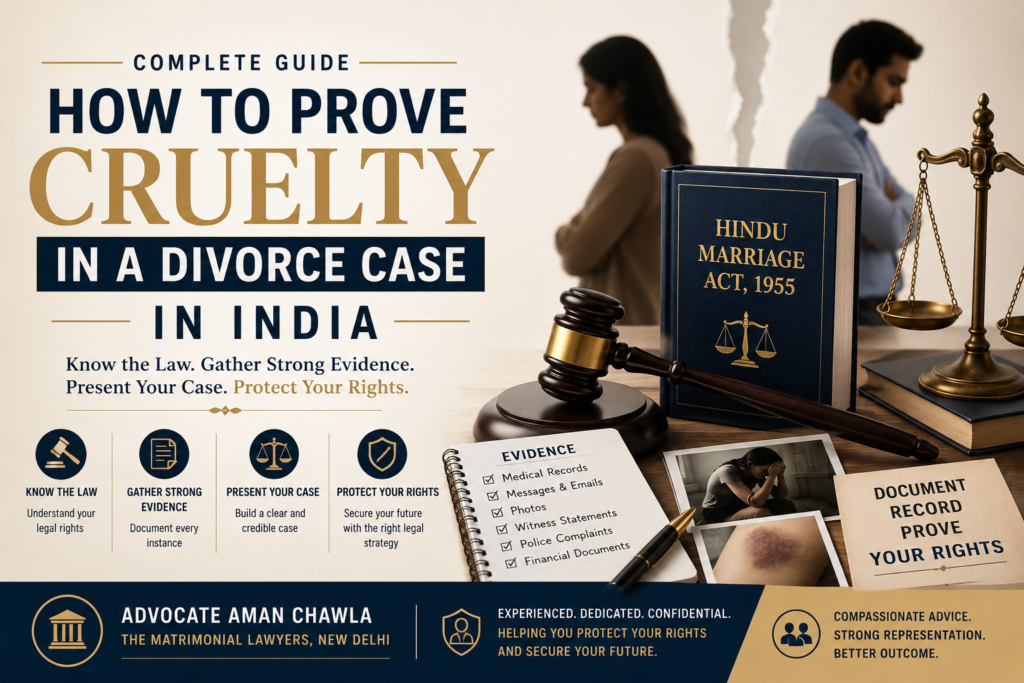
A chat log full of arguments isn’t automatically “cruelty” in the legal sense. Courts, following the guiding framework in Samar Ghosh v. Jaya Ghosh, look for conduct that’s grave and weighty enough to make continued cohabitation genuinely intolerable, not the ordinary friction every marriage experiences. Messages showing sustained verbal abuse, threats, humiliation, or a consistent pattern of harassment carry far more weight than a single heated exchange. For adultery, chats don’t need to contain an explicit confession, romantic or intimate messages with a third party, arrangements to meet, or language clearly inconsistent with an innocent relationship have all been treated as strong circumstantial evidence, particularly when read alongside other material rather than in isolation.
What To Do Next
If you already have WhatsApp chats you believe support your case, don’t touch anything further, don’t delete, don’t forward the messages elsewhere, and don’t rely on a screenshot alone. Preserve the device exactly as it is and speak to your lawyer immediately about obtaining the proper certification before the chats are ever placed before the court. If you’re still deciding whether to access a spouse’s phone to gather this kind of evidence, understand that Family Courts have shown real willingness to admit what you find, but that willingness has limits, and the authentication step is not optional no matter how compelling the content looks on your screen.
A Realistic Example
A wife believes her husband has been having an affair and finds messages between him and a colleague on a shared family tablet he occasionally used, arrangements to meet, and language clearly inconsistent with a professional relationship. Rather than simply taking screenshots and forwarding them to her own phone, her lawyer has the tablet preserved and obtains a certificate under Section 63 BSA from a forensic expert confirming the messages’ origin and integrity. When the husband’s counsel objects that the messages were found without his consent, the Family Court, relying on the reasoning in Anjali Sharma, admits them into evidence, noting that the manner of discovery doesn’t automatically exclude relevant material in a matrimonial dispute. Because the certification was done properly from the outset, the evidence survives scrutiny through the rest of the proceedings, unlike a case built on screenshots alone, which could have been challenged and excluded at any stage.
Frequently Asked Questions
Can I use my spouse’s WhatsApp chats as evidence even if I accessed their phone without permission?
Often, yes, in a Family Court setting. Courts have held that a privacy violation alone doesn’t automatically make such evidence inadmissible, since Family Courts have special powers under Section 14 of the Family Courts Act to receive material that helps resolve the dispute. But how the evidence was obtained can still affect other things, so it’s worth discussing your specific situation with a lawyer.
Is a screenshot of a WhatsApp chat enough to prove my case?
Not on its own. A screenshot is secondary electronic evidence, and courts have made clear it generally needs to be accompanied by a certificate confirming how it was produced and that the device wasn’t tampered with. Without that certificate, even genuine, damaging messages can be excluded entirely.
What happened in the Patna High Court case where a divorce decree was overturned?
A husband had won his divorce case partly using WhatsApp messages, but the wife successfully appealed, and the High Court found the messages had been submitted without the mandatory certification. Because that step was missed, the messages were treated as if they were never valid evidence at all, and the case had to be reconsidered.
Do casual arguments over WhatsApp count as cruelty?
Not usually. Courts look for a sustained pattern of conduct serious enough to make living together genuinely intolerable, not the ordinary disagreements every couple has. A handful of heated messages spread over years is unlikely to meet that bar on its own.
Can WhatsApp chats alone prove adultery?
They can serve as strong circumstantial evidence, especially where the content clearly points beyond an innocent relationship, but courts generally look at the fuller picture, other communications, conduct, and circumstances, rather than treating a single chat log as conclusive proof on its own.
What should I do the moment I find WhatsApp messages I think support my case?
Don’t alter, delete, or forward them, and avoid taking only a screenshot as your sole record. Preserve the original device and speak to a lawyer promptly about obtaining proper certification before the evidence is placed before the court.
Does this apply the same way to a criminal case, like a 498A complaint, as it does to a divorce case?
The certification requirement under the Evidence Act applies broadly, but the special flexibility of Section 14 is specific to Family Courts. In a criminal proceeding, the standard evidentiary rules, including the mandatory certificate, apply more strictly, so the same shortcuts aren’t necessarily available.
Conclusion
WhatsApp chats can be genuinely powerful evidence in a cruelty or adultery case, Indian courts have said so plainly, even where the chats were obtained without the other spouse’s knowledge. But the difference between evidence that wins your case and evidence that gets an entire decree overturned on appeal usually comes down to one unglamorous step, proper certification under Section 65B or Section 63 BSA. Preserve your evidence carefully, get it authenticated the right way, and let the content do the work it’s actually capable of doing, rather than losing a strong case to a procedural gap that was entirely avoidable.
Adv. Aman Chawla practices matrimonial and family law before the Delhi High Court, Delhi Family Courts (Saket, Rohini, Dwarka, Karkardooma, Patiala House), and the Supreme Court of India. For a consultation on your specific situation, reach out through the contact details on this website.
Disclaimer: This article is for general informational purposes only and does not constitute legal advice. As per the Rules of the Bar Council of India, advocates are not permitted to advertise or solicit work, and nothing in this article should be construed as advertising, solicitation, or an invitation to engage this firm. Readers should consult a qualified advocate regarding their specific circumstances before taking any legal action.